Students can use Exploration Class 9 Science Solutions Chapter 8 Journey Inside the Atom Question Answer NCERT Solutions as a quick reference guide.
Class 9 Science Exploration Chapter 8 Question Answer
Class 9 Science Ch 8 Journey Inside the Atom Question Answer
Journey Inside the Atom Class 9 Questions and Answers (Exercise)
Revise, Reflect, Refine (NCERT Textbook Page No. 158 – 160)
Question 1.
Choose the correct options and explain the reason for the correct and incorrect options in the context of Ernest Rutherford’s gold foil experiment:
(i) The experiment clearly showed the existence of neutrons in the nucleus.
(ii) The results disproved the plum pudding model and led to the idea of a nucleus at the centre of the atom.
(iii) The large deflection of a few alpha particles indicated that most of the mass of the atom and positive charge are packed into a tiny centre.
(iv) The way alpha particles were deflected showed that electrons move around the nucleus.
Answer:
(i) Incorrect.
The gold foil experiment did not show the existence of neutrons. Neutrons were discovered by James Chadwick in 1932, much later, through a completely different experiment. The gold foil experiment only revealed the existence and nature of the nucleus (positively charged and dense).
(ii) Correct.
The gold foil experiment’s results – that most alpha particles passed through undeflected but some were sharply deflected and a few bounced back – could not be explained by Thomson’s plum pudding model (where positive charge is spread out). These results disproved the plum pudding model and led Rutherford to propose the idea of a small, dense, positively charged nucleus at the centre of the atom.
(iii) Correct.
A few alpha particles bounced back sharply, which is only possible if they encountered a very small but extremely dense and strongly positive region. If the positive charge were spread out (as in Thomson’s model), no alpha particle would bounce back. The large deflection of a few alpha particles confirmed that most of the mass and all the positive charge are packed into a tiny centre called the nucleus.
(iv) Incorrect.
The gold foil experiment did not show or study the movement of electrons around the nucleus. It only revealed information about the nucleus – its size, charge, and density. The movement of electrons in orbits around the nucleus was proposed by Rutherford’s model as a logical conclusion, but the experiment itself did not directly demonstrate this.

Question 2.
Which of the following statements are correct or incorrect according to the Bohr’s atomic model? Give a reason for each statement.
(i) Electrons lose energy while moving in fixed orbits and slowly fall into the nucleus.
(ii) Electrons can exist anywhere around the nucleus with no fixed energy.
(iii) Electrons revolve around the nucleus in orbits of fixed energy without losing energy.
(iv) Electrons can be found between energy levels as they move around the nucleus.
Answer:
(i) Incorrect.
According to Bohr’s model, electrons do NOT lose energy while moving in fixed orbits. The key feature of Bohr’s model is the concept of stationary states – when an electron is in a fixed orbit (shell), its energy remains constant and it does not lose energy. Therefore, electrons do not spiral inward or fall into the nucleus.
(ii) Incorrect.
According to Bohr’s model, electrons cannot exist anywhere around the nucleus freely.
They must follow fixed circular paths called orbits or shells (K, L, M, N,…). Each shell has a definite, fixed amount of energy. Electrons must be in one of these fixed energy levels; they cannot float freely with no fixed energy.
(iii) Correct.
This statement correctly describes Bohr’s model. Electrons revolve around the nucleus in fixed circular orbits (stationary states). While revolving in these fixed orbits, electrons do not lose energy. Their energy remains constant in a given orbit. This is the reason Bohr’s model could explain atomic stability, unlike Rutherford’s model.
(iv) Incorrect.
According to Bohr’s model, electrons cannot be found between energy levels. They can only exist in the fixed shells (K, L, M, N, …). An electron can move from one shell to another by absorbing or releasing a fixed amount of energy, but it cannot stay in the space between two energy levels. The moment energy is absorbed or released, the electron jumps directly from one level to another.
Question 3.
The composition of the nuclei of three atomic species X, Y, and Z are given as follows.
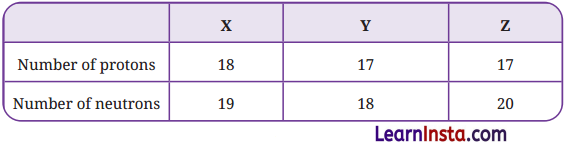
Explain the relation between the following:
(i) Y and Z
(ii) Z and X
Answer:
(i) First, let us find the mass numbers:
X: No. of protons = 18,
No. of neutrons = 19
Mass number = No. of protons + No. of neutrons = 18 + 19 = 37
Y: No. of protons = 17,
No. of neutrons = 18
Mass number = 17 + 18 = 35
Z: No. of protons = 17,
No. of neutrons = 20
Mass number = 17 + 20 = 37
(i) Y and Z:
Both Y and Z have the same number of protons (atomic number = 17), which means they belong to the same element – Chlorine (Cl). However, they have different mass numbers (Y = 35, Z = 37). Therefore, Y and Z are isotopes of each other. They are atoms of the same element with the same atomic number but different mass numbers.
(ii) Z and X:
Z has atomic number = 17 (Chlorine), and X has atomic number =18 (Argon). They are different elements. However, both Z and X have the same mass number = 37. Atoms of different elements that have the same mass number but different atomic numbers are called isobars. Therefore, Z and X are isobars.
Question 4.
What conclusion did Rutherford draw about the position and characteristics of the atom’s positively charged part based on the few alpha particles that bounced back or were deflected at large angles in the gold foil experiment?
Answer:
Rutherford concluded that the positive charge of the atom is concentrated in a very small, dense region called the nucleus. Most of the mass of the atom is concentrated in the nucleus.
Question 5.
Explain and arrange the following statements in the correct chronological order to show how atomic models have evolved.
(i) Bohr’s model proposed that electrons move in fixed orbits around the nucleus, each with a definite energy.
(ii) Thomson’s model depicted the atom as a ‘plum pudding ’ with electrons embedded in a sphere of positive charge.
(iii) Rutherford’s model proposed that atoms have a dense central nucleus.
(iv) Dalton’s model described atoms as indivisible particles.
Answer:
Here’s the correct chronological order of atomic models and the reasoning behind each step in the evolution:
(iv) Dalton’s model (1808): Dalton described atoms as indivisible particles – the fundamental building blocks of matter that cannot be broken down further. This was the first scientific atomic theory, based on experiments of that time.
(ii) Thomson’s model (1897 onwards): After the discovery of the electron by J. J. Thomson, he proposed that the atom is a sphere of positive charge with electrons embedded throughout it (plum pudding model). This was the first model to acknowledge that atoms contain smaller charged particles.
(iii) Rutherford’s model (1911): After the gold foil experiment, Rutherford proposed the planetary model – the atom has a small, dense, positively charged nucleus at its centre, with electrons revolving around it like planets around the Sun. This disproved Thomson’s model.
(i) Bohr’s model (1913): To explain why electrons do not lose energy and fall into the nucleus (a limitation of Rutherford’s model), Niels Bohr proposed that electrons move in fixed circular orbits (shells) with definite energies, called stationary states. Electrons do not lose energy while in these fixed orbits.
Chronological Order
(iv) Dalton → (ii) Thomson → (iii) Rutherford → (i) Bohr.
Question 6.
Electrons move around the nucleus in orbits. Why do they not fly away from the atom? Explain what keeps them attracted to the nucleus.
Answer:
Electrons do not fly away from the atom because they are held in place by the electrostatic force of attraction between the negatively charged electrons and the positively charged protons in the nucleus. This attractive force acts like the force that keeps a planet in orbit around the Sun – it continuously pulls the electron towards the nucleus, preventing it from flying away in a straight line.
According to Bohr’s model, electrons revolve in fixed circular orbits (stationary states). In these fixed orbits, the centripetal force needed to keep the electron moving in a circle is provided by the electrostatic attraction between the electron and the nucleus. As long as the electron remains in its allowed orbit, it does not lose energy and does not fly away or fall inward.
Thus, the attractive electrostatic force between the oppositely charged electron and nucleus is what keeps the electron orbiting and prevents it from flying away.
Question 7.
Assertion (A): The discovery of subatomic particles helped in understanding the atomic structure.
Reason (R): The number of electrons is equal to the number of protons in an atom.
Choose the correct option:
(i) Both A and R are true, and R is the correct explanation of A.
(ii) Both A and R are true, but R is not the correct explanation of A.
(iii) A is true, but R is false.
(iv) A is false, but R is true.
Answer:
(ii) The Assertion (A) is true. The discovery of subatomic particles (electrons by Thomson, protons and nucleus by Rutherford, neutrons by Chadwick) was crucial in helping scientists understand the structure of the atom. Each discovery led to a better and more accurate model of the atom.
The Reason (R) is also true. In a neutral atom, the number of electrons is always equal to the number of protons. This is a fundamental fact that ensures atoms are electrically neutral.
However, R is not the correct explanation of A. The equal number of electrons and protons is a consequence (result) of atomic neutrality – it tells us something about the balance of charge in an atom. It does not explain how or why the discovery of subatomic particles helped understand atomic structure. The discovery of subatomic particles helped understand atomic structure by revealing what atoms are made of, how their mass is distributed, and how they are arranged – not merely because electrons equal protons.
Question 8.
Magnesium is essential for many biological processes, including muscle contraction. For an atom of magnesium with a mass number of 24 and atomic number 12, determine the number of (i) protons, (ii) neutrons, (iii) electrons, and also illustrate the arrangement of electrons in a magnesium atom.
Answer:
Here, Mass number (A) = 24,
Atomic number (Z) =12.
(i) Number of protons = Atomic number =12.
(ii) No. of neutrons = Mass number – Atomic number
= 24- 12 = 12.
(iii) Number of electrons = Number of protons (atom is neutral) = 12.
Arrangement of electrons in Magnesium (Electronic Configuration):
K – shell (n = 1):
2 electrons (maximum = 2, filled first)
L – shell (n = 2):
8 electrons (maximum = 8, filled next)
M – shell (n = 3): 2 electrons (remaining electrons).
Electronic configuration: 2, 8, 2.
Question 9.
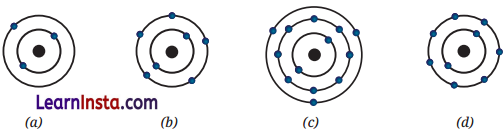
Find the following information for the elements shown in Fig.
(i) Name of the element
(ii) Symbol
(iii) Total number of electrons
(iv) Number of valence electrons
(v) Valency of the element
(vi) Number of protons
(vii) Atomic number
Answer:
Note: (a) 2 shells K = 2, L = 1
(b) 2 shells K = 2, L = 5
(c) 3 shells K = 2, L = 8, M = 3
(d) 2 shells K = 2, L = 7
Step 1: Count total electrons
Each dot on the circles = 1 electron.
Add them up for each atom.
In a neutral atom:
Number of electrons = number of protons = atomic number
Step 2: Identify the element and symbol
Once you know the total electrons (atomic number), match it with the periodic table:
Step 3: Find valence electrons Look only at the outermost shell (last circle).
Step 4: Determine valency
Valency = how many electrons an atom loses, gains, or shares to become stable (octet rule: 8 electrons in outer shell)
If valence electrons < 4 ⇒ valency = same number • If valence electrons > 4
⇒ valency = 8 – valence electrons
Step 5: Protons atomic number
Protons = electrons (for neutral atoms)
Atomic number = number of protons
So both are the same as the total electrons you counted.
Now let’s go through (i) to (vii) clearly for each diagram and also understand why each answer is correct.
(a) Here, total electrons = 2 (inner) + 1 (outer) = 3
(i) Name Lithium
(ii) Symbol: Li
(iii) Total electrons: 3
(iv) Valence electrons: 1 (outermost shell)
(v) Valency: 1 (loses 1 electron to become stable) (vz) Number of protons: 3 (same as electrons)
(vii) Atomic number: 3
(b) Here, total electrons = 2 + 5 = 7
(i) Name: Nitrogen
(ii) Symbol: N
(iii) Total electrons: 7
(iv) Valence electrons: 5
(v) Valency: 3 (can share 3 electrons)
(vi) Number of protons: 7
(vii) Atomic number: 7
(c) Here, total electrons = 2 + 8 + 3 = 13
(i) Name: Aluminium
(ii) Symbol: Al
(iii) Total electrons: 13
(iv) Valence electrons: 3 (full outer shell)
(v) Valency: 3 (can share 3 electrons)
(vi) Number of protons: 13
(vii) Atomic number: 13
(d) Here, total electrons = 2 + 7 = 9
(i) Name: Fluorine
(ii) Symbol: F
(iii) Total electrons: 9
(iv) Valence electrons: 7
(v) Valency: 1 (needs 1 electron to complete octet)
(vi) Number of protons: 9
(vii) Atomic number: 9
| (a) | (b) | (c) | (d) |
| Lithium | Nitrogen | Aluminium | Fluorine |
| Li | N | Al | F |
| 3 | 7 | 13 | 9 |
| 1 | 5 | 3 | 7 |
| 1 | 3 | 3 | 1 |
| 3 | 7 | 13 | 9 |
| 3 | 7 | 13 | 9 |
Question 10.
Both Rutherford’s and Bohr’s models have electrons orbiting the nucleus. Why did Rutherford’s model fail to explain atomic stability, while Bohr’s model succeeded?
Answer:
Rutherford’s model failed to explain atomic stability because, according to it, electrons moving around the nucleus should continuously lose energy and eventually fall into the nucleus, causing the atom to collapse.
Bohr’s model succeeded because it proposed that electrons move in fixed energy levels (shells) where they do not lose energy while revolving around the nucleus. This prevents them from falling into the nucleus and keeps the atom stable.
Question 11.
An atom 70X has 31 electrons. How many neutrons are there in its nucleus?
Answer:
We are given:
Atom: 70X
Number of electrons = 31
Now, number of electrons = number of protons.
So, atomic number (Z) = 31.
Mass number (A) = 70 (given).
No. of neutrons = Mass number – No. of protons
= 70 – 31 =39
This element is Gallium (Ga).
Question 12.
An atom has 79 protons and a mass number of 197. Calculate
(i) the number of neutrons, and
(ii) the number of electrons.
Answer:
Number of protons = 79
Mass number = 197
(i) Number of neutrons = Mass number – Number of protons
Number of neutrons = 197 – 79 = 118
(ii) Number of electrons = Number of protons = 79
Question 13.
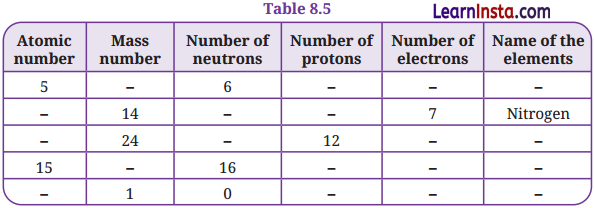
Complete the Table (below):
Answer:
Here,
Row 1:
Atomic number = 5,
No. of neutrons = 6
Number of protons = Atomic number = 5
Mass number = No. of protons + No. of neutrons = 5 + 6=11
Number of electrons = 5 (neutral atom)
Name = Boron (B)
Row 2:
Mass number =14,
No. of electrons = 7,
Name = Nitrogen
Since it is Nitrogen, atomic number = 7,
So, No. of protons = 7
No. of neutrons = Mass number – No. of protons
= 14 – 7 = 7
Number of electrons = 7
Row 3:
Mass number = 24,
No. of protons = 12
Atomic number = No. of protons = 12
Number of neutrons = Mass number – No. of protons
= 24 – 12 = 12
Number of electrons = 12 (neutral atom)
Name = Magnesium (Mg)
Row 4:
Atomic number = 15,
No. of neutrons = 16
Number of protons = atomic number =15
Mass number = No. of protons + No. of neutrons
= 15 + 16 = 31
Number of electrons = 15 (neutral atom)
Name = Phosphorus (P)
Row 5:
Mass number = 1,
No. of neutrons = 0
Number of protons = Mass number – No. of protons
= 1 – 0 = 1
Atomic number = No. of protons = 1
Number of electrons = No. of protons = 1
Name = Hydrogen (H).
Completed Table:
| Atomic number | Mass number | Number of neutrons | Number of protons | Number of electrons | Name of the elements |
| 5 | 11 | 6 | 5 | 5 | Boron (B) |
| 7 | 14 | 7 | 7 | 7 | Nitrogen(N) |
| 12 | 24 | 12 | 12 | 12 | Magnesium (Mg) |
| 15 | 31 | 16 | 15 | 15 | Phosphorus (P) |
| 1 | 1 | 0 | 1 | 1 | Hydrogen (H) |
Question 14.
A man was discussing the structure of an atom with his classmates. During the discussion, he learnt that an element X has a mass number of 35 and contains 18 neutrons. Based on this information, answer the following questions:
(i) How many electrons and protons does element X have?
(ii) What is its atomic number?
(iii) Identify the element X.
(iv) Write its electronic configuration.
(v) How many valence electrons does it have?
(vi) What will be the mass number if two neutrons are added to its nucleus?
(vii) What will be the relation of X with the new atom?
Answer:
Given:
Mass number = 35,
No. of neutrons = 18
(i) Number of protons = Mass number – No. of Neutrons
= 35 – 18 = 17
In a neutral atom, No. of electrons = No. of protons = 17.
(ii) Atomic number = number of protons = 17.
(iii) Atomic number 17 corresponds to Chlorine (Cl).
(iv) Electronic configuration for 17 electrons: 2, 8, 7
K shell = 2
L shell = 8
M shell = 7
(v) Outermost shell (M) has 7 valence electrons.
(vi) New mass number if two neutrons are added:
New mass number = 35 + 2 = 37
(vii) Relation of X with the new atom
Both atoms have the same number of protons (17) but different neutrons (18 vs 20).
Therefore, they are isotopes of chlorine – (Cl – 35 and Cl – 37).
Final Answer
(i) Electrons = 17, Protons = 17
(ii) Atomic number = 17
(iii) Chlorine (Cl)
(iv) Electronic configuration = 2, 8, 7
(v) Valence electrons = 7
(vi) Mass number = 37
(vii) Isotopes
Question 15.
In an atom, there are 12 protons and 12 neutrons in the nucleus. Now, imagine that all the electrons are replaced with some hypothetical particles that have the same charge as electrons but are 500 times heavier. What effect will this replacement have on the atom’s:
(i) Atomic number
(ii) Atomic mass
(iii) Mass number
(iv) Overall charge
Answer:
(i) Atomic number:
The atomic number is determined by the number of protons in the nucleus. Since the protons in the nucleus remain unchanged (we only replaced electrons, not protons), the atomic number will remain the same = 12.
(ii) Atomic mass:
Increases, because normally electrons have negligible mass, but replacing them with particles 500 times heavier adds significant extra mass to the atom.
(iii) Mass number
Mass number = number of protons + number of neutrons. Both protons and neutrons remain unchanged (12 + 12 = 24). Electrons (or the hypothetical particles) are not included in the mass number calculation. Therefore, the mass number will remain unchanged = 24.
(iv) Overall charge
The hypothetical particles have the same charge as electrons (charge = – 1 each). Since the number of hypothetical particles equals the original number of electrons (12), and they carry the same charge, the total negative charge remains -12. The total positive charge from the 12 protons remains + 12. Therefore, the overall charge of the atom remains zero – the atom remains electrically neutral. The overall charge will not change.
Class 9 Science Chapter 8 Journey Inside the Atom Question Answer (InText)
Think It Over (NCERT Textbook Page No. 140)
Question 1 .
Are atoms the smallest indivisible particles?
Answer:
Atoms are not the smallest indivisible particles. Earlier, they were considered indivisible, but later discoveries showed that they are made up of smaller particles like electrons, protons, and neutrons.
Question 2.
Why do electrons not fall into the nucleus even though they are attracted to protons in it?
Answer:
Electrons are negatively charged and are attracted to the positively charged protons in the nucleus. If they kept losing energy, they would fall into the nucleus. But this does not happen. According to Bohr’s model of the atom, electrons revolve around the nucleus in fixed energy levels (orbits). As long as an electron stays in its orbit, it does not lose energy. Therefore, electrons remain outside the nucleus and the atom is stable.
Conclusion:
Electrons do not fall into the nucleus because they revolve in fixed energy levels without losing energy.
Question 3.
Why did scientists keep modifying atomic models?
Answer:
Scientists kept modifying atomic models because new experiments provided better evidence. Earlier models could not explain all observations, so they were improved to give a more accurate understanding of the atom.
Pause and Ponder (NCERT Textbook Page No. 143)
Question 1.
Suppose you made up your own ‘atom’, as Thomson described, using clay for the positive charge and small beads for the electrons spread through it. What will happen if:
(i) the positive charge on the clay is lesser than the total negative charge of the beads?
(ii) by mistake, the clay itself carries a bit of negative charge? Would your mode! still represent a neutral atom?
Answer:
(i) If the positive charge on the clay is less than the total negative charge of the beads, the atom will become negatively charged and not neutral.
(ii) If the clay also carries a negative charge, the total negative charge increases, so the atom will not remain neutral.
Question 2.
Could an orange or a lemon, which also contain seeds inside soft pulp, be a good comparison? In what ways does it match Thomson’s idea and where does it fall short?
Answer:
An orange or lemon can be used as a rough comparison to Thomson’s model in the following ways:
Matches Thomson’s idea:
- The soft pulp (like the positive sphere in Thomson’s model) fills the interior.
- The seeds (like electrons) are embedded within the pulp.
- The object has a roughly spherical shape, similar to an atom.
Falls short:
- In Thomson’s model, electrons are uniformly and evenly distributed throughout the positive sphere. But in an orange or lemon, the seeds are not uniformly distributed – they are clustered together in certain sections (compartments).
- The pulp of an orange or lemon is not uniformly positive – it is just neutral fruit pulp, not a positively charged sphere.
- So while it gives a visual idea, it is not a perfect or accurate representation.
Question 3.
Why did Thomson conclude that electrons are present in all atoms?
Answer:
Thomson found that cathode rays (streams of electrons) were produced regardless of the material used for the cathode or the type of gas filled in the cathode ray tube. Since the same negatively charged particles (electrons) were emitted from any material under any condition, Thomson concluded that electrons are a fundamental and common component present in all atoms of all elements.
Pause and Ponder (NCERT Textbook Page No. 144)
Question 4.
What do you think would happen if a-particles were replaced with negatively charged particles in Rutherford’s gold foil experiment?
Answer:
If negatively charged particles were used instead of positively charged alpha particles, the result would be very different. The nucleus of gold atoms is positively charged. A negatively charged particle approaching the nucleus would be attracted towards the nucleus (unlike alpha particles which are repelled). So instead of bouncing back or being deflected at large angles (which happens due to repulsion between like charges), the negatively charged particles would be pulled inward towards the nucleus. Most of them would curve towards the nucleus rather than pass straight through or bounce back. The scattering pattern would be completely different.
Question 5.
Rutherford found that a few a-particles bounced back sharply. How does this single surprising result completely rule out Thomson’s ‘plum pudding model’ of the atom?
Answer:
In Thomson’s plum pudding model, the positive charge is spread uniformly throughout the entire volume of the atom like a diffuse sphere. If this were true, the positive charge at any point would be extremely weak and spread out. An alpha particle passing through such an atom would never encounter a concentrated or strong enough repulsive force to bounce it back. Even if slightly deflected, the particle could not be deflected at large angles, and certainly could not bounce straight back.
The fact that a few alpha particles did bounce back sharply clearly means there must be a very small, extremely dense, and very strongly positively charged region inside the atom – the nucleus. Only a concentrated mass of positive charge could repel the fast-moving alpha particles so strongly. This single surprising observation completely rules out the plum pudding model and proves that positive charge cannot be spread out uniformly throughout the atom.
Question 6.
If you could ask Rutherford one question about his work, what would it be?
Answer:
I would ask Rutherford: “How are electrons arranged around the nucleus, and what keeps them from falling into it?”
Pause and Ponder (NCERT Textbook Page No. 145)
Question 7.
Assertion (A): Rutherford concluded that most of the mass of an atom is concentrated in a small region at the centre called the nucleus.
Reason (R): According to Thomson’s model, electrons are embedded in a uniformly distributed positive charge sphere.
Choose the correct option:
(i) Both A and R are true, and R is the correct explanation of A.
(ii) Both A and R are true, but R is not the correct explanation of A.
(iii) A is true, but R is false.
(iv) A is false, but R is true.
Answer:
(iii) A is true, but R is false.
Explanation:
The Assertion (A) is true – Rutherford did conclude from the gold foil experiment that most of the mass of an atom is concentrated in a small, dense region called the nucleus. This was one of his key conclusions.
However, the Reason (R) is false – it describes Thomson’s model (where electrons are embedded in a uniformly distributed positive charge sphere), which is actually the opposite of what Rutherford proposed. Thomson’s model was the model that Rutherford disproved. So the reason does not explain the assertion, and in fact describes the model that the assertion’s evidence argues against.
Pause and Ponder (NCERT Textbook Page No. 149)
Question 8.
Imagine you are a scientist who has discovered a new element. Name this element after yourself and justify that the symbol you have chosen follows the IUPAC rules.
Answer:
Naming the Element:
Let’s say you name it “Rathorium” (if your surname were Rathore, for example).
- According to IUPAC rules, the name of an element is usually derived from a person, place, property, or mythological concept.
- Since you discovered it, naming it after yourself is acceptable.
Choosing the Symbol
- The symbol must be one or two letters (sometimes three for temporary names).
- The first letter is always capitalized, and the second (if any) is lowercase.
- For Rathorium, the symbol could be Ra or Rt.
- Ra is already taken by Radium, so you would choose Rt.
- This follows IUPAC rules: unique, short, and derived from the element’s name.
Question 9.
What problems could arise if every scientist used different symbols for the same element?
Answer:
If every scientist used different symbols for the same element, the following problems would arise:
(i) There would be great confusion in scientific communication worldwide. Scientists from different countries could not understand each other’s research papers or findings.
(ii) Chemical equations and formulas would be inconsistent and completely unreadable to others.
(iii) Errors would occur in chemical experiments, industrial applications, and medicine, which could be dangerous.
(iv) International scientific collaboration and the sharing of knowledge would become impossible.
(v) The same element could be represented by hundreds of different symbols, making it impossible to maintain a universal language of science.
(vi) It would slow down scientific progress and create chaos in science education globally.
Pause and Ponder (NCERT Textbook Page No. 150)
Question 10.
An atom with an atomic number of 26 has 56 nucleons. Find out its number of electrons, protons and neutrons. (Page 150)
Answer:
Given:
Atomic number (Z) = 26,
so number of protons = 26.
Since the atom is electrically neutral, number of electrons = number of protons = 26.
Number of nucleons (mass number A) = 56.
No. of neutrons = Mass number – Atomic number
= 56 – 26 = 30.
∴ Protons = 26,
Electrons = 26,
Neutrons = 30. (This element is Iron, Fe.)
Question 11.
The nucleus of an atom contains 20 protons. If its mass number is 41, find the number of neutrons in it.
Answer:
Number of protons = 20
Mass number = 41
Number of neutrons = Mass number – Number of protons
Number of neutrons = 41 – 20 = 21
Question 12.
An atom has 18 neutrons and an atomic number of 17. What is its mass number?
Answer:
Given:
Atomic number (Z) = 17
⇒ Number of protons = 17
Number of neutrons = 18
∴ Mass number = No. of protons + No. of neutrons
= 17 + 18 = 35
Question 13.
An atom 23A has 11 electrons. Find the number of neutrons in it.
Answer:
Here, mass number (A) = 23,
number of electrons =11.
Since the atom is neutral,
number of protons = number of electrons = 11.
No. of neutrons = mass number – number of protons
= 23 – 11 = 12.
Pause and Ponder (NCERT Textbook Page No. 152)
Question 14.
Identify the number of electrons in the outermost shell of the following elements:
(i) 126C
(ii) 199F
(iii) 2814Si
Answer:
Let’s carefully solve each part:
(i) 126C

- Carbon has atomic number = 6
- Electronic configuration = 2, 4
- Carbon has 2 electrons in the first shell (K) and 4 in the second shell (L).
- Number of electrons in outermost shell = 4
(ii) 199F

- Fluorine has Atomic number = 9
- Electronic configuration = 2, 1
- Distribution: 2 in K shell, 7 in L shell.
- Number of electrons in outermost shell = 7
(iii) 2814Si

- Silicon has atomic number = 14
- Electronic configuration = 2, 8, 4
- Distribution: 2 in K shell, 8 in L shell, 4 in M shell.
- Number of electrons in outermost shell = 4
Question 15.
Write the electronic configuration of the elements having atomic numbers 12,16 and 18.
Answer:
- Electronic configuration of the element having atomic number 12 = 2, 8, 2
- Electronic configuration of the element having atomic number 16 = 2, 8, 6
- Electronic configuration of the element having atomic number 18 = 2, 8, 8
Question 16.
Solve this riddle: I am an atom with a mass number of 23 and 11 protons. I am a soft metal and react vigorously with water. Who am I and how many neutrons do I have? You can also create one such riddle.
Answer:
Here,
number of protons = Atomic number = 11 (Sodium (Na))
mass number = 23
∴ No. of neutrons = mass number – No. of protons
= 23 – 11 = 12
It is Sodium (Na), with 12 neutrons. Sodium is very soft metal’ it can be easily cut with a knife. It is highly reactive with water, when a small piece of sodium is added to water, it reacts vigorously and may produce flames.
A new riddle (example):
“I am an atom with 20 protons and a mass number of 40. I help make bones strong and am found in milk. Who am I and how many neutrons do I have? ”
Number of protons = 20 = Atomic number Calcium (Ca)
Number of protons = 20 = Mass number = 40
No. of neutrons = Mass number – No. of protons
= 40 – 20 = 20.
Pause and Ponder (NCERT Textbook Page No. 156)
Question 17.
Two different atoms have 11 protons each, but one has 12 neutrons, and the other has 13 neutrons. How do their atomic numbers and mass numbers compare? Are they the same element or different elements?
Answer:
Both atoms contain exactly 11 protons; their atomic numbers are identical (both have Z = 11).
However, their mass numbers will be different. The first atom has a mass number of 23 (11 + 12), while the second atom has a mass number of 24 (11 + 13).
Since their atomic number is exactly the same, they belong to the same element (which is sodium).
These different forms of the same element, having different masses, are known as isotopes.
Question 18.
If a bromine atom is available in the form of, say two isotopes, 7935Br (49.7 %) and 7935Br(50.3 %), calculate the average atomic mass of the bromine atom.
Answer:
Weighted average atomic mass = \(\frac{\text { mass of first isotope × its \% abundance }}{100}+\frac{\text { mass of second isotope × its \% abundance }}{100}\)
= \(\frac{79 \times 49.7}{100}+\frac{81 \times 50.3}{100}\)
= (79 × 0.497) + (81 × 0.503)
= 39.263 + 40.743
= 80.006 u ≈ 80 u
The average atomic mass of bromine is approximately 80 u.