Students can use Exploration Class 9 Science Solutions Chapter 13 Earth as a System Energy Matter and Life Question Answer NCERT Solutions as a quick reference guide.
Class 9 Science Exploration Chapter 13 Question Answer
Class 9 Science Ch 13 Earth as a System Energy Matter and Life Question Answer
Earth as a System Energy Matter and Life Class 9 Questions and Answers (Exercise)
Revise, Reflect, Refine (NCERT Textbook Page No. 267-268)
Question 1.
Choose the most appropriate option to describe the role of biogeochemical cycles in an ecosystem.
(i) To provide food directly to all organisms.
(ii) To recycle essential nutrients between biotic and abiotic components.
(iii) To create new elements for use by living things.
(iv) To remove pollutants and toxins from the organism.
Answer:
(ii) Biogeochemical cycles ensure nutrients like carbon, nitrogen, and oxygen are continuously recycled and remain available to support life.
Question 2.
Which of the following is primarily responsible for warming of the Earth?
(i) Solar radiation is immediately absorbed by carbon dioxide, which then releases it as heat.
(ii) The atmosphere’s tiny particles absorb incoming solar radiation, which directly heats the Earth.
(iii) The Earth’s surface absorbs solar radiation, which is then re-radiated and trapped by greenhouse gases.
(iv) The Earth’s environment is heated only by the solar radiation reflected by the clouds.
Answer:
(iii) This is the greenhouse effect that warms Earth.

Question 3.
Explain how climate change affects the water cycle. Illustrate with examples.
Answer:
Climate change intensifies the water cycle in several ways:
- More evaporation: A warmer atmosphere holds more moisture, leading to heavier rainfall events in some areas.
- Glacial melt: Himalayan glaciers melt faster, initially increasing river flows but threatening long-term water supply to millions.
- Sea level rise: Meltwater raises sea levels, threatening coastal cities like Mumbai and Chennai.
- Droughts: Some areas receive less rainfall, making groundwater recharge difficult and affecting agriculture.
- Soil erosion: Sudden intense rainfall increases surface runoff, eroding soil and reducing infiltration, which worsens drought in dry months.
Question 4.
Describe how albedo affects the Earth’s surface temperature and its climate.
Answer:
Albedo refers to the fraction of solar radiation reflected by a surface, and it plays a crucial role in regulating the Earth’s temperature.
Surfaces with high albedo, such as snow and ice, reflect most of the incoming solar radiation and therefore remain cooler. In contrast, surfaces with low albedo, like oceans, forests, and dark soils, absorb more heat and become warmer. This difference in heat absorption leads to temperature variations across regions.
Question 5.
How are mountain and valley breezes formed? Suppose there are two mountains, one covered with grass and another covered with barren rocks; would the temperature of the two mountain breezes be different? If so, how?
Answer:
A valley breeze is formed as the Sun heats mountain slopes more rapidly than the valley floor. Warm air over slopes rises, creating a low pressure zone. Cooler valley air moves upslope to replace it. This is known as the valley breeze.
Mountain breeze is formed as after sunset, slopes cool rapidly while the valley floor retains heat longer. Cold, dense air on slopes sinks into the valley. This is known as the mountain breeze.
Yes, the breezes would be different. The bare rock mountain would experience more intense breezes than the grass-covered one.
A bare rock mountain has lower albedo, so it absorbs more solar radiation and heats up faster during the day, creating a stronger temperature difference between the slope and the valley floor resulting in a stronger valley breeze. At night, bare rock also cools faster, producing a stronger mountain breeze.
A grass covered mountain has higher albedo. Therefore heats up more slowly, and creates a smaller temperature difference resulting in gentler valley and mountain breezes in both day and night.
Question 6.
You have witnessed weather phenomena, such as winds, storms, rainfall, etc. Which atmospheric layer is mainly responsible for such phenomena and what is the primary reason for its occurrence?
Answer:
The troposphere (0 – 12 km) is responsible for nearly all weather phenomena such as winds, storms, rainfall, clouds, etc. The primary reason is that this layer is heated from below by Earth’s surface, causing temperature to decrease with height. This creates convection currents where warm air rises and cool air sinks, generating the vertical mixing of air that drives weather. The layer contains most atmospheric water vapour, enabling cloud formation and precipitation. The stratosphere above it is stable suppressing vertical mixing and confining weather to the troposphere.
Question 7.
Explain the processes involved in the nitrogen cycle. How would life on Earth be affected if nitrogen were not cycled?
Answer:
The processes involved are:
- Nitrogen fixation: Bacteria like Rhizobium (in legume root nodules) and Azotobacter convert atmospheric N2 into ammonia (NH3). Lightning also fixes small amounts.
- Nitrification: Nitrosomonas converts NH3 → nitrite (NO2–); Nitrobacter converts NO2– → nitrate (NO3–), which plants can absorb.
- Assimilation: Plants absorb nitrates; animals obtain nitrogen by eating plants/other animals.
- Ammonification: Decomposers break down dead organic matter, returning nitrogen as ammonia to the soil.
- Denitrification: Pseudomonas and similar bacteria convert nitrates back to N, gas, completing the cycle.
If nitrogen were not cycled then Nitrogen would accumulate in the atmosphere as N2; which is unusable; or in dead matter. Soil would lose its nitrogen content rapidly, making it infertile. Without nitrogen, proteins and nucleic acids cannot be synthesised and therefore all life would cease. Agriculture would also collapse completely without nitrogen-rich soil.
Question 8.
What are the impacts of deforestation on the Earth’s oxygen and carbon cycles? What are the other consequences of deforestation?
Answer:
The oxygen cycle will be impacted as trees are major producers of oxygen through photosynthesis. Deforestation reduces photosynthesis, decreasing oxygen production and increasing CO2 in the atmosphere.
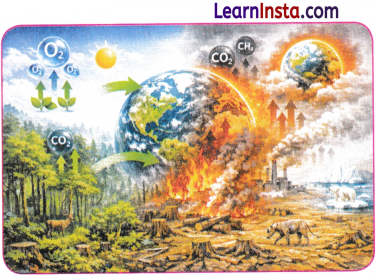
The carbon cycle will be impacted as forests are large carbon sinks that is, they absorb and store CO2 When forests are cleared and trees are burnt or left to decay, stored carbon is released as CO2, intensifying the greenhouse effect. This saturates the atmosphere’s carbon-absorbing capacity.
The other consequences of deforestation are:
- Reduced transpiration which leads to decreased local rainfall and subsequently drier climate.
- Increased surface albedo changes local temperature.
- Loss of tree roots would increase chances of soil erosion by rain and wind.
- Destruction of habitats will cause the loss of biodiversity.
- The water cycle will be disrupted as there will be less groundwater recharge, irregular river flow etc.
Question 9.
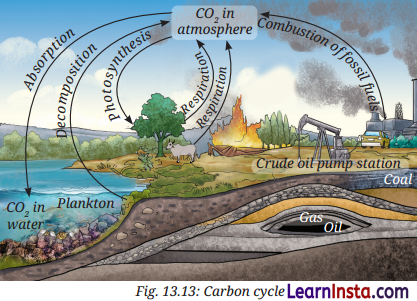
Explain with suitable diagram the path that carbon takes to go back to the atmosphere. You may start from plants using CO2 from the atmosphere.
Answer:
Carbon pathway (starting from plants):
Question 10.
Why is an excess of CO2 in the atmosphere considered undesirable even though it is required by plants?
Answer:
Carbon dioxide is essential for plants as it is used in photosynthesis to produce food. However, an excess of CO2 in the atmosphere disturbs the natural balance of the carbon cycle. Increased CO2 levels enhance the greenhouse effect, causing more heat to be trapped in the atmosphere, leading to global warming.
This rise in the Earth’s temperature results in melting of glaciers, rising of sea levels, and extreme weather conditions such as floods and droughts. It also affects agriculture by altering rainfall patterns and reducing crop productivity.
Question 11.
How is heat lost from the surface of the Earth? What is its significance?
Answer:
Earth’s surface loses heat in three main ways, these being:
- Re-radiation: When the surface absorbs visible sunlight and re-radiates it as infrared radiation back into the atmosphere
- Convection: When the warm air near the surface rises, carrying heat upward.
- Evaporation: When the water bodies and vegetation release water vapour, which carries latent heat into the atmosphere.
The significance of heat loss is that it drives atmospheric circulation, the water cycle and ocean currents. Greenhouse gases trap some of this outgoing heat, maintaining Earth’s average temperature at around 15°C otherwise, the Earth would have an average temperature of around – 18°C and be unable to support life.
Question 12.
If the Earth were a flat disc instead of a sphere, how would the patterns of solar radiation and temperature be different?
Answer:
On a spherical Earth, solar radiation hits equatorial regions at a direct angle and hits polar regions at an oblique angle causing uneven heating. On a flat disc, if it faced the Sun perpendicularly, all parts would receive equally intense radiation, resulting in uniform temperature across the disc. There would be no temperature gradient between equator and poles, so no planetary pressure differences, no global winds, and no major ocean current patterns.
Without differential heating, monsoons, trade winds, jet streams, and the Indian southwest monsoon would not exist. Local differences due to land, sea and elevation would still produce minor breezes. Essentially, the complex climate system driven by uneven solar heating would largely disappear.
Question 13.
Suppose there is a rise in atmospheric temperature on Earth. How would this affect the cryosphere, hydrosphere and biosphere?
Answer:
The rise in atmospheric temperature on the cryosphere, hydrosphere and biosphere would be:
1. Cryosphere:
Glaciers, ice caps, and polar ice would melt faster. This reduces Earth’s albedo which would mean less reflective ice causing more heat absorption therefore further warming in a loop.
2. Hydrosphere:
Melting ice raises sea levels, threatening coastal cities and low lying areas. The warmer atmosphere holds more moisture, intensifying the water cycle, leading to heavier rains in some regions, severe droughts in others. Ocean temperatures rise, reducing CO2, absorption capacity and causing ocean acidification from dissolved CO2.
3. Biosphere:
Many species face habitat loss. Coral reefs bleach and die from warm, acidic water. Crop patterns shift as rainfall and temperature zones change. Marine food chains are disrupted by plankton loss. Increased extreme weather events such as cyclones, heat waves, floods would destroy habitats and reduce biodiversity.
Question 14.
Explain how the Earth’s atmosphere helps in maintaining a suitable temperature for life to survive on the Earth.
Answer:
The atmosphere maintains Earth’s temperature through two key ways, the first being selective filtering, the ozone layer in the stratosphere absorbs most harmful UV radiation from the Sun, protecting living organisms from radiation damage while allowing beneficial visible light and some infrared through. Clouds and gases also reflect and absorb some incoming radiation. The second being greenhouse effect, Earth’s surface absorbs sunlight and re-radiates it as infrared heat.
Greenhouse gases in the troposphere absorb this outgoing infrared and re-radiate it back to the surface, maintaining Earth’s average temperature at about 15°C. Without the atmosphere, Earth’s temperature would be around -18°C which is too cold for life. The atmosphere thus acts like a natural blanket, creating a stable temperature range in which life can thrive.
Question 15.
Describe the interrelationship between different spheres of the Earth. Illustrate with example how these spheres function in a delicate balance.
Answer:
Earth’s five spheres namely, geosphere, hydrosphere, cryosphere, atmosphere, and biosphere are deeply interconnected and in constant exchange of energy and matter.
Examples of interrelationship:
- Cryosphere and Hydrosphere: Himalayan glaciers (cryosphere) melt in summer to feed rivers like the Ganga (hydrosphere), sustaining millions. If glaciers disappear, rivers dry up seasonally.
- Atmosphere and Hydrosphere: Warm Arabian Sea (hydrosphere) drives evaporation, fuelling India’s southwest monsoon (atmosphere) which brings rainfall critical for agriculture.
- Biosphere and Atmosphere: Forests (biosphere) absorb C02 and release O, (atmosphere), regulating the carbon cycle. Deforestation disrupts this balance, increasing greenhouse gas concentrations.
- Geosphere, Hydrosphere and Biosphere: Nutrients from rocks and soil (geosphere) dissolve in water (hydrosphere) and are absorbed by plants (biosphere) to support ecosystems.
Class 9 Science Chapter 13 Earth as a System Energy Matter and Life Question Answer (InText)
Think it Over (NCERT Textbook Page No. 252)
Question 1.
How does the warming of Arabian Sea water affect the southwest monsoon in India?
Answer:
Warming of the Arabian Sea increases evaporation, adding more moisture to the atmosphere. This can lead to stronger and more variable monsoon winds. As a result, some regions may receive heavy rainfall and floods, while others may face irregular rainfall or drought, causing fluctuations in the southwest monsoon.
Question 2.
If a large forest is cleared, how can that affect the flow of a river in that area?
Answer:
Forests play a critical role in the water cycle and clearing of a large forest can cause several problems. Such as:
- Transpiration stops, reducing atmospheric moisture and local rainfall.
- Tree roots no longer hold soil, so heavy rain causes rapid runoff and soil erosion instead of gradual infiltration.
- Reduced groundwater recharge means rivers receive less steady subsurface water. Together, these effects can cause rivers to flood briefly after rain and run very low or dry in the dry season.
Question 3.
What might happen to coastal cities in India if glaciers and polar ice keep melting faster?
Answer:
Faster melting of glaciers and polar ice leads to a rise in sea levels. This can cause flooding of low-lying coastal areas, damage infrastructure, and lead to loss of habitats and displacement of people in coastal cities.
Question 4.
How would increasing carbon dioxide levels in the atmosphere affect ocean plankton?
Answer:
Higher atmospheric CO2 means more CO2 dissolves in ocean water, forming carbonic acid and making the ocean more acidic. This acidic environment weakens the calcium carbonate shells of tiny marine organisms like plankton and corals. Since ocean plankton are the base of marine food chains and produce a significant portion of Earth’s oxygen through photosynthesis, their decline would threaten marine biodiversity and disrupt the global oxygen and carbon cycles.
Pause and Ponder (NCERT Textbook Page No. 258)
Question 1.
Visit the website given below and study the effect of the concentration of greenhouse gases on surface temperature: https://phet.colorado.edu/en/ simulations/greenhouse-effect.
Answer:
The concentration of greenhouse gases has a direct and significant effect on the Earth’s surface temperature.
The relationship between greenhouse gases and temperature is as follows:
1. Heat Trapping: Greenhouse gases in the atmosphere trap the heat (infrared radiation) that reflects off the Earth’s surface instead of letting it escape into space.
Direct Relationship: As the concentration of greenhouse gases increases, more heat is trapped within the atmosphere.
2. Temperature Rise: This trapped heat causes the Earth’s average surface temperature to rise.
Conclusion: Higher concentrations of greenhouse gases lead to an increase in surface temperature, a process commonly known as the Greenhouse Effect.
Pause and Ponder (NCERT Textbook Page No. 261)
Question 2.
How does the cool mountain breeze benefit agricultural activity, particularly the crops and soil?
Answer:
The cool mountain breeze at night brings cooler air down into the valley, moderating nighttime temperatures. This cooling helps reduce excessive evaporation from soil, conserving soil moisture. The temperature differential between warm days and cool nights is ideal for certain crops like apples and stone fruits as it promotes sugar accumulation. The breeze also reduces the risk of fungal diseases that thrive in stagnant warm air and helps maintain healthy soil conditions.

Question 3.
What happens to the warm surface of water from the equator as it travels toward the poles? What impact does this movement have on the area?
Answer:
Warm surface water from the equator moves toward the poles through ocean currents. As it travels, it gradually cools and releases heat into the surrounding atmosphere. This warms the nearby coastal regions, making their climate milder. It also helps in maintaining the global temperature balance. This movement plays an important role in regulating Earth’s climate system.
Pause and Ponder (NCERT Textbook Page No. 263)
Question 4.
The CO2 dissolved in the ocean is disturbed when the global temperature increases. What will happen to marine life?
Answer:
When global temperature rises, oceans become warmer, which reduces their capacity to absorb CO2 as warmer water holds less dissolved gas. The CO2 that remains in the ocean reacts with water to form carbonic acid, making the ocean more acidic. This acidic environment dissolves the calcium carbonate shells of marine organisms like plankton, corals, molluscs, and echinoderms. Since plankton form the base of marine food chains and also produce oxygen via photosynthesis, their decline would trigger a collapse of marine ecosystems, threatening fisheries and biodiversity.
Pause and Ponder (NCERT Textbook Page No. 265)
Question 5.
What would happen to plants and animals on Earth if the biogeochemical cycles were disrupted and stopped? Explain by giving a few examples.
Answer:
If the biogeochemical cycles (like the carbon, nitrogen, oxygen, and water cycles) were disrupted or stopped, life on Earth would collapse because these cycles recycle essential elements and maintain balance in ecosystems. Let’s break it down with examples:
Effects on Plants:
- Carbon cycle disruption: Plants would not get carbon dioxide for photosynthesis. Without photosynthesis, they couldn’t produce food or oxygen.
- Nitrogen cycle disruption: Plants would lack usable nitrogen compounds (like nitrates) needed to build proteins and DNA. Growth would stop, leading to crop failure.
- Water cycle disruption: Without rainfall and water movement, plants would dry out and die.
Effects on Animals:
- Oxygen cycle disruption: Animals would not get oxygen for respiration, leading to suffocation.
- Food chain collapse: If plants die, herbivores lose food, and carnivores lose prey. Entire ecosystems would collapse.
- Nitrogen cycle disruption: Animals would lack proteins and nucleic acids, making survival impossible.
Conclusion:
Biogeochemical cycles are the life- support systems of Earth. If they stopped, plants and animals would not survive because the essential elements (carbon, nitrogen, oxygen, water) would no longer be recycled and made available for biological processes.
Pause and Ponder (NCERT Textbook Page No. 266)
Question 6.
Discuss how human activities increase the concentration of greenhouse gases in the atmosphere. What would you do as an individual to reduce the emission of greenhouse gases?
Answer:
Human activities have significantly increased the concentration of greenhouse gases (GHGs) in the atmosphere, leading to global warming and climate change. Let’s break this down:
How Human Activities Increase Greenhouse Gases
1. Burning of fossil fuels:
Coal, oil, and natural gas used in power plants, vehicles, and industries release large amounts of carbon dioxide (CO2).
2. Deforestation:
Cutting down forests reduces the number of trees that absorb CO2, increasing its concentration in the atmosphere.
3. Agriculture:
Paddy fields and livestock (especially cattle) release methane (CH2), a potent greenhouse gas.
4. Industrial processes:
Factories emit gases like nitrous oxide (N2O) and fluorinated gases (CFCs, HFCs), which trap heat more effectively than CO2.
5. Waste management:
Landfills produce methane as organic waste decomposes without oxygen.
What I Can Do as an Individual
- Use public transport, cycle, or walk instead of relying on private vehicles to reduce fuel consumption.
- Save electricity by switching off lights and appliances when not in use, and using energy- efficient devices.
- Plant trees and support afforestation to absorb CO2.
- Reduce, reuse, recycle to minimize waste and methane emissions from landfills.
- Adopt sustainable diets (e.g., reducing excessive meat consumption) to lower methane emissions from livestock.
- Conserve water since water treatment and pumping consume energy.
Conclusion:
Human actions like burning fuels, deforestation, and industrialisation are the main drivers of rising greenhouse gases. As individuals, small lifestyle changes — saving energy, reducing waste, planting trees — collectively make a big difference in slowing climate change.