Get the simplified Class 7 Maths Extra Questions Chapter 8 Working with Fractions Class 7 Extra Questions and Answers with complete explanation.
Class 7 Working with Fractions Extra Questions
Class 7 Maths Chapter 8 Working with Fractions Extra Questions
Class 7 Maths Chapter 8 Extra Questions
Question 1.
Multiply and reduce to the lowest form and convert into a mixed fraction.
(i) 2 × \(\frac{1}{3}\)
(ii) 5 × \(\frac{3}{2}\)
(iii) \(\frac{3}{2}\) × 3
Answer:

Question 2.
Multiply and express as a mixed fraction.
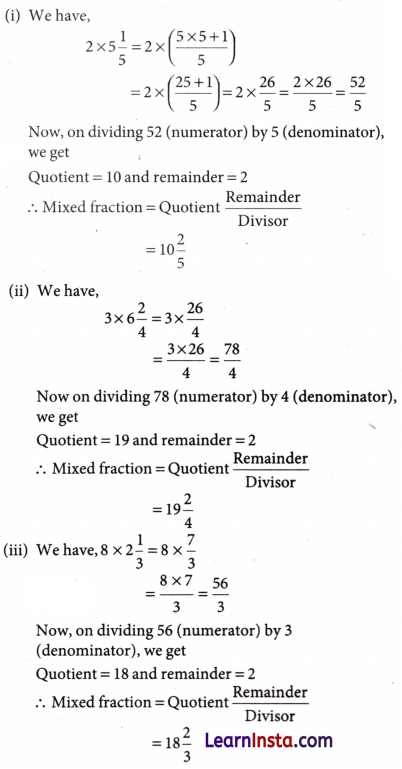
(i) 2 × 5 \(\frac{1}{5}\)
(ii) 3 × 6 \(\frac{2}{4}\)
(iii) 8 × 2 \(\frac{1}{3}\)
Answer:
Question 3.
What is \(\frac{1}{3}\) of 6 ?
Answer:
‘Of’ means multiplication So, \(\frac{1}{3}\) of 6 = \(\frac{1}{3}\) × 6 = 2
Question 4.
Mohan and Bhanu joined the gym. Mohan consumed \(\frac{1}{5}\) of the badam milk out of the 5 L from a bottle. Bhanu consumed the remaining badam milk.
(i) How much badam milk did Mohan drink?
(ii) What fraction of total quantity of badam milk did Bhanu drink?
Answer:
(i) Given, the total amount of badam milk in a bottle = 5 L
Badam milk consumed by Mohan = \(\frac{1}{5}\) of 5L = \(\frac{1}{5}\) × 5
= \(\frac{5}{5}\) = \(\frac{5}{5}\) = 1 L
So, Mohan drink 1 L of badam milk.

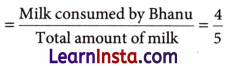
(ii) Badam milk consumed by Bhanu
= Total amount of milk – Milk consumed by Mohan = 5 – 1 = 4 L
∴ Fraction of total quantity of milk consumed by Bhanu
Question 5.
In a class of 40 students, \(\frac{1}{5}\) of the total number of students like to eat rice only, \(\frac{2}{5}\) of the total number of students like to eat chapati only and the remaining students like to eat both. What fraction of the total number of students like to eat both?
Answer:
Total number of students = 40[given]
Students who eat rice only = \(\frac{1}{5}\) of total students
= \(\frac{1}{5}\) × 40 = 8
Students who eat chapati only =\(\frac{2}{5}\) of total students
= \(\frac{2}{5}\) × 40 = 16
∴ Students who eat both chapati and rice = Total number of students – (Students who eat rice only + Students who eat chapati only)
= 40-(8+16)=40-24=16
∴ Fraction of students who eat both chapati and rice

= \(\frac{16}{40}\) = \(\frac{2}{5}\)
Question 6.
Multiply and reduce to the lowest form (if possible).
(i) \(\frac{1}{5}\) × \(\frac{4}{3}\)
(ii) \(\frac{2}{7}\) × \(\frac{7}{8}\)
(iii) \(\frac{4}{5}\) × \(\frac{6}{7}\)
(iv) \(\frac{1}{2}\) × \(\frac{15}{8}\)
(v) \(\frac{9}{5}\) × 2 \(\frac{2}{3}\)
(vi) 2 \(\frac{2}{7}\) × 1 \(\frac{1}{3}\)
Answer:

Question 7.
Find
(i) \(\frac{1}{4}\) of (a) \(\frac{2}{5}\) (b) \(\frac{3}{7}\)
(ii) \(\frac{1}{6}\) of (a) \(\frac{2}{5}\) (b) \(\frac{5}{8}\)
Answer:

Question 8.
Vikas writes \(\frac{2}{5}\) part of a novel in one hour. How much part of the novel will he write in 1 \(\frac{1}{3}\) h ?
Answer:
Given, the part of the novel written by Vikas in one hour
= \(\frac{2}{5}\)
So, the part of the novel would written by him 1 \(\frac{1}{3}\) h
= 1 \(\frac{1}{3}\) × \(\frac{2}{5}\) = \(\frac{4}{3}\) × \(\frac{2}{5}\) = \(\frac{8}{15}\)
Question 9.
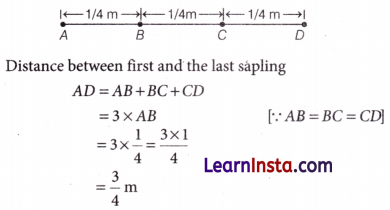
Anupa plants 4 saplings in a row, in her garden. The distance between two adjacent saplings is \(\frac{1}{4}\) m. Find the distance between first and last saplings.
Answer:
Let 4 saplings be planted in a row at the points A, B, C and D respectively such that distance between two adjacent saplings is \(\frac{1}{4}\)m
Question 10.
A square field has side 15 \(\frac{2}{5}\) m. Then, find the area of the field.
Answer:

Question 11.
Ravi had 63 chocolates. Sonu had \(\frac{1}{7}\) of the chocolates that Ravi had. How many chocolates did Sonu have?
Answer:
Given, Ravi had 63 chocolates.
Sonu had chocolates = 63 × \(\frac{1}{7}\) = 9 chocolates
Question 12.
(i) Provide the number in the box such that
\(\frac{3}{4}\) × □ = \(\frac{30}{20}\)
(ii) Simplest form of number obtained in □ is ….
Answer:
(i) \(\frac{3}{4}\) × □ = \(\frac{30}{20}\)
Here, 3 × 10 = 30 and 4 × 5 = 20
Hence, the required number in the box is \(\frac{10}{5}\)
(ii) Simplest form of \(\frac{10}{5}\) = \(\frac{2}{1}\)
Question 13.
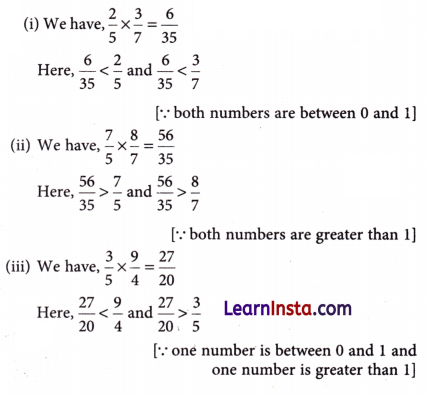
What happens to the value of product of fractions when we multiply given two fractions in each of the following?
(i) \(\frac{2}{5}\) and \(\frac{3}{7}\)
(ii) \(\frac{7}{5}\) and \(\frac{8}{7}\)
(iii) \(\frac{3}{5}\) and \(\frac{9}{4}\)
Answer:
Question 14.
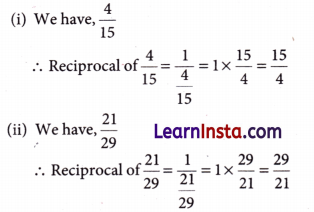
Find the reciprocal of the following fractions.
(i) \(\frac{4}{15}\)
(ii) \(\frac{21}{29}\)
Answer:
Question 15.
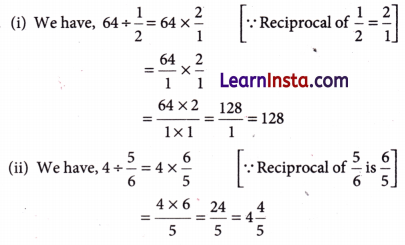
Find
(i) 64 ÷ \(\frac{1}{2}\)
(ii) 4 ÷ \(\frac{5}{6}\)
Answer:
Question 16.
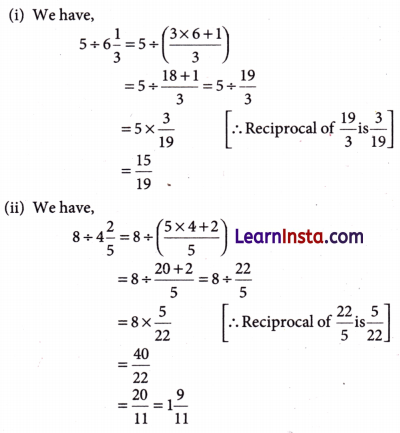
Find
(i) 5 ÷ 6 \(\frac{1}{3}\)
(ii) 8 ÷ 4 \(\frac{2}{5}\)
Answer:
Question 17.
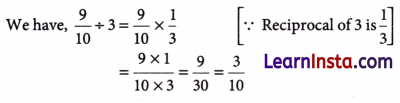
Solve it \(\frac{9}{10}\) ÷ 3.
Answer:
Question 18.
Ravi made 6 glasses of juice. He used \(\frac{1}{3}\) litre of orange syrup for this. How much syrup is there is each glass of juice?
Answer:
We have, the fraction syrup used in 6 glasses of juice
= \(\frac{1}{3}\) litre
So, in 1 glass of juice, the amount of syrup = \(\frac{1}{3}\) ÷ 6
= \(\frac{1}{3}\) × \(\frac{1}{6}\) = \(\frac{1}{18}\) litre
Question 19.
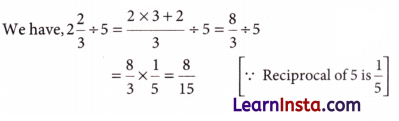
Solve it 2 \(\frac{2}{3}\) ÷ 5.
Answer:
Question 20.
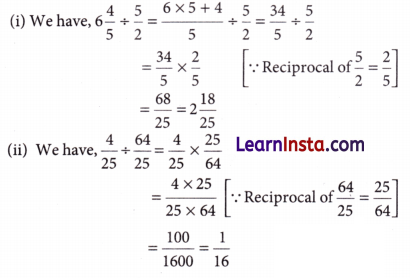
Find
(i) 6 \(\frac{4}{5}\) ÷ \(\frac{5}{2}\)
(ii) \(\frac{4}{25}\) ÷ \(\frac{64}{25}\)
Answer:
Question 21.
If product of two numbers is 20 \(\frac{3}{5}\). If one of them is 2 \(\frac{2}{5}\), then find the other number.
Answer:
Let the other number be x.
Now, according to the question,

Question 22.
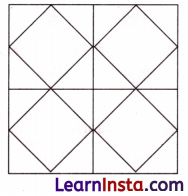
In the figure given below, find the fraction of the big square that the shaded region occupies.
Answer:
Let the area of the whole square be 1 square unit.
If we divide the square into four equal squares then each has \(\frac{1}{4}\) of the area of the whole square.
∴ Area of the top left square = \(\frac{1}{4}\) square unit.
The top left square is further divided into four equal parts, each having an area of \(\frac{1}{4}\) × \(\frac{1}{4}\) = \(\frac{1}{16}\) square unit and each part contains two equal triangles (if cut into two pieces diagonally) having area \(\frac{1}{16}\) × \(\frac{1}{2}\) = \(\frac{1}{32}\) square unit.
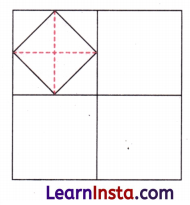
∴ The area of shaded region in top left square is \(\frac{1}{32}\) + \(\frac{1}{32}\) + \(\frac{1}{32}\) + \(\frac{1}{32}\) = \(\frac{4}{32}\) = \(\frac{1}{8}\) square unit.
Since, there are four squares, each containing shaded region of area \(\frac{1}{8}\) square unit.
∴ Total area of the shaded region is \(\frac{1}{8}\) + \(\frac{1}{8}\) + \(\frac{1}{8}\) +\(\frac{1}{8}\) = \(\frac{4}{8}\) = \(\frac{1}{2}\) square unit.
Hence, the fraction of the big square that the shaded region occupies is \(\frac{1}{2}\).
Note When the divisor is between 0 and 1, the quotient is greater than the dividend. When the divisor is greater than 1, the quotient is less than the dividend.
Working with Fractions Extra Questions Class 7
Question 1.
Multiply and reduce to lowest form and convert into mixed fraction.
(i) \(\frac{20}{5}\) × 4
(ii) \(\frac{6}{2}\) × 5
(iii) \(\frac{1}{9}\) × 7
(iv) \(\frac{5}{13}\) × 17
Answer:
(i) 16
(ii) 15
(iii) \(\frac{7}{9}\)
(iv) 6 \(\frac{7}{13}\)
Question 2.
Multiply and express as mixed fraction.
(i) 3 × 4 \(\frac{1}{4}\)
(ii) 4 × 1 \(\frac{1}{3}\)
(iii) 3 × 2 \(\frac{3}{4}\)
(iv) 7 × 3 \(\frac{2}{5}\)
Answer:
(i) 12 \(\frac{3}{4}\)
(ii) 5 \(\frac{1}{3}\)
(iii) 8 \(\frac{1}{4}\)
(iv) 23 \(\frac{4}{5}\)
Question 3.
Find
(i) \(\frac{2}{5}\) of (a) 10
(b) 25
(ii) \(\frac{1}{4}\) of (a) 8
(b) 7
(iii) \(\frac{2}{3}\) of (a) 27
(b) 36
Answer:
(i) (a) 4 (b) 10
(ii) (a) 2 (b) \(\frac{7}{4}\)
(iii) (a) 18 (b) 24
Question 4.
Muskan and Deepak went for a picnic. Their mother gave them a juice bottle that contained 4 L of juice. Muskan consumed \(\frac{1}{4}\) of the juice. Deepak consumed the remaining juice.
(i) How much juice did Muskan drink?
(ii) What fraction of the total quantity of juice did Deepak drink?
Answer:
(i) 1 L
(ii) \(\frac{3}{4}\)
Question 5.
In a class of 60 students, \(\frac{1}{3}\) of the total number of students like to study Hindi, \(\frac{2}{5}\) of the total students like to study English and remaining students like to study Maths. What fraction of students like to study Maths?
Answer:
\(\frac{4}{15}\)
Question 6.
Multiply and reduce to lowest form (if possible)
(i) \(\frac{8}{3}\) × \(\frac{6}{5}\)
(ii) \(\frac{3}{5}\) × \(\frac{5}{7}\)
(iii) \(\frac{7}{9}\) × \(\frac{6}{4}\)
(iv) \(\frac{1}{2}\) × 1 \(\frac{1}{2}\)
(v) 1 \(\frac{2}{7}\) × 2 \(\frac{3}{5}\)
Answer:
(i) \(\frac{16}{5}\)
(ii) \(\frac{3}{7}\)
(iii) \(\frac{7}{6}\)
(iv) \(\frac{3}{4}\)
(v) \(\frac{117}{35}\)
Question 7.
Find –
(i) \(\frac{1}{5}\) of
(a) \(\frac{1}{5}\)
(b) \(\frac{3}{4}\)
(c) \(\frac{5}{7}\)
(ii) \(\frac{1}{6}\) of
(a) \(\frac{2}{3}\)
(b) \(\frac{7}{5}\)
(c) \(\frac{5}{2}\)
Answer:
(i) (a) \(\frac{1}{25}\)
(b) \(\frac{3}{20}\)
(c) \(\frac{1}{7}\)
(ii) (a) \(\frac{1}{9}\)
(b) \(\frac{7}{30}\)
(c) \(\frac{5}{12}\)
Question 8.
Rohan reads a book for \(\frac{3}{4}\) h every day. He reads the entire book in 6 days. How many hours in all were required by him to read the book?
Answer:
\(\frac{9}{2}\) hrs
Question 9.
A rectangular field is 16 \(\frac{1}{3}\) m long and 10 \(\frac{2}{5}\) m wide. Then, find the area of the field.
Answer:
169 \(\frac{13}{15}\) m2
Question 10.
Sugar is sold at ₹ 17 \(\frac{3}{5}\) per kg . Find the cost of 16 kg of sugar.
Answer:
₹ 281 \(\frac{3}{5}\)
Question 11.
Rajiv had 64 apples. Monu had \(\frac{1}{8}\) of the apples that Rajiv had. How many apples did Monu have?
Answer:
8 apples
Question 12.
(i) Provide the number in the box such that \(\frac{2}{9}\) × □ = \(\frac{20}{45}\)
(ii) Simplest form of number obtained in □ □ is
Answer:
(i) \(\frac{10}{5}\)
(ii) \(\frac{2}{1}\)
Question 13.
What happens to the value of product when we multiply two fractions? Fill in the table.

Answer:
4 ; \(\frac{4}{9}\) < \(\frac{8}{45}\), \(\frac{2}{5}\) < \(\frac{8}{45}\) ; Product is less than each fraction
Question 14.
What happens to the value of product when we multiply two fractions? Fill in the table.

Answer:
8 ; \(\frac{8}{7}\) < \(\frac{24}{14}\), \(\frac{3}{2}\) < \(\frac{24}{14}\) ; Product is greater than each fraction.
Question 15.
Find the reciprocal of each and classify them as proper or improper fraction or whole numbers.
(i) \(\frac{4}{9}\)
(ii) \(\frac{5}{11}\)
(iii) \(\frac{3}{7}\)
(iv) \(\frac{6}{5}\)
(v) \(\frac{3}{7}\)
(vi) \(\frac{1}{11}\)
(vii) \(\frac{2}{7}\)
(viii) \(\frac{1}{12}\)
(ix) \(\frac{9}{7}\)
(x) \(\frac{1}{6}\)
Answer:
(i) \(\frac{9}{4}\), Improper
(ii) \(\frac{11}{5}\), Improper
(iii) \(\frac{7}{3}\), Improper
(iv) \(\frac{5}{6}\), Proper
(v) \(\frac{7}{3}\), Improper
(vi) 11, Whole
(vii) \(\frac{7}{2}\), Improper
(viii) 12 , Whole
(ix) \(\frac{7}{9}\), Proper
(x) 6, Whole
Question 16.
Find the value of the following
(i) 169 ÷ \(\frac{1}{13}\)
(ii) 15 ÷ \(\frac{1}{5}\)
(iii) 9 ÷ \(\frac{4}{3}\)
(iv) 5 ÷ 2 \(\frac{2}{5}\)
(v) 4+1 \(\frac{1}{2}\)
Answer:
(i) 2197
(ii) 75
(iii) \(\frac{27}{4}\)
(iv) \(\frac{25}{12}\)
(v) \(\frac{8}{3}\)
Question 17.
Find the value of the following
(i) \(\frac{6}{11}\) ÷ 7
(ii) \(\frac{5}{13}\) ÷ 7
(iii) 5 \(\frac{1}{2}\) ÷ 4
(iv) 6 \(\frac{1}{5}\) ÷ 5
Answer:
(i) \(\frac{6}{77}\)
(ii) \(\frac{5}{91}\)
(iii) \(\frac{11}{8}\)
(iv) \(\frac{31}{25}\)
Question 18.
Find
(i) \(\frac{3}{5}\) + \(\frac{1}{2}\)
(ii) \(\frac{6}[{7}\) ÷ \(\frac{2}{3}\)
(iii) 3 \(\frac{1}{2}\) ÷ \(\frac{2}{3}\)
(iv) \(\frac{4}{5}\) ÷ 1 \(\frac{1}{2}\)
(v) 2 \(\frac{1}{5}\) + 3 \(\frac{2}{7}\)
Answer:
(i) \(\frac{6}{5}\)
(ii) \(\frac{9}{7}\)
(iii) \(\frac{21}{4}\)
(iv) \(\frac{8}{15}\)
(v) \(\frac{77}{115}\)
Question 19.
The product of two numbers is 40 \(\frac{4}{5}\). If one of the number is 2 \(\frac{2}{5}\), then find the other number.
Answer:
17