Students often refer to Maths Mela Class 5 Solutions Chapter 1 We the Travellers 1 Question Answer NCERT Solutions to verify their answers.
Class 5 Maths Chapter 1 We the Travellers 1 Question Answer Solutions
We the Travellers 1 Class 5 Maths Solutions
Class 5 Maths Chapter 1 Solutions
Reading and writing Large numbers (Page 1)
How do you write numbers to show several thousand objects?
Let us start with 1,000. What numbers do we get when we keep adding a thousand?

What number do we get when we add a thousand to 9,000? We get ten thousand. How do we write this number?
Answer:

Also, 9000 + 1000 = 10,000
(Page 3)
Let us see how we write numbers beyond 10,000 and how we name them. We write them in the same way as numbers below 9,999. You can use the tokens given in the end of the book.
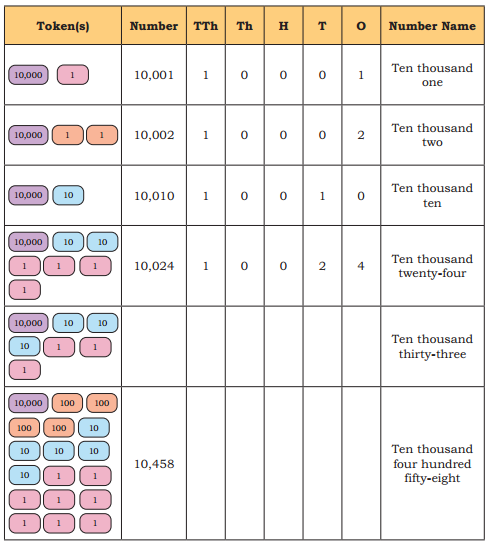
Answer:
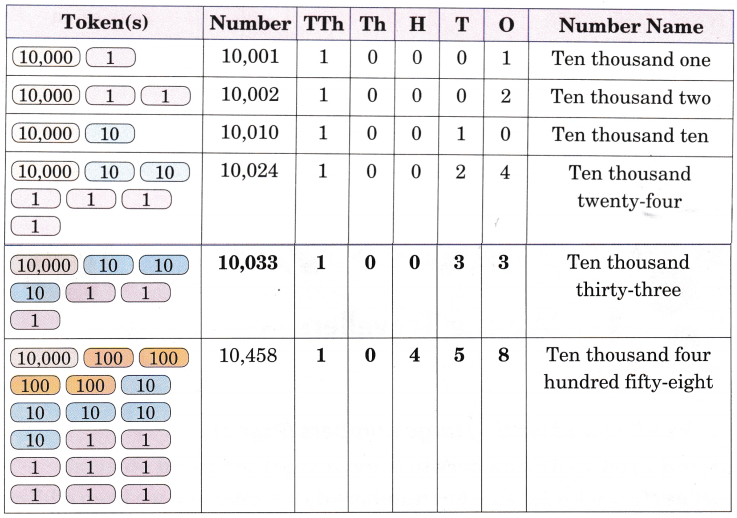

(Page 4)
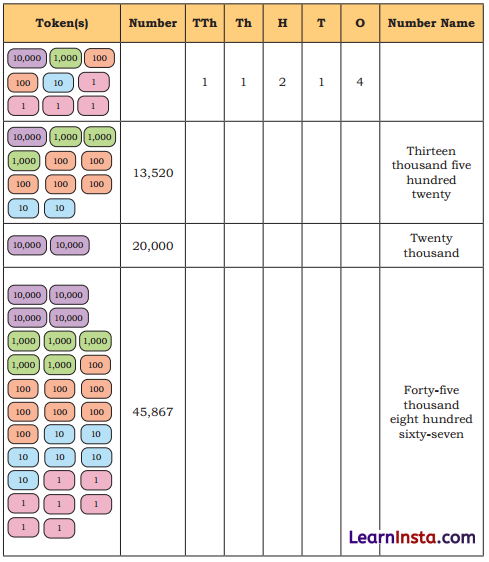
Answer:
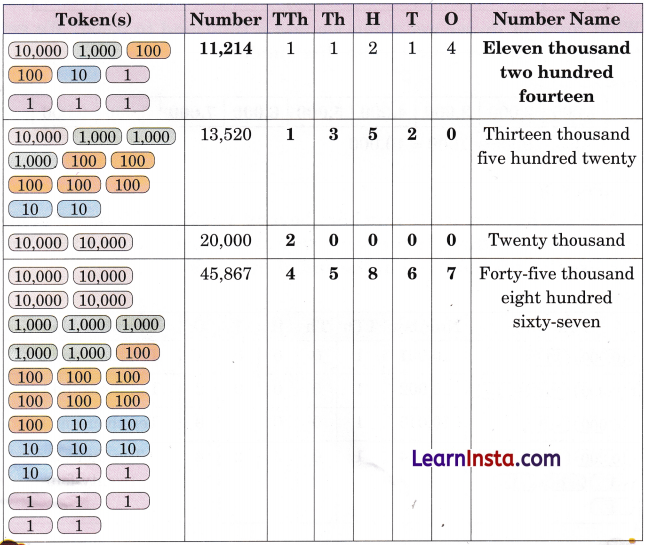
Let Us Do (Pages 5-7)
Question 1.
Fill in the blanks by continuing the pattern in each of the following sequences. Discuss the patterns in class.
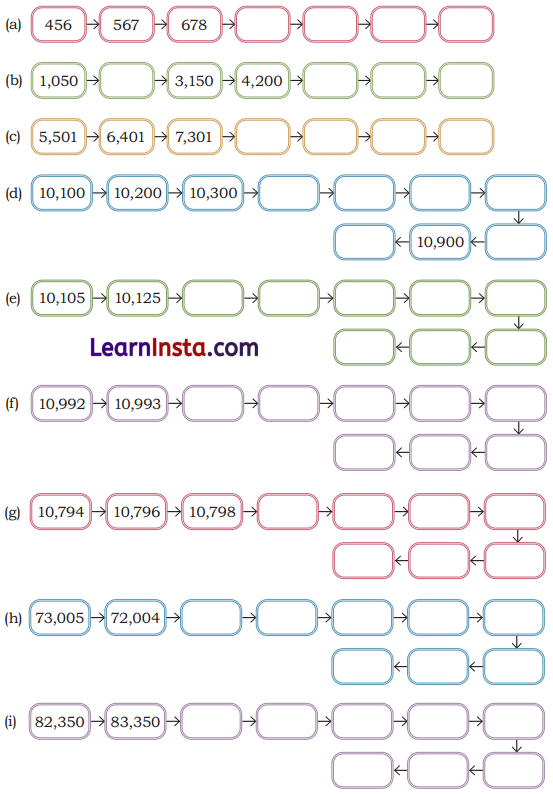
Answer:
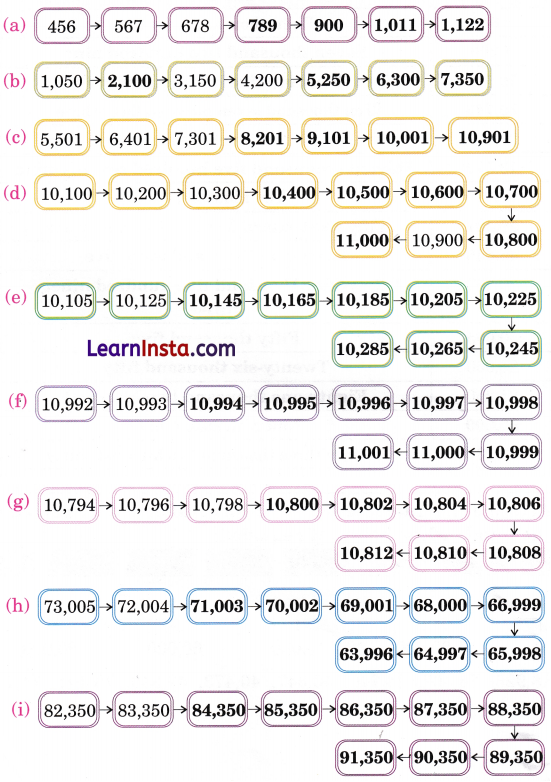
Question 2.
Fill in the blanks appropriately. Use commas as required.
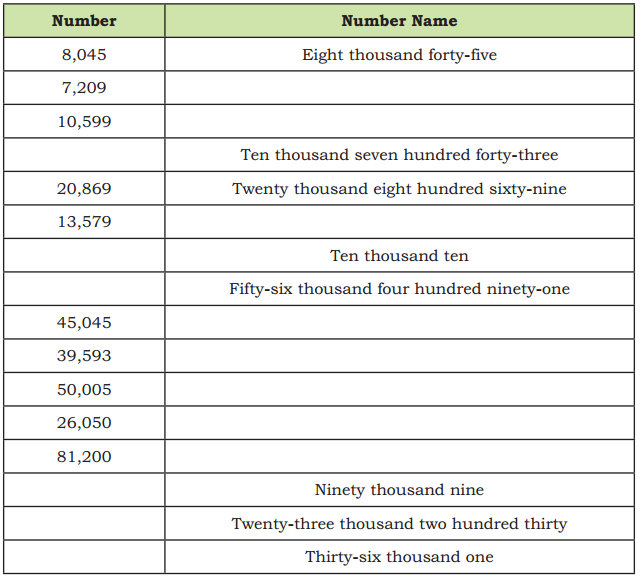
Answer:
| Number | Number Name |
| 8,045 | Eight thousand forty-five |
| 7,209 | Seven thousand two hundred nine |
| 10,599 | Ten thousand five hundred ninety-nine |
| 10,743 | Ten thousand seven hundred forty-three |
| 20,869 | Twenty thousand eight hundred sixty-nine |
| 13,579 | Thirteen thousand five hundred seventy-nine |
| 10,010 | Ten thousand ten |
| 56,491 | Fifty-six thousand four hundred ninety-one |
| 45,045 | Forty-five thousand forty-five |
| 39,593 | Thirty-nine thousand five hundred ninety-three |
| 50,005 | Fifty thousand five |
| 26,050 | Twenty-six thousand fifty |
| 81,200 | Eighty-one thousand two hundred |
| 90,009 | Ninety thousand nine |
| 23,230 | Twenty-three thousand two hundred thirty |
| 36,001 | Thirty-six thousand one |
Question 3.
Arrange the numbers below in increasing order. You can use the number line below, if required.
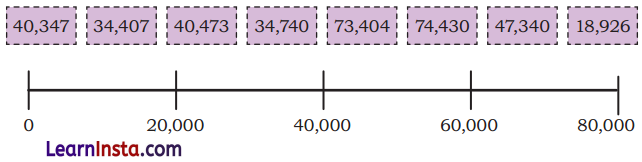
Answer:
18,926, 34,407, 34,740, 40,347, 40,473, 47,340, 73,404, 74,430
Question 4.
A student said 9,990 is greater than 49,014 because 9 is greater than 4. Is the student correct? Why or why not?
Use the number line below to find the position of the numbers. Fill in the blanks.
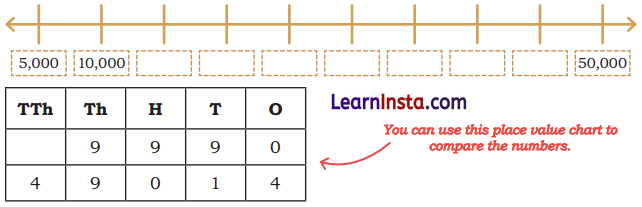
Answer:
No, the student is not correct.
Comparing the numbers by place value chart from left to right. 9,990 is a 4-digit number (less than 10,000)
49,014 is a 5-digit number
So, clearly, 49,014 is greater than 9,990, no matter what digits are inside.

Question 5.
Digit swap
(a) In the number 1,478, interchanging the digits 7 and 4 gives 1,748. Now, interchange any two digits in the number 1,478 to make a number that is larger than 5,500.
Answer:
1478 = 7,418 (or others like 8,471 also work)
(b) Interchange two digits of 10,593 to make a number
(i) Between 11,000 and 15,000.
(ii) More than 35,000.
Answer:
(i) 10,593 = 13,590
(ii) 10,593 = 50,193
(c) Interchange two digits of 48,247 to make a number
(i) As small as possible.
(ii) As big as possible.
Answer:
(i) 48,247 = 28,447
(ii) 48,247 = 84,247
Nearest Tens (10s), Hundreds (100s), and Thousands (1,000s) (Pages 7-8)
A rabbit is hungry. Its location is given in the pictures below. Its food has been kept at two places. Help the rabbit to reach its food.
The rabbit is at 2,346. Its food has been kept at its neighbouring tens. On which tens should the rabbit go to get its food, with the least number of steps.

2,350 is the nearest ten of 2,346. It will need 4 jumps to reach 2,350.
The rabbit is at 2,346. Its food has been kept at its neighbouring hundreds. Which of the two hundreds should the rabbit go to?
_______ is the nearest hundred of 2,346. It will need______ jumps to reach ______.
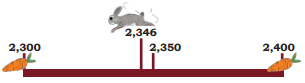
Answer:
2,300 is the nearest hundred of 2,346. It will need 2346 – 2300 = 46 jumps to reach 2,300.
The rabbit is at 2,346. Its food has been kept at its neighbouring thousands. Which number should the rabbit go to?
_________ is the nearest thousand of 2,346. It will need _______ jumps to reach ______.
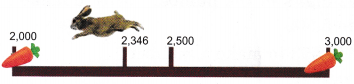
Answer:
2,000 is the nearest thousand of 2,346. It will need 2346 – 2000 = 346 jumps to reach 2,000
Fill in the boxes appropriately.
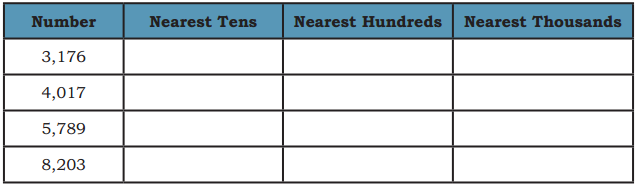
Answer:
| Number | Nearest Tens | Nearest Hundreds | Nearest Thousands |
| 3,176 | 3,180 | 3,200 | 3,000 |
| 4,017 | 4,020 | 4,000 | 4,000 |
| 5,789 | 5,790 | 5,800 | 6,000 |
| 8,203 | 8,200 | 8,200 | 8,000 |
Let Us Think (Pages 8-9)
Question 1.
Vijay rounded off a number to the nearest hundred. Suma rounded off the same number to the nearest thousand. Both got the same result.
Circle the numbers they might have used.
7,126 7,835 7,030 6,999
Answer:
Both 7,030 and 6,999 give the same result when rounded off to the nearest hundred and nearest thousand.
Question 2.
Think and write two numbers that have the same—
(a) Nearest ten.
(b) Nearest hundred.
(c) Nearest thousand.
For example, 19 and 21 have the same nearest ten, that is, 20.
Answer:
(a) Nearest ten: 12, 14 have nearest ten as 10 and 46, 48 both round to 50.
(b) Nearest hundred: 240,160 have nearest hundred as 200 and 5,720, 5,740 both round to 5,700.
(c) Nearest thousand: 3,100, 2,900 have nearest thousand as 3,000 and 8,450, 7,890 both round to 8,000.
Question 3.
Think and write the numbers that have the same—
(a) Nearest ten and nearest hundred.
(b) Nearest hundred and nearest thousand.
(c) Nearest ten, hundred and thousand.
Answer:
(a) Nearest ten and nearest hundred: 104 rounds to 100 (nearest ten) and 100 (nearest hundred) OR 4,502, which rounds to 4,500 for both.
(b) Nearest hundred and nearest thousand: 7,030 and 6,999 both have the same nearest hundred (7,000) and nearest thousand (7,000) OR 4,960 which rounds to 5,000 for both.
(c) Nearest ten, hundred and thousand: 1,004 rounds to 1,000 for the nearest ten, 1,000 for the nearest hundred, and 1,000 for the nearest thousand OR 5,002, which rounds to 5,000 for all three.
Let Us Do (Page 10)
Question 1.
A cyclist can cover 15 km in one hour. How much distance will she cover in 4 hours, if she maintains the same speed?
Answer:
We Know, speed = \(=\frac{\text { distance }}{\text { time }}\) ⇒ distance = speed × time
= 15 km/hour × 4 hours
= 60 km in 4 hours.
Question 2.
A school has 461 girls and 439 boys. How many vehicles are needed for all of them to go on a trip using the following modes of travel?
The numbers in the bracket indicates the number of people that can travel in one vehicle.
(a) Bicycle (2)
(b) Autorickshaw (3)
(c) Car (4)
(d) Big car (6)
(e) Tempo traveller (10)
(f) Boat (20)
(g) Minibus (25)
(h) Aeroplane (180)
Answer:
Total people = 461 + 439 = 900
(a) Bicycle (2): 900 ÷ 2 = 450 bicycles
(b) Autorickshaw (3): 900 ÷ 3 = 300 autorickshaws
(c) Car (4): 900 ÷ 4 = 225 cars
(d) Big car (6): 900 ÷ 6 = 150 big cars
(e) Tempo traveller (10): 900 ÷ 10 = 90 tempo travellers
(f) Boat (20): 900 ÷ 20 = 45 boats
(g) Minibus (25): 900 ÷ 25 = 36 minibuses
(h) Aeroplane (180): 900 ÷ 180 = 5 aeroplanes
(Page 11)
List some quantities whose count is a 4-digit or a 5-digit number in the context of—
(i) A tree.
Answer:
- The number of leaves on a large tree (e.g., 20,000 to 50,000).
- The number of fruit seeds in a very large fruit tree over its lifetime.
- The number of insects living on a large tree at any given time,
(ii) Your village/town/city, or any other place of your choice.
Answer:
- The population of a small city (e.g., 10,000 to 99,999 people).
- The number of students in a large school district.
- The number of vehicles registered in a medium-sized town.
- The total number of houses or residential units.
- The number of books in a large public library.
Pastime Mathematics (Page 11)
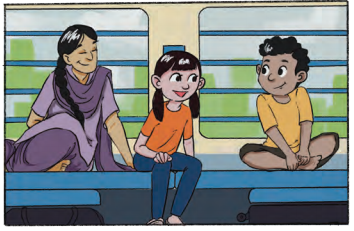
Sanju and Mira are traveling on a train. To pass time, they challenge each other with games and puzzles.
Question 1.
Mira poses the river crossing puzzle to Sanju.
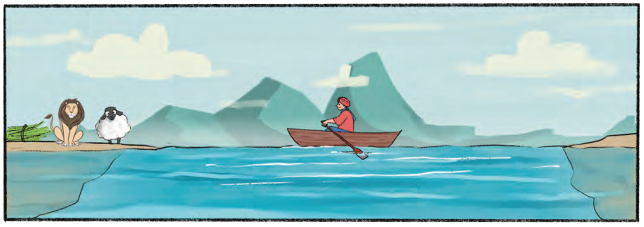
A boatman wants to cross a river in a boat. He has to take a lion, a sheep, and a bundle of grass with him. He can take one of them at a time. If the sheep and grass are left on the shore, the sheep will eat the grass. And, if the sheep and lion are left on the shore, the lion will eat the sheep.
How can the boatman take the lion, sheep, and grass across the river?
Help him so that he can ferry the lion, sheep, and grass across the river safely, and in the minimum number of trips.
Answer:
1. The boatman takes the sheep across the river.
Leave the sheep on the other side and return.
2. The boatman takes the lion across the river.
He must then take the sheep back with him so the lion won’t be alone with it.
3. The boatman takes the sheep back to the starting side.
Leave the sheep and take the grass across.
4. The boatman takes the grass across the river.
Leave the grass with the lion (the lion won’t eat the grass) and return.
5. The boatman takes the sheep across the river one last time.
All three are now safely on the other side. This completes the task in a minimum of five trips.
Let Us Do (Pages 13-14)
Question 1.
Write 5 numbers between the numbers 23,568 and 24,234.
______, ______, ______, ______ and ______
Answer:
23,569, 23,570, 23,571, 23,572 and 23,573
Question 2.
Write 5 numbers that are more than 38,125 but less than 38,600.
______, ______, ______, ______ and ______
Answer:
38,126, 38,127, 38,128, 38, 129 and 38,130
Question 3.
Ravi’s car has been driven for 56,987 km till now. Sheetal’s car has been driven 67,543 km. Whose car has been driven more?
Answer:
56,987 km < 67,543 km, Sheetal’s car
Question 4.
The following are the prices of different electric bikes. Arrange the prices in ascending (increasing) order.
₹ 90,000 ₹ 89,999 ₹ 94,983 ₹ 49,900 ₹ 93,743 ₹ 39,999
Answer:
₹ 39,999, ₹ 49,900, ₹ 89,999, ₹ 90,000, ₹ 93,743, ₹ 94,983
Question 5.
The following table shows the population of some towns.
Arrange them in a descending (decreasing) order.
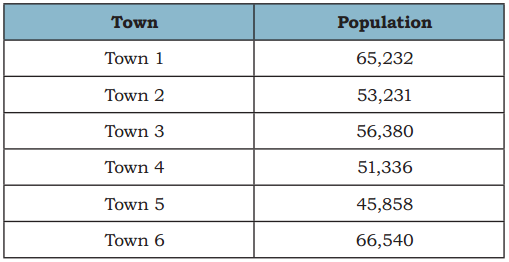
__________ , __________ , __________ , __________ , __________, __________,
Answer:
66,540, 65,232, 56,380, 53,231, 51,336, 45,858
Question 6.
Find numbers between 42,750 and 53,500 such that the ones, tens, and hundreds digits are all 0?
Answer:
43,000, 44,000, 45,000, 46,000, 47,000, 48,000, 49,000, 50,000, 51,000, 52,000,53,000.
Question 7.
Write the following numbers in the expanded form. One has been done for you.
(a) 783 = 700 + 80 + 3
(b) 8,062 = ______.
(c) 9,980 = ______.
(d) 10,304 = ______.
(e) 23,004 = ______.
(f) 70,405 = ______.
Answer:
(b) 8,000 + 60 + 2
(c) 9,000 + 900 + 80
(d) 10,000 + 300 + 4
(e) 20,000 + 3000 + 4
(f) 70,000 + 400 + 5
Question 8.
Fill in the blanks with the correct answer. Share your thoughts in class.
(a) 983 = 90 Tens + 83 Ones
(b) 68 = ___ Tens + 18 Ones
(c) 607 = 4 Hundreds + ___ Ones
(d) 5,621 = 4 Thousand + ___ Hundreds + 2 Tens + ___ Ones
(e) 7,069 = ___ Thousand + 20 Hundreds + ___ Ones
(f) 37,608 = ___ Ten Thousand + 17 Thousand + ___ Hundreds + 8 Ones
(g) 43,001 = 3 Ten Thousand + ____ Thousand + ____ Hundreds + 1 Ones
Answer:
(b) 5 tens +18 ones
(c) 607 = 4 Hundreds + 207 Ones
(d) 5,621 = 4 Thousand + 16 Hundreds + 2 Tens + 1 Ones
(e) 7,069 = 5 Thousand + 20 Hundreds + 69 Ones
(f) 37,608 = 2 Ten Thousand + 17 Thousand + 6 Hundreds + 8 Ones
(g) 43,001 = 3 Ten Thousand + 13 Thousand + 0 Hundreds + 1 Ones
Question 9.
Fill in the blanks with the correct answers.
(a) How many notes of ₹ 10 are there in ₹ 7,934?
Answer:
793
(b) How many notes of ₹ 100 are there in ₹ 7,934?
Answer:
79
(c) How many thousands are there in 7,934?
Answer:
7
(d) How many ₹ 500 notes are there in ₹ 7,934?
(Hint: Observe the answer of (c))
Answer:
15
(e) How many notes of? 10 are there in ₹ 65,342?
Answer:
6,534
(f) How many notes of? 100 are there in ₹ 65,342?
Answer:
653
(g) How many thousands are there in 65,342?
Answer:
65
(h) How many ₹ 500 notes are there in ₹ 65,342?
Answer:
130