Experts have designed these Class 9 Science Notes and Exploration Chapter 3 Tissues in Action Class 9 Notes for effective learning.
Class 9 Science Chapter 3 Tissues in Action Notes
Class 9 Science Exploration Chapter 3 Notes
Class 9 Science Chapter 3 Notes – Class 9 Tissues in Action Notes
→ Apical meristem: Meristematic tissue at the tips of roots and shoots, responsible for increase in length in plants.
→ Ball and socket joint: A joint in which the rounded end of one bone fits into a cup-shaped hollow of another bone, allowing movement in all directions.
→ Cartilage: A soft, flexible connective tissue with a jelly-like matrix that cushions bones at joints.
→ Companion cells: Specialised parenchyma cells in phloem that regulate loading and unloading of sugars in sieve tubes.
→ Connective tissue: An animal tissue that connects and supports other tissues and organs (e.g., blood, bone, cartilage, tendons, ligaments).
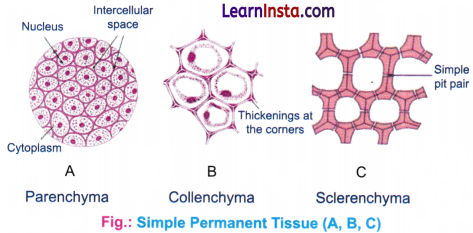
→ Collenchyma: A simple permanent tissue with living cells that have unevenly thickened comers (due to pectin). They provide flexibility to plants.
→ Cuticle: A waxy layer of cutin on the surface of the epidermis that reduces water loss and provides protection.
→ Differentiation: The process by which meristematic (dividing) cells change in structure and function to become specialised permanent tissue cells.
→ Epidermis: The outermost protective layer of a plant, made of a single layer of tightly packed flat cells.
→ Epithelial tissue: An animal tissue that covers the body surface and lines internal organs, providing protection, secretion and absorption.
→ Fixed joint: A joint that does not allow any movement (e.g., joints between the bones of the skull).
→ Hinge joint: A joint that allows movement in one direction only, like a door hinge.

→ Intercalary meristem: Meristematic tissue at the base of intemodes or above nodes, responsible for regrowth after cutting e.g. grasses.
→ Lateral meristem: Meristematic tissue along the sides of stems, responsible for growth in girth in plants.
→ Ligament: A band of connective tissue that connects bone to bone at a joint and limits excessive movement.
→ Meristematic tissue: A plant tissue made up of actively dividing cells, responsible for growth.
→ Muscular tissue: An animal tissue made of specialised contractile cells (muscle fibres) that are responsible for movement.
→ Nervous tissue: An animal tissue made of neurons that receive, process and transmit signals for control and coordination.
→ Neuron: A nerve cell consisting of a cell body, dendrites (receive signals) and an axon (transmits signals).
→ Parenchyma: A simple permanent tissue with thin-walled living cells that stores food and may also perform photosynthesis in plants.
→ Permanent tissue: A plant tissue formed by differentiation of meristematic tissue; its cells have lost the ability to divide.
→ Phloem: A complex permanent tissue that transports food from leaves to other parts of the plant.
→ Pivot joint: A joint that allows rotational side- to-side movement (e.g., the joint between the skull and the backbone).
→ Sclerenchyma: A simple permanent tissue with thick lignified walls and mostly dead cells, providing strength and hardness to plants.
Introduction
- A living organism is formed when a single cell divides itself several times to give rise to a large number of cells. These cells gradually form the skin, muscles, bones, nerves and all other organs.
- A tissue is a group of cells (similar in structure) that work together to perform a specific function.
- In multicellular organisms, there is a hierarchy of organisation. Cells of similar type performing similar functions are grouped together to form a tissue, more than one type of tissues form organs, different organs form organ systems and organ systems form an organism.
Cells → Tissues → Organs → Organ systems → Organism. - The formation of different types of tissues leads to the division of labour, which increases the efficiency of the body.
- In unicellular organisms such as Amoeba, a single cell performs all functions of life.
Why are Plant and Animal Tissues Different?
- Most plants are fixed at one place. Plant cells have a cell wall that provides rigidity and strength. Animal cells lack a rigid cell wall, so they can change shape easily. This cellular flexibility helps their bodies to become suitable for locomotion.
- Plants and animals differ in their mode of nutrition. Plants synthesise food by photosynthesis; animals have tissues that help digest food obtained from different sources.
- Plants and animals have distinct tissues for transporting food and water to different parts of the body.
- Growth patterns in plants and animals vary because the tissues responsible for growth differ in structure and function.
Tissues for Growth in Plants
- Plants grow in three ways: increase in length, increase in girth (thickness), and regrowth after cutting or grazing.
- Growth requires actively dividing cells that form a tissue called meristematic tissue.
- Meristematic cells are small, have thin cell walls, a large prominent nucleus, dense cytoplasm and generally lack vacuoles. They are tightly packed with little or no intercellular space.
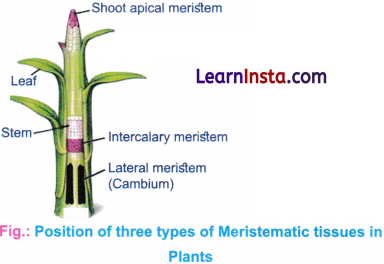
→ Apical Meristem – How do Plants Grow in Length?
Apical meristem is present at the tips of roots and shoots. It helps the plant to grow in length.
→ Lateral Meristem-How do Plants Grow in Girth?
Lateral meristem is present as a ring along the stem. Its cells divide to produce new cells on both sides, leading to an increase in girth. Annual rings in a tree trunk are formed by the activity of the lateral meristem.
→ Intercalary Meristem-How do Plants Grow after Being Cut?
- A node is the point where leaves, branches, or flowers arise, while the intemode is the stretch of stem connecting them.
The internode is the part of the stem between two successive nodes. - Intercalary meristem is located at the base of intemodes or above the nodes. It helps plants like grasses regrow after being cut or grazed.
- Differentiation is the process by which meristematic cells lose the ability to divide and become permanent tissues which are specialised to perform specific functions.
Permanent tissues
Permanent tissues can be simple (one type of cell) or complex (more than one type of cell).
(i) Protective tissue – Epidermis
- Epidermis is the outermost protective layer of the plant. It is a single layer of tightly packed, flat and rectangular cells covered by a waxy cuticle.
- In roots, epidermal projections called root hairs increase the surface area for absorption of water and minerals.
- In leaves and stems, tiny pores called stomata help in gaseous exchange of carbon dioxide and oxygen and transpiration (evaporation of water vapour).
(ii) Supporting tissue – Simple permanent tissues
- Parenchyma are living cells with thin walls and intercellular spaces. These cells store food and also perform photosynthesis in green parts (Chlorenchyma). In aquatic plants, parenchyma forms air spaces to help the plant float (Aerenchyma).
- Collenchyma are living cells with unevenly thickened comers due to pectin. These cells provide support and flexibility, allowing stems and tendrils to bend without breaking.
Sclerenchyma are mostly dead cells with thick walls due to deposition of lignin. These cells provide hardness and strength and are found in stems, leaf veins, coconut husk and walnut shell.
(iii) Conducting tissues – Complex permanent tissues
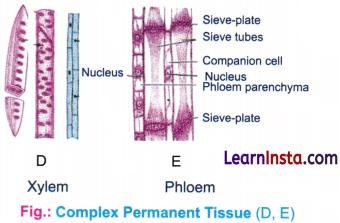
- Xylem consists of tracheids, vessels, xylem parenchyma and xylem fibres. Xylem parenchyma is the only living component of xylem. Xylem transports water and minerals from roots to other parts of the plant. It also provides mechanical support.
- Phloem consists of sieve tubes, companion cells, phloem parenchyma and phloem fibres. Phloem transports food from leaves to other parts of the plant. Sieve tubes, companion cells, phloem parenchyma are living cells.
- Sieve tubes are long, tubular cells joined end to end by perforated walls that transport food.
- Companion cells are specialised parenchyma cells that regulate the function of sieve tubes by loading and unloading of sugars.
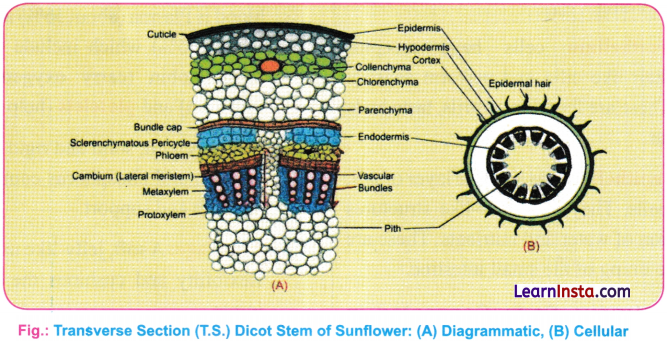
→ Plant tissues are organised into three tissue systems
- Dermal tissue system forms the outer covering (epidermis). It protects inner parts and reduces water loss.
- Ground tissue system forms the main body between dermal and conducting tissues. It includes parenchyma, collenchyma and sclerenchyma.
- Vascular tissue system consists of xylem and phloem. It is a conducting tissue.
Animal Tissues
Animal tissues are of four main types: Epithelial, Connective, Muscular and Nervous.
→ Epithelial Tissues — Structure and Functions
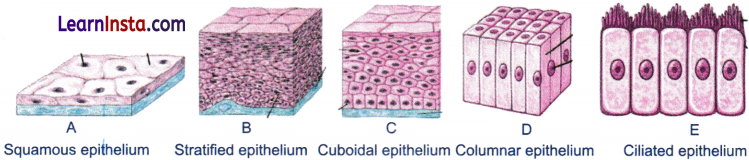
- Epithelial tissue forms the outer covering of the body (skin) and lines internal organs such as the mouth, lungs, blood vessels and intestine. It is composed of closely packed cells with very little space between them. This structure prevents the entry of germs, reduces water loss and helps in absorption, secretion and movement of substances.
- Different types of epithelial tissues are:
- Squamous epithelium is a single layer of thin, flat cells which helps in rapid diffusion of liquids and gases. It is found in the lining of blood vessels and lungs.
- Stratified epithelium has many layers of cells. Outer cells are flat and tightly packed. It protects against mechanical injury, friction and microbes and is found in skin, mouth and oesophagus.
- Glandular epithelium cells are specialised for producing and releasing substances such as mucus, enzymes, hormones, sweat and saliva. These are found in salivary glands, sweat glands and stomach lining.
- Ciliated epithelium cells have receptor cells with hair-like cilia and perform sensory functions. These are found in nostrils, taste buds and inner ear.
- Columnar epithelium has a single layer of tall, pillar-like cells. They have hair-like structures for absorption of water and nutrients. These are found in the lining of the small intestine.
→ How are Various Parts Connected in Our Body?
Connective Tissue connects and supports other tissues. Two main types of connective tissues are blood and bones, but they differ in composition and consistency. Other types of connective tissues are cartilage, tendons and ligaments.
- Blood is a fluid connective tissue. Its matrix is watery, soft and jelly-like. Composition of blood is Plasma (about 55%) and its components (about 45%) which include RBCs containing haemoglobin (carry oxygen), WBCs (fight infection) and platelets (help in clotting).
- Bone: A hard, solid and rigid matrix containing calcium and phosphorus compounds that gives strength and support.
- Cartilage: A soft, jelly-like matrix that provides flexibility and cushions the ends of bones at joints.
- Tendons connect muscles to bones and bring about movement.
- Ligaments connect bone to bone, provide stability and help prevent dislocation at a joint.
→ Can We Control Movement in our Body?
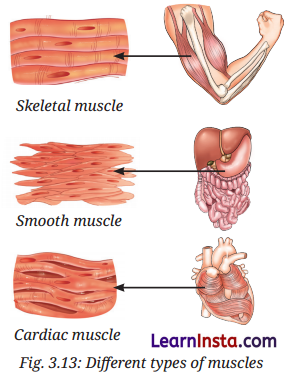
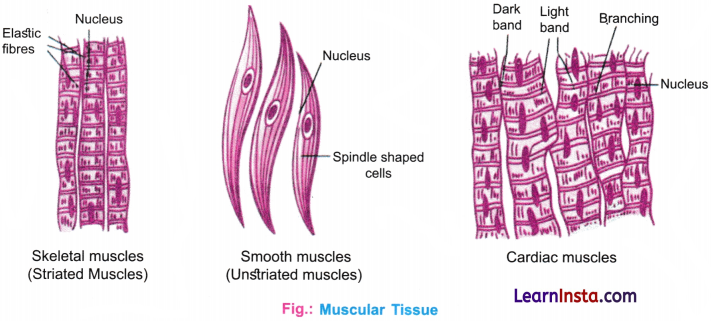
Muscular Tissue is made up of bundles of long cylindrical cells called muscle fibres. This tissue controls our movements. Muscles are of three types.
- Skeletal muscles (Striated Muscles) show voluntary movements and have long, cylindrical, unbranched, multinucleate cells with striations (showing light and dark bands). These are attached to the skeleton. They help in running, writing or lifting of objects.
- Smooth muscles (Unstriated muscles) show involuntary movements and have spindle-shaped cells with a single nucleus and no striations. These are found in the stomach and intestines. They produce slow, continuous movements like digestion.
- Cardiac muscles show involuntary movements and have cylindrical and branched cells with a single nucleus and faint striations. These are found only in the heart. Cardiac muscles work tirelessly and rhythmically throughout life without fatigue.
→ How does the Body Sense, Communicate and Respond?
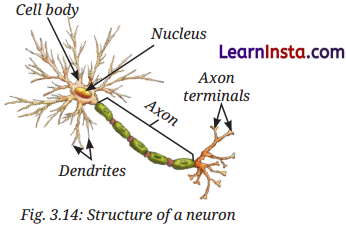
Nervous Tissue forms the body’s control and coordination network. The brain acts as the control centre. The cells of nervous tissue are called neurons (or nerve cells). Each neuron has a cell body with a nucleus, dendrites that receive signals from other neurons, and an axon that carries messages and ends at axon terminals.
The Musculoskeletal System
The Musculoskeletal System in Action:
- The musculoskeletal system is made up of bones, muscles, joints, cartilage, tendons and ligaments. It helps us stand upright, move, maintain posture and protect delicate organs.
- Muscles exert a pull on bones through tendons to produce movement at a joint, under the control of the nervous system.
- On an average, adult males have about 40 – 50% muscles and adult females have about 30 – 40% muscles.
- The adult human skeleton makes up about 12 to 15 per cent of body weight.
Types of Joints
Some parts of our body can move easily in many directions, while others move only in a single direction. It is due to the types of joints present. A joint is a junction between two or more bones. Joints allow movement but they cannot move the bones on their own. Different types of joints are:
- Ball and Socket Joint: Ball and socket joint allows movement in all directions (e.g., shoulder and hip).
- Hinge Joint: Hinge joint allows movement in one direction only, like a door hinge (e.g., elbow and knee).
- Pivot Joint: Pivot joint allows side-to-side rotational movement (e.g., the joint between the skull and the backbone).
- Fixed Joints: Fixed joint: Does not allow any movement (e.g., joints between bones of the skull).
- Stem cells in the bone marrow are special cells that can divide and make new cells. In a bone marrow transplant, stem cells from a healthy person are given to patients who have blood cancers like Leukemia or disorders, such as Thalassemia.
Skeletal System
- Skeletal System is a framework of bones that provides strength and protects delicate internal organs. It includes the skull, vertebral column and rib cage.
- Vertebral column (backbone/spine) is made of small bones called vertebrae with a cartilage disc between each vertebra that cushions the spine and allows flexibility.
- Rib cage has 12 pairs of ribs attached to the vertebral column (spine) at the back and the breast bone (sternum) in front, joined by flexible cartilage. It protects the heart and lungs, and allows the chest to expand and contract during breathing.
- Maintaining correct posture, proper nutrition, regular exercise and yoga keep our bones strong, muscles fit, joints flexible, and protects the body from stiffness.