Students often prefer our concise Class 7 English Poorvi Worksheet and Class 7 English Chapter 3 Three Days to See Worksheet with Answers Pdf for quick practice.
Class 7 English Chapter 3 Three Days to See Worksheet with Answers
Class 7 English Three Days to See Worksheet
Class 7 English Chapter 3 Worksheet – Class 7 Three Days to See Worksheet
Multiple Choice Questions (MCQs)
Question 1.
What sense does the author mainly rely on to perceive the world?
(a) Sight
(b) Hearing
(C) Touch
(d) Smell
Question 2.
What does the author feel when touching the bark of a pine tree?
(a) Smoothness
(b) Rough, shaggy texture
(c) Delicate symmetry
(d) Happy quiver
Question 3.
How does the author recognise laughter and sorrow in their friends?
(a) By observing facial expressions
(b) Through their voices
(c) By feeling their faces with fingertips
(d) By looking into their eyes
Question 4.
What activity does the author associate with the second day?
(a) Meeting friends
(b) Watching the dawn and exploring museums
(c) Observing the city streets
(d) Feeling the bark of trees
Question 5.
Where does the author plan to see “the pageant of man’s progress”?
(a) At a park
(b) At the museums
(c) In the city streets
(d) In the countryside
Assertion and Reason Questions
There are two statements, Assertion (A) and Reason (R) given below. Mark your answer according to the code given below.
Question 1.
Assertion (A): The narrator considers sight the most delightful of all senses.
Reason (R) : The narrator finds immense pleasure in touch, but believes
sight reveals greater beauty.
(a) Both (A) and (R) are true, and (R) is the correct explanation of (A).
(b) Both (A) and (R) are true, but (R) is not the correct explanation of (A).
(c) (A) is true, but (R) is false.
(d) (A) is false, but (R) is true.
Question 2.
Assertion (A): The authorfeels emotions such as happiness and compassion while observing people’s daily lives.
Reason (R): The author believes that understanding daily lives provides new revelations of beauty.
(a) Both (A) and (R) are true, and (R) is the correct explanation of (A).
(b) Both (A) and (R) are true, but (R) is not the correct explanation of (A).
(c) (A) is true, but (R) is false.
(d) (A) is false, but (R) is true.

Fill in the blanks with the words given in the box below
| Kindness, Pageant, leaf, blind, bud |
1. I feel the delicate symmetry of a ____________
2. In spring, I touch the branches of trees hopefully in search of a ____________
3. On the first day, I should want to see the people whose ____________ and ____________ companionship have made my life worth living.
4. On the second day, I should devote time to see the ____________ of man’s progress in museums.
5. Use your eyes as if tomorrow you would be stricken ____________.
State whether the following statements are True or False
1. Keller could see colours in her imagination.
2. She prioritised material wealth over relationships.
3. The third day was dedicated to exploring forests.
4. Keller believed touch could reveal emotions.
5. She considered sight the “most delightful” sense.
Let us Listen
I. Scan the QR code and listen to the transcript. Answer the following questions as you listen by choosing the correct options.
Question 1.
What happened to Mira after the fever?
(a) She forgot how to walk
(b) She lost her hearing and speech
(c) She moved to another village
(d) She became a teacher
Question 2.
Who helped Mira learn again?
(a) Her father
(b) A doctor
(c) Miss Anaya
(d) Her friend
Question 3.
What word did Mira learn while feeling water?
(a) River
(b) Wet
(c) Rain
(d) Water
Question 4.
How did Mira learn to communicate?
(a) By singing
(b) Through books only
(c) Using signs and touch
(d) By shouting
II. Once, again, scan the QR code and listen to the transcript. Answer the following questions as you listen and fill in the blanks with the words from the transcript.
1. Mira lost her ____________ and ability to speak after a high fever.
2. Miss ____________ was the kind teacher who helped Mira.
3. Mira learned her first word while feeling ____________ in her hand.
4. Mira used signs and ____________ to understand words.
5. Mira grew up to write beautiful ____________ and help others.
Let us Speak
Activity: “Describe It Blindfolded”
Instructions:
- Pair Up: Students work in pairs (Partner A and Partner B).
- Blindfold: Partner A wears a blindfold or closes their eyes.
- Sensory Challenge: Partner B places a mystery object (e.g., a pinecone, velvet cloth, citrus fruit) in Partner A’s hands.
- Describe & Guess:
- Partner A describes the object’s texture, weight, and smell without naming it.
- Partner B listens and guesses the object.
- Reflect: Swap roles and discuss:
- How did touch/smell help “see” the object?
- What was challenging? What surprised you?
- Example Dialogue:
- Partner A (blindfolded): “It’s rough, with sharp edges like tiny stairs. Smells earthy, like rain.”
- Partner B: “Is it… a pinecone?”
- Dialogue:
Answer:
____________________________________
____________________________________
____________________________________
____________________________________
____________________________________
Let us Write
Question 1.
Imagine you are Helen Keller on the evening of her third imagined day of sight. Write a 50-word diary entry describing your emotions. Use sensory details (touch, sound) to express both joy and sadness.
Answer:
____________________________________
____________________________________
____________________________________
____________________________________
____________________________________
Let us imagine
Brainstorm Time
I’m rough as a bear, yet stand tall like a man.
I lose my coat when the weather turns cold,
But my arms stretch wide with stories untold.
What am I?
Answer:
A tree
Now, create your own riddle and ask your classmates.
Answer:
____________________________________
____________________________________
____________________________________
____________________________________
____________________________________
Let us Understand
Question 1.
Find and Categorise:
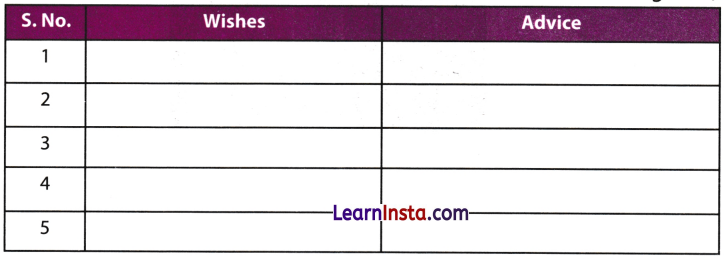
- Students scan the text for sentences with modal verbs (e.g., “I should want to see the people”).
- Sort them into two columns: Wishes (unreal) vs. Advice (moral obligation).
2. Rewrite:
- Change 3 “wish”sentences to advice (e.g., “You should cherish your loved ones’faces”).
Example from Text: - Wish: “I should behold with awe the magnificent panorama of light.”
- Advice:”You should behold the sunrise with awe every morning.”
(a) Wish : ____________________________________
Advice: ____________________________________
(b) Wish: ____________________________________
Advice: ____________________________________
I. Look at the picture given. Identify the picture and write a short paragraph.

Read the following passages and answer the questions that follow:
I. “I, who cannot see, find hundreds of things to interest me through mere touch. I feel the delicate symmetry of a leaf. I pass my hands lovingly about the smooth skin of a silver birch, or the rough, shaggy bark of a pine. In spring, I touch the branches of trees hopefully in search of a bud, the first sign of awakening Nature after her winter’s sleep.”
1. What does “delicate symmetry of a leaf” refer to?
(a) Its color
(b) Its evenness and balanced shape
(c Its smell
(d) Its size
2. The phrase “awakening Nature after her winter’s sleep” refers to the arrival of ____________
3. The author prefers the rough bark of a pine over the smooth skin of a birch. (True or False)
4. How does the author experience nature despite being blind?
Answer:
____________________________________
5. What does the author search for in spring?
Answer:
____________________________________
II. “The next day I should arise with the dawn and see the thrilling miracle by which night is transformed into day. I should behold with awe the magnificent panorama of light with which the sun awakens the sleeping earth.”
1. Why does the author call the sunrise a “thrilling miracle”?
(a) Because it is rare
(b) Because it symbolises hope and renewal
(c) Because it is scientifically unexplained
(d) Because it is loud
2. The sun awakens the ____________ earth.
3. The author takes the sunrise for granted. (True or False)
4. What does the author want to witness at dawn?
Answer:
____________________________________
5. How does the author describe the sun’s light?
Answer:
____________________________________
Very Short Answer Type Questions
Question 1.
What does the narrator find interesting through touch?
Answer:
____________________________________
Question 2.
Which sense does the narrator consider the most delightful?
Answer:
____________________________________
Question 3.
How does the narrator recognise friends?
Answer:
____________________________________
Question 4.
What does the narrator search for on tree branches in spring?
Answer:
____________________________________
Question 5.
What emotion does Keller associate with a bird’s song?
Answer:
____________________________________
Short Answer Type Questions
Question 1.
Why did Keller value sight so deeply?
Answer:
____________________________________
Question 2.
How does Keller’s advice apply to daily life?
Answer:
____________________________________
Question 3.
What does the narrator wish to see on the second day if given sight?
Answer:
____________________________________
Question 4.
Why does the narrator long to see things if they already find joy in touch?
Answer:
____________________________________
Question 5.
What lesson does the narrator offer to people with sight and other senses?
Answer:
____________________________________
Long Answer Type Questions
Question 1.
Discuss the importance of the narrator’s imagined experience of sight in fostering emotional connections.
Answer:
____________________________________
Question 2.
What does the narrator’s perspective teach us about the importance of appreciating life?
Answer:
____________________________________