Students rely on Class 9 Science Extra Questions and Class 9th Exploration Chapter 11 Extra Question Answer Reproduction How Life Continues Class to improve their grades.
Class 9 Science Chapter 11 Reproduction How Life Continues Extra Questions
Class 9 Science Chapter 11 Extra Questions on Reproduction How Life Continues
Reproduction How Life Continues Class 9 Very Short Question Answer
Question 1.
What is vegetative propagation?
Answer:
A type of asexual reproduction in plants in which new plants grow from vegetative parts such as stems, roots, or leaves.
Question 2.
Name the type of asexual reproduction seen in yeast.
Answer:
Budding.
Question 3.
What type of cell division is involved in asexual reproduction?
Answer:
Mitosis.
Question 4.
Give one example of a plant that reproduces through its leaves.
Answer:
Bryophyllum.
Question 5.
What is a clone?
Answer:
An organism that is genetically identical to its parent, produced by asexual reproduction.

Question 6.
What is pollination?
Answer:
The transfer of pollen grains from the anther to the stigma of a flower.
Question 7.
Name the three parts of the pistil.
Answer:
Stigma, style, and ovary.
Question 8.
What is a zygote?
Answer:
The cell formed by the fusion of a male gamete and a female gamete during fertilisation.
Question 9.
How many chromosomes are present in a human gamete?
Answer:
23 chromosomes.
Question 10.
What does the ovule develop into after fertilisation?
Answer:
Seed.
Question 11.
What is external fertilisation?
Answer:
The fusion of gametes that takes place outside the female body, usually in water is called external fertilisation as is seen in frogs and most fish.
Question 12.
Where does internal fertilisation occur?
Answer:
Inside the body of the female.
Question 13.
Name one animal that passes through a larva stage.
Answer:
Butterfly (or frog).
Question 14.
What is the function of yolk in an egg?
Answer:
Yolk contains nutrients that nourish the developing embryo.
Question 15.
Name two groups of animals that show internal fertilisation.
Answer:
Reptiles and birds (mammals also show internal fertilisation).
Question 16.
What is ovulation?
Answer:
Ovulation is the release of a mature egg from an ovary, usually once a month.
Question 17.
Name the organ in which the foetus develops.
Answer:
Uterus.
Question 18.
What is menstruation?
Answer:
The shedding of the thickened uterine lining along with blood through the vagina, which happens when the egg is not fertilised.
Question 19.
How long does a human pregnancy usually last?
Answer:
About nine months.
Question 20.
Name one contraceptive method that also prevents STIs.
Answer:
Condom.
Reproduction How Life Continues Class 9 Short Question Answer
Question 1.
Differentiate between budding and spore formation.
Answer:
- In budding, a small outgrowth (bud) develops on the parent body, grows, and then separates to live as a new individual. It is seen in yeast and Hydra.
- In spore formation, organisms like fungi, mosses and ferns produce millions of tiny spores inside a sac-like structure. Each spore can germinate into a new individual when it lands on a suitable surface with moisture.
Question 2.
How has tissue culture helped farmers?
Answer:
- Tissue culture allows mass production of genetically identical, disease-free plantlets from a small piece of plant tissue, usually the shoot tip.
- It has revolutionised farming of crops like banana by providing virus-free plants that give high yields within a short time.
Question 3.
Why are moulds common on stale bread kept in a warm, damp place?
Answer:
- Mould spores are always present in the air.
- When bread is warm and moist, these spores settle on it, germinate rapidly, and grow into thread-like hyphae. Within a few days, mould colonies produce more spores and multiply.
This is why we store bread in cool, dry places or in refrigerators.
Question 4.
Distinguish between self-pollination and cross-pollination.
Answer:
- Self-pollination is the transfer of pollen from the anther to the stigma of the same flower or another flower on the same plant.
- Cross-pollination is the transfer of pollen from a flower of one plant to the stigma of a flower on another plant of the same species.
- Cross-pollination leads to greater genetic variations in the offspring.
Question 5.
How do insect-pollinated flowers attract pollinators?
Answer:
- Insect-pollinated flowers are usually brightly coloured, produce sweet nectar, and have a fragrance.
- Their pollen grains are large, sticky, or spiny so they cling to the insect’s body easily.
- The stigma is also sticky to catch the pollen carried by insects.
Question 6.
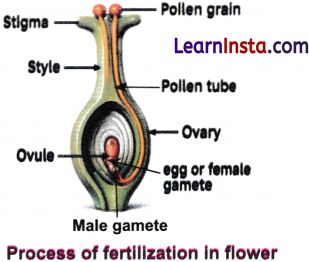
Describe the process of fertilisation in flowering plants.
Answer:
- After pollination, the pollen grain produces a pollen tube that grows through the style into the ovary.
- The male gamete travels through this tube and fuses with the egg cell inside the ovule.
- This fusion of gametes is called fertilisation and forms a zygote, which later develops into an embryo within the seed.
Question 7.
Why do organisms with external fertilisation produce a large number of eggs?
Answer:
- In external fertilisation, eggs and sperms are released into water. Many eggs are destroyed by currents, eaten by predators, or never meet sperms.
- By producing thousands of eggs, the species makes sure that at least some eggs fertilise, hatch, and grow into adults.
Question 8.
Give two differences between internal and external fertilisation.
Answer:
(You can give any two of the following differences).
| Internal fertilisation | External fertilisation |
| 1. It takes place inside the female body. | 1. It takes place outside the female body. |
| 2. The male animal puts its sperms into the female animal’s body. | 2. The eggs and sperms are released in water. |
| 3. The sperm then fertilises the eggs to form zygote inside the body of female parent. | 3. The sperms which lie near the egg will fertilise it and form zygote in the water. |
| 4. Less number of eggs are formed. In human beings one egg is formed from an ovary in a month. A hen also lays one egg at a time. | 4. Hundreds of eggs are laid which are surrounded by jelly like material which protects the eggs. |
| 5. Sperms are formed in very large number. Many sperms try to enter the body of female. When egg and sperm come close together, fertilisation occurs. | 5. Millions of sperms are laid near the eggs and they swim randomly in water with the help of their tail. The sperms come in contact with egg and result in fertilisation. |
| 6. It is common in man, cat, dog, horse, hen, etc. | 6. It is common in aquatic animals like fish, starfish, amphibians (frog) etc. |
Question 9.
Why do mammals produce fewer young ones at a time than fish?
Answer:
- Mammals develop their young inside the mother’s body, where each embryo is well protected and receives nutrition directly from the mother. Because survival is high and each baby requires a large amount of nutrition and care, mammals produce only a few young ones at a time.
- Fish, on the other hand, face high egg mortality in water and so it compensates by producing thousands of eggs.
Question 10.
What are STIs? How can they be prevented?
Answer:
Sexually Transmitted Infections (STIs) spread from one person to another through sexual contact. Examples are gonorrhoea, syphilis, herpes, genital warts, and HIV/AIDS.
They can be prevented by using condoms, which act as a physical barrier. Regular medical check-ups and avoiding high-risk behaviour also help.
Question 11.
Why does the uterine lining thicken every month?
Answer:
- The uterine lining thickens and becomes rich in blood vessels to prepare the uterus for receiving and nourishing a fertilised egg.
- If fertilisation does not occur, this lining is no longer needed and is shed during menstruation.
Question 12.
How can prenatal sex determination harm society?
Answer:
- The practice of self-selective abortion, usually driven by a preference for male children, leads to fewer girls being bom.
- Over time, this creates a serious imbalance in the sex ratio of the population.
- To prevent this, prenatal sex determination is strictly prohibited by law in India.
Reproduction How Life Continues Class 9 Long Question Answer
Question 1.
Describe the main methods of vegetative propagation used in agriculture.
Answer:
The main methods of vegetative propagation used in agriculture are:
(a) Cutting:
A healthy stem piece with 3 to 4 nodes is cut from a parent plant and planted in moist soil at an angle of 45 to 60 degrees. With regular watering, roots develop from the buried nodes and a new plant grows.
Example: sugarcane, money plant.
(b) Grafting:
A stem piece (scion) from a desired variety is joined to the rooted stem (stock) of another plant. A slit is made on the stock and the scion is inserted into it. The graft is wrapped with cloth or film to protect it. After healing, the scion grows using the strong root system of the stock.
Example: rose varieties.
(c) Layering:
A flexible twig is bent and its middle part is buried in soil. After 10 to 15 days, roots develop from the buried part, and the twig is cut from the parent plant.
Example: lemon, jasmine.
(d) Tissue culture:
Plant cells from the shoot tip (apical meristem) are grown on artificial nutrient media under sterile conditions. This produces thousands of genetically identical, disease-free plantlets in a short time. It is widely used in banana farming.
Question 2.
Explain the structure and function of the different parts of a flower.
Answer:
A complete flower has four main parts arranged in whorls, from outside to inside.
(a) Sepals:
The outermost green covering that protects the flower while it is in the bud stage.
(b) Petals:
The coloured inner whorl. Bright colours attract pollinators such as insects and birds, which help in pollination.
(c) Stamen (male part):
Made up of a thin filament and a rounded anther. The anther produces pollen grains that contain the male gametes.
(d) Pistil (female part):
Ovary is made up of three parts: stigma (receives pollen), style (thin tube connecting stigma to ovary). Ovary contains ovules with egg cells. After fertilisation, the ovary becomes the fruit and each ovule becomes a seed.
Question 3.
Describe the different sexual reproductive methods seen across animal groups.
Answer:
(a) Fish, amphibians, and insects:
They produce several hundred to several thousand eggs at a time.
- Each egg contains a small amount of yolk, enough only to produce a larva.
- The larva hatches early and gets further nutrition by feeding on organic matter.
- Once it has grown enough, it transforms into the adult form, as in butterflies and frogs.
(b) Reptiles and birds:
They lay fewer eggs, but each egg contains enough yolk to nourish the embryo until it hatches as a young one that can move on its own.
(c) Mammals:
- The zygote grows and develops inside the female body, where it is well protected and well fed through the mother’s body.
- After birth, the young ones are fed with breast milk and cared for until they can live on their own.
- In some mammals (like lambs or foals), the young can walk soon after birth, while in others (like humans), they stay completely dependent for several years.
Question 4.
Describe the human menstrual cycle in detail.
Answer:
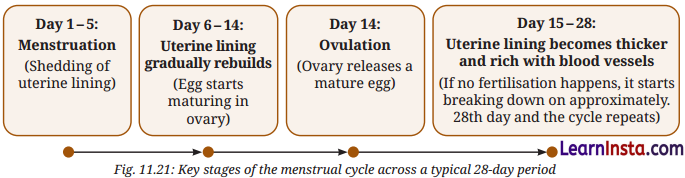
The menstrual cycle is a monthly cycle of changes in the female reproductive system, typically lasting 21 to 35 days (often about 28 days).
(i) Days 1 to 5 (Menstruation):
The thickened uterine lining is shed along with some blood through the vagina. This lasts 3 to 7 days.
(ii) Days 6 to 14 (Rebuilding):
The uterine lining gradually rebuilds itself. At the same time, a new egg begins to mature inside an ovary.
(iii) Day 14 (Ovulation):
A mature egg is released from the ovary and travels into the oviduct. This is the time when pregnancy is most likely if fertilisation occurs.
(iv) Days 15 to 28 (Waiting phase):
The uterine lining becomes thick and rich in blood vessels, ready to receive a fertilised egg. If no fertilisation takes place, the lining begins to break down around day 28, and the cycle repeats.
Question 5.
Explain the different methods of contraception along with their advantages and limitations.
Answer:
(a) Barrier methods: Condoms and vaginal covers physically block sperms from reaching the egg.
Advantage: They also prevent STIs.
Limitation: They must be used correctly every time.
(b) Hormonal methods: Oral contraceptive pills alter hormones to stop the release of eggs.
Advantage: They are highly effective when taken regularly.
Limitation: They do not protect against STIs and may have side effects like nausea or weight change.
(c) Intra-Uterine Devices (IUDs): Devices like Copper-T are placed in the uterus to prevent pregnancy.
Advantage: They provide long-term protection.
Limitation: They may sometimes irritate the uterus.
(d) Surgical methods: Blocking the vas deferens in males or the fallopian tubes in females prevents sperms and egg from meeting.
Advantage: Almost permanent protection.
Limitation: The method is difficult or impossible to reverse.
Reproduction How Life Continues Class 9 Case Based Questions
I. A farmer noticed that his banana plants were getting infected by a virus, which reduced his yield every season. He contacted a Krishi Vigyan Kendra (KVK), where scientists suggested using tissue culture to produce healthy, virus-free banana plantlets from the shoot tip (apical meristem) of a healthy plant. Within a few months, the farmer received hundreds of identical, disease-free plantlets ready for planting.
Answer the following questions:
Question 1.
What type of reproduction is tissue culture an example of?
Answer:
Asexual reproduction (vegetative propagation).
Question 2.
Why are the plantlets produced by tissue culture genetically identical?
Answer:
Tissue culture involves only mitosis starting from a single parent plant. Since there is no mixing of genetic material from two parents, all plantlets are clones.
Question 3.
Why is the shoot tip (apical meristem) used for tissue culture?
Answer:
The shoot tip is generally free from viruses, so the plantlets produced from it are virus-free and healthy.
Question 4.
Name one advantage and one disadvantage of growing genetically identical crops.
Answer:
Advantage:
All the plants have the same desirable traits like high yield.
Disadvantage:
If there is an attack by disease causing organism, all plants are equally vulnerable because there is no variation to provide resistance.
II. Pooja is a 13-year-old girl who recently started experiencing her menstrual periods. She was initially worried, but her mother explained that menstruation is a sign of a healthy reproductive system and is completely normal. Her mother also taught her important hygiene practices, such as using clean sanitary products, changing them regularly, and washing hands before and after changing pads.
Answer the following questions:
Question 1.
What is menstruation?
Answer:
Menstruation is the shedding of the thickened inner lining of the uterus, along with some blood, through the vagina. It occurs when the egg released during ovulation is not fertilised.
Question 2.
At what age does menstruation usually begin in girls?
Answer:
Menstruation usually begins at puberty, between the ages of 10 and 14 years.
Question 3.
Why does the uterine lining thicken before menstruation?
Answer:
The lining thickens and becomes rich in blood vessels to prepare the uterus for receiving and nourishing a fertilised egg. If fertilisation does not take place, the lining is no longer needed and is shed.
Question 4.
Name two important hygiene practices to follow during menstruation.
Answer:
(a) Use clean menstrual products such as sanitary pads, and change them every 4 to 6 hours.
(b) Wash hands with soap and water before and after changing products.
III. In the lower Himalayan region, apple farmers noticed that their fruit yield was declining year after year. Scientists found that the population of natural pollinators like bees was decreasing due to climate change. To solve this, a group of researcher-farmers introduced bee colonies in some apple orchards and compared results with orchards that relied only on natural pollinators. The orchards with bee colonies showed a fruit set of about 40% (compared to 26% in natural orchards) and a much lower fruit drop of about 8 % (compared to 35 %).
Answer the following questions:
Question 1.
What type of pollination do apple flowers depend on?
Answer:
Cross-pollination by insects, mainly bees.
Question 2.
Why did the introduction of bee colonies improve the fruit yield?
Answer:
Bees are very efficient pollinators. With managed bee colonies, more flowers received pollen, leading to more successful pollination and fertilisation. This increased the fruit set and reduced fruit drop.
Question 3.
Why is the fruit drop percentage lower in orchards with bee colonies?
Answer:
Better pollination leads to successful fertilisation and healthier development of fruits. Poorly pollinated flowers often produce weak fruits that drop off before they can ripen.
Reproduction How Life Continues Extra Questions for Practice
Very Short Answer Type Questions
Question 1.
What is the function of the anther in a flower?
Question 2.
Name one organism that reproduces by spore formation.
Question 3.
Where does fertilisation normally take place in human females?
Question 4.
What is the function of the scrotum?
Question 5.
What does the term ‘diploid’mean?
Question 6.
Name one method of seed dispersal.
Question 7.
What is the cervix?
Question 8.
Name the structure where the foetus develops.
Question 9.
What is the full form of IVF?
Question 10.
Name two sexually transmitted infections.
Short Answer Type Questions
Question 1.
Explain why meiosis is necessary for sexual reproduction.
Question 2.
Give two differences between external and internal fertilisation.
Question 3.
How does cross-pollination lead to genetic variations?
Question 4.
Describe the role of hormones in the menstrual cycle.
Question 5.
What is the importance of breastfeeding for a newborn in humans?
Question 6.
Why is prenatal sex determination prohibited by law in India?
Question 7.
How do wind-pollinated flowers differ from insect-pollinated flowers?
Long Answer Type Questions
Question 1.
Draw a labelled diagram of a flower and explain the function of each part.
Question 2.
Describe the process of fertilisation and seed formation in flowering plants.
Question 3.
Explain the three stages of pregnancy in human beings.
Question 4.
Compare asexual and sexual reproduction, giving at least four differences.
Question 5.
Describe the male and female reproductive systems in humans with the help of labelled diagrams.
Question 6.
Explain different methods of contraception, their advantages, and their limitations.
Question 7.
Why are genetic variations important? How does sexual reproduction contribute to it?