Students rely on Class 9 Science Extra Questions and Class 9th Exploration Chapter 10 Extra Question Answer Sound Waves Characteristics and Applications to improve their grades.
Class 9 Science Chapter 10 Sound Waves Characteristics and Applications Extra Questions
Class 9 Science Chapter 10 Extra Questions on Sound Waves Characteristics and Applications
Sound Waves Characteristics and Applications Class 9 Very Short Question Answer
Question 1.
What is the audible range of sound for human beings?
Answer:
The audible range of sound for human beings is from 20 Hz to 20,000 Hz.
Question 2.
Which sound has a higher pitch, guitar or car horn?
Answer:
A guitar produces a higher pitch than a car horn.
Question 3.
The frequency of a source of sound is 100Hz. How many times does it vibrate in a minute?
Answer:
Frequency = 100 Hz (which means 100 vibrations per second)
Time = 1 minute = 60 seconds
Total vibrations = 100 × 60 = 6000
Question 4.
What do waves transport – matter or energy?
Answer:
Energy.

Question 5.
Distinguish between infrasound and ultrasound.
Answer:
- Infrasound refers to sound waves with frequencies below 20 Hz, which are inaudible to humans.
- Ultrasound refers to sound waves with frequencies above 20,000 Hz, which are also inaudible to humans.
Question 6.
Why are the ceilings of concert halls curved?
Answer:
The ceilings of concert halls are curved to uniformly reflect sound waves to all comers of the hall, ensuring that the sound reaches the entire audience effectively and clearly.
Question 7.
Explain why sound waves are called mechanical waves.
Answer:
Sound waves are called mechanical waves because they require a material medium (solid, liquid, or gas) to propagate.
Question 8.
Which characteristics of the sound help us to identify a person by his voice if he is sitting in a dark room?
Answer:
Timbre. The unique quality or texture of a sound that distinguishes it from others.
Question 9.
What is the reflection of sound? Give one application.
Answer:
Reflection of sound is the phenomenon where sound waves bounce off a surface when they encounter it. An application is in megaphones.
Sound Waves Characteristics and Applications Class 9 Short Question Answer
Question 1.
Differentiate between loudness and intensity of sound.
Answer:
- Loudness is the physiological sensation of sound, which depends on the intensity of the sound wave and the sensitivity of the ear.
- Intensity is a measurable physical quantity that describes the amount of sound energy passing through a unit area per unit time.
Question 2.
An echo is heard in 3 seconds. If the speed of sound in air is 340 m/s, what is the distance of the reflecting surface from the source?
Answer:
Given:
Time taken to hear echo (t) = 3 s,
Speed of sound (v) = 340 m/s.
For an echo, the sound travels to the reflecting surface and back.
So, total distance covered = 2d, where d is the distance of the reflecting surface.
Using the formula, distance = speed × time
⇒ 2d = v × t
⇒ 2d = 340 m/s × 3s
⇒ 2d = 1020 m
⇒ d = \(\frac{1020}{2}\) m
⇒ d = 510 m
Hence, the distance of the reflecting surface from the source is 510 m.
Question 3.
What is echo? Explain the conditions necessary for hearing a distinct echo.
Answer:
- Echo is the phenomenon of repetition of sound due to the reflection of sound waves from a distant obstacle.
- Condition necessary for hearing a distinct echo is the time gap between two sounds reaching to the listner at least 0.1 s.
Question 4.
A sound wave travels from air into water. What changes will you observe in its speed, wavelength, andfrequency? Explain your reasoning.
Answer:
When a sound wave travels from air into water, its speed increases significantly because water is denser and less compressible than air, allowing sound to travel faster. Consequently, its wavelength will also increase (since wavelength = speed/frequency, and speed increases while frequency remains constant).
The frequency of the sound wave, however, remains unchanged as it is determined by the source of the sound and does not depend on the medium through which it travels.
Question 5.
Why do we hear the sound of humming bees but not the vibrations of a pendulum?
Answer:
Humans can hear sounds only in the frequency range of 20 Hz to 20,000 Hz (audible range).
- The humming bee produces sound due to rapid wing vibrations, which fall within the audible range, so we can hear it.
- A pendulum vibrates very slowly (very low frequency, usually less than 20 Hz), which lies in the infrasonic range, so we cannot hear it.
Question 6.
If an explosion occurs at the bottom of a lake, what type of shock waves are produced in water?
Answer:
In water, the explosion produces longitudinal shock waves.
Reason:
Sound waves in liquids travel as longitudinal waves, where particles vibrate parallel to the direction of wave propagation, creating compressions and rarefactions.
Question 7.
The sound of thunder is heard 10 s after lightning. Find the distance of the cloud.
Answer:
Given:
Time = 10 s
Speed of sound = 340 m/s
Distance = Speed × Time
Distance = 340 × 10 = 3400 m
Hence, the thundercloud is approximately 3400 m (or 3.4 km) away.
Question 8.
The shortest wavelength of ultrasonic waves that a bat emits is 1.70 mm. What is the frequency of these waves? Speed of sound in air at room temperature is 340 ms-1.
Ans Here,
v = 340 m s-1,
λ = 1.70 mm = 1.70 x 10⁻³ m
Frequency, v = \(\frac{v}{\lambda}\)
= \(\frac{340}{1.70 \times 10^{-3}}\)
= 2 × 10⁵ Hz.
Question 9.
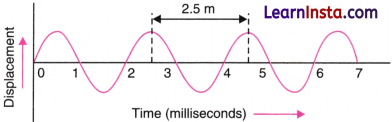
Find the velocity of the wave shown in Fig.
Answer:
Since the distance between two successive crests is λ, therefore λ = 2.5 m
Now a wave travels a distance equal to wavelength in one time period, therefore, time-period is
T = 4.5 – 2.5 = 2 ms
= 2 × 10⁻³ s
Velocity of wave, v = \(\frac{\lambda}{T}\)
= \(\frac{2.5}{2 \times 10^{-3}}\) = 1250 m/s.
Question 10.
A child hears an echo from a cliff 4 seconds after the sound from a powerful cracker is produced. How far away is the cliff from the child? Given that the speed of sound is 340 m/s.
Answer:
Time taken by sound to travel from child to cliff,
t = \(\frac{4}{2}\) = 2 s
Speed of sound in air, v = 340 m/s
Distance of cliff from the child = vt
= 340 × 2 = 680 m.
Sound Waves Characteristics and Applications Class 9 Long Question Answer
Question 1.
Define sound and explain how it is produced and propagated through a medium.
Answer:
Sound is a form of energy that produces the sensation of hearing. It is produced by vibrating objects. When an object vibrates, it sets the particles of the medium (like air) around it into vibration. These vibrating particles then transfer energy to adjacent particles, causing them to vibrate, and so on. This creates a disturbance that travels through the medium as a wave. Sound waves are longitudinal waves, meaning the particles of the medium vibrate parallel to the direction of wave propagation.
Question 2.
Give reasons for the following:
(a) The reverberation time of a hall used for speeches should be very short.
(b) A vibrating body produces sound. However no sound is heard when a simple pendulum oscillates in air.
(c) Sound waves are called mechanical waves.
Answer:
(a) If reverberation time is long, the reflected sound persists for a while and overlaps with the next spoken words. This causes echo and mixing of sounds, making speech unclear. A short reverberation time ensures that sound dies out quickly, so words remain clear and distinct, which is essential for speeches.
(b) Although a simple pendulum vibrates, its frequency is very low (less than 20 Hz). Human ears can hear only sounds in the range of 20 Hz to 20,000 Hz (audible range). So, the pendulum produces infrasonic vibrations, which are not audible, hence no sound is heard.
(c) Sound waves require a material medium (like air, water, or solids) to travel.They propagate through the vibrations of particles in the medium. Since they depend on the motion of particles, sound waves are classified as mechanical waves.
Question 3.
Two tuning forks A and B produce sounds of frequencies 256 Hz and 260 Hz. What phenomenon will occur when both are sounded together? Explain.
Answer:
The phenomenon observed is beats.
Beat frequency = |υ1 – υ2|
= |256 – 260| = 4 Hz
This means the sound will become loud and soft 4 times per second due to interference of waves.
Question 4.
Represent graphically two separate diagrams in each case,
(a) Two sound waves having same amplitude but different frequencies.
(b) Two sound waves with same frequency and different amplitudes.
(c) Two sound waves having different amplitudes and different wavelengths.
Answer:
(a) 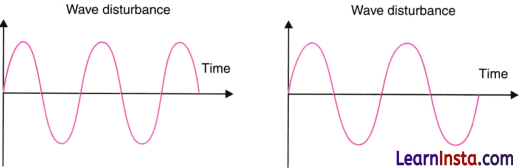
(b) 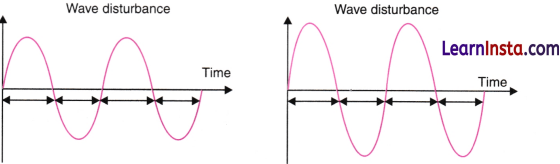
(c) 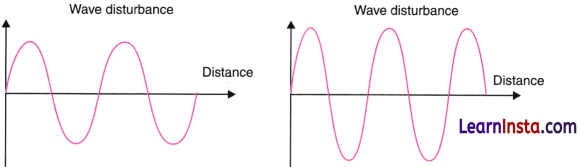
Sound Waves Characteristics and Applications Class 9 Case Based Questions
I. Ultrasound refers to sound waves with frequencies higher than the upper audible limit of human hearing, typically above 20,000 Hz. These high- frequency waves have several important applications in science, technology, and medicine. Because of their short wavelength, ultrasound waves can be focused into narrow beams and can travel over long distances without much loss of energy. This property makes them useful for imaging internal organs, detecting flaws in materials, and even for cleaning delicate objects.
Answer the following questions:
Question 1.
Name two medical applications of ultrasound.
Answer:
Two medical applications of ultrasound are: imaging internal organs (e.g., prenatal scans) and breaking kidney stones.
Question 2.
Explain why bats use ultrasound for navigation and hunting.
Answer:
Bats use ultrasound for navigation and hunting (echolocation) because ultrasound waves have a short wavelength and can be focused into narrow beams. This allows bats to detect small objects and create detailed ‘sound maps’ of their surroundings, even in complete darkness. The high frequency also means the waves reflect well off small prey.
II. Echoes are distinct reflections of sound waves heard after the original sound has died out. For a distinct echo to be heard, the minimum distance between the source of sound and the reflecting surface must be at least 17.2 meters (assuming the speed of sound in air is 344 m/s and the persistence of hearing is 0.1 seconds). Reverberation, on the other hand, is the persistence of sound in an enclosed space due to multiple reflections. Excessive reverberation can make speech unintelligible in large halls. Architects often use sound-absorbing materials like curtains, carpets, and acoustic panels to control reverberation in auditoriums and cinema halls.
Answer the following questions:
Question 1.
Explain the difference between an echo and reverberation.
Answer:
An echo is a distinct reflection of sound heard after the original sound has died out, requiring a minimum distance to the reflecting surface. Reverberation is the persistence of sound due to multiple reflections in an enclosed space, leading to a prolonged sound.
Question 2.
If the speed of sound in air is 340 m/s, what is the minimum time interval required between the original sound and the reflected sound for a distinct echo to be heard?
Answer:
The minimum time interval required between the original sound and the reflected sound for a distinct echo to be heard is 0.1 seconds (persistence of hearing).
Question 3.
A person claps their hands in front of a cliff and hears an echo 4 seconds later. If the speed of sound in air is 340 m/s, how far away is the cliff?
Answer:
The sound travels to the cliff and back in 4 seconds.
So, the time taken for the sound to reach 4 the cliff is \(\frac{4}{2}\) s = 2 s.
Distance = Speed × Time
= 340 m/s × 2 s = 680 m.
The cliff is 680 m away.
Sound Waves Characteristics and Applications Extra Questions for Practice
Very Short Answer Type Questions
Question 1.
If the velocity of sound in air is 340 m/s, calculate the frequency when wavelength is 0.85 m.
Question 2.
Define the term amplitude.
Question 3.
On which day, a hot day or a cold day, an echo is heard sooner. Why?
Question 4.
If the velocity of sound in air is 340 m/s, calculate the wavelength when frequency is 256 Hz.
Question 5.
Why do astronauts in space use radio communication instead of sound waves?
Short Answer Type Questions
Question 1.
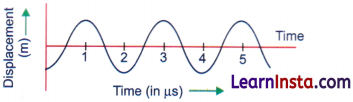
The given graph shows the displacement versus time relation for a disturbance travelling with velocity of 1500 ms-1. A Calculate the wavelength of the disturbance.
Question 2.
Three persons A, B and C are made to hear a sound travelling through different mediums as given below:
| Person | Medium |
| A | Aluminium rod |
| B | Air |
| C | Water |
Who will hear the sound first and why?
Question 3.
A radar signal is reflected by an aeroplane and is received 2 × 10⁻⁵ s after it was sent. If the speed of these waves is 3 × 10⁸ m/s, how far is the aeroplane?
Question 4.
Explain how amplitude affects the loudness of sound.
Long Answer Type Questions
Question 1.
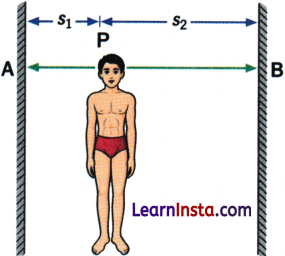
A person standing between two vertical cliffs and 640 m away from the nearest cliff shouted. He heard the first echo after 4 seconds and the second echo 3 seconds later. Calculate
(i) the velocity of sound in air, and
(ii) the distance between the cliffs.
Question 2.
In a ripple tank, 12 full ripples are produced in one second. If the distance between a crest and next trough is 10 cm, find
(a) wavelength,
(b) frequency and
(c) velocity of the wave.
Question 3.
The following graph shows the displacement versus time relation for disturbance travelling with a velocity of 1500 m/s.
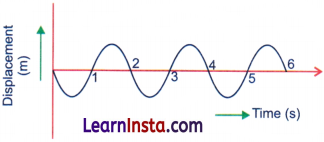
(a) Calculate the wavelength of the disturbance.
(b) Find its time period.
(c) The given sound is audible to the human ear. State true/false and justify.
Question 4.
Draw a curve showing density or pressure variations with respect to distance for a disturbance produced by sound. Mark the position of compression and rarefaction on this curve. Also define wavelengths and time period using this curve.
Question 5.
Establish the relationship between speed of sound, its wavelength and frequency. If velocity of sound in air is 340 m s-1, calculate
(i) wavelength when frequency is 256 Hz.
(ii) frequency when wavelength is 0.85 m.
Question 6.
Represent graphically by two separate diagrams in each case
(i) Two sound waves having the same amplitude but different frequencies?
(ii) Two sound waves having the same frequency but different amplitudes.
(iii) Two sound waves having different amplitudes and also different wavelengths.
Case/Source Based Questions
I. Sound waves are longitudinal waves, meaning the particles of the medium vibrate parallel to the direction of wave propagation. They are characterized by their amplitude, frequency, wavelength, and speed. Amplitude is related to the loudness or intensity of the sound; a larger amplitude means a louder sound. Frequency determines the pitch of the sound; higher frequency means higher pitch. Wavelength is the distance between two consecutive compressions or rarefactions. The speed of sound is constant for a given medium under specific conditions. The quality or timbre of a sound is determined by the mixture of different frequencies (overtones) present in the sound, which allows us to distinguish between different musical instruments even if they play the same note at the same loudness.
Question (a)
What type of wave is a sound wave and why?
Question (b)
How are loudness and pitch of a sound related to its wave characteristics?
Question (c)
Two sounds have the same loudness and pitch, but one is produced by a guitar and the other by a piano. How can you distinguish between them?
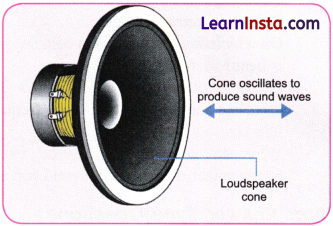
II. The given figure shows a loudspeaker cone vibrating to produce sound waves. Vibration means a kind of rapid to and fro motion of an object. As the sound wave passes a point, it produces regions of higher and lower pressure. These regions created in the air, make the sound wave that propagates through the medium.
Question (i)
State the names of the regions formed in the above process.
Question (ii)
Describe how the movement of the loudspeaker cone produces these regions of different pressure.
Question (iii)
State the effect on the loudness and pitch of the sound from the loudspeaker when
(a) the amplitude increases but the frequency of the sound stays the same,
(b) the amplitude stays the same but the frequency increases.