Students can use Kaveri Book Class 9 Solutions and Class 9 English Book Kaveri Chapter 7 Question Answer Carrier of Words as a quick reference guide.
Carrier of Words Class 9 Question Answer
Class 9 English Kaveri Chapter 7 Question Answer
Kaveri Book Class 9 Chapter 7 Carrier of Words Question Answer
Reflect and Respond (NCERTPage 203)
I. Look at the pictures given below of persons engaged in the same profession.
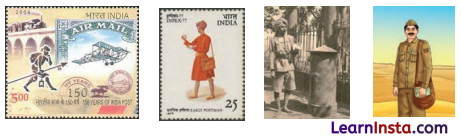
Discuss in pairs and share your answers with your classmates and teacher.
Question 1.
Which profession do they belong to?
Answer:
The people shown in the pictures are postmen.
Question 2.
Do they face any difficulties while doing their duty?
Answer:
Yes, they face many difficulties. They have to travel long distances in harsh weather like heat, rain, or snow. In remote areas, they may walk on rough roads or sandy paths. Carrying heavy mailbags also makes their job physically tiring.

Question 3.
How does their profession affect the people they meet?
Answer:
Their profession plays an important role in people’s lives. They deliver important letters, money orders, and news. They connect families living far apart. In villages, they are trusted and respected because they bring hope, happiness, and sometimes emotional support.
II. Discuss in groups.
Question 1.
How can ‘words’ be ‘carried’?
Answer:
Words can be carried through letters, messages, phone calls, emails and conversations.
In earlier times, postmen physically carried written letters from one place to another. In this way, words travel across distances and connect people emotionally and socially.
Question 2.
Who could be a carrier of words?
Answer:
A postman or postal worker can be a carrier of words, as they deliver letters and messages to people.
Question 3.
What are the means for people to stay connected?
Answer:
People stay connected through letters, telephones, mobile phones, emails, social media, video calls and messaging apps. In remote areas, the postal system still plays an important role in communication and financial transactions like money orders.
III. Read the words given in the box below and place them in their appropriate context in the following passage.
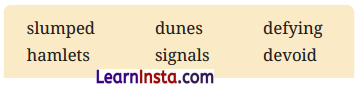
We stepped out of the vehicle at the end of the road. Immediately, our body sent 1. _______ that our decision to visit the sand 2. _______ in the afternoon was insane. We had passed a few 3. _______ on our way to the desert. We could not find even a single soul outdoors, 4. _______ the blazing sun. Even the camels were 5. _______ in the little shade offered by the khejri trees. In this remote place people relied on Bharat Sanchar Nigam Limited (BSNL) to connect to the world as the area was 6 . _______ of any other network service.
Answer:
1. signals
2. dunes
3. hamlets
4. defying
5. slumped
6. devoid
Check Your Understanding (NCERT Page 207)
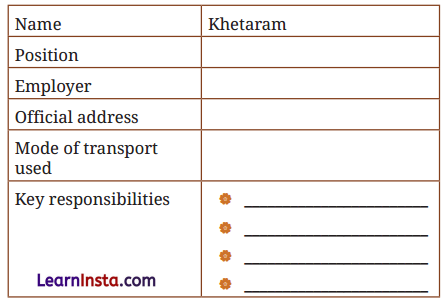
I. Khetaram needs to submit information about himself for getting an identity card. While reading the text, fill up the following information sheet for Khetaram.
Answer:
| Name | Khetaram |
| Position | Gramin Dak Sewak (GDS) |
| Employer | India Post |
| Official address | Somarad Branch Post Office, near Indo-Pak border, Rajasthan. |
| Mode of transport used | On foot (sometimes with help from BSF vehicles or buses for part of the journey). |
| Key responsibilities | Delivering letters, parcels, and money orders to remote villages. Acting as a trusted link between families in isolated areas. Reading out letters and writing replies for villagers. Ensuring timely delivery of mail even in extreme desert conditions. |
II. Discuss with your teacher.
Question 1
Why do you think Khetaram has taken up this challenging job?
Answer:
Postmen often take up this challenging job to secure a steady livelihood, support their families, and serve as a vital link for people living in remote or difficult regions.
Question 2
How do you think Khetaram would feel about taking up this challenging task every day?
Answer:
Khetaram would likely feel proud and responsible despite the harsh conditions. The passage shows his dedication as he walks long distances in extreme heat and sandstorms. Being described as the ‘lone face of the state’ and a ‘trusted link’ suggests he feels a sense of duty and importance in serving remote communities.
Check Your Understanding (NCERT Page 210)
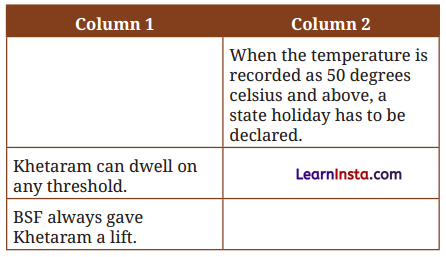
I. Complete the table given below with the situations given in Column 1 and the reasons in Column 2.
Answer:
| Column 1 | Column 2 |
| Mail is delivered in the evenings. | When the temperature is recorded as 50 degrees celsius and above a state holiday has to be declared. |
| Khetaram can dwell on any threshold. | He is trusted by everyone in the villages. |
| BSF always gave Khetaram lift. | The jawans are kind and helpful. |
II. Why was a piece of jaggery offered in the village when he brought news of a birth or weddings?
Answer:
In India, villagers believe that good news should be welcomed with sweetness. So, offering a piece of jaggery to the postman when he brings news of a birth or a wedding is a symbolic gesture of sharing happiness.
III. How would phone lines help Khetaram in his job?
Answer:
Phone lines would help Khetaram become a Gramin Sanchar Sewak. His duty would then include carrying a cell phone along with the post, helping people stay better connected in remote areas.
Critical Reflection (NCERTPage 210)
I. Read the extracts given below and answer the questions that follow.
Extract 1
“Akaal or famine is a way of life here. In a good year, I get one crop of bajra. That cannot feed my family of five. We would starve without this job,” he says.
And for each family which resides in this arid land, survival is partly dependent on money orders remitted by a relative.
(i) Complete the sentence given below with an appropriate reason.
One crop of bajra makes a little difference for people like Khetaram because _______ .
Answer:
it is not enough to feed his family of five for the whole year
(ii) Why did Khetaram term famine as ‘a way of life’?
Answer:
Khetaram termed famine as ‘a way of life’ because drought and scarcity of food are common in his region. Farming does not produce enough crops regularly, so people are used to facing shortages almost every year.
(iii) Give one reason why Khetaram had to take up a job to help his family to survive.
Answer:
Khetaram had to take up the job because farming alone could not support his family, and without this job, they would starve.
(iv) Complete the analogy given below with a word from the extract.
Other families: Money orders :: Khetaram: _______.
Answer:
bajra
(v) What would ‘a good year’ signify?
Answer:
‘A good year’ would signify a year with sufficient rainfall and a proper harvest of bajra, though even then the crop would not be enough to fully support his family.
Extract 2
There is one letter delivery he dreads. The envelope with the right corner torn off, which signifies that the missive bears news of death. “Ashubh Samachar cannot be carried into the house,” says Khetaram. So, he stands outside, reads out the letter twice, then tears it to bits. “Bad news must be destroyed,” he mutters philosophically.
(i) Choose the correct option for the following question.
Who could have torn the right corner of the envelope?
A. Khetaram
B. Sender of the letter
C. Receiver of the letter
D. The postmaster
Answer:
B. Sender of the letter
(ii) Complete the sentence with an appropriate reason.
The most likely reason for Khetaram reading the letter twice is because _______ .
Answer:
he wanted to ensure that he conveyed the sad news correctly and clearly before destroying the letter
(iii) What was Khetaram’s philosophy regarding bad news, and how did he act upon it?
Answer:
Khetaram’s philosophy regarding bad news was that bad news should not be carried into the house and must be destroyed. He followed this belief by standing outside, reading the letter aloud twice and then tearing it into pieces.
(iv) State whether the following sentence is true or false.
Khetaram’s action of tearing the letter differed from his beliefs.
Answer:
False
(v) Mention any one aspect of Khetaram’s temperament which is revealed through this extract.
Answer:
The extract shows that Khetaram is sensitive, as he handles the delivery of sad news carefully and thoughtfully.
II. Answer the following questions.
Question 1.
Justify the statement made by the Postmaster-General, Rajasthan Western Region, stating that the role of GDS is ‘invaluable’.
Answer:
‘Invaluable’ means extremely important. The Postmaster-General’s statement reveals that GDSs are the backbone of rural postal services. They are trusted local representatives who deliver letters, parcels, and money to remote villages of the country.
Question 2.
How was the purpose of India Post different from that of the British postal system?
Answer:
The British postal system was established mainly to relay company dak between administrative centres. In contrast, after independence, India Post aimed to bring the entire population within its mailing ambit, ensuring communication and financial services reached even the remotest and rural parts of the country.
Question 3.
People trusted Gramin Dak Sewaks. Support this statement with any two instances from the text.
Answer:
People trusted Gramin Dak Sewaks because villagers comfortably asked Khetaram to read their letters and write replies. Additionally, rural families depended on money orders delivered through the post office, showing their confidence in the system and in Khetaram’s honesty and responsibility.
Question 4.
Infer the most likely reason that Khetaram was grateful to continue as GDS, even after 60.
Answer:
Khetaram was grateful to continue to work even after 60 years primarily because the job provided him with a livelihood for a long time, as his other source of income from Bajra farming was too little to manage his family expenses.
Question 5.
Explain why the author pays tribute to people like Khetaram.
Answer:
The author pays tribute to people like Khetaram because they serve selflessly in harsh and inaccessible regions, ensuring communication and financial support reach remote communities. Despite extreme weather and physical hardship, they remain dedicated and reliable, forming an essential part of the nation’s social fabric.
Vocabulary and Structures in Context (NCERT Page 212)
I. Study the phrases given in Column 1 and match them with their meanings in Column 2.
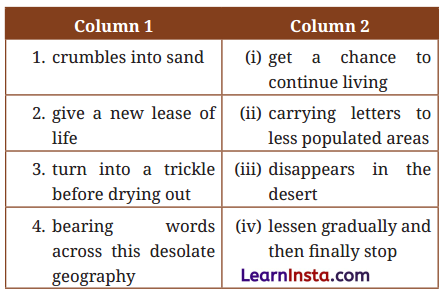
Now, use the phrases from Column 1 in sentences of your own.
Answer:
| Column 1 | Column 2 |
| 1. crumbles into sand | (iii) disappears in the desert |
| 2. give a new lease of life | (i) get a chance to continue living |
| 3. turn into a trickle before drying out | (iv) lessen gradually and then finally stop |
| 4. bearing words across this desolate geography | (ii) carrying letters to less populated areas |
Crumbles into sand: The old mud wall slowly crumbled into sand after years of neglect.
Give a new lease of life: The scholarship gave a new lease of life to the struggling student.
Turn into a trickle before drying out: The river turns into a trickle before drying out during severe summer.
Bearing words across this desolate geography. The postman kept bearing words across this desolate geography to connect families.
II. Identify examples of alliteration and metaphor in the extract given below.
Khetaram’s khaki turban and uniform are his only protection against the desert’s furies, the scorching summer winds and swirling sandstorms which turn him into a walking sandman.
Answer:
Alliteration
- Khetaram’s khaki (repetition of the ‘ k ‘ sound)
- Scorching summer (repetition of the ‘ s ‘ sound)
- Swirling sandstorms (repetition of the ‘s’ sound)
Metaphor
- Walking sandman (Khetaram is compared to a sandman without using ‘like’ or ‘as’).
III. Match the words in Column 1 to what they suggest in Column 2 in the context of the chapter.
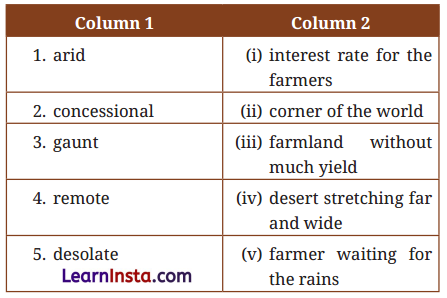
Now, use the words from Column 1 in sentences of your own.
Answer:
| Column 1 | Column 2 |
| 1. arid | (iii) farmland without much yield |
| 2. concessional | (i) interest rate for the farmers |
| 3. gaunt | (v) farmer waiting for the rains |
| 4. remote | (ii) corner of the world |
| 5. desolate | (iv) desert stretching far and wide |
- Arid: The arid land could not support many crops due to lack of rainfall.
- Concessional: The bank offered a concessional loan to help the farmers.
- Gaunt: The farmer looked gaunt after months of drought and hardship.
- Remote: The village was so remote that even mobile networks did not work there.
- Desolate: The travellers walked across the desolate desert under the blazing sun.
IV. Read the underlined verbs in the sentences given in Column 1 and their functions in Column 2.
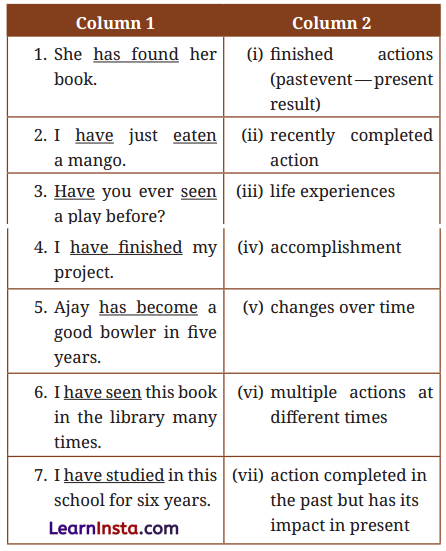
Now, fill in the blanks by using the present perfect form of the verbs given in brackets to complete the paragraph.
I 1. _______ (has/have) just _______ (get) a collection of postage stamps from my grandfather. He 2. _______ (collect) these stamps over a period of 20 years. 13. _______ (study) most of the stamps in his collection and loved all of them. I 4. _______(begin) my own collection of postage stamps.Grandfather 5. _______ truly _______ (inspire) me.
Answer:
- have, got
- has collected
- have studied
- have begun
- has, inspired
V. Study the sentences given below.
1. GDS delivers the mail at the border.
- When the subject does the action, the sentence is in active voice.
2. The mail is delivered by the GDS at the border.
- This implies that the ‘mail’ receives the action ‘deliver’.
- This sentence is in passive voice because the subject is receiving the action.
3. Khetaram’s nephew wants to join the GDS. He asks Khetaram how to prepare for it. Khetaram gives him the following advice.
- You will need a lot of stamina for this job.
- Practise reading clearly as some of the villagers will expect you to read out the letters.
- Write words neatly as some villagers will ask you to draft replies.
- Wear full-sleeved shirts and trousers to protect yourself from the heat.
Now, complete the following paragraph about the advice given by Khetaram. One example has been done for you.
To begin with, a lot of stamina will be needed for this job. Next, reading clearly A. _____, as you B. _______ to read out the letters by some of the villagers. Words C. _______ neatly as you D. _______ to draft replies by some villagers. Full sleeved shirts and trousers E. _______ to protect yourself from the heat.
Answer:
A. should be practised
B. will be expected
C. should be written
D. will be asked
E. should be worn
Speaking Activity (NCERT Page 216)
I. The postcard, inland letter envelope, and money order form were engaged in a discussion on which one was the most important.

In groups of four, select one each and reason with each other logically. You may use the points for discussion given in Column 1 and the cues given in Column 2 to express your opinion.
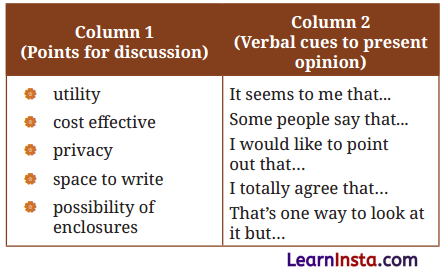
Answer:
- The postcard can be considered important because it is highly cost-effective. It allows people to send short messages at a very low price. Its utility lies in quick communication for simple greetings and information.
- However, the inland letter envelope provides more space to write and ensures better privacy, as the content is not openly visible like a postcard. It is suitable for longer and more personal messages.
- On the other hand, the money order form has great utility because it helps people send money safely, especially in places where banking facilities are limited. It plays an important role in financial communication.
- In conclusion, each one is important in its own way. The postcard is economical, the inland letter ensures privacy and space, and the money order provides financial support. All three serve different but essential purposes.
Writing Task (NCERTPage 217)
A condolence message communicates your feelings to someone whose relative or a person close to them has just passed away. It mentions how sorry you feel for the loss and prayers for strength to the family members.
I. Khetaram saw a letter with a torn corner. It had news about Bhawar Singh’s uncle passing away. Read the condolence message that Sawant Singh sent to his cousin as a reply to the letter.
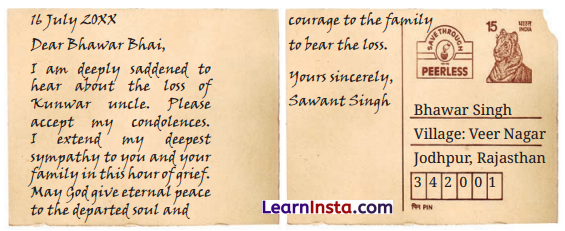
Now, on behalf of your parents, draft an imaginary condolence message for your aunt on the recent passing away of her father.
Answer:
H.No. 24, Shanti Nagar
Near Post Office
Jaipur – 30XXXX
18 February 2026
Mrs. Sunita Sharma
45, Green Park Colony
Udaipur – 31XXXX
Subject Heartfelt Condolences
Dear Sunita
We were deeply saddened to hear about the passing away of your beloved father. Please accept our heartfelt condolences on this irreparable loss. It is truly a painful time for you and your family.
Your father was a kind and noble person who was respected by everyone. His guidance and affection will always be remembered. May God grant him eternal peace and give you strength and courage to bear this great sorrow.
Our thoughts and prayers are with you and your family during this difficult time.
With deepest sympathy
Rajesh and Meena