Students can use Poorvi Book Class 7 Solutions Unit 1 Learning Together Chapter 3 Three Days to See Questions and Answers as a quick reference guide.
Three Days to See Class 7 Questions and Answers
Three Days to See Class 7 Question Answer
NCERT Class 7 English Poorvi Chapter 3 Three Days to See Question Answer
Three Days to See Question Answer – Let us do these activities before we read (Page 28)
I. Work in pairs. Recall a visit to a place that you liked. Discuss the details of that place and write about the following:
Question 1.
Name of the place
Answer:
A Visit to the Beach
The place I visited was Juhu Beach in Mumbai.
Question 2.
The person(s) you went with
Answer:
I went to the beach with my family—my parents, younger brother, and my cousins.
Question 3.
The things that you could:
- see
- listen
- smell
- taste
- touch and feel
Answer:
See: The first thing that struck me was the vast stretch of golden sand stretching along the coastline. I could see the rolling waves of the ocean, their white foam splashing against the shore. In the distance, there were boats anchored. The sun was beginning to set, painting the sky in shades of pink, orange, and purple.
Listen: The sound of the waves crashing on the shore was soothing, creating a calming, rhythmic sound. There were also the sounds of people laughing, talking, and the occasional splash of water.
Smell: The air was filled with the salty, fresh scent of the ocean. There was also the sweet scent of coconut from the local vendors. As we walked along the beach, the aroma of fresh seafood being cooked by beachside vendors tempted us to try something.
Taste: We tasted the fresh seafood offered by the local stalls. I also tried some local sweets. Of course, the cool, refreshing coconut water we drank directly from the coconut was a highlight of the day.
Touch and Feel: The sand beneath my feet was warm, but as I walked closer to the water, I felt the cool, gentle touch of the waves as they lapped against my feet. I could feel the warmth of the sun on my skin, but it was balanced by the coolness of the sea breeze.
II. How does this memory make you feel?
Answer:
The visit to the sea beach was an unforgettable experience. The combination of sights, sounds, smells, tastes, and the overall feeling of tranquility made it a place I would love to visit again.
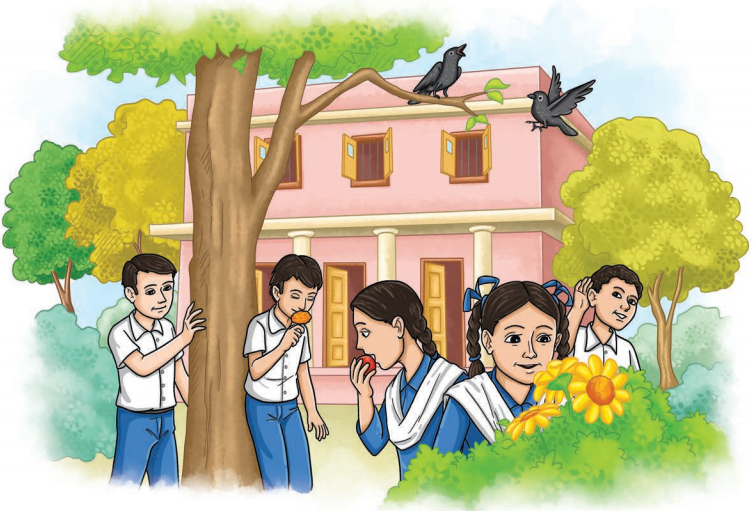
III. Do you think your visit/experience would be different if you could not see or hear? Share your answers with your classmates and the teacher.
Did you know that our five senses are essential for us to experience and make sense of the world around us?
Answer:
If I could not see or hear, I must have been deprived of some of the experiences that I enjoyed with my eyes and ears. Our sense organs are our windows to the world and they are very essential to experience the world around us.

Three Days to See Class 7 Question Answer – Let us discuss (Page 31)
I. Work in pairs. Identify the statements that are true from the ones given below. Share your answers with the teacher.
1. The author expresses a deep longing to experience the world through the sense of hearing.
2. The author would like exploring the city only to observe how people are suffering.
3. The author would spend the first day seeing the people whose kind heartedness and friendship have enriched her life.
4. The author acknowledges that even in three days, she would not be able to see everything.
5. The author feels that everyone can find the greatest joy merely by the sense of touch.
6. The author advises those who can see to appreciate every moment as if they might lose their senses tomorrow.
Answer:
The narrator, Helen Keller, understands the feelings of a person through the sense of touch. She fe,els the contours of a face, detects emotions like laughter and sorrow, and senses expressions through voice modulations. Though she cannot see, she perceives emotions through physical contact and vibrations, enabling her to ‘see’ beyond what eyes can reveal.
Class 7 English Three Days to See Question Answer – Let us think and reflect (Pages 32-33)
1. Read the extracts given below and answer the questions that follow.
Question 1.
I feel the delicate symmetry of a leaf I pass my hands lovingly about the smooth skin of a silver birch, or the rough, shaggy bark of a pine. In spring, I touch the branches of trees hopefully in search of a bud, the first sign of awakening Nature after her winter’s sleep. Occasionally, I am very fortunate; I place my hand gently on a small tree and feel the happy quiver of a bird in full song.
(i) What does the ‘delicate symmetry of a leaf symbolise?
Answer:
The ‘delicate symmetry of a leaf symbolizes the intricate beauty and balance in nature, which the writer perceives through touch despite being blind. It highlights the perfection and order in the natural world.
(ii) List two phrases from the extract that describe the texture of objects in nature
Answer:
- “the smooth skin of a silver birch”
- “the rough, shaggy bark of a pine”
(iii) Complete the sentence appropriately.
The phrase ‘awakening Nature after her winter’s sleep’ refers to
Answer:
the arrival of spring, when plants and trees begin to bloom after the cold and barren winter.
(iv) What is the tone of the writer in this extract?
(a) nostalgic
(b) proud
(c) admiring
(d) celebratory
Answer:
(c) admiring
Question 2.
The next day I should arise with the dawn and see the thrilling miracle by which night is transformed into day. I should behold with awe the magnificent panorama of light with which the sun awakens the sleeping earth. This day I should devote to a hasty glimpse of the world, past and present. I should want to see the pageant of man’s progress, and so I should go to the museums.
(i) The word ‘thrilling’ has been used with ‘miracle’.
Which of the following words does not match with the word ‘thrilling’?
A. experience
B. tale
C. knowledge
D. adventure
Answer:
(c) knowledge
(ii) Why does the writer refer to the earth as ‘sleeping earth’?
Answer:
The writer refers to the earth as ‘sleeping earth’ because during the night, everything appears calm and inactive, as if nature is at rest.
(iii) Complete the sentence with an appropriate reason.
The writer wishes to dedicate the day to a brief look at the present and past world because __________________.
Answer:
she wants to witness human progress, history, and culture in a sjiort period, knowing she has limited time to see.
(iv) Why does the writer use ‘should’ multiple times in the extract?
Answer:
The writer uses ‘should’ multiple times to express a hypothetical scenario—what she would do if given sight for three days. It conveys longing, desire, and a sense of planning for an imagined experience.
II. Answer the following questions.
Question 1.
The sense of touch makes up for the loss of sight and hearing. Explain this statement with reference to the text.
Answer:
Helen Keller, despite being blind and deaf, finds joy and understanding in the world through her sense of touch. She feels the texture of trees, the quiver of a bird, and the contours of a friend’s face. Through touch, she experiences emotions, nature, and human connection, making up for what she cannot see or hear.
Question 2.
Why does the author believe that the sense of sight is the most wonderful?
Answer:
Helen Keller believes that sight is the most delightful sense because it allows one to witness the beauty of the world, people’s emotions, and history’s wonders. She longs to see faces, nature’s transformations, and human progress, which she can only imagine through touch.
Question 3.
How might the author’s opinion on making the most of our senses guide us to be kinder towards people with special abilities?
Answer:
Keller’s perspective encourages us to value and appreciate our senses while developing empathy for those who lack them. By recognizing the richness of touch, sound, and sight, we can be more understanding and supportive of people with disabilities, ensuring inclusivity and kindness in our interactions.
Question 4.
What is the significance of imagining the loss of a sense, according to the author?
Answer:
The author suggests that imagining the loss of a sense helps people appreciate their abilities more deeply. If one were to pretend they would go blind tomorrow, they would cherish every sight today. This mindset fosters gratitude and a more meaningful engagement with life’s experiences.
Question 5.
How does the author encourage people to approach their everyday sensory experiences?
Answer:
Helen Keller advises people to experience the world with heightened awareness, as if they might lose their senses the next day. She urges them to cherish sights, sounds, and textures, making the most of every moment by truly engaging with their surroundings.
Question 6.
What do the author’s choices for the three days tell us about her values and priorities?

Answer:
Helen Keller’s choices reflect her deep appreciation for human relationships, nature, and knowledge. On the first day, she wishes to see her loved ones, showing the importance of companionship. On the second, she desires to witness the world’s beauty and history, emphasizing her curiosity. On the third, she observes people’s daily lives, highlighting her empathy and love for humanity.
Three Days to See Class 7 Questions and Answers – Let us learn (Paws 34-35)
I. Sensory words are descriptive—they i describe how we experience the world: how
we see, hear, smell, taste or feel something.
Complete the following table with sensory words from the text in Column 2 for the five senses in Column 1. Add new words in Column

Answer:
| Column 1 | Column 2 | Column 3 |
| What you see | panorama | scenic, vibrant, dazzling |
| What you hear | music | melody, whisper, rustle |
| What you smell | perfume | fragrance, aroma, scent |
| What you taste | relish | savour, delicious, tangy |
| What you feel | rough | smooth, soft, chilly |
II. Read the following sentences from the text and underline the verbs.
- I should divide the period into three parts.
- On the fist day, I should want to see…
- The next day I should arise with the dawn…
- I should behold with awe…
The words you have underlined are a combination of two verbs. In each of these sentences, ‘should’ is the modal verb (suggestion), and the second verb (divide, want, arise, behold) is the main verb
Answer:
- I should divide the period into three parts.
- On the first day, I should want to see …
- The next day, I should arise with the dawn…
- I should behold with awe …
The words you have underlined are a combination of two verbs. In each of these sentences, ‘should’ is the modal verb (suggestion), and the second verb (divide, want, arise, behold) is the main verb.
Modal verbs are auxiliary verbs that express necessity, possibility, permission, or ability. They are used before the main verb to give additional information about the function of the main verb. Common modal verbs include can, could, may, might, shall, should, will, would, must, and ought to.
III. Identify the modal verbs in the following sentences. Choose the functions they express from those given in the box below.

1. You can learn a lot from this experience.
Answer:
- Modal verb: can
- Function: ability
2. They might arrive late due to traffic.
Answer:
- Modal verb: might
- Function: possibility
3. She must finish her homework before dinner.
Answer:
- Modal verb: must
- Function: necessity
4. They ought to apologise for their mistake.
Answer:
- Modal verb: ought to
- Function: moral obligation
5. He would like to have some lassi, please.
Answer:
- Modal verb: would
- Function: polite request
IV. Read the situations in Column 1 and functions in Column 2. Fill in the blanks in the sentences in Column 4 with appropriate modal verbs from Column 3. After filling in the blanks, explain the function of each modal verb you used to your classmates and the teacher.

Answer:
| Column 1 | Column 2 | Column 3 | Column 4 |
| 1. You want to leave work early. | permission | may | (i) May I leave early today if I finish all my tasks? |
| 2. You have an important deadline tomorrow. | obligation | must | (ii) I must finish this report by tomorrow. |
| 3. Your friend is thinking whether to join Art class. | advice | should | (iii) You should consider all the pros and cons before making a decision. |
| 4. There are dark clouds in the sky. | possibility | might | (iv) It might rain later today. |
| 5. Asking someone politely to pass the salt at the dinner table. | request | could | (v) Could you pass the salt, please? |
| 6. Advising someone to apologise for a mistake. | moral obligation | ought to | (vi) You ought to apologise for the mistake .you made. |
| 7. Deciding where to go for a picnic. | suggestion | could | (vii) We could go to any park nearby for a picnic. |
Functions of Modal Verbs:
Can
Can is used to show ability.
Example: I can solve these difficult sums.
Could
‘Could’ is used to show a person’s ability, show possibility, take permission and for polite request. For examples:
1. He could solve even the most difficult sums. (Ability)
2. That could be my pen. (Possibility)
3. Could I borrow your bicycle? (Permission)
4. Could you move aside, please? (Polite request)
May
‘May’ is used to seek permission or grant permission, make informal request, used to show possibility of an action.
For examples:
1. You may rest now. (Permission given)
2. May I come in, sir? (Seeking permission)
3. May I borrow your bike? (Informal request)
4. It may rain today. (Possibility)
Might
The modal ‘might’ is used to show a remote possibility and seek permission.
For examples:
(i) They might come next week. (Remote possibility) Might I ask your hand? (Permission)
Shall ‘
‘Shall’ is used to expresses an action that will take place in future.
For example:
We shall go there tomorrow.
Will
‘Will’ is used to express actions likely to take place in future and show willingness, promise, certainty, determination, intention, threat.
For example:
He will come here tomorrow.
Should
‘Should’ is used to express an obligation or duty, advice, inference.
For examples:
1. The students should stand up when the Principal comes. (Duty)
2. You should behave properly. (Advice)
3. He should not be late as he started quite early. (Inference)
Would
Would’ is used to express past action.
For example:
I would play with dolls when I was a child.
Must
‘Must’ is used to express necessity, obligation or urgency, some duty, obligation, give instructions, orders and advice.
For examples:
1. You must do it. (Urgency)
2. You must help him. He i$ in a critical condition. (Necessity)
3. You must do your duty. (Duty)(4. We must help the needy. (Obligation)
5. Students must answer all the questions. (Instructions)
6. The staff must report by 9.30 am. (Order)
7. The pedestrians must use the over bridge. (Strong advice)
Ought to
‘Ought to’ is used to show some moral obligations. For example:
You ought to help physically challenged persons. (Moral obligation)
Three Days to See Question Answer Class 7 – Let us listen (Page 36)
You will listen to a conversation between a mother and son. As you listen, select four true statements from 1-7 given below. (Refer to the NCERT textbook page-41 for transcript)
| Statements | True of False |
| 1. Anuj finds the concept of Braille fascinating and wants to learn more about it. | _________ |
| 2. Mother is unsure of the school’s efforts to include students with visual impairment. | _________ |
| 3. Anuj initially thinks that Digital India is only about learning how to use computers. | ________ |
| 4. Mother believes that screen readers are very effective for persons who are visually impaired. | ________ |
| 5. Anuj already knew that persons who are visually impaired can use computers and smartphones. | ________ |
| 6. Anuj wants to know about the effectiveness of assistive technologies for persons who are visually impaired. | ________ |
| 7. Mother believes a right mindset is the best support for persons who are visually impaired. | ________ |
Answer:
Statements 1, 3, 4, 6 are true.
Class 7 English Chapter 3 Question Answer – Let us speak (Pages 36-37)
Work in pairs. Take turns to speak for a minute on anyone of the senses you value the most. Use the given prompts to frame your response before you speak.
- I value my sense of sight/sound/touch/smell/ taste the most because …
- One of my favourite experiences is …
- This is so because …
- I appreciate being able to see/hear/touch/ smell/taste ….
- God forbid, if I were to lose the sense of sight/ sound/touch/smell/taste, it would make me feel …
- I would not be able to …
- I thank God that I am able to see/hear/touch/ smell/taste …
Remember to
- speak clearly and confidently
- glance at your notes for reference rather than reading
- make eye contact
- use gestures if you wish to
- pronounce words clearly and avoid mumbling
- speak at a steady, moderate pace
Answer:
Do it yourself.
NCERT Class 7 English Poorvi Chapter 3 Question Answer – Let us write (Page 37)
A descriptive paragraph describes a person, place, object or event to create a memorable experience for the reader. Write a descriptive paragraph describing a place that you visited recently.
Follow the guidelines given below to draft this paragraph.
1. In the opening line, begin with something interesting to capture the reader’s attention. Introduce the place you visited.
2. In the supporting lines, describe the place using adjectives and specific details that appealed to your five senses—sight, sound, smell, taste, and touch. You may include alliterations, similes, and personifications to hold the reader’s attention.
3. In the concluding lines, summarise the description to provide a final impression. Mention what was the most important thing about that place which others should also experience.
Answer:
A Mesmerizing Visit to Munnar
Last weekend, I had the opportunity to visit Munnar, a breathtaking hill station nestled in the Western Ghats of Kerala. As soon as I arrived, I was greeted by rolling tea plantations that stretched like a green carpet across the hills. The cool mountain breeze carried the aromatic scent of fresh tea leaves and wildflowers, instantly refreshing my senses.
The soft rustling of leaves and the distant chirping of birds created a symphony of nature, while the mist-covered valleys added a magical
touch to the sceneiy. Standing atop a viewpoint, I could see the sun gently kissing the peaks, painting the sky in shades of orange and pink. I also visited a local tea factory, where I tasted the finest, freshly brewed tea—its warmth and rich flavor were simply unforgettable. Munnar’s serene beauty, soothing climate, and picturesque landscapes left an everlasting impression on me. If there’s one place that can truly rejuvenate your soul, it’s Munnar!
Class 7th English Chapter 3 Three Days to See Question Answer – Let us explore (Pages 37-38)
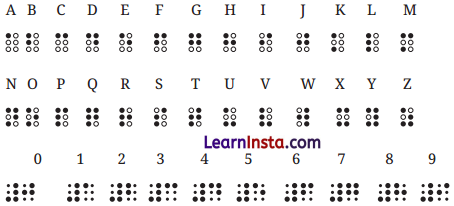
I. Do you know how persons with visual challenges are able to read and write? They read through touch with the help of Braille, a code of raised dots that represents the letters of the alphabet. This tactile code was developed over a period of nine years by Louis Braille, who became blidd at a very young age due to an accident.
Louis Braille (Courtesy FMT)

Study the code given below and write your name using it. You may use bindis or grains of,daal to make the dots that you can touch and feel. ABCDEFGHl’j KLM
Answer:
Writing Your Name in Braille
To write your name in Braille, use the given Braille code to find the corresponding raised dot patterns for each letter. You can use bindis or grains of daal to create the dots, making it a tactile experience.
Example:
If your name is RAHUL, the Braille representation will be:
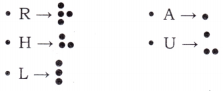
Arrange the dots accordingly on a sheet of paper and feel the letters!
II. Have you heard about the International Day of Persons with Disabilities? Find out when and how it is observed in India. Write your findings on a sheet and put it up on the class board.
Answer:
International Day of Persons with Disabilities Date: December 3rd
Observance in India:
- Awareness campaigns and discussions on disability rights.
- Schools and organizations conduct special programs, including cultural events, exhibitions, and inclusive activities.
- Government initiatives and policies are highlighted to promote accessibility and equal opportunities.
- People with disabilities share their stories to inspire and educate society about inclusivity.
You can write this information on a sheet and display it on your class board to spread awareness.
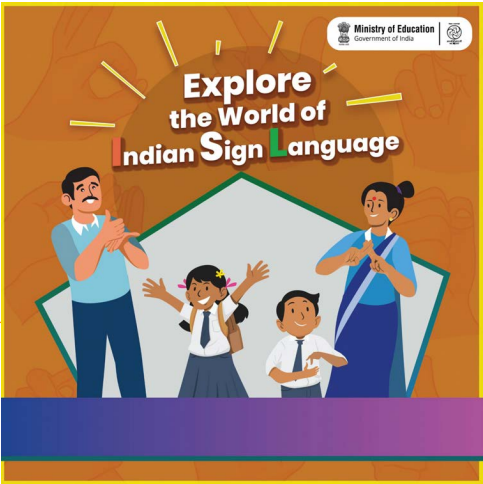
III. Do you want to know about sign language? Go to the link given below to learn about the Indian sign language.
https: / nee rt.nic.in/pdf/accessibility/ lSL_200word_v 15. pdf
Answer:
Do it yourself.