Teachers guide students to use Exploring Society India and Beyond Class 7 Solutions and Class 7 SST Part 2 Chapter 1 The Story of Indian Farming Question Answer NCERT Solutions for quick learning.
The Story of Indian Farming Questions and Answers Class 7 SST Chapter 1
The Story of Indian Farming Class 7 Question Answer (In-Text)
The Big Questions? (Page 1)
Question 1.
What are the main characteristics of Indian agriculture?
Answer:
Indian agriculture is one of the oldest occupations of humankind. It includes the preparation of soil, cultivation of plants, rearing of livestock, forestry, and horticulture. India’s agricultural landscape is a blend of traditional and modern farming practices with diverse crops and deep-rooted cultural traditions.

Question 2.
How are farming, climate, soil, and water interrelated?
Answer:
Growing crops depends on several factors like soil, climate, availability of water, and terrain. Climate decides rainfall and temperature, soil provides nutrients, and water enables crops to grow. Farming is closely linked to all these natural factors.
Question 3.
How can traditional practices and contemporary ones complement each other?
Answer:
Traditional practices protect soil, conserve water, and support sustainability, while contemporary methods increase production using technology. When combined, they help increase food production while protecting the environment.
Think About It
Question 1.
When you read or hear the word ‘farmer’, what do you visualise? (Page 2)
Answer:
When I hear the word ‘farmer’, I visualise a person working in the fields, ploughing the soil, sowing seeds, or harvesting crops. I imagine someone caring for plants and animals, often wearing simple clothes and a hat or turban, working hard under the sun to grow our food.
Question 2.
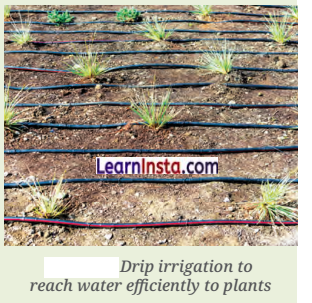
Imagine a network of small pipes with tiny holes placed near the base of your plants. These pipes are connected to a water source, and when the water is turned on, it drips slowly and steadily from the holes, watering only the roots. This targeted delivery ensures that water is used efficiently, minimising waste. (Page 18)
Answer:
This description explains drip irrigation. Drip irrigation delivers water slowly and directly to the roots of the plants and helps in saving water and reducing waste.
Question 3.
With its rich alluvial soil, for millennia the Ganga basin has been a source of food and water to millions of people over 500 million today. Yet, for some years, the Ganga river has been under stress and is increasingly unable to replenish itself; parts of it are no longer navigable in summer as the water level is too low even for river boats. (Page 26)
Answer:
The causes are glacier melting due to global warming, excessive diversion of water for irrigation, groundwater extraction, and construction of dams. This affects agriculture by reducing water availability and making farming less sustainable.
Let’s Explore
Question 1.
Create a list of the foods you typically eat. Identify the grains, pulses, oils, vegetables, and fruits in them. Now locate where you live on a physical map of India. Which of the food items do you think grow in and around where you live? What do you think are the reasons that they are cultivated in your region? Which of them comes from other places? Why do you think they are not grown in your area? (Page 3)
Answer:
I usually eat rice, wheat (chapati), dal, vegetables, fruits, and food made with oil. The grains I eat are rice and wheat, the pulses are moong dal and chana dal, the oils are sunflower and groundnut oil, and the vegetables and fruits include potatoes, tomatoes, bananas, and mangoes.
For example, I live in Tamil Nadu. Many foods like rice, groundnuts, bananas, and most vegetables grow in and around my region because the climate is warm, the soil is mainly red and alluvial, and we get rainfall from two monsoons, which helps farming. Foods like wheat, apples, and mustard come from other places because they need cooler weather and different soil types, which are not found in my area.
Question 2.
Imagine that your state received less than normal monsoon rains for two consecutive years. Which items are likely to disappear from your meals, or are likely to become difficult to access? (Page 7)
Answer:
If my state received very little monsoon rain for two years, many water-intensive crops would suffer. Items like rice, sugarcane, and some vegetables (such as tomatoes and leafy greens) would become scarce or very expensive because they need a lot of water to grow.
Groundnuts, pulses, and oilseeds might also reduce because farmers would not have enough water for irrigation. Fruits like bananas and mangoes could also become harder to get. Thus, many everyday foods would become costly or disappear because crops depend heavily on the monsoon.
Question 3.
Prepare a list of the crops that are cultivated in your state or union territory in a year and classify them into kharif, rabi, and zaid. (Page 9)
Answer:
List of crops are as follows:
- Kharif crops: Rice, maize, jowar, bajra, cotton, groundnut
- Rabi crops: Wheat, barley, peas, mustard, gram
- Zaid crops: Watermelon, cucumber, muskmelon, pumpkin
Question 4.
(i) Try to name at least two states in each of the zones mentioned above. (Page 11)
Answer:
The two states in each of the six major soil types are as follows:
- Alluvial soil: Uttar Pradesh, Bihar
- Black soil: Maharashtra, Gujarat
- Red soil: Tamil Nadu, Odisha
- Laterite soil: Kerala, Karnataka
- Desert soil: Rajasthan
- Mountain/Alpine soil: Himachal Pradesh, Uttarakhand
(ii) Which type of soil is predominantly found in your state or union territory? (Page 11)
Answer:
For example, I live in the state of Madhya Pradesh and here the soil predominately found is the black soil.
(iii) Soils tell us stories about places – what might have happened over thousands of years during which the soils were being formed. Take a few samples of soil from your neighbourhood. Look carefully at them. (Examine the soil using a magnifying glass or microscope if you have access to either.) What do the samples consist of? What might be the origins of the soil? Are there signs of human activity that you notice? What might happen to the soil over time on account of this? (Page 11)
Answer:
When I observed the soil samples from my neighbourhood, I found sand, small stones, clay, dry leaves, and bits of organic matter. Some samples also had pieces of plastic and small construction debris. This shows the soil was formed from weathered rocks and decayed plants, but human activity has mixed waste into it. If this continues, the soil may lose fertility and become polluted or eroded over time.
Question 5.
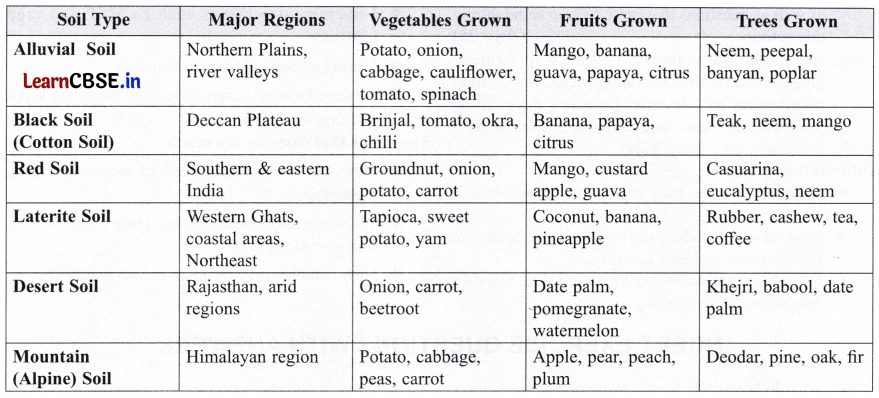
Take up a small group project. Identify the types of vegetables, fruits, and trees that grow in the different soil types. (Page 11)
Answer:
India has a wide variety of soils, and each soil type supports different kinds of vegetables, fruits, and trees. The type of soil affects water retention, nutrient availability, and root growth, which in turn decides what can be grown successfully. For example, our group studied the major soil types of India and identified the crops grown in each.
Question 6.
Create a family food flowchart that connects your favourite dishes to the different crops they are prepared from and the corresponding soil types in which they are cultivated. (Page 11)
Answer:
Family Food Flowchart: From Soil to Plate
This flowchart shows how my favourite dishes are connected to the crops used to prepare them and the soil types in which those crops are cultivated.
Dish 1: Vegetable Biryani
Vegetables & Rice
↓
Crops Used: Rice, potato, carrot, onion, peas
↓
Soil Type: Alluvial soil
(Found in river plains; very fertile and suitable for rice and vegetables)
Dish 2: Chapati with Dal
Chapati + Dal
Crops Used: Wheat (chapati), gram/black gram (dal)
Soil Type: Alluvial soil and Black soil
(Alluvial soil for wheat; black soil for pulses)
Dish 3: Rajma Chawal
Rajma Chawal
↓
Crops Used: Rice, kidney beans (rajma)
↓
Soil Type: Alluvial soil
(Supports both cereals and pulses with good irrigation)
Dish 4: Mango Shake
Mango Shake
Crop Used: Mango
↓
Soil Type: Red soil / Alluvial soil
(Mango grows well in well-drained red and alluvial soils)
Dish 5: Aloo Paratha
Aloo Paratha
↓
Crops Used: Wheat, potato
↓
Soil Type: Alluvial soil
(Suitable for wheat and tuber crops like potato)
This flowchart shows that every dish we eat is directly connected to agriculture. Different crops grow in different soil types, and together they make the food on our plate. Understanding this connection helps us appreciate farmers, soil, and nature that support our daily life.
Question 7.
Identify modern agricultural solutions inspired by traditional practices (for example, neem-based practices). (Page 22)
Answer:
Neem-based pesticides and organic farming are modern agricultural solutions inspired by traditional practices.
Question 8.
Listen to the special programmes for farmers on the radio or watch a programme on television for a few days. Write down carefully the information that is shared through these mediums. Make a short report on the categories of information you gathered as well as questions that came to your mind during this activity. (Page 25)
Answer:
Let’s take an example: I listened to farmers’ programmes on the radio and watched agricultural programmes on television for a few days. These programmes share useful information to help farmers in their daily work.
Information gathered:
- Weather updates such as rainfall forecasts and climate warnings
- Crop advice including sowing time, seed selection, fertiliser use, and pest control
- Soil and water management techniques like drip irrigation and soil testing
- Government schemes such as MSP and crop insurance
- Market prices and storage facilities
- Modern farming technologies like improved seeds and organic farming
Questions that came to my mind:
- How can small farmers afford modern farming technology?
- What can farmers do during crop failure due to climate change?
- How can chemical fertiliser use be reduced?
The Story of Indian Farming Class 7 Solutions (Exercise)
Question 1.
Why do farmers in Kerala grow rice while farmers in Punjab grow mostly wheat? What would happen if they swapped?
Answer:
Farmers in Kerala grow rice because the state has heavy rainfall, high humidity, warm temperatures, and water-retentive soils, which are ideal for paddy cultivation. Rice needs a lot of water and grows well in flooded fields. Farmers in Punjab grow wheat because it has cool winters, moderate rainfall, fertile alluvial soil, and well-developed irrigation, which suit wheat cultivation.
If the crops were swapped, rice would not grow well in Punjab due to lower rainfall and unsuitable climate, and wheat would fail in Kerala because of excess rainfall and high humidity. This would lead to poor yields and crop loss.
Question 2.
Match the following:
| Column A | Column B |
| (a) Kharif crops (b) Rabi crops (c) Alluvial soil (d) Terrace farming (e) Alpine soil (f) Zaid crops |
(i) Crops during the winter (ii) Crops grown during the monsoon (iii) Thin, rough, and rocky soil found in mountainous regions (iv) Crops grown in summer (v) Soil rich in nutrients deposited by rivers (vi) Method of farming on hillsides |
Answer:
| Column A | Column B |
| (a) Kharif crops (b) Rabi crops (c) Alluvial soil (d) Terrace farming (e) Alpine soil (f) Zaid crops |
(ii) Crops grown during the monsoon (i) Crops during the winter (iv) Crops grown in summer (vi) Method of farming on hillsides (iii) Thin, rough, and rocky soil found in mountainous regions (iv) Crops grown in summer |
Question 3.
Why do certain crops thrive in specific regions?
Answer:
Certain crops thrive in specific regions because they need particular climate, soil type, rainfall, temperature, and water availability to grow properly. When these conditions match the crop’s requirements, the crop grows well and gives high yield. Different regions have different natural conditions, so different crops are grown in different places.
Question 4.
How has modern technology helped farmers?
Answer:
Modern technology has helped farmers by improving crop yield and efficiency. Tractors and harvesters reduce hard labour, improved seeds increase production, irrigation systems save water, and mobile apps provide weather forecasts and market prices. Technology helps farmers make better decisions and reduce losses.
Question 5.
Why is sustainable agriculture important? Write a short note on this.
Answer:
Sustainable agriculture protects soil and water, avoids harmful chemicals, supports environmentfriendly farming, and ensures long-term food security.
Question 6.
Name some challenges that farmers face today. What might be their impact for people?
Answer:
Farmers face challenges like small landholdings, climate change, debt, lack of machines, and market risks. These can lead to food shortage and higher food prices.
Question 7.
Have a debate in class on the topic “Traditional irrigation methods are better than modern ones.”
Answer:
Do it yourself.
Question 8.
Write a short essay describing what farming might be like when you are 60 years old.
Answer:
Do it yourself.
Question 9.
Form small groups and discuss the issues affecting the Ganga basin. Prepare a presentation proposing your solutions and their rationale.
Answer:
Do it yourself.
Question 10.
Looking at the crops listed in the section ‘Echoes from the Past’, which ones do you find in use in your home? What conclusion can you draw from your observations?
Answer:
Do it yourself.