These Class 8 Science Curiosity Worksheet and Class 8 Science Chapter 2 The Invisible Living World: Beyond Our Naked Eye Worksheet with Answers are excellent for board exam practice.
Class 8 Science Chapter 2 The Invisible Living World: Beyond Our Naked Eye Worksheet
Class 8 The Invisible Living World: Beyond Our Naked Eye Worksheet
Worksheet On The Invisible Living World: Beyond Our Naked Eye Class 8 – The Invisible Living World: Beyond Our Naked Eye Worksheet Class 8
Let’s Begin
A. Multiple-Choice Questions
Question 1.
The first tool that helped humans see tiny living organisms is
(a) Spectrometer
(b) Microscope
(c) Thermometer
(d) Telescope.
Question 2.
Which part of a plant cell helps it to maintain shape and store substances?
(a) Nucleus
(b) Mitochondria
(c) Vacuole
(d) Cytoplasm
Question 3.
A foldscope is a
(a) Digital camera
(b) Low-cost microscope
(c) Temperature-measuring device
(d) Slide cleaner
Question 4.
Which gas is produced during biogas formation?
(a) Oxygen
(b) Methane
(c) Hydrogen
(d) Nitrogen
Question 5.
This question consists of an Assertion (A) and a Reason (R). Read the Assertion and Reason and choose the appropriate answer.
Assertion (A): The letters appear larger when seen through the flask.
Reason (R): The flask filled with water acts like a magnifying glass.
(a) Both A and R are true and R is the correct explanation of A.
(b) Both A and R are true but R is not the correct explanation of A.
(c) A is true but R is false.
(d) A is false but R is true.
Question 6.
This question consists of an Assertion (A) and a Reason (R). Read the Assertion and Reason and choose the appropriate answer.
Assertion (A): The outer layer of animal cell is called the cell membrane.
Reason (R): The cell membrane is composed of the cytoplasm and nucleus.
(a) Both A and R are true and R is the correct explanation of A.
(b) Both A and R are true but R is not the correct explanation of A.
(c) A is true but R is false.
(d) A is false but R is true.

B. State True (T) or False (F).
1. The cell wall is found only in animal cells. _________
2. Nerve cells are branched to help carry messages. _________
3. Microorganisms are always harmful to humans. _________
4. Bacteria have a well-defined nucleus. _________
5. Microorganisms cannot survive in extreme climates. _________
C. Fill in the blanks.
1. Antonie van Leeuwenhoek is known as the Father of _________.
2. In bacteria, the genetic material is located in a region called _________.
3. _________ is a bacterium that helps convert milk into cur(d)
4. _________ gas is released by yeast during dough fermentation.
5. Yeast is a type of _________ used in baking to make the dough rise.
6. Dr. Ananda Mohan Chakrabarty developed a special bacterium to break down _________.
D. Assign one word to the following terms.
1. The tiny helpers in water that maintain the oxygen balance in water bodies. _________
2. The basic unit of life. _________
3. The green pigment of a plant cell. _________
4. The yellow part of an egg. _________
5. Book published by Robert Hooke. _________
6. A copyright given to protect someone’s invention. _________
7. The dirty water with fine particles of soil. _________
8. Term used in the Vedas for tiny visible and invisible entities. _________
9. A bird having egg with the largest known single cell. _________
10. A group of similar cells. _________
E. Match the Columns.
Question 1.
Match the images of microorganisms given in Column I withtheir description listed in Column II.

Question 2.
Unjumble the letters to form the correct word given in Column II and write them in the space provide(d) Then match them with the descriptions given in Column I.
| Column I | Column II |
| (i) Controls the entry and exit of materials | (a) CHONTOMIDRIA |
| (ii) Controls the activities of a cell | (b) ELLC EMBNERMA |
| (iii) Site of most life processes | (c) CLJOLEAV |
| (iv) Stores substances and maintains shape | (d) YTOPCSMLA |
| (v) Provides energy for life processes | (e) LEUSCUN |
Wonder Why?
A. Read the paragraph and answer the following questions. Analyse
Rahul was curious about how yeast works, so his teacher explained him through a simple experiment in the science laboratory. She poured warm sugar solution into a flask and added a spoonful of yeast.
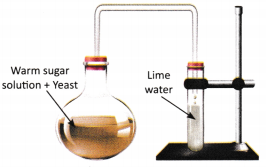
To observe the gas produced by the yeast, she fixed a delivery tube from the flask into another test tube containing lime water. The setup was placed on the table undisturbed for a few hours. After four- five hours, the teacher asked Rahul to observe any changes. He noticed tiny bubbles rising in the sugar solution.
Question 1.
What did the teacher add to the warm sugar solution in the flask?
___________________________________________
___________________________________________
Question 2.
What change occurred in the lime water?
___________________________________________
___________________________________________
Question 3.
Why were tiny bubbles produced by the yeast in this experiment?
___________________________________________
___________________________________________
Question 4.
What would have happened if yeast had not been added to the sugar solution?
___________________________________________
___________________________________________
B. Give reasons for the following.
1. Curd forms faster in warm milk than in cold milk.
___________________________________________
___________________________________________
2. Gardeners put dry leaves and plant waste into pits.
___________________________________________
___________________________________________
3. Onion peel cells are rectangular, but cheek cells are flat.
___________________________________________
___________________________________________
4. Spirulina is called a superfoo(d)
___________________________________________
___________________________________________
5. Bread kept at room temperature spoils faster than bread kept in the refrigerator.
___________________________________________
___________________________________________
6. Dough with yeast become soft and fluffy.
___________________________________________
___________________________________________
C. Microorganisms are classified into four main groups: bacteria, fungi, protozoa, and algae. We missed ‘viruses’ here. Viruses are not explicitly categorised as microorganisms. Explain.
___________________________________________
___________________________________________
D. Select the materials that could be used to make manure that would enrich the soil and make it more suitable for large-scale cultivation and write them in the given space.
| Cow dung, milk, food waste, polythene bags, leaves of fruits and vegetables, metal cans, the sludge of a river, plastic bottles |
___________________________________________
___________________________________________
Learn By Doing
A. Differentiate between plant and animal cells in the given tabte by putting a tick (✓) mark if the part is present in the cell and a cross (✗) mark if not.
| Part | Plant Cell | Animal Cell |
| 1. Cell membrane | ||
| 2. Cell wall | ||
| 3. Nucleus | ||
| 4. Nuclear membrane | ||
| 5. Cytoplasm | ||
| 6. Plastids | ||
| 7. Vacuole |
B. Give two examples of food items that result from each food preservation method listed below.
1. Salting ___________________________________________
2. Oiling ___________________________________________
3. Airtight packaging ___________________________________________
4. Sugaring ___________________________________________
5. Freezing ___________________________________________
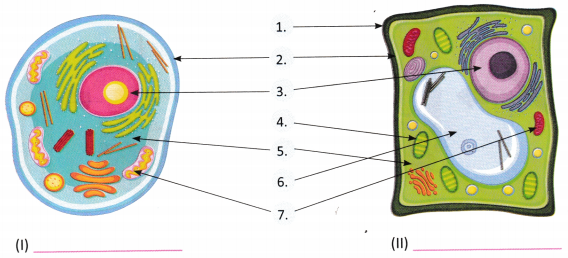
C. Identify diagrams (I) and (II) and label them. Also, explain how you identified each one, giving at least two reasons in the space given below.
1. _________
2. _________
3. _________
4. _________
5. _________
6. _________
7. _________
D. Rinse your mouth with clean water. Using the blunt end of a clean toothpick, gently scrape the inside of your cheek. Place the collected material in a drop of water on a clean slide and spread it evenly. Add a drop of methylene blue to stain the cells. After one minute, add a drop of glycerin to prevent drying. Carefully place a coverslip over the sample and remove any excess liquid with blotting paper. Observe the slide under a microscope. Draw the cheek cells with labelling and write your observation in the space provide(d) (Demonstration of experiment to be done under teacher’s supervision.)
___________________________________________
___________________________________________
___________________________________________
Explore With Curiosity
A. Label the different levels of organisation of life in the following figure. Identify/Observe

Now, answer the following questions.
Question 1.
What is the smallest level of organisation in all living beings?
___________________________________________
Question 2.
What does repeated cell division of an egg lead to?
___________________________________________
Question 3.
Which organ system carries messages in the human body?
___________________________________________
B. Rahul adds some yeast to two test tubes containing a sugar solution. One test tube is
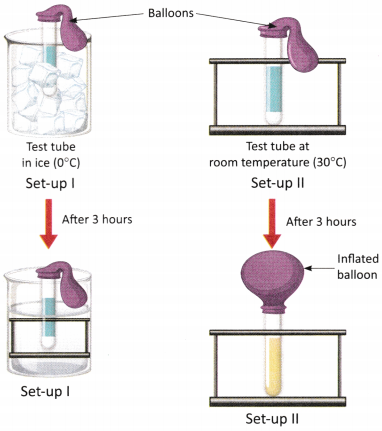
Now, answer the following questions.
Question 1.
Why is there a difference in the observations between the two test tubes?
___________________________________________
Question 2.
Which gas is released during this process?
___________________________________________
Question 3.
Name the process carried out by yeast in this experiment.
___________________________________________
C. Arjun visited his uncle’s farm during the planting season. He saw that in one part of the land, his uncle was growing peas without adding any chemical fertilisers. In another part, where maize was planted, fertilisers were being added regularly. Arjun was puzzled and asked why the treatment for the two crops was different. Can you explain why peas can grow well without adding nitrogen fertiliser, while maize needs it?
___________________________________________
___________________________________________
___________________________________________
Word Puzzle
Complete the crossword with the help of the given clues.
DOWN
1. Curved glass piece used for magnification
2. Process in which microorganisms produce gas, alcohol, or acids
4. Methane-rich fuel from waste decomposition
6. A fungus used in baking bread
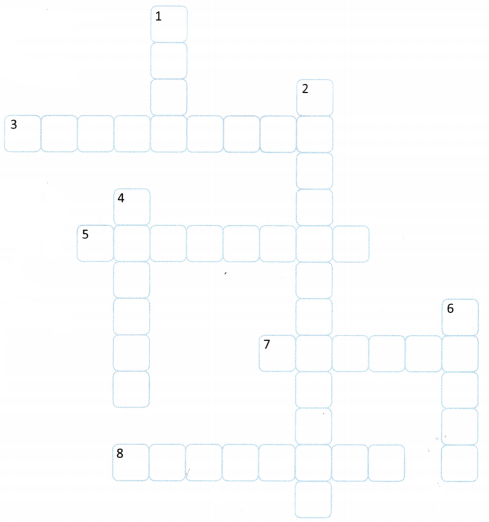
ACROSS
3. Low-cost paper microscope
5. Tiny living organisms too small to be seen with the naked eye
7. Nutrient-rich material formed by decomposition
8. A region ¡n bacterial cell having genetic material
Suggested Activities
A. To observe microorganisms in pond water, collect a small amount of water from a nearby pond or any stagnant water source with the help of a clean container. Using a dropper, place a single drop of this pond water on the centre of a clean glass slide. Carefully place a coverslip over the drop to avoid air bubbles. Place the slide under a microscope and adjust the focus slowly. Now, note your observation in a notebook and display it to your class.
B. Set up a clear glass tank in a bright place away from direct sunlight. Fill it with pond water and add live Spirulino culture. Cover with a shade net and stir the water twice a week. After 3-6 weeks, harvest the Spirulina by filtering it through a fine cloth. Observe its green colour and discuss its nutritional benefits as a protein-rich superfoo(d).
C. Visit a local mushroom farm or invite an entrepreneur to class. Observe and note the steps: preparing and sterilising the growing medium, adding mushroom spores, keeping the setup at the proper temperature and humidity, and harvesting mature mushrooms. Record your observations and discuss how mushrooms are marketed and used as foo(d).