Teachers guide students to use Exploring Society India and Beyond Class 8 Solutions and Class 8 Social Science SST Chapter 4 The Colonial Era in India Question Answer NCERT Solutions for quick learning.
Class 8 Social Science Chapter 4 Question Answer The Colonial Era in India
NCERT Class 8 Social Science Chapter 4 The Colonial Era in India Questions and Answers Solutions
The Colonial Era in India Class 8 Question Answer (In-Text)
The Big Questions?
Question 1.
What is colonialism?
Answer:
Colonialism is the practice where one country takes control of another region, establishing settlements there and imposing its political, economic, and cultural systems. Though it existed since ancient empires, the term “Age of Colonialism” usually refers to European expansion from the 15th century onwards. Colonialism often involved military conquest, economic exploitation, destruction of traditional ways of life, and imposition of foreign values. Colonisers claimed they brought ‘progress’, but in reality, they caused widespread suffering, resource loss, and cultural damage to colonised societies.
Question 2.
What drew European powers to India?
Answer:
India was a prosperous and flourishing country, with highly valued goods like spices, cotton, ivory, gems, sandalwood, and steel. Historical estimates suggest India contributed about one- fourth of the world GDP, making it one of the largest economies alongside China. Its vibrant manufacturing, agriculture, and internal and external trade networks made it attractive. European powers were also driven by the desire for economic gain, new trade routes, territorial expansion, religious conversion, and sometimes scientific curiosity. This made India a major target of colonial ambitions.
Question 3.
What was India’s economic and geopolitical standing before and during the colonial period?
Answer:
Before colonisation, India was one of the wealthiest nations, with strong trade links and a large share in global GDP. It was known for its manufacturing, textiles, and exports. However, during colonial rule, especially under the British, India’s economy declined sharply. Indian industries were dismantled, trade was controlled by the British, and heavy taxation led to widespread poverty and devastating famines. India’s wealth was drained to benefit Britain, and its geopolitical autonomy was lost as
it became part of the British Empire.

Question 4.
How did the British colonial domination of India impact the country?
Answer:
British colonial rule had a profound and damaging impact on India:
- Economic drain: Wealth was extracted to fund British growth, including the Industrial Revolution.
- Famines: Harsh taxation and neglect during famines led to millions of deaths (e.g., Bengal Famine, 1876-78 famine).
- Deindustrialisation: India’s traditional industries like textiles collapsed due to British policies.
- Loss of sovereignty: Indian kingdoms were annexed or brought under indirect control.
- Educational and cultural disruption: Traditional education systems were replaced to create a class of Indians loyal to the British.
- Exploitation of resources: India was made to export raw materials and import British goods, harming its economy.
- Resistance: These impacts led to early resistance movements, culminating in the 1857 Rebellion. While the British built infrastructure like railways and telegraphs, these were mainly for British benefit and funded by Indian taxes.
Let’s Explore
Question 1.
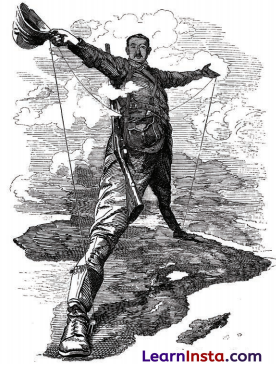
What do you think the cartoon given below, is trying to express? (Keep in mind that the telegraph, which permitted instant communications for the first time, was then a recent invention.) Analyse different elements of the drawing. (Page 87)
Answer:
This cartoon shows Cecil Rhodes, a British businessman, standing with one foot in South Africa and the other in Egypt, holding a telegraph wire. It means he wanted to connect Africa with British power from north to south using new technology like the telegraph and railway. His giant size shows British control and ambition over Africa. The cartoon shows how the British believed they were bringing progress, but it also shows how they ignored the people and countries already living there. It was made to praise British rule but also shows the unfairness of colonialism.
Question 2.
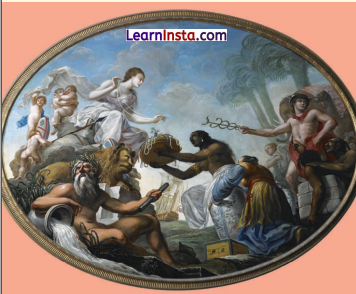
Before you read further, have a good look at the painting given below. It was specially ordered for the London headquarters of the East India Company and is over three metres long. Observe every aspect of it – the people in it, the objects, the symbols and the attitudes. Form groups of four or five students and let each group present its conclusions as regards the messages the painting conveys. (You will find our answers a few pages down, when we return to the painting, but avoid looking at them right now!) (Page 92)

Answer:
Do it yourself.
Question 3.
Why do you think Dadabhai Naoroji means by ‘un- British rule in India’? (Hint: he was an MP in the House of Commons in 1892.) (Page 98)
Answer:
Dadabhai Naoroji used the term “un-British rule in India” to show that the British were not ailing India in a fair or just way. Britain claimed to follow democracy and justice at home, but in India, they were doing the opposite—taking away wealth, treating Indians unfairly, and using India for their own benefit.
|Even though Naoroji was a Member of Parliament in Britain in 1892, he strongly spoke out against this. He proved that British rule made Indians poor and that this kind of rule was wrong and not what Britain claimed to stand for. So, he called it “un-
British” because it went against British values like fairness and justice.
Question 4.
Do you understand all the terms used like cotton, silk, wool, jute, hemp and coir, to list and describe Indian textiles? If not, form groups of four or five and try to find out more, then compare your findings with the help of your teacher. (Page 100)
Answer:
Do it yourself
Question 5.
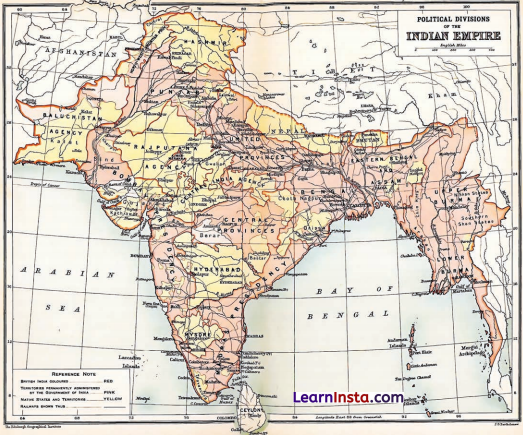
Examine the below map. What are the main differences with the map of today’s India, in terms both of borders and of names? (Page 105)
Answer:
The differences between the old map of the Indian Empire and today’s map of India:
- India included present-day Pakistan and Bangladesh, which became separate countries after 1947 and 1971.
- Burma (now Myanmar) was part of British India until 1937.
- Several city names have changed, like Bombay to Mumbai, Calcutta to Kolkata, and Madras to Chennai.
- Old regions like Punjab and Bengal are now divided between different countries.
- The map shows British-ruled areas in red. semi- controlled in pink, and princely states in yellow, while today’s India is divided into states and union territories.
- Some old names like United Provinces (now Uttar Pradesh) and Central Provinces (now Madhya Pradesh) are no longer used.
Question 6.
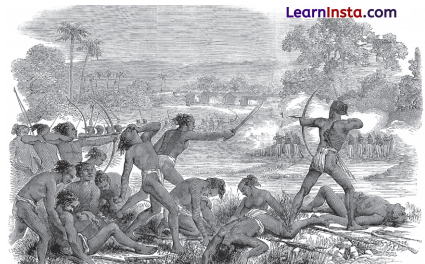
Note how the Santhals are depicted in the, 1856 sketch (given below) drawn from an artist’s imagination: observe their complexion, dress, weapons and draw your conclusions as regards the image this depiction would create in the popular mind in Britain. (Page 107)
Answer:
In the 1856 sketch of the Santhals:
- They are shown with dark skin, minimal clothing, and traditional bows and arrows.
- Their posture is aggressive, showing them as violent and wild.
- The background is rural, suggesting they live in forests or isolated areas.
This kind of drawing would make people in Britain at the time see the Santhals as primitive, dangerous, and uncivilised. It would support the idea that British rule was needed to bring ‘order’ and ‘civilisation’ to such people. The image reflects the colonial attitude of looking down upon native communities and justifying control over them.
Question 7.
Indigo is a natural deep blue pigment used in dyeing. Can you think of other natural substances that have been traditionally used in India to dye cloth? (Page 108)
Answer:
Yes, several natural substances have been traditionally used in India to dye cloth. Some of them include:
- Turmeric – gives a bright yellow color.
- Henna (Mehendi) – used for reddish or orange shades.
- Madder root – used for red and pink dyes.
- Pomegranate rind – gives yellow or greenish- yellow shades.
- Indigo – for deep blue dye.
- Haritaki (myrobalan) – gives a yellowish or light brown tint.
- Saffron – used for orange or golden hues.
- Onion skins – can be used for pale pink or light brown shades.
These dyes were eco-friendly and formed part of India’s rich textile tradition.
Question 8.
Why do you think was the term ‘Sepoy Mutiny’ rejected after Indian Independence? Write One paragraph explaining your reasons. (Page 108)
Answer:
After Indian Independence, the term ‘Sepoy Mutiny ’ was rejected because it failed to reflect the true scale and significance of the 1857 uprising. The British had used this term to downplay the event as a mere rebellion by a few discontented Indian soldiers, or sepoys, in their army. However, after independence, Indian historians and leaders viewed the uprising as a much larger and more meaningful resistance against British colonial rule, involving not just soldiers but also peasants, rulers, and common people across northern and central India. Calling it a mutiny ignored its nationalistic spirit and widespread participation. Therefore, it began to be referred to as the First War of Indian Independence, highlighting its role as an early and united effort to end foreign domination.
Question 9.
In the sentence “It opened (or re-opened) India to the world and the world to India”, why do you think we added re-opened’? (Page 112)
Answer:
In the sentence “It opened (or re-opened) India to the world and the world to India”, the word “re-opened” is added because India had already been connected to other parts of the world through trade, culture, and knowledge long before colonial rule. Ancient India traded with many countries like Rome, China, and Arabia. So, British rule did not open India to the world for the first time – it reconnected or re¬opened that connection in a new way.
Question 10.
Some argue that stolen cultural heritage has been better preserved abroad than it would have been in India. What is your view on its repatriation? Discuss ingroups. (Page 112)
Answer:
On the question of repatriation of stolen cultural heritage: Even if some artefact have been well- preserved in foreign museums, it does not change the fact that they were taken without permission during colonial rule. These items are part of India’s history and identity. They belong in India, where people can see and learn from them in their own land. Repatriating them would help restore cultural pride and correct a historical wrong.
Think About It
Question 1.
Let us return to the below painting, but now with some clues to its symbolism. Note how Britannia (a symbolic figure for Britain) sits higher than the colonies, pointing to her superior power; contrast with the lower position and bent posture of the colonies. Did they really ‘offer’ their wealth? Or did Britain seize it by force or ruse? Note also the Indians’ dark complexion (in contrast with that of Britannia), reflecting the belief in the superiority of white people over the dark-skinned ‘natives’. (Page 98-99)
Answer:
This painting is trying to show that the East, especially India and China, willingly gave their riches to Britain. But in reality, it was not a peaceful offering. The wealth was taken by force or clever tricks during colonial rule. Britannia is shown sitting high and proud, symbolising British power. The Indian and other figures are shown lower, bowing or kneeling, which makes them look weak and submissive. Their darker skin also reflects the racist idea of white superiority, which was common in Europe at the time. So, the painting tries to make colonialism look noble and generous, when in truth, it involved violence, exploitation, and injustice.
Question 2.
What exactly did Macaulay mean when he wrote that “a single shelf of a good European library was worth the whole native literature of India and Arabia”? And why should he want to make Indians “English in taste, in opinions, in morals, and in intellect”? How does this relate to the ‘civilising mission’ mentioned at the start of the chapter? Ask your teacher to guide a class debate on these questions. (Page 102)
Answer:
Macaulay meant that he believed European books and knowledge were far more valuable than all the traditional literature of India and Arabia. He saw Indian and Arabic texts as inferior and not useful for modern education. He wanted to make Indians think and behave like the British – to adopt British values, culture, and ways of thinking. This was part of the so-called “civilising mission” where the British claimed they were bringing progress and civilisation to India. In reality, it was a way to control Indians by making them feel their own culture was backward and to create a class of Indians who would support British rule.
Question 3.
What is meant by “the sun never sets on the British Empire”? Do you think this was a correct statement? (Page 104)
Answer:
“The sun never sets on the British Empire” means that the British Empire was so large and spread across so many parts of the world that, at any given time, the sun was shining on at least one of its territories. This statement was true in terms of geography, as Britain controlled colonies across different time zones. However, it was also used to show British pride and power. Still, many people today see it as a symbol of colonialism and exploitation, not something to be proud of.
Class 8 SST Chapter 4 The Colonial Era in India Question Answer (Exercise)
Question 1.
What is colonialism? Give three different definitions based on the chapter or your knowledge.
Answer:
Colonialism is a system where one country controls another territory politically, economically, and culturally, usually to exploit its resources and people.
- As described in the chapter, colonialism was not simply military conquest, but a long-term domination marked by exploitation, subjugation, and sometimes brutal repression.
- It can also be understood as a global structure of power in which colonising countries claimed superiority and justified control through ideas like the ‘civilising mission,’ even while they plundered wealth and culture.
Question 2.
Colonial rulers often claimed that their mission was to ‘civilise’ the people they ruled. Based on the evidence in this chapter, do you think this was true in the case of India? Why or why not?
Answer:
No, the idea of a ‘civilising mission’ was mostly a cover for colonial exploitation. The chapters clearly.show that British rule brought more, harm than good. While the British introduced English education and documented Indian culture, their real motive was economic gain. They looted India’s wealth, destroyed its industries, and enforced social hierarchies based on race. Their acts were more about control than upliftment.
Question 3.
How was the British approach to colonising India different from earlier European powers like the Portuguese or the French?
Answer:
The British colonised India more systematically. The Portuguese focused on coastal trade and religious conversions. The French aimed to create alliances with Indian rulers but had limited success. The British, through the East India Company, gradually established political control by manipulating rivalries among Indian states. After 1858, the British Crown took direct control, setting up extensive administrative and military systems to maintain dominance.
Question 4.
“Indians funded their own subjugation.” What does this mean in the context of British infrastructure projects in India like the railway and telegraph networks?
Answer:
It means that the British built railways, telegraphs, and other infrastructure using Indian taxes and revenues. These projects primarily served British interests-moving troops and exporting goods. While Indians paid for these developments, they didn’t benefit equally. Instead, these systems strengthened British control over India.
Question 5.
What does the phrase ‘divide and rule’ mean? Give examples of how this was used by the British in India.
Answer:
“Divide and rule” refers to the British strategy of creating divisions among Indians to prevent unity. They played one group against another—Hindus vs. Muslims, upper castes vs. lower castes, and even princely states against each other. For example, during the 1857 rebellion, they maintained the loyalty of some rulers while crushing others. Later, the introduction of separate electorates deepened communal divisions.
Question 6.
Choose one area of Indian life, such as agriculture, education, trade, or village life. How was it affected by colonial rule? Can you find any signs of those changes still with us today? Express your, ideas through a short essay, a poem, a drawing, or a painting.
Answer:
Title: Agriculture and Colonial Rule
British colonialism drastically changed Indian agriculture. Traditional farming systems were
replaced with cash crop cultivation-indigo, cotton, and opium-meant for export. Land revenue systems like the Permanent Settlement led to the rise of zamindars and the decline of peasant rights. Famines-increased due to food crop neglect. Even today, challenges like farmer indebtedness, dependence on cash crops, and unequal land ownership reflect this colonial legacy.
Question 7.
Imagine you are a reporter in 1857. Write a brief news report on Rani Lakshmibai’s resistance at Jhansi. Include a timeline or storyboard showing how the rebellion began, spread, and ended, highlighting key events and leaders.
Answer:
Headline: Jhansi’s Warrior Queen Rallies Against British Rule
Report: Jhansi, June 1857-Rani Lakshmibai, denied her rightful rule under the British ‘Doctrine of Lapse,’ has taken up arms. Defying colonial power, she led her people with unmatched bravery. Timeline:
- May 1857: Revolt begins in Meerut; spreads across North India.
- June 1857: Rani Lakshmibai defends Jhansi against British forces.
- March 1858: British siege of Jhansi begins. The Rani leads troops personally.
- April 1858: Escapes with allies like Tantia Tope.
- June 1858: Killed in battle at Gwalior. Fler legacy of courage lives on.
Question 8.
Imagine an alternate history where India was never colonised by European powers. Write a short story of about 300 words exploring how India might have developed on its own path.
Answer:
Story Title: India’s Path Without Colonisation India flourished as a federation of self-governed regions. The textile cities of Surat and Dhaka grew into global trade hubs. Without British economic drain, Indian artisans prospered. Nalanda and Takshashila reopened, blending ancient knowledge with global science.
Women held leadership roles in councils. Farmers cultivated diverse crops, supported by local cooperatives. Rivers were clean, forests protected by village panchayats. In 1900, India hosted the Pan-Asian Summit on climate and culture. By the 21st century, it had become a leading power-peaceful, pluralistic, and proud of its heritage.
Question 9.
Role-play: Enact a historical discussion between a British official and an Indian personality like Dadabhai Naoroji on the British colonial rule in India.
Answer:
Do it yourself.
Question 10.
Explore a local resistance movement (tribal, peasant, or princely) from your state or region during the colonial period. Prepare a report or poster describing:
• What was the specific trigger, if any?
• Who led the movement?
• What were their demands?
• How did the British respond?
• How is this event remembered today (e.g., local festivals, songs, monuments)?
Answer:
Do it yourself.