Students often revise Class 6 SST Extra Questions and Class 6th SST Chapter 6 The Beginnings of Indian Civilisation Important Extra Question Answer before their exams for better preparation.
The Beginnings of Indian Civilisation Class 6th Extra Question Answer
Class 6 Social Science SST Chapter 6 The Beginnings of Indian Civilisation Class 6 Extra Questions and Answers
The Beginnings of Indian Civilisation Class 6 Extra Questions Very Short Answer Type
Question 1.
What is the primary river that supported the Indus Valley civilisation?
Answer:
Indus River
Question 2.
What type of writing system did the Harappans use?
Answer:
Seals with animal figures and signs.
Question 3.
Which city was the first of the Harappan civilisation to be excavated?
Answer:
Harappa
Question 4.
Name one crop grown by the Harappans.
Answer:
Barley
Question 5.
What was the primary purpose of the ‘Great Bath’ in Mohenjo-daro?
Answer:
Its exact purpose is debated; possible uses include public bath, royal bath, or ritual tank.

Question 6.
Which metal did the Harappans use to make bronze?
Answer:
Copper and tin
Question 7.
Where is the Sarasvati River mentioned in ancient texts?
Answer:
Rig Veda
Question 8.
What is the name of the river that has dried up and is now seasonal?
Answer:
Sarasvati River (Ghaggar-Hakra River)
Question 9.
What was one of the major imports for the Harappans?
Answer:
Copper
Question 10.
What significant climatic change affected the Harappan civilisation?
Answer:
Reduced rainfall and a drier phase
Question 11.
In Rig Veda, what docs the term ‘Sapta Sindhava’ refer to?
Answer:
‘Sapta Sindhava’ refers to the land of the seven rivers/ particularly referring to the northwest region of the Indian subcontinent.
Question 12.
Name the two terms which were mentioned in Mahabharata to refer to the Indian subcontinent.
Answer:
Bharatavarsha and Jambudvipa.
Question 13.
What is the literal meaning of the term ‘Jambudvipa’?
Answer:
The term ‘Jambudvipa’, first mentioned in Mahabharata literally means ‘the island of the fruit of the Jamun tree’. This term was used to refer to the Indian subcontinent.
Question 14.
From which river was the term ‘Hindu’ derived?
Answer:
The term ‘Hindu’ was derived from the Indus River, which was earlier known as Sindhu, by the Persians.
Question 15.
Which was the common term used by most invaders of India to describe the Indian subcontinent?
Answer:
Hindustan
The Beginnings of Indian Civilisation Class 6 Extra Questions Short Answer Type
Question 1.
What were some of the key features of Harappan cities?
Answer:
Wide streets oriented to cardinal directions, fortifications, and two distinct parts (upper town and lower town).
Question 2.
Describe the water management system of Harappan cities.
Answer:
The Harappans had individual bathrooms in homes connected to a network of underground drains, wells for water supply, and large reservoirs for water harvesting and distribution.
Question 3.
What evidence suggests the Harappans were engaged in extensive trade?
Answer:
Archaeological findings include small seals used for trade, and exported goods like ornaments, gold, and cotton.
Question 4.
What was the role of the ‘Great Bath’ in Mohenjodaro according to current interpretations?
Answer:
Its purpose remains unclear, but it might have been used for public or ritual purposes.
Question 5.
How did Harappans manage their agricultural surplus?
Answer:
Agricultural produce from rural areas was transported daily to sustain the cities.
Question 6.
What technological advance is associated with Harappan craftsmanship?
Answer:
Techniques for drilling and decorating beads and working with conch shells.
Question 7.
What are two reasons proposed for the decline of the Harappan civilisation?
Answer:
Climatic changes leading to reduced rainfall and the drying up of the Sarasvati River.
Question 8.
Which Indian emperor used the term ‘Jambudvipa’ to describe India? What does this term mean for him?
Answer:
(i) Emperor Ashoka used the term ‘Jambudvipa’ in many inscriptions.
(ii) He used the term to describe present-day India, Bangladesh, Pakistan and parts of Afghanistan.
Question 9.
How did ancient Persians influence the naming of India?
Answer:
(i) Ancient Persians controlled the region of the Indus river, which was earlier known as ‘Sindhu’.
(ii) Therefore, they referred to India as ‘Hind’, ‘HidtT or ‘Hindu’, which are derived from the word ‘Sindhu’.
(iii) This Persian adaptation later led to the names used by the Greeks and even influenced the term ‘Hindustan’.
Question 10.
Who was Xuanzang, and what made him significant in the context of Indian history?
Answer:
Xuanzang was a Chinese scholar who travelled to India in the 7th century CE, studied Buddhist texts and returned to China after 17 years. He is significant because he translated many Sanskrit texts into Chinese after his return, contributing to cultural exchange between India and China, and even influenced other scholars to do the same.
Question 11.
What is the importance of the phrase ‘India, that is Bharat’, mentioned in the very beginning of the Constitution?
Answer:
The phrase ‘India, that is Bharat’ in the Indian Constitution highlights the continuity of the country’s ancient identity (Bharat) with its modern identity (India), acknowledging its historical roots and beliefs.
Question 12.
Why are names important?
Answer:
Names are important as they provide a unique label and are the fundamental identities that are carried over years or even ages. They further reflect cultural and historical contexts, facilitate communication, and symbolise deeper meanings.
The Beginnings of Indian Civilisation Class 6 Extra Questions Long Answer Type
Question 1.
Discuss the impact of environmental changes on the Harappan Civilisation.
Answer:
The decline of the Harappan Civilisation is attributed to environmental changes such as reduced rainfall and a drier phase from around 2200 BCE . This climatic shift made agriculture more difficult and decreased food supply to the cities. Additionally, the Sarasvatī River, which was crucial for the Civilisation, dried up in its central basin, leading to the abandonment of cities in that region. These environmental challenges forced people to revert to a more rural lifestyle, contributing to the decline of the civilisation.
Question 2.
Explain the role of trade in the Harappan Civilisation.
Answer:
Trade was a vital aspect of the Harappan Civilisation, both internally and externally. The Harappans engaged in active trade within their own cities and with distant regions. They exported goods such as ornaments, timber, gold, and cotton, while importing items like copper and possibly tin.
This trade was facilitated by land routes, rivers, and maritime activities, with significant trading hubs like Lothal having large dockyards. The ability to trade goods efficiently required identifying both the goods and the traders, which is reflected in the use of seals found in Harappan settlements.
Question 3.
How did the Harappans use their maritime activities and seals to facilitate trade, and what can we infer about their trade practices from these practices and artefacts?
Answer:
The Harappans engaged in extensive maritime trade by using land routes, rivers, and the sea, marking India’s first intensive maritime activity. They established coastal settlements in Gujarat and Sindh, crucial for trade. Lothal, with its large dockyard basin, highlights the significance of maritime trade.
Harappans also used steatite seals with animal figures and writing to manage trade, although the exact meanings are unclear. These seals likely helped identify goods and transactions. Overall, the Harappans demonstrated a sophisticated and organized trading system, essential for their extensive trade networks.
Question 4.
Mention how ancient and foreign accounts contributed to the naming and understanding of the unified Indian subcontinent.
Answer:
(i) Ancient texts like the Rig Veda, Mahabharata and Vishnu Purana called Indian subcontinent with names such as ‘Sapta Sindhava/ ‘Bharatavarsha/ and ‘Jambudvipa’.
(ii) These names were important as they provided a collective identity to all the regions that fell within the specified boundaries and these texts altogether highlighted the geographical and cultural unity of the area.
(iii) Foreign accounts, especially from Persians and Greeks, introduced names like ‘Hindu’ and ‘Indoi/ based on their interactions with the region, which later influenced terms like ‘Hindustan.’
(iv) These names gave global recognition to the Indian subcontinent.
(v) Together, these sources helped shape the understanding of India’s identity over the years.
The Beginnings of Indian Civilisation Class 6 Source-based Questions
1. Read the below passage and answer the following questions:
Harappa and Mohenjo-daro, now in Pakistan, were the first two cities of this civilisation to be discovered; their identification goes back to 1924, a century ago. Several sites followed in the Indus plains, which is why the civilisation was initially called ‘Indus Valley civilisation’.
Later on, other major cities, such as Dholavira (in Gujarat), Rakhigarhi (in Haryana), Ganweriwala (in the Cholistan desert of Pakistan), and hundreds of smaller sites (such as Lothal in Gujarat), were discovered, some of them excavated.
Such discoveries continue even today! It is interesting to note that the Sarasvati basin includes not only two major cities – Rakhigarhi and Ganweriwala – but also several smaller ones (Farmana in Haryana, Kalibangan in Rajasthan) and a few towns (Bhirrana and Banawali, both in Haryana); makes clear the high density of sites in that region.
Question i.
What were the first two major cities of the Indus Valley Civilisation that were discovered, and when did their identification begin?
Answer:
The first two major cities of the Indus Valley Civilisation discovered were Harappa and Mohenjodaro. Their identification began in 1924.
Question ii.
Besides Harappa and Mohenjo-daro, name two other major cities of the Indus Valley Civilisation found in the Sarasvati basin.
Answer:
Besides Harappa and Mohenjo-daro, two other major cities found in the Sarasvati basin are Rakhigarhi and Ganweriwala.
Question iii.
Which smaller sites of the Indus Valley Civilisation were discovered in Gujarat, and what is notable about these discoveries?
Answer:
Smaller sites discovered in Gujarat include Dholavira and Lothal. The notable aspect of these discoveries is that they highlight the extensive network of settlements and trade in the region.
Locating Places on the Earth Class 6 Picture-based Questions
1. Observe the below image and answer the following questions:
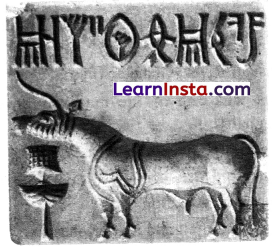
Question i.
What is depicted on the Harappan seal that has intrigued archaeologists?
Answer:
The Harappan seal depicts a unicorn.
Question ii.
What significance does the unicorn on the Harappan seal have?
Answer:
The significance of the unicorn is not entirely understood, but it is part of a larger collection of seals that are believed to be related to trade and symbolic communication in the Harappan Civilisation.
Question iii.
Why is the depiction of a unicorn on Harappan seals of interest to historians and archaeologists?
Answer:
The depiction of a unicorn is of interest because it represents a unique symbol in Harappan art and might provide insights into their symbolic language and trade practices.