Students rely on Class 9 Science Extra Questions and Class 9th Exploration Chapter 8 Extra Question Answer Journey Inside the Atom to improve their grades.
Class 9 Science Chapter 8 Journey Inside the Atom Extra Questions
Class 9 Science Chapter 8 Extra Questions on Journey Inside the Atom
Journey Inside the Atom Class 9 Very Short Question Answer
Question 1.
Why did Rutherford select the gold-foil in his α-particle scattering experiment?
Answer:
Due to high malleability of gold.
Question 2.
What is an orbit?
Answer:
Orbit is the path of the electron around the nucleus.
Question 3.
What is a neutron ? What are its characteristics?
Answer:
(i) Neutron is an elementary particle.
(ii) Mass. The mass of neutron is approximately equal to the mass of a proton, i.e., 1.672 × 10⁻²⁷ kg. or 1 u.
(iii) Charge. It carries no charge, i.e., it is a neutral particle.
Question 4.
What will the addition of a neutron to the nucleus of an atom do?
Answer:
It will increase the atomic mass of the atom.

Question 5.
Magnesium atom has 12 electrons. Which energy shell is incomplete?
Answer:
- There are 12 electrons in an atom of magnesium.
- K-shell contains 2 electrons and L-shell contains 8 electrons.Thus K and L-shell are full.
- Remaining 2 electrons (12 – 2 – 8 = 2) are accommodated in third or M-shell.
- M-shell can accommodate 18 electrons. So M-shell is incomplete.
Question 6.
Fluorine atom has 9 electrons and 9 protons. How many energy shells it has?
Answer:
Since only 2 electrons can be accommodated in the first shell, the remaining seven electrons are accommodated in the second shell or L-shell which has a maximum capacity of 8 electrons. So, fluorine can have two energy shells.
Question 7.
What is meant by electronic configuration of elements?
Answer:
The systematic distribution of electrons in various orbits or energy shells of an atom is called the electronic configuration of elements.
Question 8.
If the atomic number of an element is 18, find out the following:
(a) Number of valence electrons.
(b) Valency.
Answer:
The electronic configuration of the element is 2, 8, 8.
(a) It has 8 valence electrons
(b) Valency = 0
Question 9.
Which property of an element can be used for its identification?
Answer:
Atomic number
Question 10.
The mass number of chlorine atom is 35 and its atomic number is 17. How will this chlorine atom be represented?
Answer:
\({ }_{17}^{35} Cl\)
Question 11.
Give one point of similarity and one point of difference between isotopes of \({ }_6^{14} C\) and \({ }_6^{12} C\).
Answer:
Similarity:
Both \({ }_6^{14} C\) and \({ }_6^{12} C\) have similar chemical properties.
Difference:
\({ }_6^{14} C\) and \({ }_6^{12} C\) have different masses.
Question 12.
Name the elements whose isotopes are used in:
(i) Nuclear Reactor
(ii) Treatment of cancer
Answer:
(i) Uranium
(ii) Cobalt.
Question 13.
Given that natural sample of iron has isotopes \({ }_{26}^{54} F e\), \({ }_{26}^{56} Fe\) and \({ }_{26}^{57} Fe\) in the ratio of 5 %, 90 % and 5 % respectively. What will be the average atomic mass of iron (Fe)?
Answer:
Average atomic mass of iron = 54 × \(\frac{5}{100}\) + 56 × \(\frac{90}{100}\) + 57 × \(\frac{5}{100}\)
= 2.7 + 50.4 + 2.85 = 55.95.
Journey Inside the Atom Class 9 Short Question Answer
Question 1.
Describe the magnitude of the size of an atom in comparison to its nuclear size.
Answer:
The radius of an atom is 105 times greater than the radius of the nucleus.
\(\frac{\text { Radius of an atom }}{\text { Radius of nucleus }}=\frac{10^{-8} \mathrm{~cm}}{10^{-13} \mathrm{~cm}}\)
= 105 = 100,000.
Question 2.
What was the model of atom as proposed by Rutherford?
Answer:
The main features of Rutherford’s model of an atom are:
(i) The atom consists of a positively charged centre called the nucleus.
(ii) Most of the mass is concentrated in the nucleus.
(iii) The volume of the nucleus is very small compared to the total volume of the atom.
(iv) The nucleus is surrounded by the negatively charged electrons which are revolving round the nucleus at very high speeds like the planets revolving round the sun.
Question 3.
Why are the shells in which the electrons revolve around the nucleus of an atom called energy levels?
Answer:
An electron revolving in a shell is associated with a definite amount of energy. Its energy changes when it jumps to another shell, that is to say when it goes from one level of energy to another level of energy. Thus, a shell also gives the energy of an electron besides its location and are, therefore, called energy shells or levels.
Question 4.
What was the concept incorporated by Neils Bohr in the model of atom proposed by him?
Answer:
He gave a new concept that particles at atomic level would behave differently from the macroscopic objects. He suggested that electrons could revolve in stable orbits without continuously radiating or losing energy. According to Bohr’s model, an electron revolves in an orbit with well-defined energy.
Question 5.
State the similarities and dissimilarities between protons and neutrons.
Answer:
Similarities:
(i) Both protons and neutrons are present in the nucleus of an atom.
(ii) The mass of a neutron is approximately equal to the mass of a proton, i.e., 1.67 × 10⁻²⁷ kg.
Dissimilarities:
(i) Protons possess a unit positive charge (1.6 × 10⁻¹⁹ coulomb).
(ii) Neutron carries no charge, i.e., it is electrically neutral particle.
Question 6.
Argon atom has 18 electrons. How many energy shells or orbits are incomplete? How many energy shell it contains?
Answer:
Distribution of 18 electrons in argon atom is as follows:
K-shell = 2 electrons
L-shell = 8 electrons
M-shell = 8 electrons
- K-shell and L-shell have maximum capacity of 2 and 8 electrons respectively.
- M-shell has a capacity of 18 electrons.
- Since, it is the outermost orbit and there is a rule that ‘the maximum number of electrons that can be accommodated in the outermost orbit is 8’.
- In the present case, M-shell is also complete.
- Thus, in argon atom, no shell is incomplete.
- Argon atom has three energy shells.
Question 7.
What are the similarities in the electronic structure of the following sets of atoms: No. of electrons in each atom is given in brackets:
Lithium (3), sodium (11), potassium (19), helium (2), neon (10), argon (18), beryllium (4), magnesium (12) and calcium (20).
Answer:
- Lithium (2, 1), sodium (2, 8, 1) and potassium (2, 8, 8,1) all have one electron in outermost shell.
- Helium (2) , neon (2, 8) and argon (2, 8, 8) all have eight electrons in outermost shell.
- Beryllium (2, 2), magnesium (2, 8, 2) and calcium (2, 8, 8, 2) all have two electrons in outermost shell.
Question 8.
An element \({ }_{12}^{24} X\) loses two electrons to form a cation which combines with the anion of element \({ }_{17}^{35} Y\) formed by gaining an electron.
(i) Write the electronic configuration of element X.
(ii) Write the electronic configuration of the anion of element Y.
(iii) Write the formula of the compound formed by the combination of X and Y.
Answer:
(i) 2, 8, 2 (Atomic no. 12). Cation X2+ is (2, 8).
(ii) 2, 8, 7 (Atomic no. 17). Anion Y1- is (2, 8, 8).
(iii) XY2
Question 9.
What are valence electrons? Give two examples to illustrate the answer.
Answer:
The number of electrons present in the outermost shell of an atom are known as valence electrons.
Examples:
| Element | No. of electrons | Electronic configuration | Valence electrons |
| Boron | 5 | 2, 3 | 3 |
| Oxygen | 8 | 2, 6 | 6 |
Question 10.
An element has 16 protons. How many electrons will be present in K, L and M shell of its atom. What will its electrovalency be?
Answer:
No. of electrons = no. of protons = 16
Electronic configuration: K = 2; L = 8; M = 6
Valence electrons in the element are 6.
∴ Valency or electrovalency is 8 – 6 = 2.
Question 11.
What is atomic number? How has this concept improved the definition of an element?
Answer:
Atomic number of an element is equal to the number of protons present in the nucleus of its atom.
∴ Atomic number = Number of unit positive charges on the nucleus
Since the atom as a whole is electrically neutral, therefore, atomic number is the same as the number of electrons around the nucleus of an atom.
Atomic number gives the position of the element in the periodic table. In terms of atomic number an element can now be defined as a substance comprising of atoms all of which have the same atomic number.
Question 12.
What information do you get from the figure given below about the atomic number, mass number and valency of atoms X, Y and Z. Give your answer in tabular form.

Answer:
| Atoms | X | Y | Z |
| Atomic number | 5 | 8 | 15 |
| Mass number | 11 | 18 | 31 |
| Valency | 3 | 2 | 3 |
Question 13.
State the similar properties of isotopes.
Answer:
Properties of isotopes are:
(i) Isotopes of an element have same atomic number.
(ii) Isotopes of an element have similar chemical properties.
(iii) Isotopes of an element have similar no. of electrons.
(iv) Isotopes of an element have similar electronic configurations.
Example.
The three isotopes of oxygen are \({ }_8^{16} O\), \({ }_8^{17} O\) and \({ }_8^{18} O\). They have same atomic no. (i.e., 8) and same no. of electrons (i.e., 8) and same electronic configuration (i.e., 2, 6).
Question 14.
List applications of any three isotopes in various fields.
Answer:
Isotopes have the following uses:
(i) Treatment of diseases—Radioactive isotopes are used for the treatment of dreadful diseases like cancer. Cobalt-60 is used to kill malignant cells in patients suffering from cancer.
(ii) Radioactive isotopes are used in chemical analysis.
(iii) Diseases in plants are investigated by using radioactive isotopes.
(iv) Production of energy: Uranium-235 can be subjected to fission process and thus production of electricity.
(v) Dating of plants, animals/human beings obtained from ancient times after excavation by using carbon-14.
(vi) I – 131 is used in the treatment of thyroid disorders.
(vii) P – 32 is used in the treatment of leukaemia.
Journey Inside the Atom Class 9 Long Question Answer
Question 1.
List three conclusions drawn by Rutherford from his alpha-particle scattering experiment. State three features of nuclear model of an atom put forward by Rutherford.
Answer:
Rutherford was interested in knowing how the electrons are arranged within an atom. He designed an experiment in which fast moving a-particles were made to fall on a thin gold foil. He selected gold foil because he wanted a thin layer as small as possible. Gold foil was about 1000 atoms thick, a-particles were selected as these have a considerable amount of energy. He expected a-particles to be deflected by protons in the atom. Since protons are lighter than a-particles, he did not expect large deviations.
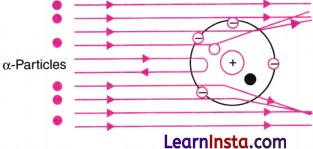
When Rutherford bombarded thin sheet of gold foil (about 1000 atoms thick) with a-particles (α-particles are doubly charged helium ions, He2+), he found that:
(i) Most of the α-particles pass through the foil without any deflection. He calculated that only one particle out of 12000 bounced back. This shows that most of the space inside the atom is empty and hollow.
(ii) Some of the α-particles were deflected through various angles while a very small number were actually deflected by as much as 180°.
This shows that: Conclusions/Observations made by Rutherford:
(a) There is a heavy positively charged centre inside the atom. This centre is known as nucleus.
(b) Since only a very small fraction of α-particles were deflected through large angles, the nucleus is situated in a very small volume of the atom and is positively charged. The nucleus was found to be about 105 times smaller than the total area occupied by the atom as a whole.
(c) Since α-particles deflected by the nucleus have an appreciable mass, it means that the entire mass of the atom lies inside the nucleus.
Question 2.
From Rutherford’s α-particle scattering experiment give the experimental evidence for deriving the conclusion that
(i) most of the space inside the atom is empty.
(ii) the nucleus of an atom is positively charged
Answer:
(i) When α-particles are allowed to strike a very thin gold foil, it is found that most of these particles pass through the foil without any deflection. It is calculated that one particle in 105 deflected back by 180° showing that larger part (105 : 1) of the atomic space is empty.
(ii) The fact that atomic nuclei are positively charged can be shown by performing Ruther-ford’s α-particle scattering experiment. Take a thin sheet of metal foil. Allow α-particles to bombard over it. It will be observed that only a small fraction of α-particles (positively charged) are deflected through large angles and the rest pass through the foil without any deflection. This shows that positive charge of the atom is concentrated at the centre of the nucleus.
Question 3.
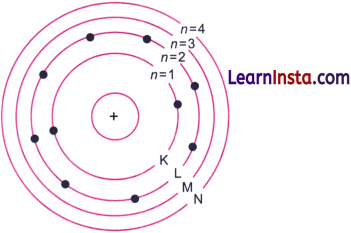
Describe the main features of Bohr’s model of an atom. Draw a neat and labelled diagram of energy levels.
Answer:
According to Bohr’s theory:
(i) The atom consists of a small (positively charged) nucleus at its centre.
(ii) The whole mass of the atom is concentrated at the nucleus and the volume of nucleus is smaller than the volume of the atom by a ratio of about 1 : 105.
(iii) All the protons and neutrons of the atom are contained in the nucleus.
(iv) The electrons of the atom revolve round the nucleus in definite circular paths known as orbits or shells which are designated as K, L, M, N etc. or numbered as (n) = 1, 2, 3, 4 etc. outward from the nucleus.
(v) Each orbit is associated with a fixed amount of energy. Therefore, these orbits are also known as energy levels or energy shells.
(vi) The energy of the atom changes when an electron jumps from one state (energy level) to another state (energy level). As long as an electron remains in a particular orbit, it does not lose or gain energy.
Question 4.
State the suggestions made by Bohr and Bury with regard to distribution of electrons in different energy levels in the atoms of elements.
Or
Explain Bohr and Bury rules for maximum number of electrons in different shells and number of electrons in valence shell.
Answer:
Bohr and Bury gave the following rules for the distribution of electrons around the nucleus.
Electrons are revolving around the nucleus in different orbits or shells. These energy shells are represented by numbers 1, 2, 3, 4 or K, L, M, N.
(ii) The maximum number of electrons in any shell cannot exceed 2n2, where n is the number of that energy level.
Thus for K-shell, n = 1, no. of electrons = 2 × 12 = 2
L-shell, n = 2, no. of electrons = 2 × 22 = 8
M-shell, n = 3, no. of electrons = 2 × 32 = 18
N-shell,w = 4, no. of electrons = 2 × 42 = 32.
(iii) The outermost orbit of an atom cannot have more than 8 electrons and the next to the outermost shell (penultimate shell) can have at the most 18 electrons.
(iv) It is not absolutely necessary that an orbit has its full quota of electrons before starting to fill the next higher orbit but the shells are filled in a stepwise manner.
Question 5.
The following data represents the distribution of electrons, protons and neutrons in atoms of four elements A, B, C and D.
| Element | Protons | Neutrons | Electrons |
| A | 9 | 10 | 9 |
| B | 16 | 16 | 16 |
| C | 12 | 12 | 12 |
| D | 17 | 22 | 17 |
Answer the following questions:
(a) Give the electronic distribution of element B.
(b) The valency of element A.
(c) The atomic number of element B.
(d) The mass number of element D.
Answer:
(a) Electronic distribution of B = 2, 8, 6
(b) Electronic distribution of A is 2, 8, 1 and so its valency is + 1.
(c) Since B contains 16 protons and so its atomic number is 16.
(d) Mass number of D = Number of protons + number of neutrons
= 17 + 22 = 39
Question 6.
Explain the method to write the electronic configuration of the atom of an element whose mass number (A) is 35 and atomic number 16. What are the no. of electrons, protons and neutrons?
Answer:
Writing of electronic configuration We know that K-shell (n = 1) can accommodate only two electrons. Hence out of 16 electrons 2 occupy K-shell, L-shell (n = 2) can accommodate 8 electrons, therefore, of the remaining 14, 8 electrons go to L-shell. 6 electrons are left, M-shell (n = 3) can accommodate 18 electrons. Hence all the 6 electrons will occupy M-shell. Thus
K-shell – 2 electrons;
L-shell – 8 electrons;
M-shell – 6 electrons.
Number of protons = atomic number = 16
∴ No. of neutrons = mass no. – no. of protons
= 35 – 16 = 19
∴ No. of electrons = no. of protons = 16.
Question 7.
If the mass number of an atom of element is 23 and its atomic number is 11, then:
(a) Write its electronic configuration and valency.
(b) Find the number of neutrons in its nucleus.
(c) Mention the type of ion formed by it
Answer:
(a) No. of electrons = No. of protons = atomic number = 11
∴ Electronic configuration is 2, 8, 1.
Valency is 1.
(b) Number of neutrons = Mass number – atomic number
= 23 – 11 = 12
(c) It forms + ve ion.
Question 8.
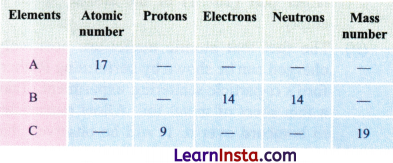
Complete the following table:
Answer:
| Elements | Atomic number | Protons | Electrons | Neutrons | Mass number |
| A | 17 | 17 | 17 | 18 | 35 |
| B | 14 | 14 | 14 | 14 | 28 |
| C | 9 | 9 | 9 | 10 | 19 |
Question 9.
Atom A has a mass number 238 and atomic number 92 and atom B has mass number 235 and atomic number 92.
(i) How many protons, atoms A and B have?
(ii) How many neutrons, atoms A and B have?
(iii) Are atoms A and B isotopes of the same element? How?
Answer:
(i) Both atoms A and B have the same number of protons = atomic number = 92
(ii) Number of neutrons in atom A = Mass number – Atomic number
= 238 – 92 = 146
Number of neutrons in atom B = 235 – 92 = 143
(iii) Atoms A and B are isotopes of the same element as they have similar chemical properties. This is because both have same number of electrons.
Question 10.
The description of atomic particles of two elements X and V is given below:
| X | Y | |
| Protons | 8 | 8 |
| Neutrons | 8 | 9 |
| Electrons | 8 | 8 |
(i) What is the atomic number of Y?
(ii) What is the mass number of X?
(iii) What is the relation between X and Y?
(iv) Which element/elements do they represent?
(v) Write the electronic configuration of X?
(vi) Write the cation/anion formed by the element XandY.
Answer:
(i) Atomic number of Y = Number of protons = 8
(ii) Mass number of X = Number of protons + number of neutrons
= 8 + 8 = 16
(iii) Both X and Y have same atomic number and so are isotopes.
(iv) X and Y represent oxygen atoms.
(v) Electronic configuration of X = 2, 6
(vi) Anion, X-2 or Y-2.
Journey Inside the Atom Class 9 Case Based Questions
Case I.
We know that protons are present in the nucleus of an atom. It is the number of protons of an atom which determines its atomic number and hence identity. After studying the properties of subatomic particles it is concluded that protons together with neutrons reside in the nucleus and this determines the mass of the atom. The number of protons and neutrons together are known as nucleus.
Answer the following questions:
Question 1.
Where do the electrons reside?
Answer:
In the extranuclear part.
Question 2.
Where is the positive charge of the atom situated?
Answer:
In the nucleus
Question 3.
What are such atoms called which have same number of protons but different number of nucleons?
Answer:
Isotopes
Question 4.
What are such atoms called which have same number of nucleons but different number of protons?
Answer:
Isobars
Case II.
Atom is a neutral particle. The study of static electricity and the fact that electricity is conducted by charged particles revealed that an atom is divisible and consists of charged particles. In 1900 J.J. Thomson identified the presence of one sub-atomic particle. It was called electron. Even before the electron was identified, E. Goldstein in 1886 discovered the emanation of positively charged radiations from the atoms. This led to the discovery of another sub-atomic particle which had a charge equal in magnitude but opposite in sign to that of the electron. It was given the name proton. It was also found that the electron could be easily peeled off but not protons.
Answer the following questions:
Question 1.
What makes removal or peeling of electrons easier but not of protons?
Answer:
The protons are densely populated in the interior of the atom whereas electrons are sparsely located around the nucleus.
Question 2.
Positive charge is formed when an electron or more electrons are removed from an atom. Is the negative charge formed by removal of a proton?
Answer:
Protons are never removed from the atom. Negative charge is formed by addition of electron/s.
Question 3.
What sub-atomic particles are involved in the conduction of electricity through metals?
Answer:
Electrons
Question 4.
What particles make the conduction through solutions possible?
Answer:
Movement of positive and negative ions in the solution.
Journey Inside the Atom Extra Questions for Practice
Very Short Answer Type Questions
Question 1.
An element ‘X’has a mass number 4 and atomic number 2. Find the valency of ‘X’.
Question 2.
What is the maximum number of electrons which can be accommodated in the outermost orbit of an atom?
Question 3.
Name the subatomic particles which are same in two isotopic species of an atom.
Question 4.
Where are the electrons and protons located in an atom?
Question 5.
Find the number of electrons, protons and neutrons possessed by the alpha particles \({ }_2^{4} He\)++ used in the gold leaf experiment.
Question 6.
Name any two noble gases.
Short Answer Type Questions
Question 1.
Write the distribution of electrons in various orbits of Magnesium having atomic number 12.
Question 2.
What unexpected observations were obtained by E. Rutherford during his experiments?
Question 3.
Which of the Na+ and He has completely filled K and L shells? Give reason to support your answer.
Question 4.
An element B-1 contains 18 electrons and 18 neutrons. Calculate the atomic number and mass number of element A. Identify A.
Question 5.
Define isobars. Discuss their physical and chemical properties.
Question 6.
Give reason: Noble gases show least reactivity.
Long Answer Type Questions
Question 1.
(a) Explain Bohr and Bury rules for distribution of electrons into different shells.
(b) Draw the electronic structure of element X with atomic number 17 and element Y with atomic number 16?
Question 2.
What are the different properties of the neutrons? Compare these with the properties of electrons and protons.
Question 3.
Define valency. How is it calculated? Explain the formation of two ionic compounds and two covalent compounds on the basis of valency.
Question 4.
What is the ‘present concept of an atom’? Describe in detail why this model is considered to be the most appropriate model.
Question 5.
(a) Explain why Rutherford selected a gold foil in his alpha scattering experiments.
(b) What observations in α-scattering experiment led Rutherford to make the following observations:
(i) Most of the space in an atom is empty.
(ii) Nucleus is positively charged.
(c) Mention any two drawbacks of Rutherford’s model.
Question 6.
An atom of an element has 4 electrons in the outermost M shell. What will be the atomic number of this element? Name this element. Find the valency of this element. Draw the schematic diagram of its atom showing the distribution of electrons in its shells.