Students rely on Class 9 Science Extra Questions and Class 9th Exploration Chapter 9 Extra Question Answer Atomic Foundations of Matter to improve their grades.
Class 9 Science Chapter 9 Atomic Foundations of Matter Extra Questions
Class 9 Science Chapter 9 Extra Questions on Atomic Foundations of Matter
Atomic Foundations of Matter Class 9 Very Short Question Answer
Question 1.
Who proposed the law of conservation of mass?
Solution:
Antoine Lavoisier
Question 2.
What does the law of conservation of mass state?
Solution:
Mass can neither be created nor destroyed in a chemical reaction.
Question 3.
What did Dalton say about atoms of different elements?
Solution:
They differ in mass and properties.
Question 4.
Why is the law of conservation of mass important in chemistry?
Solution:
It helps balance chemical equations.
Question 5.
Does the total mass of reactants equal the total mass of products?
Solution:
Yes.

Question 6.
Can mass vanish during a chemical reaction?
Solution:
No.
Question 7.
Is the law of conservation of mass applicable to physical changes?
Solution:
Yes, it applies to both physical and chemical changes.
Question 8.
Who proposed the law of constant proportions?
Solution:
Joseph Louis Proust.
Question 9.
What does the law of constant proportions state?
Solution:
A chemical compound always contains the same elements in the same fixed ratio by mass.
Question 10.
Give one example of the law of constant proportions.
Solution:
Water (H2O) always has hydrogen and oxygen in the ratio 1 : 8 by mass.
Question 11.
Is the ratio of elements in a compound variable?
Solution:
No, it is fixed.
Question 12.
Who proposed the atomic theory?
Solution:
John Dalton
Question 13.
When was Dalton’s atomic theory proposed?
Solution:
In 1808.
Question 14.
What does Dalton’s atomic theory state about matter?
Solution:
Matter is made up of tiny, indivisible particles called atoms.
Question 15.
Are atoms of the same element identical according to Dalton?
Solution:
Yes, they have the same mass and properties.
Atomic Foundations of Matter Class 9 Short Question Answer
Question 1.
How does the Law of Conservation of Mass apply to chemical reactions? Explain with reference to a closed system.
Solution:
The Law of Conservation of Mass states that matter can neither be created nor destroyed during chemical reactions. In closed systems, total mass before reaction equals total mass after reaction. When baking soda reacts with vinegar producing carbon dioxide, if conducted in a closed container with a balloon, the gas is trapped and total mass remains unchanged, verifying this law.
Question 2.
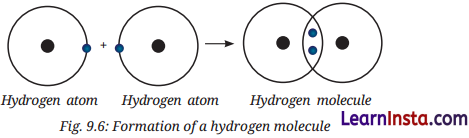
Explain how a covalent bond is formed in a hydrogen molecule (H2).
Solution:
Hydrogen atoms have one electron in their K-shell and need one more to become stable with a duplet configuration. Two hydrogen atoms share one electron each to complete their shells. This shared pair of electrons forms a single covalent bond between them. The resulting hydrogen molecule is represented as H-H or H2 and exists as a stable entity.
Question 3.
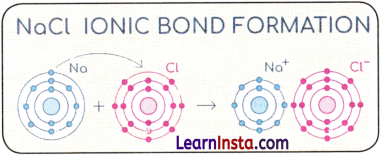
Describe the formation of sodium chloride (NaCl) through ionic bonding.
Solution:
Sodium has one valence electron which it loses to achieve stability, forming a positively charged cation (Na+) with 11 protons and 10 electrons. Chlorine has seven valence electrons and gains one electron to complete its octet, forming a negatively charged anion (Cl–) with 17 protons and 18 electrons. The electrostatic attraction between oppositely charged Na+ and Cl– ions creates an ionic bond.
Question 4.
What is the Law of Constant Proportions? Provide an example to support your answer.
Solution:
The Law of Constant Proportions, proposed by Joseph Louis Proust, states that elements in any chemical compound are always present in a fixed ratio by mass, regardless of source or preparation method. For example, water always contains hydrogen and oxygen in the mass ratio of 1 : 8. Thus, 9 grams of water will always decompose to give 1 gram of hydrogen and 8 grams of oxygen.
Question 5.
Why do ionic compounds conduct electricity in aqueous or molten state but not in solid state?
Solution:
In solid state, ions in ionic compounds are fixed in their crystal lattice positions and cannot move freely, preventing electrical conductivity. However, in aqueous solution or molten state, these ions become free to move. The movement of charged ions allows the flow of electric current, enabling ionic compounds to conduct electricity under these conditions but not when solid.
Question 6.
In a reaction, 12 g of carbon combines with 32 g of oxygen to form carbon dioxide. Find the mass of carbon dioxide formed.
Solution:
Mass of reactants = 12 g + 32 g = 44 g
Mass of product = 44 g (same, by law of conservation of mass)
Question 7.
4 g of hydrogen reacts with 32 g of oxygen to form water. Calculate the mass of water formed.
Solution:
Mass of reactants = 4 g + 32 g = 36 g
Mass of product = 36 g (water formed)
Question 8.
When 5 g of calcium reacts with 2 g of oxygen, calcium oxide is formed. What is the mass of calcium oxide produced?
Solution:
Mass of reactants = 5 g + 2 g = 7 g
Mass of product = 7 g (calcium oxide)
Question 9.
Why is the Law of Conservation of Mass important in chemistry?
Solution:
This law is important because:
(i) It helps in balancing chemical equations.
(ii) It proves that matter is indestructible in ordinary chemical reactions.
(iii) It provides the basis for quantitative chemical analysis. Without this law, predicting the amount of products formed in a reaction would be impossible.
Question 10.
Why is the Law of Constant Proportions important in chemistry?
Solution:
(i) It proves that compounds have a definite composition.
(ii) It distinguishes compounds from mixtures, since mixtures can vary in composition.
(iii) It provides a foundation for Dalton’s Atomic Theory.
(iv) It helps chemists analyse and predict the composition of compounds accurately.
Atomic Foundations of Matter Class 9 Long Question Answer
Question 1.
Analyse how Dalton’s Atomic Theory explains the Law of Conservation of Mass and the Law of Constant Proportions in chemical reactions.
Solution:
Dalton’s Atomic Theory explains both laws through its postulates. It states atoms are indivisible and can neither be created nor destroyed during chemical reactions, only rearranged. This directly explains the Law of Conservation of Mass as total mass remains unchanged when atoms simply rearrange. The theory also states atoms combine in simple whole number ratios and that the relative number and kinds of atoms in a compound remain constant. This explains the Law of Constant Proportions, as fixed atom ratios mean fixed mass ratios in compounds regardless of source.
Question 2.
Compare the properties of ionic and covalent compounds in terms of solubility, electrical conductivity, and melting points.
Solution:
Solubility:
Ionic compounds like sodium chloride dissolve in water but not in kerosene or petrol, while covalent compounds like camphor dissolve in kerosene and petrol but not in water.
Electrical conductivity:
Ionic compounds conduct electricity in aqueous or molten state due to free ions, but not in solid state. Covalent compounds generally do not conduct electricity even in solution as they lack free ions.
Melting and boiling points:
Ionic compounds have high melting and boiling points due to strong electrostatic forces, whereas covalent compounds usually have lower melting and boiling points.
Question 3.
Justify why atoms combine to form molecules and explain the two main ways atoms achieve stability when combining.
Solution:
Atoms combine to form molecules because they seek to achieve a stable electronic configuration with complete outermost shells (octet for most, duplet for hydrogen and helium). When atoms combine, the total energy of the system becomes lower than individual atoms’ energies, making the arrangement more stable. Atoms achieve stability through two main methods: sharing electrons to form covalent bonds (like in H– and O– molecules), or transferring electrons to form ionic bonds where one atom loses electrons becoming a cation and another gains electrons becoming an anion (like in NaCl).
Atomic Foundations of Matter Class 9 Case Based Questions
I. The simplest compounds, which are made up of two different elements are called binary compounds. While writing the chemical formulae for compounds, the constituent elements and their valencies are written. Then crossover the valencies of the combining atoms. For the ionic compound, the symbol of cation written first followed by the symbol of the anion. Then their charges are criss-crossed to get the formula. The
positive and negative charges must balance each other and the overall structure must be neutral. The molecular mass of a substance is the sum of the atomic masses of all the atoms in a molecule of the substance.
Answer the following questions:
Question 1.
Which of the following statement correctly justifies that crystallisation technique considered better than simple evaporation to purify solid?
(a) Solid decompose or get charred on heating to dryness.
(b) Impurities may remain dissolved in the solution even after filtration.
(c) Both (a) and (b)
(d) Impurities are easily removed in solution.
Answer:
(c) Both (a) and (b)
Question 2.
In magnesium chloride, ________ chloride ions for each magnesium ion.
(a) one
(b) two
(c) three
(d) four
Answer:
(b) two
Question 3.
The molecular mass of HNO3 is
(a) 63 u
(b) 1 u
(c) 54 u
(d) 45 u
Answer:
(a) 63 u
Question 4.
The formula unit mass of CaCl2 is:
(a) 111 u
(b) 342 u
(c) 213 u
(d) 122 u
Answer:
(a) 111 u
Question 5.
The formula unit mass of a substance is:
(a) the sum of the atomic masses of all atoms
(b) the sum of the atomic mass of only one atom
(c) both (a) and (b)
(d) none of the above
Answer:
(a) the sum of the atomic masses of all atoms
Atomic Foundations of Matter Extra Questions for Practice
Very Short Answer Type Questions
Question 1.
State the Law of Conservation of Mass.
Question 2.
In a reaction: 3 g of hydrogen reacts with 24 g of oxygen. What is the mass of water formed?
Question 3.
Give one example to verify the Law of Conservation of Mass.
Question 4.
State the Law of Constant Proportions.
Question 5.
In water, hydrogen and oxygen are present in the ratio 1 : 8 by mass. If 9 g of water is formed, how much oxygen is present?
Question 6.
State the postulates of Dalton s Atomic Theory.
Short Answer Type Questions
Question 1.
How does Dalton s theory explain:
(i) Law of conservation of mass
(ii) Law of constant proportions
Question 2.
Write chemical formulae for:
(i) Sodium chloride
(ii) Calcium oxide
(iii) Aluminium oxide
(iv) Potassium sulphate
Question 3.
Write the formula for:
(i) Ammonium chloride
(ii) Magnesium hydroxide
Question 4.
What are ions? Give examples.
Question 5.
Write steps for writing chemical formulae.
Question 6.
Why do ionic compounds have high melting points?
Question 7.
Why do covalent compounds have low melting points?
Question 8.
Write any four differences between ionic and covalent compounds.
Question 9.
Calculate molecular mass of:
(i) H2O
(ii) CO2
(iii) NH3
Question 10.
Calculate formula unit mass of:
(i) NaCl
(ii) CaCO3
(iii) K2O
Long Answer Type Questions
Question 1.
State the Law of Constant Proportions. Explain with a suitable experiment.
Question 2.
Differentiate between the two laws with examples.
Question 3.
Write the limitations of Dalton s atomic theory.
Question 4.
Explain step-by-step how to write chemical formulae with two examples.
Question 5.
Write the formulae of the following compounds and explain the method:
(i) Calcium chloride
(ii) Aluminium oxide
(iii) Ammonium sulphate
Question 6.
What are polyatomic ions? Give examples and explain their role in writing formulae.
Question 7.
Compare ionic and covalent compounds on the basis of:
(i) Formation
(ii) Melting and boiling points
(iii) Electrical conductivity
(iv) Solubility
Question 8.
Define molecular mass and explain how it is calculated with examples.
Question 9.
Define formula unit mass. How is it different from molecular mass?
Question 10.
Calculate:
(i) Molecular mass of CO2 and NH3
(ii) Formula unit mass of NaCl and CaCO3 (show full steps)
Case/ Source Based Questions
I. Atoms are too small, or they are smaller than anything that we can imagine or compare with. Our entire world is made up of atom. Dalton was the first scientist to use the symbols for elements in a very specific sense. When he used a symbol for an element he also meant a definite quantity of that element, that is, one atom of that element. In the beginning, the names of elements were derived from the name of the place where they were found for the first time. For example, the name copper was taken from Cyprus. Many of the symbols are the first one or two letters of the element’s name in English. The first letter of a symbol is always written as a capital letter (uppercase) and the second letter as a small letter (lowercase).
Answer the following questions:
Question 1.
1 m is equal to nm
(a) 1010
(b) 109
(c) 108
(d) 106
Question 2.
S is the symbol of
(a) sulphur
(b) iron
(c) silver
(d) mercury
Question 3.
Who suggested the symbol of elements are made from one or two-letter of the atom?
(a) Proust
(b) Berzelius
(c) Boyle
(d) Robert
Question 4.
Law of constant proportion is given by
(a) Proust
(b) Lavoisier
(c) Dalton
(d) Berzelius
Question 5.
Full form of IUPAC
(a) International Union of Pure and Applied Chemistry
(b) International Unity of Pure and Applied Chemistry
(c) Indian Union of Pure and Applied Chemistry
(d) none of these