Students rely on Class 9 Science Extra Questions and Class 9th Exploration Chapter 7 Extra Question Answer Work Energy and Simple Machines to improve their grades.
Class 9 Science Chapter 7 Work Energy and Simple Machines Extra Questions
Class 9 Science Chapter 7 Extra Questions on Work Energy and Simple Machines
Work Energy and Simple Machines Class 9 Very Short Question Answer
Question 1.
Define 1 Joule of work.
Answer:
Work is said to be 1 Joule when a force of 1 newton moves an object through a distance of 1 metre in the direction of the force.
Question 2.
Define Power.
Answer:
Power is the rate of doing work or the rate of transfer of energy.
Question 3.
State the Law of Conservation of Energy.
Answer:
Energy can neither be created nor destroyed; it can only be transformed from one form to another.
Question 4.
A boy and a girl do the same work in 5 minutes and 10 minutes respectively. Which of these two has more power and why?
Answer:
P = \(\frac{W}{t}\)
As the boy takes less time to do the t same work as compared to the girl, so power of the boy is more than that of the girl.
Question 5.
Define Mechanical Advantage (MA).
Answer:
It is the ratio of the load lifted to the effort applied.

Question 6.
What is a “fulcrum”?
Answer:
The fixed point about which a lever turns or pivots.
Question 7.
Which class of lever is a pair of scissors?
Answer:
First-class lever (Fulcrum is in the middle).
Question 8.
Can the potential energy of an object be negative?
Answer:
Yes, potential energy is negative when forces involved are attractive.
Question 9.
Distinguish between Positive, Negative, and Zero work.
Answer:
Positive: Force and displacement are in the same direction (e.g., kicking a ball).
Negative: Force acts opposite to displacement (e.g., friction).
Zero: Force is perpendicular to displacement (e.g., carrying a bucket horizontally).
Question 10.
Define energy. What is its SI unit?
Answer:
Energy of a body is defined as its capacity to do work.
The SI unit of energy is joule (J).
Question 11.
Define 1 J of energy.
Answer:
One joule of energy is the energy required to do 1 joule of work.
Question 12.
State two factors on which the kinetic energy of a moving body depends.
Answer:
(i) K.E. of a body is directly proportional to its mass.
K.E. ∝ m.
(ii) K.E. of a body is directly proportional to the square of its velocity.
K.E. ∝ v2.
Question 13.
Can the kinetic energy of an object be negative?
Answer:
No, both m and v2 are always positive.
Question 14.
Which will have more impact on kinetic energy: doubling mass or velocity?
Answer:
Velocity, because K.E. ∝ v2, while K.E. ∝ m.
Question 15.
An object has a velocity towards south. If a force is directed towards the north, will the kinetic energy decrease or stay the same? Support your answer with suitable reason.
Answer:
The kinetic energy will decrease because the velocity of the body decreases due to the retarding nature of the applied force.
Work Energy and Simple Machines Class 9 Short Question Answer
Question 1.
On what factors the work done on a body depends?
Answer:
The work done on a body depends upon two factors:
(i) Magnitude of the force (F), and
(ii) The displacement through which the body moves (s).
Question 2.
Give any two uses of kinetic energy.
Answer:
(i) The kinetic energy of air is used to run windmills.
(ii) The kinetic energy of the running water is used to generate electricity.
Question 3.
What kind of energy transformation takes place when a body is dropped from a certain height?
Answer:
When a body falls, its potential energy gradually gets converted into kinetic energy. On reaching the ground, the whole of the potential energy of the body gets converted into kinetic energy.
Question 4
Calculate the work done against the gravity.
Answer:
Suppose a body of mass m is lifted vertically upwards through a distance h. In this case, the force required to lift the body will be equal to weight of the body, mg (where m is mass and g is acceleration due to gravity). Now,
Work done in lifting a body = Weight of body × Vertical distance
W = mg × h = mgh
where W = Work done,
and h = Height through which the body is lifted.
Question 5.
Ram can run at a speed of 8 ms-1 against the frictional force of 10 N, and Shy am can move at a speed of 3 ms-1 against the frictional force of 25 N. Who is more powerful and why?
Answer:
Power of Ram
P = F × v
= 10 × 8 = 80 W
Power of Shyam P = F. v
= 25 × 3 = 75 W
So, Ram is more powerful than Shyam.
Question 6.
Discuss whether or not work is done in the following cases:
(i) When we twist a wire.
(ii) When we press a football.
(iii) When we push a table.
(iv) When a person carries a hand bag and walks on a level road.
(v) When a person holds a book in his hand and keeps it stationary.
Answer:
(i) When we twist a wire and change its shape, work is done against internal forces of cohesion between the molecules of the wire.
(ii) When we press a football, we change its volume and work is done against the pressure of the air inside the bladder of the football.
(iii) When we push a table, we do work against the force of friction between the legs of the table and the floor.
(iv) In this case no work is done because the force the person is applying against the weight of the bag is acting vertically upwards and his motion is in the horizontal direction. There is thus no motion in the direction of the force and so work done is zero.
(v) In this case, though the force is constantly being applied, there is no displacement and hence work done is zero.
Question 7.
The work done on a body of mass 10 kg to lift it through a certain height is 490 J. Calculate the height through which the body is lifted. Take g = 9.8 m/s2.
Answer:
Here, m = 10 kg,
W = 490 J,
s = ?
As W = Fs
= mg × s (∵ F = mg)
∴ s = \(\frac{W}{mg}\)
= \(\frac{490}{10 \times 9.8}\) = 5 m
Question 8.
How does an object with energy do work?
Answer:
An object that possesses energy can exert a force on another object. When this happens, energy is transferred from the former to the latter. The second object may move as it receives energy and therefore do some work. Thus, the first object has a capacity to do work. This implies that any object that possesses energy can do work.
Question 9.
A light and a heavy object have the same momentum. Find out the ratio of their kinetic energies. Which one has a large kinetic energy?
Answer:
We know, moment p = mv
Kinetic energy, k = ½ mv2
= \(\frac{(m v)^2}{2 m}\)
= \(\frac{p^2}{2 m}\)
∴ For some p, k ∝ \(\frac{1}{m}\)
⇒ \(\frac{k_1}{k_2}=\frac{m_2}{m_1}\)
If m1 < m2, then k1 > k2
Thus, the lighter object has more kinetic energy than the heavier body.
Question 10.
Two cars are moving with velocities 36 km/h and 54 km/h on a highway. Find the ratio of their kinetic energies if the masses of the cars are 400 kg and 600 kg respectively.
Answer:
For first car:
m1 = 400 kg
v1 = 36 km/h
= \(\frac{36 \times 5}{18}\) = 10 m/s
(∵ 1 km/h = \(\frac{5}{18}\) m/s)
For second car:
m2 = 600 kg
v2 = 54 km/h
= = \(\frac{54 \times 5}{18}\) = 15 m/s
Ratio of the kinetic energies of the two cars,
\(\frac{K_1}{K_2}=\frac{\frac{1}{2} m_1 v_1^2}{\frac{1}{2} m_2 v_2^2}\)
= \(\frac{400 \times 10 \times 10}{600 \times 15 \times 15}\)
= \(\frac{8}{27}\) = 8 : 27
Question 11.
A force of 10 N acts on a body of 2 kg for 3 seconds. Find the kinetic energy acquired by the body in 3 seconds.
Answer:
Here F= 10 N,
m = 2 kg,
t = 3s
Acceleration, a = \(\frac{F}{m}\)
= \(\frac{10}{2}\)
= 5 m s-2
Velocity of the body after 3s
v = u + at
= 0 + 5 × 3
= 15 ms
K.E. of the body after 3s
K.E. = ½ mv2
= ½ × 2 × (15)2
= 225 J.
Question 12.
A man drops a 10 kg rock from the top of a 20 m ladder. What will be its kinetic energy when it reaches the ground? What will be its speed just before it hits the ground? Does the speed depend on the mass of the rock? (take g = 10 ms-2)
Answer:
Here u = 0,
m = 10 kg,
h = 20 m,
g = 10 ms-2.
As v2 – u2 = 2 gh
v2 – 02 = 2 × 10 × 20
= \(\sqrt{400}\) = 20 m/s
K.E. = ½ mv2
= ½ × 10 × (20)2
= ½ × 10 × 20 × 20
= 5 × 400 = 2000 J
The velocity does not depend on the mass of the rock because the acceleration due to gravity under which the rock falls does not depend on mass.
Question 13.
Explain that the flying bird has potential and kinetic energy and give their expressions.
Answer:
A flying bird has potential energy due to its height h above the ground.
This energy is
U = mgh
Due to its velocity v, the flying bird has a kinetic energy given by
K = ½ mv2
Question 14.
Two bodies A and B of equal masses are kept at heights of h and 2h, respectively. What will be the ratio of their potential energies?
Answer:
Let the mass of each body be m.
P.E. of body A = mgh
P.E. of body B = mg. 2h
Ratio of the potential energies = \(\frac{\text { P.E. of body A }}{\text { P.E. of body B }}\)
= \(\frac{mgh}{mg . 2 h}\)
= \(\frac{1}{2}\) = 1 : 2.
Question 15.
A body of mass 5 kg is thrown vertically upwards with a speed of 10 m/s. What is its kinetic energy when it is thrown? Find its potential energy when it reaches at the highest point. Also find the maximum height attained by the body, (g =10 m/s2)
Answer:
Here, m = 5 kg,
v = 10 ms-1
g = 10 ms2
Initial K.E. of the body = ½ mv2
= ½ × 5 × (10)2
= \(\frac{5 \times 100}{2}\) = 250 J.
P.E. at the highest point = K.E. lost by the body = 250 J.
Now, mgh = P.E.
5 × 10 × h = 250
∴ Height attained, h = \(\frac{250}{50}\) = 5 m.
Question 16.
Name and define the SI unit of power.
Answer:
Units of power:
The SI unit of power is watt (W). The power of an agent is one watt if it does work at the rate of 1 joule per second.
1 watt = \(\frac{\text { 1 joule }}{\text { 1 second }}\)
or 1 W = 1 Js-1
We can also say that power is 1 watt when the rate of consumption of energy is 1 Js-1.
Bigger units of power are kilowatt, megawatt and horse power.
1 kilowatt = 1000 watt or 1 kW = 1000 W
1 megawatt = 106 watt or 1 MW = 106 W
1 horse power = 746 watt or 1 H.P. = 746 W.
Work Energy and Simple Machines Class 9 Long Question Answer
Question 1.
Show that when a body is dropped from a certain height, the sum of its kinetic energy at any instant during its fall is constant.
Answer:
The mechanical energy (kinetic energy + potential energy) of a freely falling object remains constant. It may be shown by calculation as follows:
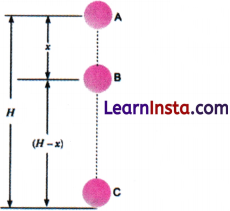
Suppose a body of mass m falls from point A, which is at height ‘H’ from the surface of earth.
Initially at point A, kinetic energy is zero and the body has only potential energy.
Total energy of body at point A = Kinetic energy + Potential energy
= 0 + mgH = mgH …………..(i)
Suppose during fall, the body is at position B.
The body has fallen at a distance x from its initial position.
If velocity of body at B is v, then from formula
v2 = u2 + 2as, we have
v2 = 0 + 2gx = 2gx
Kinetic energy of body at point B = ½ × mv2
= ½ m × 2gx = mgx
Potential energy of body at point B = mg (H – x)
∴ Total energy of body at point B = Kinetic energy + Potential energy
= mgx + mg(H – x) = mgH ……………….(ii)
Now suppose the body is at point C, just above the surface of earth (i.e., H just about to strike the earth).
Its potential energy is zero.
The height by which the body falls = H
If v is velocity of body at C, then from formula
v2 = u2 + 2as
We have u = 0, a = g, s = H
So, v2 = 0 + 2gH = 2gH
Kinetic energy of body at position C = ½ mv2
= ½ m × 2gH = mgH
∴ Total energy of body at C = Kinetic energy + Potential energy
= mgH + 0 = mgH …………….(iii)
Thus, we see that the sum of kinetic energy and potential energy of freely falling body at each point remains constant.
Thus, under force of gravity, the total mechanical energy of body remains constant.
Question 2.
Four men lift a 250 kg box to a height of 1 m and hold it without raising or lowering it.
(a) How much work is done by the men in lifting the box?
(b) How much work do they do in just holding it?
(c) Why do they get tired while holding it? (g = 10 ms 2) [NCERT Exemplar]
Answer:
(a) Here F = 250 kg × 10 ms2 (g = 10 ms2)
= 2500 N
s = 1 m
Now, W = F . s
= 2500 N × 1 m
= 2500 Nm = 2500 J
(b) Zero, as the box does not move at all while holding it.
(c) In order to hold the box, men are applying a force which is opposite and equal to the gravitational force acting on the box. While applying the force, muscular effort is involved. So, they feel tired.
Question 3.
A car of mass 900 kg is travelling at a steady speed of 30 m/s against a resistive force of 2000 N, as illustrated in figure.

(i) Calculate the kinetic energy of the car.
(ii) Calculate the energy used in 1.0 s against the resistive force.
(iii) What is the minimum power that the car engine has to deliver to the wheels?
Answer:
(i) Kinetic energy = ½ mv2
= ½ × 900 × (30)2
= ½ × 900 × 900
= 4,05,000 J
(ii) Here force F = 2,000 N and
distance d = v × t
= 30 × 1 = 30 m
Energy used = Work done against resistive force
= Force × Distance
= 2,000 × 30
= 60,000 J = 60 kJ
(iii) Minimum power = Energy used ÷ Time taken
= 60,000 J ÷ 1 s
= 60,000 = 60 kW
Question 4.
A man of mass 60 kg runs up a flight of 30 steps in 15 seconds. If each step is 20 cm high, calculate the power developed by the man. (Take g = 10 m/s2).
Answer:
Height of each step = 20 cm = 0.20 m
(∵ 1 m = 100 cm)
Height of 30 steps,
H = 30 × 0.20 = 6 m
Time, t = 15 seconds
Force exerted by man against gravity F = Weight of man = mg
∴ Work done by man = Force × Height
= mg × H
Power, P = \(\frac{\text { Work }}{\text { Time }}\)
= \(\frac{mgH}{t}\)
= \(\frac{60 \times 10 \times 6.0}{15}\)
= 240 joule.
Question 5.
An engine can pump 30,000 litres of water to a vertical height of 45 metres in 10 minutes. Calculate the work done by the machine and its power, [g = 9.8 m/s2; Density of water =103 kg/m3, 1000 litre = 1 m3].
Answer:
Volume of water raised = 30,000 litres
= 30,000 ÷ 1000 m3 = 30 m3.
Mass of water raised, M = Volume × Density
= (30 m3) × (103 kg/m3)
= 30 × 103 kg
Height, h = 45 metre
Work done by machine, W = Weight of water raised × Height
= (Mg) × h
= (30 × 103 × 9.8) × 45
= 1.323 × 10⁷ joule.
Time taken, t = 10 minutes
= 10 × 60 = 600 seconds.
Power, P = \(\frac{W}{t}\)
= \(\frac{1.323 \times 10^7 \mathrm{~J}}{600 \mathrm{~s}}\)
= 22 × 103 W = 22 kW.
Question 6.
What is the work to be done to increase the velocity of car from 30 km h-1 to 60 km h-1 if the mass of the car is 1500 kg?
Answer:
Mass of the car, m = 1500 kg
Initial velocity of the car, u = 30 km h-1
= \(\frac{30 \times 1000 \mathrm{~J}}{3600 \mathrm{~s}}\)
= \(\frac{25}{3}\) ms-1
Final velocity of the car, v = 60 km h-1
= \(\frac{60 \times 1000 \mathrm{~J}}{3600 \mathrm{~s}}\)
= \(\frac{50}{3}\) ms-1
Work done on the car = Increase in K.E. of the car
= Final K.E. – Initial K.E.
= ½ m (v2 – u2)
= ½ × 1500 [(\(\frac{50}{3}\))2 – (\(\frac{50}{3}\))2] J
= ½ × 1500 (\(\frac{50}{3}\) + \(\frac{25}{3}\)) (\(\frac{50}{3}\) – \(\frac{25}{3}\)) J
= \(\frac{1500}{2} \times \frac{75}{3} \times \frac{25}{3}\) J
= 156250 J.
Question 7.
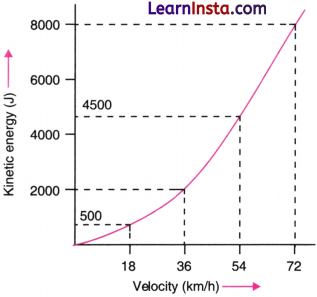
A car is moving with uniform velocities: 18 km/h, 36 km/h, 54 km/h and 72 km/h at some intervals. Calculate the kinetic energy of the boy of 40 kg sitting in the car at these velocities. Plot a graph between the kinetic energy and the velocity. What is the nature of the curve?
Ans.
Here, v1 = 18 km/h
= \(\frac{18 \times 1000 \mathrm{~J}}{3600 \mathrm{~s}}\) = 5 m/s
K1 = ½ mv12
= ½ × 40 × (5)2 = 500 J
v2 = 36 km/h
= \(\frac{36 \times 5}{18}\) m/s = 10 m/s,
K2 = ½ mv22
= ½ × 40 × (10)2 = 2000 J
v3 = 54 km/h
= \(\frac{54 \times 5}{18}\) m/s = 15 m/s,
K3 = ½ mv32
= ½ × 40 × (15)2 = 4500 J
v4 = 72 km/h
= \(\frac{72 \times 5}{18}\) m/s = 20 m/s,
K4 = ½ mv42
= ½ × 40 × (20)2 = 8000 J.
As shown in Fig., the graph between K.E. and velocity is a parabolic curve. This is because K.E. ∝ v2 .
Question 8.
Can you say if the following objects have energy? If they do, identify whether the energy is kinetic, potential or combination of the two:
(i) A ceiling fan which has been switched off.
(ii) A man climbing a hill.
(iii) A flying bird.
(iv) Water in the reservoir of a dam.
(v) A spring expanded beyond its normal shape.
(vi) A rubber band lying on a table.
(vii) A stretched rubber band lying on the ground.
Answer:
All these objects possess energies of the following forms:
(i) Potential
(ii) both kinetic and potential
(iii) both kinetic and potential
(iv) potential
(v) potential
(vi) potential
(vii) potential.
Question 9.
A body of mass 25 kg is raised to the top of a building 10 m high and then dropped freely under gravity (g = 10 m/s2):
(a) Calculate the work done in raising the body to the top of the building.
(b) What is the value of the gravitational potential energy at the top of the building?
(c) By what factor will the gravitational potential energy of the same body increase if it is raised to the top of a multistorey building 30 m high?
(d) will the kinetic energy of the body be maximum?
Answer:
Here m = 25 kg,
h = 10 m,
g = 10 m/s2
(a) Work done = mgh
= 25 × 10 × 10 J = 2500 J.
(b) Gravitational P.E. = Work done = 2500 J.
(c) Gravitational P.E. at a height of 30 m = 25 × 30 × 10 J = 7500 J
∴ \(\frac{\text { P.E. at 30 m height }}{\text { P.E. at 10 m height }}\) = \(\frac{7500 \mathrm{~J}}{2500 \mathrm{~J}}\) = 3
Thus, P.E. increases by 3 times.
(d) K.E. of the body will be maximum just before the body strikes the ground.
Work Energy and Simple Machines Class 9 Case Based Questions
Case I.
In day-to-day life, we consider any useful physical or mental labour as work. However, activities like playing in a field, talking with a friend, watching a movie, etc. are not considered to be work if we go by the scientific notation of work. In science, two conditions need to be satisfied for work to be done:
(i) a force should act on the body, and
(ii) the object must be displaced.
Suppose a girl pulls a trolley and the trolley moves through a distance. The girl has exerted a force on the trolley and it is displaced. Therefore, work is done.
Answer the following questions:
Question 1.
When do we say that work is done?
Answer:
Work is done whenever a force acts on a body and the body moves in the direction of force.
Question 2.
Write an expression for the work done when a force is acting on an object in the direction of its displacement.
Answer:
Work done = Force × Displacement.
Question 3.
Name the SI unit of work.
Answer:
Joule (J).
Question 4.
How much work is done in pushing an immovable stone?
Answer:
Zero.
Case II.
Life is impossible without energy, when a fast moving cricket ball hits a stationary wicket, the wicket is thrown away. Similarly, an object raised to a certain height gets the capability to do work. In these examples, the objects acquire, through different means, the capability to do work. An object having a capability to do work is said to possess energy. The object which does the work loses energy and the object on which the work is done gains energy.
Question 1.
Define the term energy.
Answer:
Energy is defined as the capability to do work.
Question 2.
How does the energy of an object change when it performs work?
Answer:
When an object does work, it loses energy.
Question 3.
How does the energy of an object change when work is done on it?
Answer:
When work is done on an object, the object gains energy.
Question 4.
Define 1 J of energy.
Answer:
One joule of energy is the energy required to do 1 joule of work.
Work Energy and Simple Machines Extra Questions for Practice
Very Short Answer Type Questions
Question 1.
Name and define the SI unit of work.
Question 2.
A coolie is walking on a railway platform with 20 kg load on his head. What is the amount of work done by him? Justify your answer.
Question 3.
A man is holding a suitcase in the state of rest. What is the work done by him?
Question 4.
Write a formula for the measurement of kinetic energy.
Question 5.
Write down the expression for gravitational potential energy of a body of mass m placed at a height h above the surface of the earth.
Question 6.
At what speed a body of mass 1 kg will have a kinetic energy of 1 J?
Question 7.
Identify the energy possessed by
(i) a rolling stone and
(ii) a running athlete.
Question 8.
What would be the amount of work done on an object by a force, if the displacement of the object is zero?
Question 9.
How much work is done by a weight lifter when he holds a weight of 80 kg on his shoulders for two minutes?
Question 10.
The speed of a car increases four times. What is the increase in its kinetic energy?
Question 11.
A body is thrown vertically upward. Its velocity goes on decreasing. What happens to its kinetic energy as its velocity becomes zero?
Question 12.
Name the form of energy which a wound up watch spring possesses.
Question 13.
Give one example of potential energy due to position.
Question 14.
Give an example where a body possesses both kinetic energy and potential energy.
Question 15.
Give an example where a body has potential energy due to change of shape.
Question 16.
State the law of conservation of energy.
Question 17.
Define 1 watt of power.
Question 18.
A force of 10 N moves a body with a constant speed of 2 m s~‘. Calculate the power of the body.
Question 19.
A bulb lights up when connected to a battery. State the energy change which takes place in the battery.
Question 20.
Define simple machines.
Short Answer Type Questions
Question 1.
How is work done by a force measured? A porter lifts a luggage of 20 kg from the ground and puts it on his head 1.7 m above the ground. Find the work done by the porter on the luggage (g = 10 m/s2).
Question 2.
A pair of bullocks exert a force of 140 N on a plough. The field being ploughed is 15 m long. How much work is done in ploughing the length of the field?
Question 3.
A person is holding a pitcher full of water over his head for twenty minutes and gets tired. Has he done some work or not? Justify your answer.
Question 4.
Distinguish between positive and negative work. When you lift an object, two forces act on it. Identify these forces. Which one of the two does, (a) positive work? (b) negative work? Justify your answer.
Question 5.
What will be the work done in the following situations? State whether it will be positive, negative or zero, giving reason in each case.
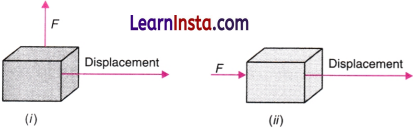
Question 6.
Define energy. Name and define its SI unit.
Question 7.
The kinetic energy of an object of mass moving with a velocity of 5 m s-1 is 25 J. Calculate its kinetic energy when its velocity is doubled.
Question 8.
A ball of mass 2 kg is dropped from a height. What is the work done by its weight in two seconds after the ball is dropped?
Question 9.
Write the form of energy possessed by the body in the following situations:
(a) a coconut falling from tree.
(b) an object raised to a certain height.
(c) blowing wind.
(d) a child driving a bicycle on road.
Question 10.
State law of conservation of energy. What is the work done when an object moves on a circular path?
Question 11.
Name the energy transformation in each case:
(i) dry cell
(ii) hydroelectric power station.
Question 12.
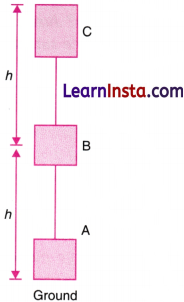
A man of mass 62 kg climbs up a stair case of 65 steps in 12 s. If height of each step is 20 cm, find his power. (Take g = 10 m s-2)
What is the potential energy of the object of mass (m) at points B and C when it is raised from points A to B and B to C.
Calculate the potential energy of the object when raised directly from points A to C. Calculate whether same amount of work is done against gravity in each case.
Question 13.
(a) A block of mass m is raised from position A to B by taking two different paths as shown in Figs. (i) and (ii). Let the height AB = h. Now answer the following questions:
(i) What is the work done on the blocks in Figs, (i) and (ii)?
(ii) Name the energy possessed by the block at position B in both the cases.
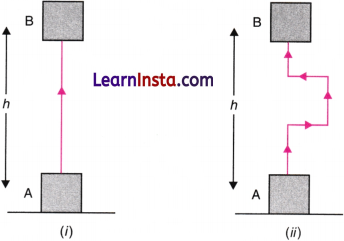
(b) An object of mass 12 kg is at a certain height above the ground. If the potential energy of the object is 2880 J, find the height to which the object is moved with respect to the ground (g = 10 m/s2).
Question 14.
Study the figure given and answer the following questions:
Long Answer Type Questions
Question 1.
(a) Write an expression of the work done when a force is acting on it. When will it be negative?
(b) Define 1 joule of work.
(c) Calculate thework done on an object of mass 1 kg lifted to a height of 1 m. Take g = 10 m s-2.
Question 2.
(a) Derive an expression for kinetic energy of a body having mass m and moving with a velocity v.
(b) When velocity of a body is increased 5 times, what is the change in its kinetic energy?
(c) Two masses m and 2m are dropped from heights h and 2h. On reaching the ground, which will have greater kinetic energy and why?
Question 3.
(a) Define potential energy. Obtain an expression for potential energy of a body of mass ‘m’ placed at a height ‘h’ above the ground.
(b) When speed of a body is increased 5 times, what is the change in its kinetic energy?
(c) Two masses m and 2m are dropped from heights h and 2h. On reaching ground, which will have a greater kinetic energy and why?
Question 4.
(a) Two objects A and B of same mass ‘m ’ are moving with velocities ‘2v’ and ‘3v’ respectively. Find the ratio of their kinetic energies.
(b) A light and a heavy object have the same momentum. Find the ratio their kinetic energies. Which one has a larger kinetic energy?
(c) What is the work to be done to increase the velocity of a car from 36 km/h to 72 km/h if the mass of the car is 2000 kg?
Question 5.
(a) What is meant by mechanical energy? State its two forms. State the law of conservation of energy. Give an example in which we observe a continuous change of one form of energy into another and vice versa.
(b) Calculate the amount of work required to stop a car of 1000 kg moving with a speed of 72 km/h.
Question 6.
Illustrate the law of conservation of energy by discussing the energy changes which occur when we draw a pendulum bob to one side and allow it to oscillate. Why does the bob eventually come to rest? What happens to its energy eventually? Is it a violation of the law of conservation of energy?