Students can use Our Wondrous World Class 5 Solutions Chapter 6 Some Unique Places Class 5 Questions and Answers as a quick reference guide.
Class 5 EVS Chapter 6 Some Unique Places Question Answer
Some Unique Places Class 5 EVS Question Answer
Our Wondrous World Class 5 EVS Chapter 6 Question Answer – Class 5 EVS Some Unique Places Question Answer
Find Out (Page 95)
Question 1.
Look at the map for the southernmost point of India.
Answer:
The southernmost point of India is Indira Point, located in the Andaman and Nicobar Islands.

Question 2.
In which sea are the Andaman and Nicobar Islands located?
Answer:
The Andaman and Nicobar Islands are located in the Bay of Bengal.
Question 3.
Name the other islands you know.
Answer:
Besides the Andaman and Nicobar Islands, I know some other islands that are part of India. The Lakshadweep Islands, located in the Arabian Sea, are famous for their coral reefs and clear waters.
Another islandis Diu, near Gujarat, known for its beaches and historical forts.
These islands show how diverse and beautiful India’s island regions are.
Activity 1 (Pages 96-97)
Take a rectangular piece of newspaper or used paper, and roll it into a thin tube. Glue the edges so it does not open. Then, make it stand up on a flat surface. Does it stay up? Now, cut 3-4 small triangles from thick paper. Stick the triangles evenly around the bottom of the roll. Rest the paper on a flat surface again. Does it stay upright now? The base supports the roll like the roots support the tree to stand upright.

Answer:
I rolled a newspaper into a tube and glued it, but it fell over on a flat surface. After gluing four thick paper triangles as a base, the tube stood upright. This shows how tree roots in the Andaman forests support trees to stand strong.
Why do you think some birds and animals are found only on these islands?
Answer:
Some birds and animals are found only on these islands. For example the Andaman Hornbill and Andaman Wood Pigeon are found only in the Andaman and Nicobar Islands because these islands are far from the mainland and are surrounded by the sea. This isolation prevents these birds from mixing with others, making them unique to the islands. Over time, they have adapted to the special environmental conditions of these islands, which is why they are not found anywhere else.
Write (Pages 97-98)
Question 1.
Draw or write about your favourite fish or other sea animal.
Answer:
My favourite sea animal is the dolphin. Dolphins are intelligent mammals that live in the ocean. They are known for their playful behaviour, such as leaping out of the water and swimming along side boats. They have a sleek body, a long snout, and communicate using clicks and whistles. Dolphins are friendly and often live in groups called pods.
Question 2.
List at least three living things found in the sea.
Answer:
Three living things found in the sea are:
- Corals
- Fish
- Sea turtles
Discuss (Page 98)
Question 1.
Why do you think life under the sea is just as important as life in the forests?
Answer:
Life under the sea is as important as life in forests because both ecosystems support a wide variety of plants and animals, contributing to biodiversity. Marine life, like corals and fish, provides food and shelter for many creatures and helps maintain the balance of the ocean, which produces oxygen and regulates the Earth’s climate. Similarly, forests provide oxygen, habitats, and resources for landbased life. Both are interconnected and essential for the health of the planet.
Question 2.
How do you think the coral reef helps the fish and other sea creatures?
Answer:
Coral reefs help fish and other sea creatures by providing shelter, breeding grounds, and food. The complex structures of corals offer hiding places from predators, spaces to lay eggs, and surfaces for algae growth, which many fish feed on. Reefs also attract a variety of marine life, creating a thriving ecosystem where creatures depend on each other.
Question 3.
How do you think their knowledge might have helped the people of North Sentinel Island stay safe?
Answer:
The people of North Sentinel Island likely used their deep knowledge of nature to stay safe during the 2004 tsunami. By observing signs such as changes in the wind, unusual sea behaviour, and altered animal movements, they might have recognised the impending danger and moved to higher ground or safer areas. Their close connection with the environment allowed them to interpret these natural warnings effectively.
Write (Page 99)
Question 1.
What do you see in the mangrove forest? List three things that live there.
Answer:
In the mangrove forest of the Sundarbans, where the river Ganga meets the sea, I can see many unique living things that make this place special. Three things that live there are mangroves, Royal Bengal tigers, and crocodiles.
- Mangroves are special trees with roots that stick out of the water to breathe in the muddy, salty land.
- Royal Bengal tigers, powerful and rare animals, roam the Sundarbans and are a symbol of its wildlife.
- Crocodiles live in the waters of the mangroves, swimming quietly and hunting for food. These living things show how the Sundarbans is a unique home for plants and animals that can survive in wet, salty conditions.
Question 2.
What do you think makes this place different from other forests?
Answer:
- The mangrove forest is different from other forests because it grows in salty, muddy coastal waters where the land is wet and unstable.
- The mangrove trees have special roots that help them breathe in the muddy water and hold the soil together, unlike typical forest trees that grow in solid, dry soil.
- This unique environment supports specific wildlife adapted to live in both water and land.
Write (Page 100)
Question 1.
In what ways do people in Sundarbans depend on the mangrove forests?
Answer:
People in the Sundarbans depend on the mangrove forests in several ways:
- They collect wood and leaves for fuel and building materials.
- They fish and collect crabs and honey from the forest for food and income.
- The mangroves protect their homes from erosion and storms by stabilising the soil and reducing wave impact.
Discuss (Page 101)
Question 1.
Why do you think it is important to take care of places like the Sundarbans?
Answer:
It is important to take care of places like the Sundarbans because they are unique ecosystems that support diverse wildlife, including rare species like the Royal Bengal Tiger. Mangroves protect coastal areas from erosion and storms, provide resources like fish and honey for local people, and help maintain the Earth’s climate by storing carbon. Preserving the Sundarbans ensures these benefits continue for future generations.
Find Out (Page 101)
Question 1.
Look around yourself. Do you see any living thing that has something special to help it live there? What is it?
Answer:
(Suggested answer) I see a cactus plant. It has thick, fleshy stems that store water, allowing it to survive in dry, desert-like conditions where water is scarce. Its spines protect it from animals and reduce water loss by minimising air flow around the plant.
Question 2.
Can you name the seven Northeastern states?
Answer:
The seven Northeastern states, known as the Seven Sisters, are:
- Arunachal Pradesh
- Assam
- Manipur
- Meghalaya
- Mizoram
- Nagaland
- Tripura
Write (Page 102)
Question 1.
Look at the picture. Can you spot three things being sold in the market?
Answer:
In the market picture, I can spot the three things being sold in the market. These are:
- Handwoven baskets
- Woven scarves/shawls
- Earthern pots/vessels
Question 2.
Can you identify the festival from the above picture?
Answer:
The festival in the picture is likely the Hornbill Festival or the festival of northeast tribes, celebrated in Nagaland, known for showcasing the culture, dance, and crafts of Northeastern tribes.
Question 3.
Why do you think the houses are built on bamboo structures?
Answer:
Houses in Northeast India are built on bamboo structures because the region experiences heavy rainfall and frequent earthquakes. Elevated bamboo houses protect against flooding and dampness, while bamboo’s flexibility makes the structures more resistant to earthquake tremors. Bamboo is also locally available and sustainable.
Question 4.
What animals can you see in the picture?
Answer:
In the picture, I can see an Elephant and a Hornbill.
Question 5.
What does this picture tell you about the people who live with nature in the Northeast of India?
Answer:
The picture shows that people in Northeast India live closely with nature. They use natural materials like bamboo for housing and sell forest products like vegetables and crafts in markets. Their festivals and daily life reflect a deep connection to their environment, with traditions that celebrate the region’s biodiversity and resources.
Discuss (Page 104)
Question 1.
In small groups, choose an animal or bird near you that needs protection. What can you do to help? Create a protection plan and share it with the class.
Answer:
Chosen animal: Sparrow
Protection Plan:
- Build nest boxes: Place small wooden or clay nest boxes in gardens or school premises to provide safe nesting sites.
- Provide food and water: Set up bird feeders with grains and shallow water containers in safe areas.
- Raise awareness: Conduct school campaigns to educate others about reducing pesticide use, which harms sparrows, and encourage planting native trees for habitat.
- Monitor and report: Observe sparrow populations and report sightings to local wildlife groups to track their numbers.
Activity 2 (Page 104)
In small groups, collect twigs, leaves, and soft materials like cotton or paper available around you. Create a small bird’s nest using the materials. What makes a good nest? What does the nest need to keep the eggs safe?
Answer:
In my group, we collected twigs, dry leaves, and soft materials like cotton and bits of paper from around our school to create a small bird’s nest, similar to the Hargila bird’s nest Shanti learned about. We shaped the twigs into a round base, weaving them tightly to make it strong. We added dry leaves to make the nest firm and used cotton and paper to line the inside, making it soft for eggs.
A good nest needs to be strong to hold the eggs without breaking, soft inside to keep eggs comfortable, and placed in a safe spot, like high in a tree, to protect from predators. To keep eggs safe, the nest must be deep enough so eggs don’t roll out, well-hidden from animals like cats, and sheltered from rain and wind. This activity taught us how birds, like the Hargila in Northeast India, build nests carefully to protect their eggs, and it shows the importance of helping wildlife.
Activity 3 (Page 105)
Try a ‘Root bridge challenge’ in class. Can you connect two chairs using string or sticks in a way that will hold a small toy?
Answer:
We tied strings and sticks between two chairs to make a bridge. It held a toy car firmly. This mimics the living root bridges in Northeast India.
Write (Pages 105-106)
Question 1.
Look at the map, locate the Western Ghats and name the six states it passes through.
Answer:
The Western Ghats pass through the following six states:
- Gujarat
- Goa
- Kerala
- Maharashtra
- Karnataka
- Tamil Nadu
Question 2.
What animals can you spot in the forest?
Answer:
In the Western Ghats Forest, I can spot:
- Lion-tailed macaque
- Indian elephant
- Malabar hornbill
Question 3.
What are the people doing in the picture given below?
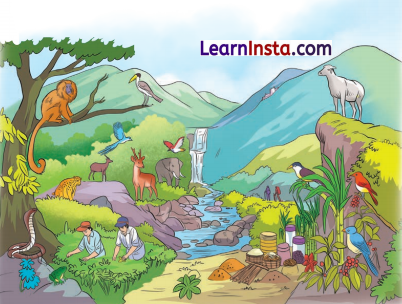
Answer:
In the picture, people are likely collecting forest resources such as medicinal plants, fruits, or firewood and interacting with their environment.
Question 4.
Why do you think forts were built on hilltops instead of flat land?
Answer:
Forts were built on hilltops because they provided strategic advantages. The elevated position offered a clear view of approaching enemies, making it easier to defend. Hilltops were harder to access, deterring attacks, and their natural terrain acted as a barrier. Additionally, the cooler climate and access to water sources on hills supported longterm habitation.
Write (Page 106)
Give the names of three rivers that start from the Western Ghats.
Answer:
Three rivers that start from the Western Ghats are:
- Godavari
- Krishna
- Kaveri
Activity 4 (Page 107)
Pick a fruit or vegetable that grows in your state. It may have varieties. With the help of your teacher or elders make a list of how many types and varieties of fruits and vegetables are locally known.
Answer:
(Suggested answer) I chose the mango, a fruit that grows in my state, Kerala. With my teacher’s help, I learned about varieties like Alphonso, Neelam, and Banganapalli. Other local fruits include jackfruit and banana, with varieties like Chakka Varatti and Nendran. These show Kerala’s rich fruit diversity.
Write (Page 109)
Question 1.
List three protected areas in the Western Ghats.
Answer:
Three protected areas in the Western Ghats are:
- Silent Valley National Park (Kerala)
- Bandipur National Park (Karnataka)
- Periyar Tiger Reserve (Kerala)
Let us reflect (Pages 109-111)
Question 1.
What surprised you the most about the places visited in this journey across India? Why?
Answer:
The living root bridges in Northeast India surprised me the most. It’s amazing how people guide tree roots to form strong bridges across streams, showing a unique way of working with nature instead of building with artificial materials. This reflects a deep understanding and respect for the environment.
Question 2.
Which place would you like to visit the most and what would you do there?
Answer:
(Suggested answer) I would like to visit the Western Ghats the most. I would trek through the forests to spot animals like the liontailed macaque and learn about medicinal plants from local tribal communities. I would also visit Silent Valley National Park to experience its quiet rainforest and understand its conservation story.
Question 3.
How is your region similar or different from one of the places in the story?
Answer:
(Suggested answer) My region, a coastal area, is similar to the Andaman and Nicobar Islands because both have beaches and marine life. However, it is different because my region lacks the unique island ecosystems and rare species like the Andaman hornbill. My area also has more urban development compared to the pristine forests of the islands.
Question 4.
Match the following aquatic animals with their features.
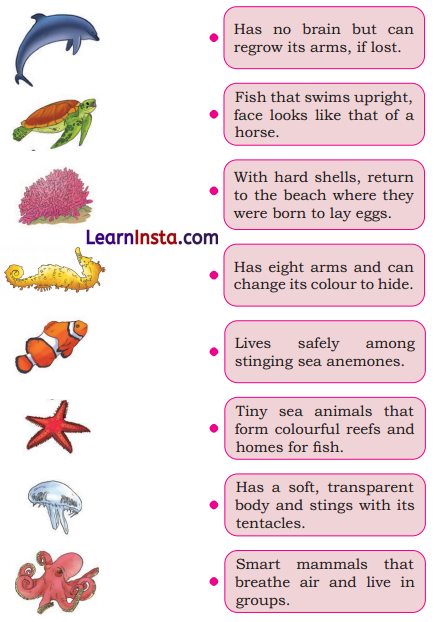
Answer:
Dolphin: Smart mammals that breathe air and live in groups.

Sea Turtle: With hard shells, return to the beach where they were born to lay eggs.

Coral: Tiny sea animals that form colourful reefs and homes for fish.

Seahorse: Fish that swims upright, face looks like that of a horse.

Clownfish: Lives safely among stinging sea anemones.

Starfish: Has no brain but can regrow its arms, if lost.

Jellyfish: Has a soft, transparent body and stings with its tentacles.

Octopus: Has eight arms and can change its colour to hide

Question 5.
What is special about mangroves?
Answer:
Mangroves are special because they grow in salty, muddy coastal waters where other trees cannot survive. Their roots, stick out of the water, help them breathe and hold the soil together, preventing erosion. They provide habitats for fish, crabs, and birds, protect coastlines from storms, and support local communities by providing resources like fish and wood.
Question 6.
How do people in different regions live in harmony with the nature?
Answer:
People in different regions live in harmony with nature by:
- Andaman and Nicobar Islands: Respecting the sea and forests, protecting unique species like the Andaman hornbill, and following sustainable fishing practices.
- Sundarbans: Depending on mangroves for fish, honey, and wood while maintaining the forest’s health to protect against storms.
- Northeast India: Using bamboo for houses, conserving birds like the Hargila, and creating living root bridges that work with nature.
- Western Ghats: Collecting forest resources sustainably and participating in movements like Save Silent Valley to protect biodiversity.
Question 7.
Make a collage by pasting pictures depicting vibrant India.
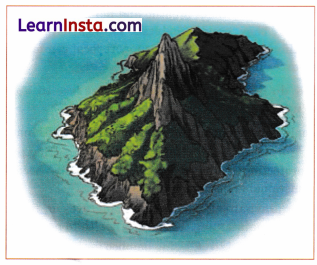
Answer:
(Sample Description of Collage)
- Images of Andaman beaches with corals and hornbills.
- Sundarbans mangroves with Royal Bengal tigers and fishermen.
- Northeast India’s living root bridges, Hornbill Festival, and Bhut Jolokia chillies.
- Western Ghats forests with lion-tailed macaques and Silent Valley’s greenery.
- Kanyakumari’s sunrise where three seas meet. These pictures show India’s diverse landscapes, wildlife, and cultures, highlighting its vibrant connection with nature.