Get the simplified Class 8 Maths Extra Questions Chapter 7 Proportional Reasoning 1 Class 8 Extra Questions and Answers with complete explanation.
Class 8 Proportional Reasoning 1 Extra Questions
Class 8 Maths Chapter 7 Proportional Reasoning 1 Extra Questions
Class 8 Maths Chapter 7 Extra Questions – Proportional Reasoning 1 Extra Questions Class 8
Very Short Answer Type Questions.
Question 1.
If a : b = 3 : 4 then find 4a : 3b.
Answer:
Let a = 3x and b = 4x
4a : 3b = 4 × 3x : 3 × 4x
= 12x : 12x
= 1 : 1
Question 2.
Fill in the box.

Answer:
We have,
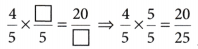
Question 3.
Write the following ratios in the simplest form,
(a) 600 g to 1 kg
Answer:
Ratio of 600 g to 1 kg = \(\frac{600}{1000}\) [∵ 1 kg = 1000 g]
= \(\frac{3}{5}\)
= 3 : 5
(b) 2 cm to 4 m
Answer:
Ratio of 2 cm to 4 m = \(\frac{2}{400}\) = 1: 200 [∵ 1 m = 100 cm]

Question 4.
Find
(i) the ratio of 70 cm to 1 m.
Answer:
We know that 1 m = 100 cm
Required ratio = 70 : 100 = 7 : 10
(ii) the ratio of 50 paise to ₹ 2.
Answer:
We know that ₹ 1 = 100 paise
Required ratio = 50 : 200 = 1 : 4
Question 5.
Given two equivalent ratios of 3 : 8.
Answer:
We have, 3 : 8 = 3 × 2 : 8 × 2 = 6:16,
3 : 8 = 3 × 3 : 8 × 3 = 9 : 24
Hence, two equivalent ratios of 3 : 8 are 6 : 16 and 9 : 24.
Question 6.
Are the ratio 10 g: 40 g and 25 kg : 100 kg in proportion?
Answer:
We have, 10 g : 40 g = 10 : 40 = 1: 4 and 25 kg : 100 kg = 25 : 100 = 1: 4
So, they are in proportion.
Question 7.
Are 10, 15, 20 and 30 in proportion?
Answer:
Ratio of 10 to 15 = 10 : 15 = 2 : 3
Ratio of 20 to 30 = 20 : 30 = 2 :3
Since, 10 : 15 = 20 : 30
Hence, 10, 15, 20 and 30 are in proportion.
Short Answer Type Questions
Question 1.
In a class, there are 20 boys and 40 girls. What is the ratio of the number of boys to the number of girls?
Answer:
1. Here, number of boys = 20 and number of girls = 40
∴ Ratio of number of boys to the number of girls
= \(\frac{\text { Number of boys }}{\text { Number of girls }}=\frac{20}{40}=\frac{2}{4}\)
[dividing numerator and denominator by 10]
= \(\frac{1}{2}\) = 1 : 2
Hence, the required ratio is 1 : 2.
Question 2.
Ram and Mohan ran in a race. Ram covered 210 m while during the same time Mohan covered only 180 m. What is the ratio of the distance covered by Mohan to that by Ram?
Answer:
Given, distance covered by Ram = 210 m
and distance covered by Mohan = 180 m
∴ Required ratio = \(\frac{180}{210}=\frac{6}{7}\) = 6:7
Question 3.
Reshma prepared 18 kg of burfi by mixing khoya with sugar in the ratio of 7 :2. How much khoya did she use?
Answer:
Given, quantity of burfi = 18 kg and Khoya : Sugar = 7 : 2
∴ Quantity of khoya = 18 × \(\frac{7}{7+2}=\frac{18 \times 7}{9}\) = 14 kg
So, Reshma used 14 kg khoya.
Question 4.
A line segment 56 cm long is to be divided into two parts in the ratio of 2 : 5. Find the length of each part.
Answer:
Given, length of line segment = 56 cm
Ratio of two parts = 2 : 5
Sum of parts = 2 + 5 = 7
∴ Length of first part = 56 × \(\frac{2}{2+5}=\frac{56 \times 2}{7}\) = 16 cm
and length of second part = 56 × \(\frac{5}{2+5}=\frac{56 \times 5}{7}\) = 40 cm
Question 5.
Find the ratio of 80 cm to 1.2 m.
Answer:
Since, both the quantities are not in the same unit. Firstly, we have to convert them into same unit.
We know that 1 m = 100 cm
⇒ 1.2 m = 1.2 × 100 cm = 120 cm
∴ Ratio of 80 cm to 1.2 m, i.e. 80 cm to 120 cm
= \(\frac{80}{120}=\frac{2}{3}\), hence the required ratio is 2 : 3.
Question 6.
If the temperature of a city is 34.7 ° F, find the temperature of the city in Celsius.
Answer:
Given, temperature of a city = 34.7° F
We know that, Celsius = \(\frac{5}{9}\) × (fahrenheit – 32)
∴ Temperature of a city in Celsius
= \(\frac{5}{9}\) × (34.7 – 32)
= \(\frac{5}{9}\) × 2.7
= 1.5° C
Question 7.
Which pair of ratios are equal and why?
(i) \(\frac{2}{3}, \frac{4}{6}\)
Answer:
We have, \(\frac{2}{3}\) = 2 : 3 and \(\frac{4}{6}\) = 2 : 3
Hence, \(\frac{2}{3}\) and \(\frac{4}{6}\) are equal.
(ii) \(\frac{8}{4}, \frac{2}{1}\)
Answer:
We have, \(\frac{8}{2}\) = 2 : 1 and \(\frac{2}{1}\) = 2 : 1
Hence, \(\frac{8}{4}\) and \(\frac{2}{1}\) are equal.
(iii) \(\frac{4}{5}, \frac{12}{20}\)
Answer:
We have, \(\frac{4}{5}\) = 4 : 5 and \(\frac{12}{20}=\frac{3}{5}\) = 3 : 5
Hence, \(\frac{4}{5}\) and \(\frac{12}{20}\) are equal.
Question 8.
The yield of wheat from 8 hectares of land is 360 quintals. Find the number of hectares of land required for a yield of 540 quintals, [NCERT Exemplar]
Answer:
Let x be the required number of hectares of land.
The ratio of number of hectares of land to number of quintals of land needs to be proportional
∴ 8 : 360 :: x : 540

Hence, the number of hectares of land is 12 hectares.
Question 9.
If the cost of 17 m of cloth is ₹ 493 then find the cost of 27 m of cloth
Answer:
Let the cost of 27 m of cloth be ₹ x.
The ratio of length of cloth to cost of cloth needs to be proportional.
∴ 17 : 493 :: 27 : x
⇒ \(\frac{17}{493}=\frac{27}{x}\)
⇒ x = \(\frac{27 \times 493}{17}\)
⇒ x = 27 × 29 = 783
∴ The cost of 27 m of cloth is ₹ 783.
Long Answer Type Questions
Question 1.
Length and breadth of the floor of a room are 5 m and 3 m, respectively. Forty tiles, each with area \(\frac{1}{16}\)m2 are used to cover the floor partially. Find the 16 ratio of the tiled and the non-tiled portion of the floor.
Answer:
Given, Length of floor of a room = 5 m
and breadth of floor of a room = 3 m
Now, area of floor = 5 × 3 = 15 m2
Since, area of one tile = \(\frac{1}{16}\) m2
∴ Area of forty tiles = 40 × \(\frac{1}{16}\)
= \(\frac{5}{2}\) m2
Area of tiled portion of the floor = \(\frac{5}{2}\) m2
Now, area of non-tiled portion of the floor
= (15 – \(\frac{5}{2}\))m2
= \(\left(\frac{30-5}{2}\right)=\frac{25}{2}\)2
The ratio of tiled and non-tiled portion of the floor 5
= \(\frac{5}{2}: \frac{25}{2}=\frac{\frac{5}{2}}{\frac{25}{2}}=\frac{5}{25}=\frac{1}{5}\)
= 1 : 5
Hence, the required ratio is 1 : 5.
Question 2.
Find the ratio of the following.
(a) 30 min to 1.5 h
Answer:
Here, we have to convert 1.5 h into min.
We know that, 1 h = 60 min
∴ 1.5 h = 1.5 × 60 min = 90 min
∴ Ratio = \(=\frac{30 \min }{90 \min }=\frac{30}{90}\)
∴ HCF of 30 and 90 is 30.
Hence, ratio = \(\frac{30 \div 30}{90 \div 30}=\frac{1}{3}\) = 1 : 3
(b) 40 cm to 1.5 m
Answer:
Here, we have to convert 1.5 m into cm.
We know that, 1 m = 100 cm
1.5 m= 1.5 × 100 cm = 150 cm
Ratio = \(\frac{40 \mathrm{~cm}}{150 \mathrm{~cm}}=\frac{40}{150}\)
∴ HCF of 40 and 150 is 10.
Hence, ratio = \(\frac{40 \div 10}{150 \div 10}=\frac{4}{15}\) = 4 : 15
(c) 55 paise to ₹ 1
Answer:
Here, we have to convert ₹ 1 into paise.
We know that, ₹ 1 = 100 paise
Ratio = \(\frac{55 \text { paise }}{100 \text { paise }}=\frac{55}{100}\)
∴ HCF of 55 and 100 is 5.
Hence, ratio = \(\frac{55 \div 5}{100 \div 5}=\frac{11}{20}\) = 11 : 20
(d) 500 mL to 2L
Answer:
(d) Here, we have to convert L into mL.
We know that, 1 L = 1000 mL
∴ 2 L = 2 × 1000 mL = 2000 mL
Ratio = \(\frac{500 \mathrm{~mL}}{2000 \mathrm{~mL}}=\frac{500}{2000}=\frac{5}{20}\)
[dividing numerator and denominator by 100]
∵ HCF of 5 and 20 is 5.
Hence, ratio = \(\frac{5 \div 5}{20 \div 5}=\frac{1}{4}\) = 1 : 4
Question 3.
Mother wants to divide ₹ 36 between her daughters Shreya and Bhoomika in the ratio of their ages. If age of Shreya is 15 yr and age of Bhoomika is 12 yr find, how much Shreya and Bhoomika will get.
Answer:
Given, Shreya’s age = 15 yr
and Bhoomika’s age = 12 yr
∴Ratio of their ages = \(\frac{\text { Shreya’s age }}{\text { Bhoomika’s age }}=\frac{15 \mathrm{yr}}{12 \mathrm{yr}}=\frac{15}{12}\)
= \(\frac{15 \div 3}{12 \div 3}=\frac{5}{4}\) = 5 : 4
[∵ H.C.F (15, 12) = 3]
Now, mother wants to divide ₹ 36 between her daughters in the ratio of their ages.
∴ Sum of the parts of ratios = 5 + 4 = 9
Amount which has to be divided = ₹ 36
Here, we can say that Shreya gets 5 parts and Bhoomika gets 4 parts out of every 9 parts.
Shreya’s share = \(\frac{5}{9}\) × 36 = ₹ 20
and Bhoomika’s share = \(\frac{4}{9}\) × 36 = ₹ 16
Hence, Shreya gets ₹ 20 and Bhoomika gets ₹ 16.
Question 4.
Consider the statement: Ratio of breadth and length of a hall is 2:5. Complete the following table that shows some possible breadths and lengths of the hall.

Answer:
Given, ratio of breadth and length of a hall = 2:5
Also given, breadth of the hall = 10 m
and length of the hall = 25 m
Then, the ratio of breadth and length = \(\frac{1}{2}\)= 2:5
Now, for finding first missing number, we have 25 × 2 = 50
i.e. when we multiply 25 by 2 we get 50.
So, to get first missing term, we multiply 10 by 2.
∴ 10 × 2 = 20
Hence, second breadth of the hall = 20 m
and length of the hall = 50 m
For finding second missing number, we have 40 = 10 × 4
i.e. when we multiply 10 by 4 we get 40.
So, to get second missing term, we multiply 25 by 4.
∴ 25 × 4 = 100
Hence, third breadth of hall = 40 m and length = 100 m
Thus, the complete table is

Question 5.
Determine, if the following ratios form a proportion. Also, write the middle term and extreme terms, where the ratios form a proportion.
(a) 25 cm : 1 m and ₹ 40 : ₹ 160
Answer:
Here, 25 cm : 1 m = 25 cm : 1 × 100 cm [∵ 1 m = 100 cm]
= 25 cm : 100 cm
= 25: 100 = \(\frac{25}{100}=\frac{25 \div 25}{100 \div 25}=\frac{1}{4}\) = 1 : 4
[∵ HCF (25, 100) = 25]
and ₹ 40: ₹ 160 = 40 : 160 = \(\frac{40 \div 40}{160 \div 40}=\frac{1}{4}\) = 1 : 4
[∵ HCF (40, 160) = 40]
Since, 25 cm : 1 m = ₹ 40 : ₹ 160
So, the ratios of 25 cm : 1 m and ₹ 40 : ₹ 160 are in proportion.
(b) 39 L : 65 L arid 6 bottles : 10 bottles
Answer:
Here, 39 L: 65 L = 39: 65 = \(\frac{39}{65}\)
= \(\frac{39 \div 13}{65 \div 13}\) [H.C.F of 39 and 65 = 13]
= \(\frac{3}{5}\) = 3 : 5
and 6 bottles : 10 bottles = 6 : 10 = \(\frac{6}{10}\)
= \(\frac{6 \div 2}{10 \div 2}=\frac{3}{5}\) = 3 : 5
[∵ HCF (6, 10) = 2]
Since, 39 L: 65 L = 6 bottles : 10 bottles.
So, the ratio of 39 L : 65 L and 6 bottles : 10 bottles are in proportion.
i.e. 39 L : 65 L :: 6 bottles : 10 bottles
Now, middle terms of ratios are 65 L and 6 bottles and extreme terms of ratios are 39 L and 10 bottles.
(c) 2 kg: 80 kg and 25 g: 625 g
Answer:
Here, 2 kg: 80 kg = 2 :80 = \(\frac{2}{80}=\frac{2 \div 2}{80 \div 2}=\frac{1}{40}\)
= 1 : 40
[∵ H.C.F (2, 80) = 2]
and 25 g : 625 g = 25 : 625 = \(\frac{25}{625}=\frac{25 \div 25}{625 \div 25}\)
= \(\frac{1}{25}\)
= 1 : 25
[∵ HCF of 25 and 625 = 25] Since, both ratios are not equal.
∴ 2 kg : 80 kg ≠ 25 g : 625 g
Hence, the given ratios are not in proportion.
(d) 200 mL : 2.5 L and ₹ 4 : ₹ 50
Answer:
Here, 200 mL : 2.5 L = 200 × \(\frac{1}{1000}\)L : 2.5 L
= \(\frac{200}{1000}\)L : 2.5 L
= 0.200 L : 2.5 L
= 0.200:2.5 = \(\frac{0.2}{2.5}=\frac{2}{25}\) = 2:25
[multiplying numerator and denominator both by 10]
and ₹ 4 : ₹ 50 = 4 : 50 = \(\frac{4}{50}=\frac{4 \div 2}{50 \div 2}=\frac{2}{25}\) = 2 : 25
[∵ HCF (4, 50) = 2]
Since, 200 mL : 2.5 L = ₹ 4 : ₹ 50
So, the ratios of 200 mL : 2.5 L and ₹ 4 : ₹ 50 are in proportion.
i.e. 200 mL : 2.5 L :: ₹ 4 : ₹ 50
Now, middle terms of ratios are 2.5 L and ₹ 4 and extreme terms of ratios are 200 mL and ₹ 50.
Skill Based Questions
Question 1.
Write monthly expenditure of your family on various items as given below.
| Items | Expenditure (in ₹) |
| House rent | |
| Food | |
| Education | |
| Electricity | |
| Transport | |
| Miscellaneous |
(i) Find the ratio of expenditure of house rent to that on food.
(ii) Find the ratio of expenditure of education to that an electricity.
Answer:
Do yourself
Question 2.
Crossword puzzle

Across
1. An equality of two ratios is called a ___________
4. In a ratio, the second terms is called the ___________
6. In a ratio, the first term is called ___________.
7. In any proportion, the ratio of first and second quantities is ___________ to the ratio of the third and fourth quantities.
Down
2. A comparison of two quantities of the same kind is called a ___________.
5. In a proportion, the first and fourth terms are called ___________
3. In a proportion, the second and third terms, are called ___________.
Answer:
1. Proportion
2. Ratio
3. Middle term
4. Consequent
5. Extremes
6. Antecedent
7. Equal
Case Study Based Question
Question 1.
In a club having 100 members, 20 play carom, 24 play table tennis, 16 play badminton and the remaining do not play any game (no member plays more than one game). Find the ratio of the number of members who play.
(i) carom to the numbers of those, who play table tennis.
(ii) badminton to the number of those, who play carom.
(iii) table tennis to the number of those, who play badminton.
(iv) badminton to the number of those, who do not play any game.
Answer:
Total number of members = 100
Number of members, who play carom = 20
Number of members, who play table tennis = 24
Number of members, who play badminton = 16
Number of members, who do not play any game
= 100 – (20 + 24 + 16)
= 100 – 60
= 40
(i) Ratio of members of carom to the members of table tennis = 20 : 24
= \(\frac{20}{24}=\frac{20 \div 4}{24 \div 4}\) = 5 : 6
[∵ HCF (20,24) = 4]
(ii) Ratio of members of badminton to the members of carom = 16:20
= \(\frac{16}{20}=\frac{16 \div 4}{20 \div 4}=\frac{4}{5}\) = 4:5
[∵ HCF (16,20) = 4]
(iii) Ratio of table tennis to the member of those, who play badminton =24:16
= \(\frac{24}{16}=\frac{24 \div 8}{16 \div 8}=\frac{3}{2}\) = 3:2
[∵ HCF (24,16) =8]
(iv) Ratio of badminton to the number of those, who do not play any game = 16:40
= \(\frac{16}{40}=\frac{16 \div 8}{40 \div 8}=\frac{2}{5}\) = 2:5
[∵ HCF (16,40) = 8]
Question 2.
Samira sells newspapers at Janpath crossing daily. On a particular day, she had 312 newspapers out of which 216 are in English and remaining in Hindi. Find the ratio of
(i) the number of English newspapers to the number of Hindi newspapers.
(ii) the number of Hindi newspapers to the total number of newspapers.
(iii) The number of English newspaper to the total number of newspapers.
Answer:
Total number of newspapers = 312
Number of english newspapers = 216
Number of hindi newspapers
= Total number of newspapers
– Number of English newspapers = 312 – 216 = 96
(i) Ratio of the number of English newspapers to the number of Hindi newspapers
= 216 : 96 = \(\frac{216}{96}=\frac{216 \div 24}{96 \div 24}\)
= \(\frac{9}{4}\)
= 9: 4 [∵ HCF (216, 96) = 24]
(ii) Ratio of the number of Hindi newspapers to the total number of newspapers
= \(\frac{96}{312}=\frac{96 \div 24}{312 \div 24}=\frac{4}{13}\) = 4:13
[∵ HCF (96,312) = 24]
(iii) Ratio of the number of English newspapers to the total number ot newspapers
= \(\frac{216}{312}=\frac{216 \div 24}{312 \div 24}\)
[∵ HCF (216,312) =24] 9
= \(=\frac{9}{13}=\) = 9 : 13