Each of our Ganita Manjari Class 9 Worksheet and Class 9 Maths Chapter 8 Predicting What Comes Next Exploring Sequences and Progressions Worksheet with Answers focuses on conceptual clarity.
Class 9 Predicting What Comes Next Exploring Sequences and Progressions Worksheet
Ganita Manjari Class 9 Chapter 8 Worksheet
Multiple Choice Questions
Question 1.
(a) 32
(b) 34
(c) 36
(d) 38
Answer:
(c) 36
Given, tn = n2 – 5n + 8 and xn = tn+1 – tn
Here, tn+1 = (n + 1)2 – 5 (n+1) + 8
= n2 + 1 + 2n – 5n – 5 + 8
= n2 – 3n + 4
So, Xn = (n2 – 3n + 4) – (n2 -5n + 8) = 2n – 4
For n = 20,
x20 = 2(20) – 4 = 36
Question 2.
A recursive sequence is defined by x1 = -2 and x(n + 1) = xn + 2n + 1. What is the value of x10?
(a) 91
(b) 95
(c) 97
(d) 101
Answer:
(c) 97
Given, x1 = – 2 and xn+1 = xn + 2n + 1
To find x10, add the increments for n = 1 to 9.
When we put n = 1 to 9 in (2n +1),
increments are 3, 5, 7,…. 19.
Sum of these increments = 3 + 5 + 7 +… +19 = 99.
So, x10 = – 2 + 99 = 97
Question 3.
An AP has 31 terms. Its 16th term is 0 and f31 -t1 = 120. What is the value of (f5 × f27)?
(a) -1936
(b) -1764
(c) 1764
(d) 1936
Answer:
(a) -1936
Given, t16 = 0 and t31 – t1 = 120.
We know that, tn = a + (n-1) d
∴ t31 – t1, = {a + (31-1)d} – a = 30d = 120
⇒ d = 4.
Now, t5 is 11 terms before t16.
∴ t5 = 0-11(4) = -44.
Similarly, t27 is 11 terms after t16.
∴ t27 7 = 0 + 11(4) = 44.
Thus, t5 × t27 = (-44)(44) = -1936.
Question 4.
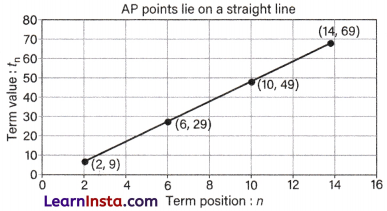
The graph below represents ordered pairs (n,tn) of an AP. If it passes through (2,9) and (6, 29),
then what is value of t25?
(a)119
(b)121
(c)124
(d)129
Answer:
(c)124
The graph of an AP is a straight line in the form of ordered pairs (n, tn).
It passes through (2,9) and (6,29).
Common difference = \(\frac{(29-9)}{(6-2)}=\frac{20}{4}\) = 5
So, tn = 5n + c
Using t2 = 9, we get 10 + c = 9 .
⇒ c = -1
Thus, tn = 5n – 1
Therefore, t25 = 5 (25) -1 = 124.

Question 5.
For the AP 3,7,11,15,… let Sn be the sum of the first n terms. Find S20 – S15.
(a) 335
(b) 345
(c) 355
(d) 365
Answer:
(c) 355
The given AP is 3, 7,11,15,…
Here, a = 3 and d = 4.
∴ tn = a + (n -1) d = 3 + (n – 1)4 = 4n – 1
Thus, t16 = 4(16)-1 = 63, t17 = 4 (17) -1 = 67,
Similarly, t18 = 71, t19 = 75 and t20 = 79.
Here, S20 – S15 is the sum of the 16th to 20th terms.
Required sum = S20 – S15 = t16 + t17 + t18 + t19 + t20
= 63 + 67 + 71 + 75 + 79 = 355
Question 6.
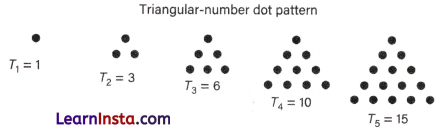
In a triangular-dot pattern, the number of dots at stage n is Tn = \(\frac{n(n+1)}{2}\) If the difference between the number of dots in two stages that are 3 stages apart is 114, then the smaller stage is
(a) 35
(b) 36
(c) 37
(d) 38
Answer:
(b) 36
In the triangular-dot pattern, Tn = \(\frac{n(n+1)}{2}\)
Let the smaller stage be n. Then the larger stage is n + 3.
Given, Tn+3 – Tn = 114
⇒ \(\left[\frac{(n+3)(n+4)}{2}-\frac{n(n+1)}{2}\right]\) = 144
⇒ \(\frac{6 n+12}{2}\) = 114
⇒ 3n + 6 = 114
⇒ n = 36
Hence, the smaller stage is 36.
Question 7.
The second, third and fourth terms of a positive geometric progression are x, 18 and 9x, respectively. Find the fifth term of the progression.
(a) 162
(b) 216
(c) 486
(d) 729
Answer:
(c) 486
The second, third and fourth terms are x, 18 and 9x. In a GP, the ratios of consective pairs of terms are all the same.
∴ \(\frac{18}{x}=\frac{9 x}{18}\)
⇒ 182 = x × 9x
⇒ 324 = 9 x 2
⇒ x2 = 36
Since, the GP is positive, so x = 6.
Thus, the terms are 6,18, 54.
Here, a = 6 and r = 3 = \(\frac{18}{6}\)
The 5th term, t5 = ar5-1
[∵ tn = arn-1 ]
= 6 × (3)4 = 6 × 81 = 486
Question 8.
In a GP, the common ratio is 3 and the 5th term is 81. Find the 8th term of the GP.
(a) 729
(b) 1458
(c) 2187
(d) 2430
Answer:
(c) 2187
Let a be the first term and r be the common ratio of the GP.
Given, common ratio r = 3 and fifth term tn = 81
We know that the nth term of a GP is given by
tn = arn-1
Now, t5 = ar5-1 = 81
⇒ ar4 = 81
and t8 = ar8-1 = ar7
= ar4 × r3
= 81 × (3)3
= 81 × 27
⇒ t8 = 2187
Hence, the 8th term of the GP is 2187.
Question 9.
Which term of the GP -2, 6, -18, 54,… is 486?
(a) 5th
(b) 6th
(c) 7th
(d) 8th
Answer:
(b) 6th
The GP is -2,6,-18,54 ,… .
Here, first term, a = – 2
and common ratio, r = \(\frac{6}{-2}\) = -3
Let 486 be the nth term of the GP.
We know that the nth term of a GP is given by
tn = ar tn-1
∴ 486 = -2(-3)n-1
⇒ (-3)n-1 = (-3)5
⇒ n-1 = 5
⇒ n = 6
Hence, 486 is the 6th term.
Question 10.
A GP has t4 = 54 and t7 = 1458. What is t8?
(a) 2916
(b) 3645
(c) 4374
(d) 6561
Answer:
(c) 4374
Given, t4 = 54 and t4 = 1458.
Now, \(\frac{t_7}{t_4}=\frac{a r^6}{a r^3}=\frac{1458}{54}\)
⇒ r3 = \(\frac{1458}{54}\)
⇒ r3 = 27
⇒ r = 3
Now, t8 = t7 × r = 1458 × 3 = 4374
Question 5.
For a GP, t1 + t2 + 12 = 12 and t2 + t3 = 36. What is the common ratio?
(a) 2
(b) 3
(c) 4
(d) 6
Answer:
(b) 3
Let the first term of the GP be a and the common ratio be r.
Then, the first three terms are
t1 = a, t2 = ar, t3 = ar2.
Given, t1c + t2 = 12
⇒ a + ar = 12
⇒ a(1 + r) = 12 ….(i)
Also, t2 + t3 = 36
⇒ ar + ar2 = 36
⇒ ar(1 + r) = 36 …(ii)
Now, on dividing Eq. (ii) by Eq. (i), we get
ar\(\frac{(1+r)}{a(1+r)}=\frac{36}{12}\)
⇒ r = 3
Hence, the common ratio of the GP is 3.
Question 11.
In a doubling-copy pattern, round 1 has 4 copies and each subsequent round has twice the previous round, Which round has 512 copies?
(a) 7
(b) 8
(c) 9
(d) 10
Answer:
(b) 8
In the given pattern, round 1 has 4 copies and every next round has twice the previous round. So, the numbers of copies form the pattern:
| Round 1 | Round 2 | Round 3 | Round 4 |
| 4 copies | 8 copies | 16 copies | 32 copies |
Since, the number is doubled every round, so the number of copies in round n is 4 × 2n-1
We need to find the round n for which tn = 512
4 × 2n-1 = 512
⇒ 2n-1 = 512 ÷ 4
⇒ 2n-1 = 128
⇒ 2n-1 = 27
Therefore, n – 1 = 7
⇒ n = 8
Thus, 512 copies will be obtained in round 8.
Question 12.
In a Sierpinski-type triangle pattern, the number of triangles produced at each step follows a GP with common ratio 3. Find the number of triangles in Step 3.
(a) 3
(b) 6
(c) 9
(d) 27
Answer:
(c) 9
a = 1, r = 3
T3 = 1 × 32 = 9
Assertion-Reason Questions
Direction (Question Nos. 1-7) Select the correct option from (a), (b), (c), (d) as given below.
(a) Both A and R are true and R is the correct explanation of A.
(b) Both A and R are true but R is not the correct explanation of A.
(c) A is true but R is false.
(d) A is false but R is true.
Question 1.
Assertion (A) The sequence defined by t1 =5,t(n+1)(n+1) = tn + 3n forms an AP.
Reason (R) A recursive rule always uses one or more previous terms to generate new terms.
Answer:
(d) A is false but R is true.
Using the rule, t, = 5, f2 = 8, t3 = 14 and t4 = 23
The differences are 3, 6 and 9, which are not constant. So, the Assertion is false.
The Reason is true because a recursive rule uses one or more previous terms to generate the next term.
Question 2.
Assertion (A) -6,-3,0,3,.., is an arithmetic progression.
Reason (R) The terms of an arithmetic progression cannot have both positive and negative integers.
Answer:
(c) A is true but R is false.
A is true because common difference is same but R is false.
Question 3.
Assertion (A) The sequence tn = 3n2 + 1 is not an AP.
Reason (R) In an AP, the difference tn+1 – tn must be the same for all values of n.
Answer:
(a) Both A and R are true and R is the correct explanation of A.
For tn = 3n2 + 1
∴ tn+1 – t2 – tn = [3(n + 1)2 + 1] – (3n2 + 1) = 6n + 3
This difference changes with n, so the sequence is not an AP.
So, Assertion is true.
Clearly, Reason is true.
Hence, both Assertion and Reason are true and Reason is the correct explanation of Assertion.
Question 4.
Assertion (A) The sum of the first 60 natural numbers is 1830.
Reason (R) The sum of the first n natural numbers is given by the formula sn = \(\frac{n(n+1)}{2}\)
Answer:
(a) Both A and R are true and R is the correct explanation of A.
We know that the sum of the first n natural numbers is Sn = \(\frac{n(n+1)}{2}\)
For n = 60,
S60 = \(\frac{60(60+1)}{2}\) = 30 × 61 = 1830
So, Assertion is true.
Clearly, Reason is true.
Hence, both Assertion and Reason are true and Reason is the correct explanation for Assertion.
Question 5.
Assertion (A) The sequence 4, 8,16, 32,… is a GP.
Reason (R) The ratio of every term to the preceding term is 2.
Answer:
(a) Both A and R are true and R is the correct explanation of A,
In the sequence 4, 8, 16, 32, …, the ratio of each term to its preceding term is the same i.e. 2. Since, this constant ratio shows that the sequence is a GP, the Reason correctly explains the Assertion. Hence, both Assertion and Reason are true and Reason is the correct explanation for Assertion.
Question 6.
Assertion (A) In a positive GP, if t3 = 6 and t5 = 24, then t4 = 12.
Reason (R) In a GP, the ratios of consecutive pairs of terms are same.
Answer:
(a) Both A and R are true and R is the correct explanation of A,
Given, t3 = 6 and t5 = 24.
In a positive GP, the term between t3 and t5 is t4 .
We know that the ratios of consecutive pairs of terms in a GP are same.
∴ \(\frac{t_4}{t_3}=\frac{t_5}{t_4}\)
⇒ \(\frac{t_4}{6}=\frac{24}{t_4}\)
⇒ (t4)2 = 24 × 6 = 144
⇒ t4 = 12 [for a positive GP]
So, Assertion is true
Clearly, Reason is true.
Hence, both Assertion and Reason are true and Reason is the correct explanation of Assertion.
Question 7.
Assertion (A) The 8th term of GP2, 2√2,4,… is 32,
Reason (R) The nth term of a GP is given by an = arn-1 where a is the first term and r is the common difference.
Answer:
(d) A is false but R is true.
Given GP is 2,2√2,4, …
Here, a = 2 and d = \(\frac{2 \sqrt{2}}{2}\) = √2
We know that tn = arn-1
∴ t8 = ar8-1 = ar7
= 2 × (√2)7
= 2 × (√2)6 × √2
= 2 × 23 × √2 = (2 × 8)√2
= 16√2
So, Assertion is false
Clearly, Reason is true.
Class 9 Maths Predicting What Comes Next Exploring Sequences and Progressions Worksheet
Worksheet On Predicting What Comes Next Exploring Sequences and Progressions Class 9
Very Short Answer Questions
Question 1.
Which term of the sequence tn = 7n -10 is 746?
Answer:
Given, tn = 7n – 10 and tn = 746.
∴ 7n – 10 = 746
⇒ 7n = 756
⇒ n = 108
Question 2.
In an AP, t12 – t4 = 40. Find the common difference.
Answer:
Let a and d be the first term and common difference of an AP respectively.
Given, t12 – t4 = 40
⇒ {a + (12 -1 )d} – {a + (4 -1 )d} = 40
[∴ tn = a + (n-1)d]
⇒ a + 11d – a -3d = 40
⇒ 8d = 40
⇒ d = \(\frac{40}{8}\)
⇒ d = 5
Hence, the common difference is 5.
Question 3.
How many three-digit numbers are divisible by 13?
Answer:
The first three digit number divisible by 13 is 104.
The last three digit number divisible by 13 is 988.
So, the required multiples of 13 are104,117,130,…, 988.
This forms an AP, where a = 104, d = 13 and t4 = 988.
We know that t4 = a + (n-1)d
⇒ 988 = 104 + (n -1)13
⇒ 884 = (n-1)13
⇒ n – 1 = 68
⇒ n = 69
Hence, there are 69 three digit numbers divisible by 13.
Question 4.
Which term of the AP \(\frac{2}{5}, \frac{7}{5}, \frac{12}{5}, \frac{17}{5},\)……is \(\frac{52}{5}\)
Answer:
Given AP is \(\frac{2}{5}, \frac{7}{5}, \frac{12}{5}, \frac{17}{5}, \ldots\)….
Here, a = \(\frac{2}{5}\) and d = \(\frac{7}{5}\) – \(\frac{2}{5}\) = 1
Let \(\frac{52}{5}\) be the nth term.
∴ tn = a + (n – 1)d
⇒ \(\frac{52}{5}\) = \(\frac{2}{5}\) + (n-1)(1)
⇒ \(\frac{52}{5}\) – \(\frac{2}{5}\) = n – 1
⇒ 10 = n – 1
⇒ n – 11
Here, \(\frac{52}{5}\) is the 11th term of the AP.
Question 5.
For the sequence defined by tn = 3n + 2, write the first term and the common difference. Also write its recursive rule.
Answer:
Given, tn = 3n + 2
To find the first term, put n = 1 in the given rule.
∴ t1 = 3(1) + 2 = 5
So, the first term is 5.
∵ t2 = 3(2) + 2 = 8; t3 = 3(3) + 2 = 11 and so on
Common difference = t2 – t1 = 8 – 5 = 3
Therefore, each term is obtained by adding 3 to the previous term.
Thus, the recursive rule is
t1 = 5, tn = tn-1 + 3, for n > 1
Question 6.
The sum of the first n natural numbers is 210. Find the value of n.
Answer:
We know that,
Sum of first n natural numbers = \(\frac{n(n+1)}{2}\)
⇒ \( \frac{n(n+1)}{2}\) = 210
⇒ n(n+1) = 420
Since 20 x 21 = 420
Therefore, n = 20.
Question 7.
If Tn is the nth triangular number and Tn – Tn-1 = 64, find the value of n.
Answer:
For triangular numbers, Tn – Tn-1 = n
Given, Tn – Tn-1, = 64,
so n = 64.
Question 8.
Find the 7th term of the GP 3,6,12,24,.
Answer:
Given, GP is 3, 6,12, 24,… .
Here, the first term is 3 and each term is obtained by multiplying the previous term by 2.
So, a = 3 and r = 3
We know that, nth term of GP is given by
tn = arn-1
∴ t7 = 3 × 27-1
= 3 × 26 = 3 × 26
= 3 × 64
⇒ t7 = 192
Hence, the 7th term of the GP is 192.
Question 9.
A sequence begins with 5. Each term after the first is obtained by multiplying the previous term by – 2. Write the first five terms of the sequence.
Answer:
Given, the first term is 5 and each next term is obtained by multiplying the previous term by – 2 Let an be the nth term of the sequence.
Now, form the terms one by one:
First term, a1 = 51
a2 = 5 × (-2) = -10,
a3 = -10 × (-2) = 20,
a4 = 20 × (-2) = -40
and a5 = -40 × (-2) = 80
So, the sequence is 5, -10,20, – 40,80,… .
Question 10.
If t6 = 96 and r = 2 in a GP, find the first term.
Answer:
Given, t6 = 96 and r = 2
Here, t6 = ar5
[∵ tn = arn-1]
⇒ 96 = a × 25
⇒ 96 = 32a
So, first term
a = 3
Question 11.
Find the common ratio and the 5th term of the GP \(\frac{81}{4}, \frac{27}{2}, 9, \ldots\)…..
Answer:
Given GP is \(\frac{81}{4}, \frac{27}{2}\)
Now, common ratio, r = \(\left(\frac{27}{2}\right) \div\left(\frac{81}{4}\right)=\frac{27}{2} \times \frac{4}{81}=\frac{2}{3}\)
We know that, tn = arn-1
∴ t5 = \(\frac{81}{4} \times\left(\frac{2}{3}\right)^4\)
∴ = \(\frac{81}{4} \times \frac{16}{81}\)
⇒ t5 = 4
Hence, the common ratio is \(\frac{2}{3}\) and the 5th term is 4.
Question 12.
Which term of the GP 5,15, 45,… is 1215?
Answer:
Given GP is 5,15, 45,…
Here, first term, a = 5
and common ratio, r = \(\frac{15}{5}\) = 3
Let the nth of the GP be 1215.
We know that, nth term of a GP,
tn = arn-1
⇒ 1215 = 5 x 3n-1
⇒ \(\frac{1215}{5}\) = 3n-1
⇒ 243 = 3n-1
⇒ 3n-1 = 35
⇒ n – 1 = 5
⇒ n = 6
Hence, 1215 is the 6th term of the given GP.
Question 13.
Write the recursive rule for the GP 2, 6,18, 54,… ,
Answer:
The given GP is 2, 6,18, 54,…
Here, the first term is t1 = 2.
Now, the common ratio is found by dividing any term by its previous term.
∴ r = \(\frac{6}{2}\) = 3
This means each term is obtained by multiplying the previous term by 3.
So, the recursive rule is
t1 = 2, tn = 3tn-1 for n > 1
Question 14.
In a Sierpinski-type square pattern, the number of squares produced at each step follows a GP with common ratio 6. Find the number of squares in step 3.
Answer:
Here, a = 1, r = 6
∴ S3 = 1 × 62 = 36
Question 15.
A ball is dropped from a height of 64 m, After each rebound, it reaches half of its previous height. Find the height after the 4th rebound.
Answer:
Given, the ball is dropped from a height of 64 m.
After each rebound, it reaches half of its previous height.
Height after 1st rebound = 64 + 2 = 32 m
Height after 2nd rebound = 32 + 2 = 16 m
Height after 3rd rebound = 16 + 2 = 8 m
Height after 4th rebound = 8 + 2 = 4 m
So, the rebound heights are 32 m, 16 m, 8 m, 4 m,…
Hence, the height after the 4th rebound is 4 m.
Short Answer Questions
Question 1.
A recursive sequence is given by x1 = 2 and xn+1 = Xn + 4n – 1. Find xn and x20.
Answer:
Given, x1 = 2, xn+1 = xn + 4n – 1
We have, xn+1 – xn = 4n – 1
Writing the given relation for successive values of n, we get
X2 – x1 = 4(1) – 1
x3 – x2 = 4(2) – 1
x4 – x3 = 4(3) – 1
xn – xn-1 = 4(n-1) -1
Adding all these equations, the intermediate terms cancel out. Hence,
xn – x1 = 4[1 + 2 + 3 +… + (n – 1)] – (n – 1)
Since, 1 + 2 + 3 +… + (n – 1) = \(\frac{n(n-1)}{2}\)
Therefore, xn – 2 = 4 \(\left[\frac{n(n-1)}{2}\right]\) – (n – 1)
= 2n(n – 1) – n + 1
xn – 2 = 2n2 – 3n + 1
xn = 2n2 – 3n + 3
Now, x20 = 2(20)2 – 3(20) + 3
= 2(400) – 60 + 3
= 800 – 57 = 743
Therefore, the explicit formula is xn = 2n2 – 3n + 3 and x20 = 743
Question 2.
In an AP, t4 = 13 and t15 = 68. Find the values of a, d and t30.
Answer:
Let the first term be a and common difference be d.
Given, t4 = a + 3d = 13 and t15 = a + 14 d = 68
[∴ tn = a + (n – 1) d]
On subtracting t4 from t15, we get,
11d = 55
⇒ d = 5.
Now, t4 = a + 3(5) = 13
⇒ a = 13 – 15 = -2
Therefore, t30 = a + 29d
= -2 + 29(5) = 143.
Question 3.
Find the sum of all natural numbers from 1 to 100, excluding the multiples of 3.
Answer:
We know that the sum of first n natural numbers,
Sn =\(\frac{n(h+1)}{2}\)
Sum of all natural numbers from 1 to 100 is
100 × \(\frac{101}{2}\) = 5050
Multiples of 3 from 1 to 100 are 3, 6, 9,…, 99.
Their sum = 3(1 + 2 + …+ 33)
= 3S33 = 3 × 33 × \(\frac{34}{2}\) = 1683.
∴ Required sum = 5050 – 1683 = 3367
Question 4.
A student is practicing mathematics problems, On the first day, the student solves 15 problems. On the second day, the student solves 16 problems, on the third day 17 problems and so on, continuing in the same pattern until the student solves 40 problems on the final day, Find the total number of problems solved by the student.
Answer:
The number of problems solved each day forms the sequence 15,16,17,…, 40
We have to find the total number of problems solved, i.e., 15 +16 +17 +… + 40
We know that, Sn = \(\frac{n(n+1)}{2}\)
The required sum can be obtained by subtracting the sum of the first 14 natural numbers from the sum of the first 40 natural numbers.
∴ 15 + 16 + 17 +… + 40 = (1 + 2 +… + 40) – (1 + 2 + … + 14) = S40 – S14
Now, S40 = \(\frac{40(40+1)}{2}=\frac{40 \times 41}{2}\) = 20 x 41 = 820
Also, S14 = \(\frac{14(14+1)}{2}=\frac{14 \times 15}{2}\) = 7 x 15 = 105
Therefore, 15 + 16 + 17 + ….. + 40 = 820 – 105 = 715
Hence, the total number of problems solved by the student is 715.
Question 5.
In the triangular-dot pattern, two stages differ by exactly 45 dots and the larger stage has 2 more rows than the smaller stage. Find the two stages.
Answer:
Given, Tn+2 – Tn = 45 ….(1)
Let the smaller stage be n. Then the larger stage is n + 2.
From the properties of triangular number sequences, the nth term representing the number of dots in stage n is the sum of first n natural numbers.
∴ Tn = \(\frac{n(n+1)}{2}\)
From Eq.(i), \(\frac{(n+2)(n+3)}{2}-\frac{n(n+1)}{2}\) = 45
⇒ \(\frac{(4 n+6)}{2}\) = 45
⇒ 2n + 3 = 45
⇒ n = 21
Thus, the two stages are 21 and 23
Question 6.
Check whether 5,-15,45,-135,is a GP or not, If yes, write its explicit rule and recursive rule.
Answer:
The sequence is 5, -15, 45, -135,….
Each term is obtained by multiplying the previous term by – 3.
So, it is a GP with first term 5 and common ratio – 3
Here, a = 5 and r = -3
Explicit rule tn = 5(-3)n-1.
[∵ tn = arn-1
Recursive rule t1 = 5, tn = -3tn-1 for n > 1
Question 7.
In a number pattern, each term is obtained by multiplying the previous term by a fixed number. If the 2nd term is 6 and the 3rd term is 18, find the first term and the fixed multiplying number.
Answer:
Given, 2nd term = 6 and 3rd term = 18
Let a be the first term, r be the common ratio and tn be the nth term of the GP.
∴ t2 = 6 and t3 = 18
Since, next term is obtained by multiplying the previous term by the same number,
∴ r = \(\frac{t_3}{t_2}\)
= \(\frac{18}{6}\) = 3
Now, t2 = t1 x r
⇒ 6 = t1 x 3
∴ t1 = \(\frac{6}{3}\) = 2
Hence, the first term is 2 and the fixed multiplying number is 3.
Question 8.
A photocopy machine reduces the length of an image in each copy to half of its previous length. If the length of the original image is 64 cm, find the length of the image after the fourth copy.
Answer:
Given, original length = 64 cm.
It is also given that each copy reduces the length to half of the previous length.
This, the successive length are After 1st copy : 32 cm;
After 2nd copy : 16 cm;
After 3rd copy : 8 cm;
After 4th copy : 4 cm.
Hence, the length after the fourth copy is 4 cm.
Question 9.
A bacteria culture starts with 30 bacteria and doubles every hour. Find the number of bacteria after 6 hours. Also, find the count if a student incorrectly adds 30 bacteria every hour for 6 hours.
Answer:
Given, initial number of bacteria = 30.
The correct count doubles every hour.
So, after 6 hours,
Correct count = 30 × 26 = 30 × 64 = 1920
Therefore, the correct number of bacteria after 6 hours is 1920.
Now, in the incorrect method, the student adds 30 bacteria every hour.
Incorrect count after 6 hours
= 30 + 6 × 30 = 30 + 180 = 210
Hence, the correct count is 1920 and the incorrect count is 210.
Question 10.
If a positive GP has t2 = 12 and t5 = 324, find the common ratio and the first term.
Answer:
Given, t2 = 12 and t5 = 324.
Let the GP have first term a and common ratio r.
Here, t2 = ar = 12
[∵tn = arn-1] ,..(i)
and t5 = ar4 = 324
On dividing Eq. (ii) by Eq (i), we get
\(\frac{a r^4}{a r}=\frac{324}{12}\)
So, r3 = \(\frac{324}{12}\) = 27
⇒ r = 3
Now, t2 = t1r
So, 12 = t1 × 3
⇒ t1 = 4
Hence, common ratio is 3 and first term is 4.
Question 11.
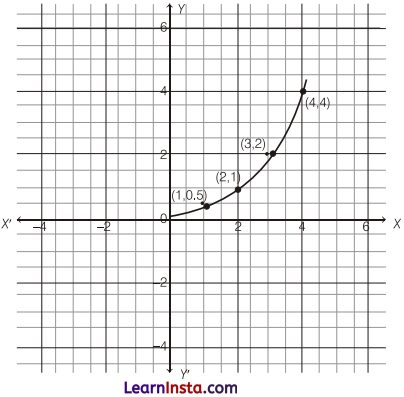
Represent the GP graphically, whose first term, a = 0.5 and common ratio, r = 2.
Answer:
Given, a = 0.5 and r = 2
Now, a = 0.5 x (2)n-1
[∵ an = arn-1 ]
Now, finding values of a corresponding to a few values of n.
| n | 1 | 2 | 3 | 4 |
| on | 0.5 | 1 | 2 | 4 |
Plot the points (1, 0.5), (2, 1), (3, 2), and (4, 4) on a graph paper and draw graph by joining the points consecutively.
Long Answer Questions
Question 12.
Let T1 = 2, T2 = 4, T3 = 6 and Tn = Tn-2 + Tn-3 for n ≥ 4.
Find T4,T5,T6,T7 and T8.
Answer:
Given, T1 = 2, T2 = 4 and T3 = 6
Tn = Tn-1 + Tn-2 + Tn-3
On putting n = 4 in Eq. (i) we get
T4 = T4-1 + T4-2 + T4-3
= T3 + T2 + T1 = 6 + 4 + 2 = 12
On putting n = 5 in Eq. (i), we get
T5 = T5-1 + T5-2 + T5-3
= T4 + T3 + T2 = 12 + 6 + 4 = 22
On putting n = 6 in Eq. (i), we get
T6 = T6-1 + T6-2 + T6-3
= T5 + T4+ T3 = 22 + 12 + 6 = 40
On putting n = 7 in Eq. (i), we get
T7 = T7-1 + T7-2 + T7-3
= T6 + T5 + T4 = 40 + 22 + 12 = 74
On putting n = 8 in Eq. (i), we get
T8 = T8-1 + T8-2 + T8-3
= T7 + T6 + T5 = 74 + 40 + 22 = 136
Question 13.
Find the recursive rules for the following APs.
(i) 3,7,11,15,…..
(ii) -8,-3,2,7, ……
(iii) \(\frac{1}{5}, \frac{4}{5}, \frac{7}{5}, \frac{10}{5}, \ldots \ldots\) …..
(iv) 1.2, 2.7,4.2,5.7…
Answer:
Recursive rule for an AP is t1, = a, tn = t n-1 + d for n ≥ 2,
where a is first term and d is common difference of AP.
(i) Recursive rule for 3,7,11,15,… is
t1, = 3, tn = tn-1 + 4 for n ≥ 2 [∴ d = 7 – 3 = 4]
(ii) Recursive rule for -8,-3,2,7,… is
t1 = – 8, tn-1 + 5 for n ≥ 2
[∵ d = -3 – (-8) = 5]
(iii) Recursive rule for \(\frac{1}{5}, \frac{4}{5}, \frac{7}{5}, \frac{10}{5}\)….is
t1 = \(\frac{1}{5}\), tn = tn-1 + \(\frac{3}{5}\) for n ≥ 2
[∵ d = \(\frac{4}{5}-\frac{1}{5}=\frac{3}{5}\)]
(iv) Recursive rule for 1.2, 2.7,4.2, 5.7,… is
t1 = 1.2, tn = tn-1 + 1.5 for n ≥ 2
[∵ d = 2.7 – 1.2 = 1.5]
Question 14.
An AP has 50 terms. If t3 + t48 = 200 and t8 – t4 = 24, find the first term, common difference, 50th term and 65th term of the sequence.
Answer:
Let the first term be a and common difference be d.
Given, t3 + t48 = 200
[∵ tn = a + (n – 1) d]
⇒ (a + 2d) + (a + 47d) = 200
⇒ 2a + 49d = 200 ….(i)
Also, t8 – t4 = 24
⇒ (a + 7d) – (a + 3d) = 24
⇒ 4d = 24
⇒ d = 6
On substituting d = 6 in Eq. (i), we get
2a + 49(6) = 200
⇒ 2a + 294 = 200
⇒ a = – 47.
[∵ tn = a + [n – 1)d]
Now, t50 = a + 49d
= – 47 + 49(6)
= – 47 + 294 = 247
and t65 = a + 64d
= – 47 + 64(6)
= – 47 + 384 = 337
Question 15.
Verify that the following sequences are arithmetic progressions and write their nth terms. What do you observe, when you plot the ordered pairs emerging from them?
Analytical, NCERT Pg. 181-82
(i) 3, 7,11,15,
(ii) -4,-1,2,5,
Answer:
(i) Given, the sequence is 3,7,11,15,…
Now, 7 – 3 = 4,11 – 7 = 4 and 15 -11 = 4
Here, we observe that difference between successive terms is same.
Therefore, this sequence is an AP with first term,
a = 3 and common difference, d = 4.
Now, the nth term of the AP,
tn = a +(n-1)d = 3 + (n-1)4
[∵ a = 3 and d = 4]
= 3 + 4n – 4 = 4n – 1
Now, we find values of tn corresponding to a few values of n.
Term number (n) 1 2 3 4 5
Term (tn = 4n – 1) 3 7 11 15 19
Now, we plot the ordered pairs emerging from the table that is, (1, 3), (2, 7), (3,11), (4,15), (5,19) and draw the graph by joining the points consecutively
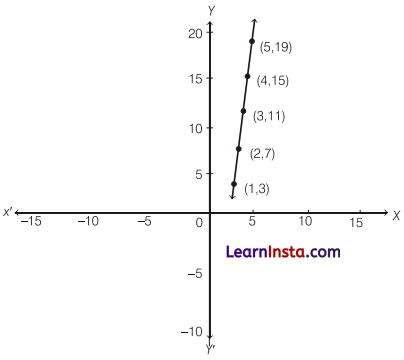
We observe that the points lie on a straight line. Hence, the graph of an AP is always a straight line,
(ii) We have, sequence is -4, -1,2,5,…
Now, -1 – (-4) = -1 + 4 = 3,
2 – (-1) = 2 + 1 = 3
and 5 – 2 = 3
Here, we observe that the difference between successive terms is same.
Therefore, this sequence is an AP with first term,
a = -4 and common difference, d = 3
Now, the nth term of the AP,
tn = a + (n-1)d
= -4 + (n-1)3
[∵ a = -4 and d = 3]
= -4 + 3n – 3 = 3n – 7
Now, we find the values of tn corresponding to a few value of n.
| Term number (n) | Term (tn = 3n – 7) |
| 1 | -4 |
| 2 | -1 |
| 3 | 2 |
| 4 | 5 |
| 5 | 8 |
Now, we plot the ordered pairs emerging from the table that is (1, – 4),(2, -1), (3,2), (4,5), (5,8) and draw the graph by joining the points consecutively.
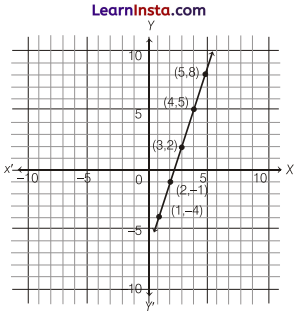
We observe that the points lie on a straight line. Hence, the graph of an AP is always a straight line.
Question 16.
How many 2-digit numbers are divisible by 4? What is the sum of all these 2-digit numbers?
Answer:
The list of 2-digit numbers, which are divisible by 4 are 12,16, 20, 24,…, 96.
Here, 16 -12 = 4,
20 -16 = 4
and 24 – 20 = 4
Hence, the list of numbers is an AP with
a = 12 and d = 4
Let 96 be the 12th term of an AP.
∴ tn = a + (n – 1)d
⇒ 96 = 12 + (n -1)(4)
⇒ 96 – 12 = (n -1)(4)
⇒ 84 = 4(n-1)
⇒ n – 1 = \(\frac{84}{4}\)
⇒ n – 1 = 21
⇒ n = 22
Hence, the number of 2-digit numbers which are divisible by 4 is 22.
Now, the sum of all 2-digit numbers, which are divisible by 4.
∴ 12 + 16 + 20 + 24 +… + 96
= 4[3 + 4 + 5 +… + 24]
= 4[1 + 2 + 3 + … + 24] – 4[1 + 2]
= 4 \(\left[\frac{24 \times(24+1)}{2}\right]-4\left[\frac{2 \times(2+1)}{3}\right]\)
[∴ sum of first n natural numbers = \(\frac{n(n+1)}{2}\)
= 4 [12 × 25] – 4 [1X 3] = 4 [300] – 4[3] = 1200-12 = 1188
= 4 \(\left[\frac{24 \times 25}{2}\right]-4\left[\frac{2 \times 3}{2}\right]\)
= 4 [12 × 25] – 4[1 × 3] = 4 [300] – 4[3]
= 1200 – 12 = 1188
Hence, the sum of all 2-digit numbers, which are divisible by 4, is 1188.
Question 17.
A GP has first term 2 and common ratio 3. Write the first five terms and find the sum of these five terms by addition.
Answer:
Given, first term a = 2
and common ratio r = 3.
In a GP, each term is obtained by multiplying the previous term by the common ratio.
Let tn be the nth term of the GP.
So, the first five terms are given below
| Term | Value |
| t1 | 2 |
| t2 | 2 × 3 = 6 |
| t3 | 6 × 3 = 18 |
| t4 | 18 × 3 = 54 |
| t5 | 54 × 3 = 162 |
Thus, the first five terms are 2, 6,18, 54 and 162.
Now, required sum of the first five terms is
2 + 6 + 18 + 54 + 162 = 242
Hence, the sum of the first five terms is 242.
Question 18.
In a positive GP, the 2nd term is \(\frac{3}{2}\) and the 5th term is \(\frac{81}{2}\)
Find the common ratio, first term and the first five terms of the GP.
Answer:
Let the first term be a and common ratio be r.
Given, t2 = ar = \(\frac{3}{2}\) … (i)
and t5 = ar4 = \(\frac{81}{2}\) ….(ii)
On dividing Eq. (ii), by Eq. (i) we get
\(\frac{a r^4}{a r}=\left(\frac{81}{2}\right) \div\left(\frac{3}{2}\right)\)
⇒ 27 = r3
⇒ r = 3
Now, ar = \(\frac{3}{2}\)
⇒ a × 3 = \(\frac{3}{2}\)
⇒ a = \(\frac{1}{2}\)
Thus, the first five terms are
a = \(\frac{1}{2}\), ar = \(\frac{1}{2}\)(3) = \(\frac{3}{2}\),
ar2 = \(\frac{1}{2}\)(3)2 = \(\frac{9}{2}\),
ar3 = \(\frac{1}{3}\)(3)3 = \(\frac{27}{2}\),
ar4 = \(\frac{1}{2}\)(3)4 = \(\frac{81}{2}\),
Hence, the common ratio is 3, the first term is \(\frac{1}{2}\) and the
terms are \(\frac{1}{2}\),\(\frac{3}{2}\),\(\frac{9}{2}\),\(\frac{27}{2}\) and \(\frac{81}{2}\).
Question 19.
For a GP with positive common ratio, t1 + t2 = 28 and t2 + t3 = 84. Find the common ratio and the first three terms
Answer:
Let the first term be a and the common ratio be r.
In a GP, the first three terms are a, ar, ar2.
Given, t1 + t2 = 28
So, a + ar = 28
⇒ a( 1 + r) = 28 …(1)
Also, t2 + t3 = 84
⇒ ar + ar2 = 84
⇒ ar(1 + r) = 84 …(2)
Now, on dividing Eq. (ii) by Eq. (i), we get
r = \(\frac{84}{28}\) = 3
On Puting r = 3 in Eq.(i), we get
a(1 + 3) = 28
⇒ 4a = 28
⇒ a = 7
Therefore, the common ratio is 3 and the first term is 7.
The first three terms are
a1 = a = 7,
a2 = ar = 7 × 3 = 21
and a3 = ar2 = 7(3)2 = 63
Hence, the common ratio is 3 and the first three terms are 7, 21 and 63.
Question 20.
A digital poster reaches 20 students initially. Every hour, the number of students reached becomes double. A student wrongly estimates that only 20 new students are added every hour. Find the first hour at which the correct number of students reached exceeds the wrong estimate by more than 100.
Answer:
Initially, the poster reaches 20 students.
Since, the number of students doubles every hour, the correct number of students after n hours is 20 × 2n.
In the wrong estimate, 20 students are added every hour. So, the wrong estimate after n hours is (20 + 20n) i.e. 20(n + 1).
Now, check the difference hour-wise.
| Hour | Correct number | Wrong estimate | Difference |
| 3rd hour | 20 × 8 = 160 | 20 × 4 = 80 | 160 – 80 = 80 |
| 4th hour | 20 × 16 = 320 | 20 × 5 = 100 | 320 – 100 = 220 |
At the 3rd hour, the difference is 80, which is not more than 100.
At the 4th hour, the difference is 220, which is more than 100.
Question 21.
A toy elevator starts from a height of 81 cm and moves down to the ground. After that, it rises to one-third of the previous height and again comes down to the ground. It repeats the same pattern. Find the total vertical distance travelled by the toy elevator till it touches the ground for the 3rd time.
Answer:
Given, the toy elevator starts from a height of 81 cm.
It first moves down from 81 cm to the ground.
Distance travelled in first fall = 81 cm
After this, it rises to one-third of its previous height i.e. 81 cm.
∴ One-third of 81 cm = 81 + 3 = 27 cm
Then, it falls from 27 cm to the ground.
Distance travelled in first rise and second fall
= 27 cm + 27 cm = 54 cm
Now, it touches the ground for the 2nd time.
Next, it rises to one-third of 27 cm.
One-third of 27 cm = 27 + 3 = 9 cm
Then, it falls from 9 cm to the ground.
Distance travelled in second rise and third fall
= 9 cm + 9 cm = 18 cm
Now, it touches the ground for the 3rd time.
Therefore, total vertical distance travelled
= 81 cm + 54 cm + 18 cm = 153 cm
Case-Based Questions
Question 1.
A student reads 12 pages on day 1 and increases the daily target by 5 pages everyday,
(i) Write the daily target tn.
(ii) Find the target on day 15.
(iii) (a) Is exactly 70 pages a daily target in this plan? Justify.
Or
(b) Between two consecutive days does the daily target change from a two-digit number to a three-digit number?
Answer:
The daily targets are 12,17, 22,… . This is an AP with a = 12 and d = 5.
(i) Daily target on day n
i.e. tn = a + (n – 1)d = 12 + (n – 1)5 = 5n + 7
(ii) Target on day 15, t15
= 5(15) + 7 = 82 pages.
(iii) (a) To check whether exactly 70 pages is a daily target,
⇒ 5n + 7 = 70
⇒ 5 n = 63
⇒ n = 126, which is not a natural number.
Hence, exactly 70 pages is not a daily target in this plan.
Or
(b) We have, tn = 5n + 7
The last two-digit target is less than 100.
∴ 5n + 7 < 100
⇒ 5n < 93
⇒ n < 18.6
Thus, the last two-digit target is on day 18.
∴ t18 = 5(18) + 7 = 97
Net, t19 = 5(19) + 7 = 102
Hence, the daily target changes from a two-digit number to a three-digit number between day 18 and day 19.
Question 29.
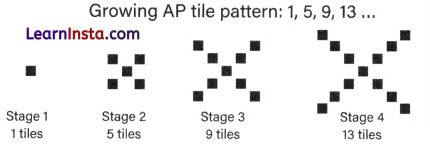
The diagram shows a growing tile pattern 1,5,9,13,…. A designer uses stage n on the nth day.
(i) Write the explicit rule for stage n.
(ii) Find the number of tiles at stage 40.
(iii) Which stage has 401 tiles?
(iv) Find the first stage at which the number of tiles becomes greater than 150.
Answer:
The tile pattern is 1, 5, 9,13,… . This is an AP with first term a = 1 and common difference d = 4.
(i) Explicit rule tn = a + (n – 1) d
= 1 + (n – 1)4 = 4n – 3,
(ii) At Stage 40, t40
= 4(40) – 3 = 157
(iii) (a) For 401 tiles, 4n – 3 = 401
⇒ 4 n = 404
⇒ n = 101
Hence, stage 101 has 401 tiles.
Or
(b)The explicit rule is tn = 4n – 3
For the number of tiles to be greater than 150,
4n – 3 > 150
⇒ 4n > 153
⇒ n > 38 -25
Since, the stage number is natural number.
So, the smallest possible value of n is 39.
Hence, the number of tiles first becomes greater. Hence, the number of tiles first become greater than 150 at stage 39.
Question 2.
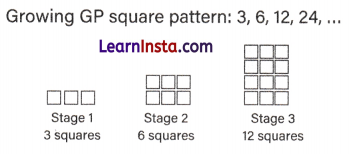
The diagram shows stages with 3, 6,12,… squares.
(i) Identify the common ratio.
(ii) Write the explicit rule for stage n.
(iii) (a) Write the recursive rule.
Or
(b) Find the first stage at which the number of squares exceeds 5000.
Answer:
The square pattern is 3, 6,12,…
This is a GP with first term 3 and common ratio 2.
(i) Common ratio = \(\frac{6}{3}\) = 2
(ii) Explicit rule: tn = 3 × 2n-1.
[∴ tn = arn-1, where a = 3 and r = 2]/
(iii) (a) Recursive rule: t1 = 3 and tn = 2tn-1, for n > 1
Or
(b) We need the first stage for which 3 × 2n-1 5000.
Since, 210 = 1024 and 211 = 2048.
For n = 11, t11 = 3 × 210 = 3072, which is less than 5000.
For n = 12, t12 = 3 × 211 = 6144, which exceeds 5000.
Hence, the first required stage is the 12th stage.
Question 3.
A ball is dropped from a height of 96 m. Each rebound is half of the previous height,
(i) Identify the common ratio of the rebound heights is \(\frac{1}{2}\)
(ii) Write the heights after the first four rebounds.
(iii) (a) Find the height after the 8th rebound.
Or
(b) Find the total upward distance travelled in the first four rebounds.
Answer:
The ball is dropped from 96 m and each rebound is half of the previous height.
(i) The common ratio of the rebound heights is \(\frac{1}{2}\)
(ii) The rebound heights form a GP. First four rebound heights :
96 × \(\frac{1}{2}\) = 48
48 × \(\frac{1}{2}\) = 24
24 × \(\frac{1}{2}\) = 12
and 12 × \(\frac{1}{2}\) = 6
So, the first four rebound heights are 48 m, 24 m, 12 m and 6 m.
(iii) (a)The sequence of rebound heights forms a GP
where first terme a = 48 and common ratio, r = \(\frac{1}{2}\)
∴ The height after the 8th rebound i.e.
t8 = 48 × \(\left(\frac{1}{2}\right)^{8-1}\)
[∵tn = arn-1]
= 48 × \(\left(\frac{1}{2}\right)^7\)
= \(\frac{48}{128}=\frac{3}{8}\) = 0.375 m