Experts have designed these Class 9 Maths Notes and Chapter 14 Math of Space Surface Area and Volume Class 9 Ganita Manjari Notes for effective learning.
Class 9 Maths Chapter 14 Math of Space Surface Area and Volume Notes
Class 9 Maths Ganita Manjari Chapter 14 Notes
Ganita Manjari Class 9 Chapter 14 Notes – Class 9 Math of Space Surface Area and Volume Notes
- The lateral surface area of a solid is the area of all its side faces or curved surfaces, excluding the top and bottom faces (if any).
- The total surface area of a solid is the area of all the faces or surfaces of the solid, including the top, bottom, and side surfaces.
- The volume of a solid is the amount of space occupied by the solid.
- 1000 cm3 = 1 litre
Cube
A cube is a three-dimensional shape that has six equal square faces, twelve edges, and eight vertices. All its sides have the same length.
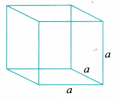
- Lateral surface Area of a cube = 4a2
- Total surface Area of a cube = 6a2
- Volume of a cube = a3
(Where a is the side of the cube)
Cuboid
A cuboid is a three-dimensional shape with six rectangular faces, twelve edges, and eight vertices. Its length, width, and height may have different measurements.
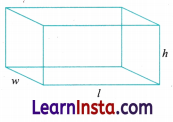
- Lateral Surface Area (LSA) of a cuboid = 2(l + w) × h
- Total Surface Area (TSA) of a cuboid = 2(lw + wh + lh)
- Volume of a cuboid = lwh
(Where l, w, and h are the length, width, and height of the cuboid)
(Where r is the radius of the hemisphere)
Cylinder
A cylinder is a three-dimensional shape with two equal circular bases connected by a curved surface.
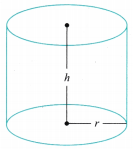
- Curved Surface Area (CSA) of a cylinder = 2πrh
- Total Surface Area (TSA) of a cylinder 2π(r + h)
- Volume of a cylinder
(where r and h are the radius and height of the cylinder)

Cone
A cone is a three-dimensional shape that has a circular base and a curved surface that tapers to a single point called the vertex.
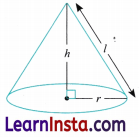
- Curved Surface Area (CSA) of a cone = πrl
- Total Surface Area (TSA) of a cone = πr(l + r)
- Volume of a cone = \(\frac{1}{3}\)πr2h
(Where r, h, and l are the radius. height. and slant height of the cone)
Pyramid
A pyramid is a three-dimensional solid with a polygonal base and triangular faces that meet at a common point called the vertex: its formulae are true for any polygonal base.
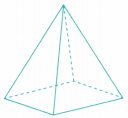
- Volume of a pyramid = \(\frac{1}{3}\) × Base Area × Height
- Surface area of a pyramid = Base Area + Area of all triangular faces
Sphere
A sphere is a three-dimensional shape in which all points on its surface are at the same distance from its centre.
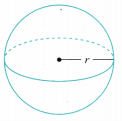
- Total Surface Area of a sphere = 4πr2
- Volume of a sphere = \(\frac{4}{3}\)πr3
(Where r is the radius of the sphere)
Hemisphere
A hemisphere is a three-dimensional shape formed when a sphere is divided into two equal halves by a plane passing through its centre.
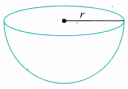
- Curved Surface Area (CSA) of a hemisphere = 2πr2
- Total Surface Area (TSA) of a hemisphere = 3πr2
- Volume of a hemisphere = \(\frac{2}{3}\)πr3
(Where r is the radius of the hemisphere)
1. Total surface area of a cuboid = 2[lw + wh + lh]
2. Lateral surface area of a cuboid = 2(l + w) × h
3. Volume of a cuboid = l × w × h
4. Total surface area of a cube = 6a2
5. Lateral surface area of a cube = 4a2
6. Volume of a cube = a3
7. Curved surface area of a cylinder = 2πrh
8. Total surface area of a cylinder = 2πr(r + l)
9. Volume of a cylinder = πr2 h
10. Curved surface area of a cone = πrl
11. Total surface area of a cone = πr(r + l)
12. Volume of a cone = \(\frac{1}{3}\)πr2 h
13. Surface area of a sphere = 4πr2
14. Volume of a sphere = \(\frac{4}{3}\)πr3
15. Curved surface area of a hemisphere = 2πr2
16. Total surface area of a hemisphere = 3πr2
17. Volume of a hemisphere = \(\frac{2}{3}\) πr3
18. Volume of a pyramid = \(\frac{1}{3}\) × area of base × height
19. 1000 cm3 = 1 litre
20. 1000 litre = 1 m3
Common Errors:
| Errors | Corrections |
| (i) Applying incorrect units of surface area and volume and making mistakes while converting units. | Learn and remember the basic units of measurement of area and volume. Also, carefully convert the units before solving a problem. |
| O’O Using diameter instead of radius in the formulas of solids having circular bases. | Always convert diameter into radius before applying the formula. Remember, Radius = Diameter ÷ 2. |
| (iii) Confusing curved surface area and total surface area of different solids. | Identify the surfaces included in the question and apply the correct formula. For example: CSA of cylinder = 2πrh TSA of cylinder = 2πr(h + r) |
| (iv) Forgetting to include the base area while finding the total surface area of a solid. | Carefully check whether the solid is open or closed. Include only the required surfaces while calculating TSA. |
| (v) Using slant height instead of height while finding the volume of a cone. | Remember that the volume of a cone is calculated using height (h), not slant height (l). Use the relation l2 = r2 + h2, if required. |
| (vi) Forgetting to square or cube the units while calculating area or volume. | Remember that surface area is measured in square units (cm2, m2) and volume is measured in cubic units (cm3, m3). |
| (vii) Writing only the numerical answer without the correct unit. | Always write the final answer with the appropriate unit, such as cm2 for area and cm3 for volume. |