Practicing Class 7 Maths MCQ and Class 7 Maths Chapter 5 Parallel and Intersecting Lines MCQ Questions Online Test with Answers daily helps in time management.
MCQ on Parallel and Intersecting Lines Class 7
Parallel and Intersecting Lines MCQ Class 7
Class 7 Maths MCQ Chapter 5 Parallel and Intersecting Lines
Multiple Choice Questions
Question 1.
If ∠a = 110°, then its adjacent angle ∠b measures
(a) 70°
(b) 110°
(c) 90°
(d) 180°
Answer:
(a) 70°
Question 2.
Which of these form vertically opposite angles?
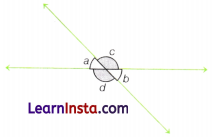
(a) ∠a and ∠b
(b) ∠a and ∠c
(c) ∠a and ∠d
(d) ∠b and ∠d
Answer:
(a) ∠a and ∠b
Question 3.
If ∠x and ∠y form a linear pair and ∠x = 65°, ∠y =?
(a) 115°
(b) 125°
(c) 105°
(d) 95°
Answer:
(a) 115°

Question 4.
If ∠m and ∠n are vertically opposite and ∠m = 140°, then ∠n is equal to
(a) 40°
(b) 140°
(c) 180°
(d) 90°
Answer:
(b) 140°
Question 5.
If ∠A = (5x – 20)° and its vertically opposite angle is 130° then the value of x is
(a) 20°
(b) 25°
(c) 30°
(d) 35°
Answer:
(c) 30°
Question 6.
How many angles are formed when a transversal cuts two lines?
(a) 2
(b) 4
(c) 6
(d) 8
Answer:
(d) 8
Question 7.
In the given figure, the pair of corresponding angles is
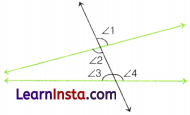
(a) ∠1 and ∠2
(b) ∠2 and ∠3
(c) ∠3 and ∠4
(d) ∠1 and ∠4
Answer:
(d) ∠1 and ∠4
Question 8.
If a transversal intersects two lines and a pair of alternate exterior angles are equal, then the lines are
(a) intersecting lines
(b) parallel lines
(c) perpendicular lines
(d) coincident lines
Answer:
(b) parallel lines
Question 9.
In the given figure, the measure of ∠8 is
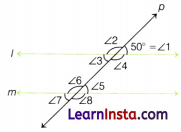
(a) 50°
(b) 30°
(c) 130°
(d) 150°
Answer:
(c) 130°
Question 10.
If two parallel lines are cut by a transversal and one angle is 70°, then its corresponding angle is
(a) 70°
(b) 110°
(c) 100°
(d) 90°
Answer:
(a) 70°
Question 11.
In a figure having two lines and a transversal, (3x + 15)° and (2x + 35)° are alternate interior angles. What is the value of x if the lines are parallel?
(a) 10°
(b) 4°
(c) 25°
(d) 20°
Answer:
(d) 20°
Question 12.
What is the sum of angles on a straight line?
(a) 180°
(b) 90°
(c) 120°
(d) 360°
Answer:
(a) 180°
Question 13.
Which of the following are always equal?
(a) Adjacent angles
(b) Co-interior angles
(c) Vertically opposite angles
(d) Linear pairs
Answer:
(c) Vertically opposite angles
Question 14.
Which of these angles form a linear pair?
(a) ∠x = 120°, ∠y = 60°
(b) ∠x = 90°, ∠y = 100°
(c) ∠x = 45°, ∠y = 45°
(d) ∠x = 30°, ∠y = 30°
Answer:
(a) ∠x = 120°, ∠y = 60°
Question 15.
Which pair of angles is equal when a transversal cuts two parallel lines?
(a) Co-interior angles
(b) Alternate interior angles
(c) Linear pair
(d) Adjacent angles
Answer:
(b) Alternate interior angles
Question 16.
If a transversal intersects two lines and the corresponding angles are equal, the lines are
(a) skew
(b) intersecting
(c) parallel
(d) perpendicular
Answer:
(c) parallel
Question 17.
If ∠A = (3x + 10)° and ∠B = (5x – 30)° are two co-interior angles formed by two parallel lines which is cut by a transversal, then the measures of ∠A and ∠B are
(a) 25°, 155°
(b) 80°, 100°
(c) 85°, 95°
(d) 90°, 90°
Answer:
(c) 85°, 95°
Assertion-Reason Based Questions
Study the Assertion (A) and Reason (R) statements given below and choose the correct alternative.
Question 1.
Assertion (A): Vertically opposite angles are never equal.
Reason (R): Vertically opposite angles are formed by two intersecting lines and lie opposite each other.
(a) Both A and R are true, and R is the correct explanation of A.
(b) Both A and R are true, but R is not the correct explanation of A.
(c) A is true but R is false.
(d) A is false, but R is true.
Answer:
(d) A is false, but R is true.
Question 2.
Assertion (A): Intersecting lines can make angles of 90° each.
Reason (R): All intersecting lines are perpendicular.
(a) Both A and R are true, and R is the correct explanation of A.
(b) Both A and R are true, but R is not the correct explanation of A.
(c) A is true but R is false.
(d) A is false, but R is true.
Answer:
(c) A is true but R is false.
Question 3.
Assertion (A): If one pair of vertically opposite angles is acute, then the other pair is obtuse.
Reason (R): Vertically opposite angles are always equal.
(a) Both A and R are true, and R is the correct explanation of A.
(b) Both A and R are true, but R is not the correct explanation of A.
(c) A is true but R is false.
(d) A is false, but R is true.
Answer:
(b) Both A and R are true, but R is not the correct explanation of A.
Question 4.
Assertion (A): Alternate interior angles are equal when lines are parallel.
Reason (R): They are on opposite sides of the transversal and inside the lines.
(a) Both A and R are true, and R is the correct explanation of A.
(b) Both A and R are true, but R is not the correct explanation of A.
(c) A is true but R is false.
(d) A is false, but R is true.
Answer:
(b) Both A and R are true, but R is not the correct explanation of A.
Question 5.
Assertion (A): If a transversal and co-interior angles cut two lines are equal, then the lines are parallel.
Reason (R): Co-interior angles must add upto 180° for the lines to be parallel.
(a) Both A and R are true, and R is the correct explanation of A.
(b) Both A and R are true, but R is not the correct explanation of A.
(c) A is true but R is false.
(d) A is false, but R is true.
Answer:
(d) A is false, but R is true.
Question 6.
Assertion (A): Corresponding angles lie on the same side of the transversal.
Reason (R): They are formed in the same relative position on both lines.
(a) Both A and R are true, and R is the correct explanation of A.
(b) Both A and R are true, but R is not the correct explanation of A.
(c) A is true but R is false.
(d) A is false, but R is true.
Answer:
(a) Both A and R are true, and R is the correct explanation of A.
Fill in the blanks.
1. Two lines that meet at a point are called ____________ lines.
Answer: intersecting
2. When two lines intersect, they form ____________ angles.
Answer: four
3. If ∠a and ∠b form a ____________, they add upto 180°.
Answer: linear pair
4. When two lines intersect, opposite angles are called ____________ angles.
Answer: vertically opposite
5. Vertically opposite angles are always ____________
Answer: equal
6. If ∠a = 130° then its vertically opposite angle is ____________
Answer: 130°
7. If ∠x = 75° then the adjacent angle to x is ____________
Answer: 105°
8. When two lines intersect and all angles are 90°, they are called ____________ lines.
Answer: perpendicular
9. Two lines that do not meet and lie in the same plane are called ____________ lines.
Answer: parallel
10. A line that intersects two or more lines at different points is called a ____________
Answer: transversal
11. When a transversal cuts two parallel lines, alternate interior angles are ____________
Answer: equal
12. Corresponding angles are equal when the lines are ____________
Answer: parallel
13. When two lines are cut by a transversal and alternate interior angles are equal, the lines are ____________
Answer: parallel
14. When the sum of interior angles on the same side of a transversal is ____________, the lines are ____________
Answer: 180°, parallel
State whether the following statements are True or False.
1. Intersecting lines always meet at one point.
Answer: True
2. Two perpendicular lines intersect at an angle of 180°.
Answer: False
3. Parallel lines always meet at a point.
Answer: False
4. An arrow mark (>) is used in mathematics to show that lines are parallel.
Answer: True
Match the Following Table.
Question 1.

Answer:
(i) – (d)
(ii) – (c)
(iii) – (b)
(iv) – (e)
(v) – (a)
Case-Based Questions
Question 1.
In a city plan, two streets PQ and RS are parallel. A diagonal road XY cuts across both, forming angles.
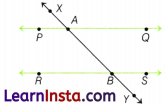
Now, based on this, answer the following questions.
(i) If ∠PAY = 68°, find ∠XBR.
(ii) If a street CD intersects PQ at 90°, what type of line is CD to PQ?
(iii) Find the measure of the alternate interior angle to ∠PAY.
(iv) Name one pair of corresponding angles.
Answer:
(i) 112°
(ii) Perpendicular
(iii) ∠ABS = 68°
(iv) ∠PAX and ∠ABR
Question 2.
In a town map, two parallel bike lanes run side by side. A newly constructed road crosses both bike lanes at an angle. At one corner, the angle between the road and one of the bike lanes is 50°.
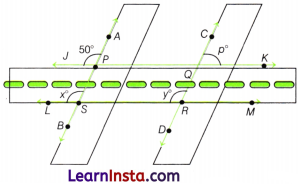
Based on the above information, answer the following questions.
(i) The relation between x and y is
(a) alternate interior angle
(b) alternate exterior angle
(c) corresponding angles
(d) cointerior angle
(ii) The value of x is
(a) 130°
(b) 100°
(c) 150°
(d) 50°
(iii) Find the value of p° and y°.
Answer:
(i) (c) corresponding angles
(ii) (d) co-interior angle
(iii) p = 130°, y = 50°
Complete the following table.
Question 1.
In each of the following cases, two lines intersect to form angles. One angle is given. Use it to find the other angles formed at the intersection.
| One Angle | All Angles |
| (i) 120° | |
| (ii) 85° | |
| (iii) 45° | |
| (iv) 110° | |
| (v) (4x + 10)° |
Answer:
| One Angle | All Angles |
| (i) 120° | 120°, 60°, 120°, 60° |
| (ii) 85° | 85°, 95°, 85°, 95° |
| (iii) 45° | 45°, 135°, 45°, 135° |
| (iv) 110° | 110°, 70°, 110°, 70° |
| (v) (4x + 10)° | (4x + 10), (170 – 4x), (4x + 10), (170 – 4x) |
Question 2.

From the given figure, complete the following table. Below l and m are two lines cut by a transversal p.
| Angle Made by a Transversal | Angles |
| (i) Pairs of vertically opposite angles | |
| (ii) Pairs of alternate interior angles | |
| (iii) Pairs of corresponding angles | |
| (iv) Pairs of co-interior angles | |
| (v) Pairs of exterior alternate angles | |
| (vi) Pairs of interior alternate angles |
Answer:
| Angle Made by a Transversal | Angles |
| (i) Pairs of vertically opposite angles | ∠1, ∠4 and ∠2, ∠3 ∠5, ∠8 and ∠6, ∠7 |
| (ii) Pairs of alternate interior angles | ∠3, ∠4, ∠5, ∠6 |
| (iii) Pairs of corresponding angles | ∠1, ∠5 |
| (iv) Pairs of co-interior angles | ∠4, ∠8 |
| (v) Pairs of exterior alternate angles | ∠2, ∠7 and ∠1, ∠8 |
| (vi) Pairs of interior alternate angles | ∠3, ∠6 and ∠4, ∠5 |
Question 3.
Look at the following figures and check whether the lines l and m are parallel or not. Write ‘Yes’ or ‘No’ and complete the table.
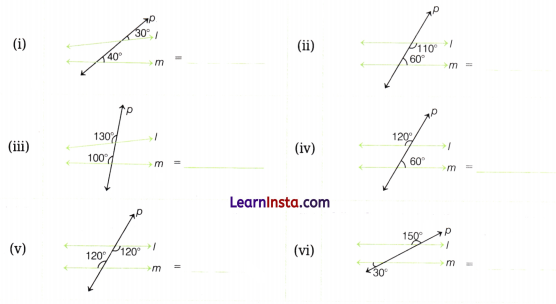
Answer:
(i) No
(ii) No
(iii) No
(iv) Yes
(v) Yes
(vi) Yes
Question 4.
In the following figures, parallel lines are cut by a transversal. Find the value of each of the lettered angles.
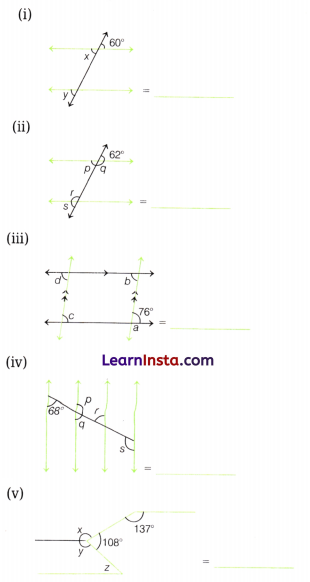
Answer:
(i) x = y = 60°
(ii) p = s = 62°, r = q = 118°
(iii) a = 104°, b = c = d = 76°
(iv) q = r = 68°, p = s = 112°
(v) x = 137°, y = 115°, z = 65°
Very Short Answer Type Questions
Question 1.
Define intersecting lines.
Answer:
Intersecting lines are two or more lines that cross each other at a single, common point in a plane. This point where the lines meet is called the point of intersection.
Question 2.
What is the measure of the vertically opposite angle of 110°?
Answer:
110°
Question 3.
What is the angle formed when two perpendicular lines meet?
Answer:
90°
Question 4.
If ∠x and ∠y form a linear pair and ∠x = 95°, what is ∠y?
Answer:
85°
Question 5.
What is the number of pairs of corresponding angles formed when a transversal cuts two lines?
Answer:
4
Question 6.
In the given figure, AD || EH and CG are the transversals. Find the value of z.
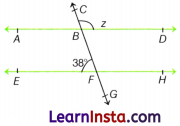
Answer:
142°
Short Answer Type Questions
Question 1.
Draw two intersecting lines and label the vertically opposite angles.
Answer:


Question 2.
If two lines are cut by a transversal and alternate interior angles are equal, what can you say about the lines?
Answer:
parallel
Question 3.
Give two examples each of a pair of parallel lines and a pair of intersecting lines from daily life.
Answer:
In daily life, parallel lines can be seen in railway tracks and the opposite edges of a rectangular table.
Question 4.
In the given figure, PQ || RS and LM is the transversals. Find the value of x and y.
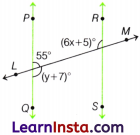
Answer:
x = 20°, y = 118°
Question 5.
If two angles form a linear pair and one is four times the other, find both angles.
Answer:
36°, 144°
Question 6.
In the given figure, find the value of x and hence find the value of the angles.

Answer:
x = 11°; ∠A = ∠B = 64°
Question 7.
Give two differences between corresponding angles and co-interior angles with diagrams.
Answer:
Corresponding angles are on the same side of the transversal, with one angle interior and the other exterior, while co-interior angles are both interior and on the same side of the transversal.

Question 8.
Construct two parallel lines using a ruler and a set-square. Draw a transversal. Label all eight angles and write all pairs of
(a) corresponding angles
(b) alternate interior angles
(c) vertically opposite angles
Answer:

Long Answer Type Questions
Question 1.
A transversal cuts two parallel lines. One of the angles is 65°.

(a) Identify all the angles equal to 65°.
(b) Identify all the angles equal to 115°.
(c) Name pairs of corresponding, alternate interior and exterior angles.
(d) What is the total of all eight angles formed?
Answer:
(a) ∠2, ∠8, and ∠4
(b) ∠1, ∠5, ∠7, and ∠3
(c) When a transversal line intersects two parallel lines, corresponding angles are in the same relative position at each intersection, alternate interior angles are on opposite sides of the transversal and inside the parallel lines, and co-interior angles are on the same side of the transversal and inside the parallel lines.
(d) 720°
Question 2.
In the given figure, find the values of ∠1, ∠2, and ∠3.

Answer:
∠1 = 60°, ∠3 = 70°, ∠2 = 110°
Question 3.
In the given figure, AE || GF || BD, AB || CG || DF, and ∠CHE = 120°. Find the value of ∠ABC, ∠FGH, and ∠CDE.

Answer:
∠ABC = 60°, ∠FGH = 120°, ∠CDE = 120°