Students rely on Class 8 Science Extra Questions and Class 8th Curiosity Chapter 13 Our Home: Earth, A Unique Life Sustaining Planet Extra Question Answer to improve their grades.
Class 8 Science Chapter 13 Our Home: Earth, A Unique Life Sustaining Planet Extra Questions
Class 8 Science Chapter 13 Extra Questions on Our Home: Earth, A Unique Life Sustaining Planet
Our Home: Earth, A Unique Life Sustaining Planet Class 8 Very Short Question Answer
Question 1.
What are the three parts of the triple planetary crisis?
Answer:
Climate change, biodiversity loss, and pollution.
Question2.
What is the biosphere?
Answer:
It is the zone on Earth where all living beings and their environment interact to survive and grow.

Question 3.
What are gametes?
Answer:
Special reproductive cells that carry only half of the parent’s genetic material.
Question 4.
How does water help living beings?
Answer:
Water transports nutrients in plants, regulates body temperature, aids digestion, and keeps animals hydrated.
Question 5.
Where does the embryo develop in mammals?
Answer:
Inside the female’s body.
Question 6.
How do seeds spread in nature?
Answer:
Animals or birds eat the fruit and drop the seeds far from the original plant through excretion.
Question 7.
What is the role of genes in living beings?
Answer:
Genes carry instructions for how an organism grows and functions.
Question 8.
Name the four rocky planets in our solar system.
Answer:
Mercury, Venus, Earth, and Mars.
Question 9.
What makes Mangalyaan a significant mission for India?
Answer:
It was India’s first Mars mission, launched in 2013, and showed that India could explore space using low-cost and efficient technology.
Question 10.
Name the two types of harmful particles from space.
Answer:
Cosmic rays and solar wind.
Our Home: Earth, A Unique Life Sustaining Planet Class 8 Short Question Answer
Question 1.
Why is Earth suitable for life while other planets are not?
Answer:
Earth is at the right distance from the Sun, allowing liquid water to exist. It has a breathable atmosphere and a moderate temperature due to the greenhouse effect, making it ideal for life.
Question 2.
Describe the importance of the greenhouse effect and water cycle in sustaining life on Earth.
Answer:
The greenhouse effect traps enough heat to keep Earth warm, allowing water to stay liquid which is essential for life. Water vapour in the atmosphere forms clouds and causes rainfall, which replenishes water in rivers and lakes, supports plant and animal life, and influences weather patterns critical for farming and survival.
Question 3.
Which four major systems of Earth interact to sustain life?
Answer:
The atmosphere (consisting of air), hydrosphere (consisting of water), geosphere (consisting of the solid part of the Earth), and biosphere (consisting of life) interact and together sustain life on the Earth.
Question 4.
What is the difference between geosphere and geodiversity?
Answer:
Geosphere refers to the solid parts of the Earth, including rocks, minerals, soil, and the Earth’s crust. It is the physical layer that supports life by providing land, nutrients, and resources.
Geodiversity means the variety of different landforms, rocks, soils, and minerals found on Earth. It describes the diversity and differences in the Earth’s surface and helps create different habitats for plants and animals.
Question 5.
List the planets in our solar system in order of their distance from the Sun. Mention which of these planets are rocky and which are made of gases.
Answer:
Mercury, Venus, Earth, Mars, Jupiter, Saturn, Uranus, and Neptune. Out of all these planets, Mercury, Venus, Earth, and Mars, are relatively small and rocky planets, while Jupiter, Saturn, Uranus, and Neptune are large planets, mostly made of gases.
Our Home: Earth, A Unique Life Sustaining Planet Class 8 Long Question Answer
Question 1.
Explain how different parts of the Earth’s system work together to support life.
Answer:
The atmosphere provides oxygen for respiration and traps heat to keep Earth warm. The hydrosphere provides water essential for life and supports aquatic organisms. The geosphere offers soil and minerals needed for plant growth and ecosystems. The biosphere includes all living organisms that interact with each other and their environment. Together, these systems maintain a delicate balance that makes Earth suitable for life. Disruption in one part can affect the whole system.
Question 2.
Describe the factors that make Earth habitable compared to other planets.
Answer:
Earth is unique because of several factors that make it suitable for life.
First, it lies in the habitable zone, also called the Goldilocks zone, where the temperature allows water to remain in liquid form. This is essential for all known life forms.
Second, Earth has an atmosphere that contains oxygen and carbon dioxide. The atmosphere also protects us from harmful radiation. The greenhouse effect helps maintain the right temperature. Lastly, Earth’s surface is mostly covered in water, making it appear blue from space and supporting diverse life forms. These combined features make Earth the only known planet to support life.
Question 3.
Explain the difference between sexual reproduction in plants and animals.
Answer:
Sexual reproduction in plants and animals involves the fusion of male and female gametes to form a zygote, but the process differs in several ways:
- In plants, the male gametes are pollen grains found in the anther, and the female gametes are ovules found in the ovary of the flower. Pollination is the process by which pollen is transferred to another flower, often by wind, insects, or animals. Fertilisation happens when pollen fuses with an ovule, forming a zygote that develops into a seed and ovary turns into a fruit.
- In animals, the male gametes are called sperm and the female gametes are called eggs. Fertilisation can occur either outside the body (as in fish and frogs) or inside the female’s body (as in birds and mammals). In birds, the fertilised egg is laid, and the embryo develops inside it during hatching. In mammals, the zygote develops into an embryo inside the mother’s body, which provides nutrition and oxygen until the baby is born.
Our Home: Earth, A Unique Life Sustaining Planet Class 8 Skill-Based Questions
Question 1.
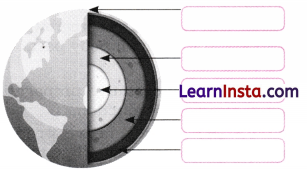
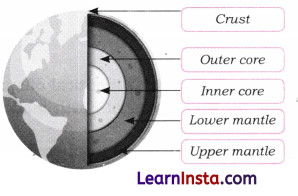
Label the given diagram of Earth.
Answer:
Question 2.
Look at the image and answer the following questions.
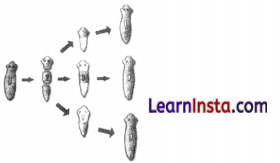
(a) Identify the organism shown here.
(b) Explain how this organism reproduces.
Answer:
(a) The organism shown is Planaria, a type of flatworm.
(b) It can regrow from the fragment of its body.
Our Home: Earth, A Unique Life Sustaining Planet Class 8 Quiz Questions
Question 1.
What process creates identical offspring?
Answer:
Asexual reproduction
Question 2.
Name the outer layer of Earth made of soil, rocks, and minerals.
Answer:
Crust
Question 3.
What planet has no atmosphere?
Answer:
Mercury
Question 4.
What gas in the atmosphere helps form ozone?
Answer:
Oxygen
Question 5.
Which planet is known as the Blue Planet?
Answer:
Earth
Question 6.
What is male gamete in plants called?
Answer:
Pollen grain
Question 7.
What process do plants use to make food?
Answer:
Photosynthesis
Question 8.
Name the process by which seeds begin to grow.
Answer:
Germination
Question 9.
What is the full form of ISRO?
Answer:
Indian Space Research Organisation
Question 10.
Name any one agent of pollination.
Answer:
Wind
Our Home: Earth, A Unique Life Sustaining Planet Class 8 Case Based Questions
Question 1.
The solid part of Earth, also called the geosphere, is made of rocks, soil, and minerals. It provides soil to grow food, minerals, and fuels like coal and oil. Soil forms when rocks break down and mix with dead plants and animals. It contains nutrients that help plants grow. The Earth also has different landforms like hills, plains, and deserts. This variety is called geodiversity, and it supports many kinds of life by creating different habitats. Even though it is non-living, the geosphere plays a big role in supporting life on Earth.
I. Which part of the Earth is made up of rocks and minerals?
II. How does soil form naturally?
III. What would happen if soil had no nutrients?
OR
How does geodiversity help support life?
Answer:
I. Geosphere
II. Soil forms when rocks break down and mix with dead plants and animals.
III. Plants would not grow properly, which would affect animals and humans who depend on them for food.
OR
Geodiversity creates different habitats that support many kinds of life.
Our Home: Earth, A Unique Life Sustaining Planet Extra Questions for Practice
Multiple Choice Questions
Question 1.
Which planet is made of gases?
(a) Earth
(b) Mars
(c) Neptune
(d) Venus
Question 2.
Which structure develops into the fruit in plants?
(a) Anther
(b) Ovule
(c) Ovary
(d) Seed
Question 3.
Planaria is a type of
(a) Algae
(b) Bacterium
(c) Protozoa
(d) Flatworm.
Question 4.
Read the given statements and select the correct option.
Assertion (A): Earth’s magnetic field protects life by pushing away harmful particles from space.
Reason (R): Cosmic rays and solar wind particles can damage the atmosphere and increase harmful UV radiation reaching Earth.
(a) Both A and R are true and R is the correct explanation of A
(b) Both A and R are true but R is not the correct explanation of A
(c) A is true but R is false.
(d) A is false but R is true.
Question 5.
Match the items in Column A to those in Column B:
Column A — Column B
(i) Sperm — (p) Zygote
(ii) Blue planet — (q) Greenhouse gas
(iii) Carbon dioxide — (r) Predator
(iv) Fertilised egg — (s) Male gamete
(v) Tiger — (t) Earth
(a) (i)-(s), (ii)-(q), (iii)-(t), (iv)-(p), (v)-(r)
(b) (i)-(s), (ii)-(t), (iii)-(p), (iv)-(q), (v)-(r)
(c) (i)-(t), (ii)-(s),(iii)-(q),(iv)-(p),(v)-(r)
(d) (i)-(s), (ii)-(t), (iii)-(q), (iv)-(p), (v)-(r)
Very Short Answer Type Questions
Question 1.
What is pollination?
Question 2.
How does Hydra reproduce?
Question 3.
Name the planet that has no atmosphere.
Question 4.
Which type of reproduction produces exact copies of the parent?
Question 5.
What is the full form of CFCs?
Short Answer Type-I Questions
Question 1.
Differentiate between pollination and fertilisation.
Question 2.
What is biodiversity loss and how does it affect ecosystems?
Question 3.
Why is reproduction important for living beings?
Question 4.
How does the position of the Earth make it suitable for life to exist?
Question 5.
Name the rocky planets.
Short Answer Type-II Questions
Question 1.
Explain the difference between biosphere, hydrosphere and geosphere.
Question 2.
How does a fruit form in a plant?
Question 3.
Explain how reproduction contributes to both similarity and variation in organisms.
Question 4.
Why is Venus hotter than Mercury, even though Mercury is closer to the Sun?
Question 5.
What do you mean by greenhouse effect?
Long Answer Type Questions
Question 1.
Explain the importance of Earth’s size, atmosphere, and magnetic field in making it suitable for life.
Question 2.
What are the major threats to life on Earth, and how can we address or overcome them?
Question 3.
Describe the differences in fertilisation and development between birds and mammals.
Suggested Projects And Activities
Question 1.
Imagine you’re creating a planet where life can survive just like on Earth. What would you include in your kit? List the key elements your planet must have (like water, oxygen, and sunlight), and explain briefly why each one is essential for life to exist and thrive.
Question 2.
Flowers are often brightly coloured and have a pleasant smell. Find out how these features help plants in the process of reproduction.