These Class 6 Science Curiosity Worksheet and Class 6 Science Chapter 11 Nature’s Treasures Worksheet with Answers are excellent for board exam practice.
Class 6 Science Chapter 11 Nature’s Treasures Worksheet
Class 6 Nature’s Treasures Worksheet
Worksheet On Nature’s Treasures Class 6 – Nature’s Treasures Worksheet Class 6
A. Objective Type Questions
Multiple Choice Questions
Question 1.
Which gas is most abundant in Earth’s atmosphere?
(a) Oxygen
(b) Nitrogen
(c) Argon
(d) Carbon dioxide
Answer:
(b) Nitrogen
Question 2.
Which gas although being the most abundant in Earth’s atmosphere, does not directly support combustion or respiration process in living organism?
(a) Oxygen
(b) Nitrogen
(c) Carbon dioxide
(d) Argon
Answer:
(b) Nitrogen

Question 3.
Which component of air, although present in small percentage, is vital for the greenhouse effect and regulating Earth’s temperature?
(a) Oxygen
(b) Nitrogen
(c) Carbon dioxide
(d) Argon
Answer:
(c) Carbon dioxide
Question 4.
What is the primary source of energy for life on earth?
(a) Wind
(b) Sun
(c) Fossil fuels
(d) Water ?
Answer:
(b) Sun
Question 5.
Consider the illustration given below about the food being cooked.
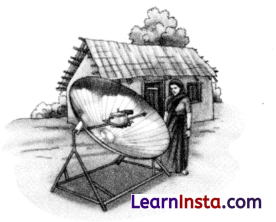
The type of energy being used for cooking is
(a) wind energy
(b) solar energy
(c) sound energy
(d) electrical energy
Answer:
(b) solar energy
Question 6.
Which type of forest conservation practice involves replanting trees in areas where forests have been cut down or destroyed?
(a) Deforestation
(b) Urbanisation
(c) Reforestation
(d) Overgrazing
Answer:
(c) Reforestation
Question 7.
Which of the following practice prevent soil erosion and maintain soil fertility?
(a) Deforestation
(b) Overgrazing
(c) Afforestation
(d) Industrialisation
Answer:
(c) Afforestation
Question 8.

The above figure represents
(a) ploughing
(b) rainwater harvesting
(c) threshing
(d) winnowing
Answer:
(a) ploughing
Question 9.
Which of the following statement regarding minerals is correct?
(a) Minerals are the building blocks of rocks
(b) Metal like aluminium extracted from minerals is used in making airplanes
(c) Minerals are non-renewable natural resources
(d) All of the above
Answer:
(d) All of the above
Question 1o.
What type of resource can be replenished naturally over short periods?
(a) Minerals
(b) Non-renewable resources
(c) Renewable resources
(d) Fossil fuels
Answer:
(c) Renewable resources
Question 11.
Which of the following is not a renewable resource?
(a) Solar energy
(b) Wind
(c) Water
(d) Coal
Answer:
(d) Coal
Question 12.
Renewable resource are used over non-renewable resources. This is because
(a) they are less abundant
(b) they are easy to find
(c) they are cheaper
(d) they do not deplete over time
Answer:
(d) they do not deplete over time
Question 13.
Which renewable resource is continuously cycled through natural processes such as the water cycle and photosynthesis?
(a) Fossil fuels
(b) Minerals
(c) Water
(d) Soil
Answer:
(c) Water
Question 14.
Which of the following resources is considered non-renewable and forms over millions of years from ancient plant and animal matter?
(a) Solar energy
(b) Fresh water
(c) Wind energy
(d) Coal
Answer:
(d) Coal
Question 15.
The primary reason for the significant environmental impact associated with the use of fossil fuel is
(a) their renewable nature
(b) the high cost of extraction
(c) the release of pollutants and greenhouse gases
(d) the limited technology for their utilization
Answer:
(c) the release of pollutants and greenhouse gases
Fill in the Blanks
Fill in the blanks by choosing the appropriate word from the box given below.
Forest, weathering, photosynthesis, surface water, oxygen
Question 1.
____ is necessary for respiration in humans, animals and plants.
Answer:
Oxygen
Question 2.
Water found in rivers, lakes and reservoirs is known as _____.
Answer:
surface water
Question 3.
The process by which plants use sunlight to produce food is called ____.
Answer:
photosynthesis
Question 4.
_____ are large areas covered with trees, shrubs and other vegetation.
Answer:
Forest
Question 5.
_____ is the process of breaking down rocks by natural forces such as wind, water and temperature change.
Answer:
Weathering
True/False
State whether the given statements are true or false.
Question 1.
Air is composed of 21% oxygen and 78% nitrogen.
Answer:
True
Question 2.
The Sun is not important to maintain earth’s climate and ecosystem.
Answer:
False. The Sun is important to maintain Earths climate and ecosystem.
Question 3.
Rain water harvesting is a technique used to conserve water.
Answer:
True
Question 4.
Fossil fuels are renewable resources that can be replenished naturally.
Answer:
False. Fossils fuels are non-renewable resources that cannot be replenished within a short period of time.
Question 5.
Soil conservation practices include deforestation and unsustainable agriculture.
Answer:
False. Soil conservation practices include afforestation and sustainable agriculture.
Match the Following
Question 1.
Match the terms in Column I with the statements given in Column II.
| Column I | Column II |
| (a) Sunlight | (i) Extracting minerals from the earth. |
| (b) Photosynthesis | (ii) Conserving and managing forests. |
| (c) Fossil Fuels | (iii) Renewable source of energy. |
| (d) Soil Conservation | (iv) Conversion of sunlight into food by plants. |
| (e) Mining | (v) Non-renewable energy source. |
(a) ______
(b) ______
(c) ______
(d) ______
(e) ______
Answer:
(a) – (iii),
(b) – (iv),
(c) – (v),
(d) – (ii),
(e) – (i).
Question 2.
Match the Column I with Column II.

Answer:
(a) – (n),
(b) – (i),
(c) – (v),
(d) – (iii).
(e) – (iv).
Assertion-Reason Questions
In the following questions, two statements are given- one is labelled as Assertion (A) and the other is labelled as Reason (R). Read the statements carefully and choose the correct alternative (a), (b), (c) and (d) as given below.
(a) Both A and R are true and R is the correct explanation of A.
(b) Both A and R are true, but R is not the correct explanation of A.
(c) A is true, but R is false.
(d) A is false, but R is true.
Question 1.
Assertion (A) The air which surrounds the Earth is a mixture of gases.
Reason (R) There are 100 squares. Out of 100 squares, 78 are occupied by nitrogen, 21 are occupied by oxygen, and 1 by argon, carbon dioxide and other gases.
Answer:
(a) Both A and R are correct and R s the correct explanation of A.
Question 2.
Assertion (A) We need water for many daily activities such as drinking, cooking, bathing, washing and cleaning.
Reason (R) Most of the water is found in oceans and seas.
Answer:
(a) Both A and R are correct and R is the correct explanation of A.
Question 3.
Assertion (A) Water harvesting is one of the methods for conserving water.
Reason (R) They store not only rainwater but also water seeping from nearby lakes, ponds and rivers.
Answer:
(a) Both A and R are correct and R is the correct explanation of A.
Question 4.
Assertion (A) We use heat and light from the Sun for various purposes.
Reason (R) Sunlight helps plants to prepare food.
Answer:
(b) Both A and R are couect, but R is not the correct explanation of A. The correct explanation is that the sunlight provides essential energy that is utilised in various ways such as generating solar power, heating our homes and providing natural daylight.
Question 5.
Assertion (A) Forests are a natural home for many wild animals, including birds and insects.
Reason (R) The diversity of life forms ensures food for every living being.
Answer:
(a) Both A and R are correct and R is the correct explanation of A.
Case Based Questions
Van Mahotsav is a weeklong event celebrated across the country during the month of July. It is a forest festival during which new plants and trees are planted, and awareness about respecting forests is raised. The aim of the event is to increase the green cover.Chipko movement was a special efforts made by India in early 1970’s to save trees and protect forest.
Question 1.
‘With which of the following ‘Van Mahotsav’ associated?
(a) Increase in crops
(b) Cutting of trees
(c) Genetic modification of trees
(d) Planting of trees
Answer:
(d) Planting of trees
Question 2.
Choose the incorrect statement regarding Chipko movement.
(a) Chipko movement helped to stop the destruction of many trees
(b) Chipko movement was started in Punjab
(c) Local women actively participated in this movement
(d) Local women encircled and hugged the trees to protect them from being felled
Answer:
(b) Chipko movement was started in Punjab
Question 3.
Which among the following is not an advantage of planting trees?
(a) Increasing CO2 levels
(b) Improving air quality
(c) Providing habitat for wildlife
(d) Reducing soil erosion
Answer:
(a) Increasing CO2 levels
B. Subjective Type Questions
Define the following terms
Question 1.
Water harvesting
Question 2.
Deforestation
Question 3.
Minerals
Question 4.
Fossil fuels
Very Short Answer Type Questions
Question 1.
What do natural treasure refers to?
Question 2.
Why are natural treasures essential?
Question 3.
What are some examples of natural treasures?
Question 4.
What role does air play in earth’s atmosphere?
Question 5.
Which gas in the air is necessary for respiration?
Question 6.
What is the primary composition of air?
Question 7.
What is wind?
Question 8.
Give one example of physical effect of air.
Question 9.
What physiological processes is water involved in?
Question 10.
What is rainwater harvesting?
Question 11.
What does water pollution result from?
Question 12.
What benefits does forest provide?
Question 13.
What is the purpose of using Solar panel?
Question 14.
What are renewable resources?
Question 15.
What are the types of fossil fuels?
Short Answer Type Questions
Question 1.
Name one method to prevent water pollution.
Question 2.
How does the sun support the plant growth?
Question 3.
How does the sun support the plant growth?
Question 4.
Why is soil called nature’s treasure?
Question 5.
What is soil erosion? How does it occur?
Question 6.
What is the role of forest in soil conservation?
Question 7.
How can we ensure the conservation of soil?
Question 8.
What is the significance of minerals in manufacturing?
Question 9.
What is primary component of natural gas?
Question 10.
What is alternative to reduce dependence of fossil fuels?
Question 11.
What essential practices should be practiced for conserving natural resources?
Question 12.
Name some human activities that impact natural resources.
Question 13.
What does the conservation of natural resources ensure?
Question 14.
Which sustainable practice for mitigating the human impact on natural resources?
Question 15.
What does sustainable usage of resources entail?
Question 16.
What is impact of using electrical vehicles on air quality?
Long Answer Type Questions
Question 1.
Explain two ways in which human activities pollute the air. Propose one action which can help in reducing air pollution.
Question 2.
World’s Water Day is observed on 22nd March every year. Find out its importance.
Question 3.
A family uses solar panels to generate electricity, a gas stove to cook food and a windmill for pumping water from a well. What would happen if there were no sunlight for a week?
Question 4.
From ancient times, India had a tradition of respecting, protecting and preserving forests. Mention any two movements associated with it.
Question 5.
A teacher asked his student Surya, why do different types of vehicles go to different filling stations? What can be the possible reason given by him? Mention different types of fuels used in different vehicles.
Skill Based Activities
Question 1.
Rainwater harvesting is an age-old practice in India. Find out some of the traditional rainwater harvesting techniques being used in your state or in other parts of the country.
Question 2.
Propose a plan to use less water in your school. What steps would you take to make this plan happen and how would it help the environment?
Question 3.
There is an increasing demand of trees to meet the requirements of industries and for housing. Therefore, trees are being felled. Is it justified? Discuss and prepare a brief report.
Question 4.
As an eco-club monitor. Organise a tree plantation drive in your school with the help of your teacher. List the steps required for organising this activity. Prepare a report listing the names of the trees planted along with their importance.
Question 5.
In many households in India, water is offered to the Sun early in the morning as an expression of gratitude to the Sun. What values dose this reflect about us?
Question 6.
Prepare a list of the names and uses of important minerals and rocks that are used in your village/town/city for various purposes.