Experts have designed these Class 8 Science Notes Chapter 8 Nature of Matter: Elements, Compounds, and Mixtures Class 8 Notes for effective learning.
Class 8 Science Chapter 8 Nature of Matter: Elements, Compounds, and Mixtures Notes
Class 8 Nature of Matter: Elements, Compounds, and Mixtures Notes
Class 8 Science Chapter 8 Notes – Nature of Matter: Elements, Compounds, and Mixtures Notes Class 8
→ Matter: Everything around us, such as air, water, food, clothes, trees, and objects, is made up of matter. Matter is anything that has mass and occupies space.
→ Mixtures: When two or more substances are physically mixed together without any chemical reaction, form a mixture. Each substance in a mixture keeps its own properties.

→ Components of Mixtures: The individual substances that make up a mixture are called its components.
→ Non-uniform Mixtures: Some mixtures, like sprout salad, contain components that are easy to see and are not evenly distributed. Such mixtures are called non-uniform mixtures.
→ Uniform Mixtures: Some mixtures, like sugar dissolved in water, have components that cannot be seen separately even with a microscope. These are called uniform mixtures.
→ Alloys: Alloys are special mixtures of two or more metals or a metal with a non-metal. For example, bronze (copper and tin) and brass (copper and zinc) are alloys. They have properties different from their constituent metals.

→ Mishraloha in Ancient India: In ancient Indian texts like Charaka Samhita, Susruta Samhita, Rasaratna Samucchaya, and Rasa Jala Nidhi, alloys were referred to as Mishraloha. These texts mention the use of alloys for medicinal purposes. Bronze, also called Kamsya, was a common alloy made from copper (Tamra – 4 parts) and Tin (Vanga – 1 part). It was believed to improve digestion and boost immunity.
→ Air as a Mixture: Air is a uniform mixture mainly composed of nitrogen (78 %), oxygen, argon, carbon dioxide, and water vapour. Oxygen supports life and combustion, while nitrogen is mostly inactive. Water vapour in the air condenses into droplets on cool surfaces.
→ Lime Water Experiment: When calcium oxide is added to water, it forms lime water. This solution turns milky when it reacts with carbon dioxide from the air, forming calcium carbonate. This shows that air contains carbon dioxide.
Calcium hydroxide + Carbon dioxide → Calcium carbonate + Water
→ Dust Particles in Air: Tiny particles like dust suspended in the air are not part of the air but are pollutants. These particles can be collected on a black sheet of paper left near an open window.

→ Air Pollutants: Major air pollutants include particulate matter like dust and gases such as carbon monoxide, ozone, nitrogen dioxide, and sulphur dioxide. Air Quality Index (AQI) is used to measure air pollution levels.
→ Types of Mixtures: Mixtures can be made from substances in different physical states:
- Gas + Gas: Air (uniform)
- Gas + Liquid: Soda water, oxygen in water (uniform)
- Solid + Gas: Carbon particles in air (nonuniform)
- Liquid + Liquid: Acetic acid in water (uniform), oil in water (non-uniform)
- Solid + Liquid: Seawater (uniform), sand in water (non-uniform)
- Solid + Solid: Alloys like bronze and baking powder (uniform)
→ Pure Substances: In science, a pure substance is one that contains only one kind of particles and cannot be separated into other substances by physical methods. For example, distilled water and pure oxygen. In daily life, however, “pure” often means unadulterated or free from impurities.
→ Adulteration: Adulteration is the illegal addition of cheaper or low-quality substances to products to increase quantity or reduce cost. It can harm health and reduce quality. For example, adding water to milk or coloured stones to pulses.
→ Types of Pure Substances: Pure substances can be classified into elements and compounds.
→ Elements: Elements are substances made up of the same type of atoms and cannot be broken down further by any physical or chemical method. Examples include gold, oxygen, carbon, and silver.
- Water can be split into hydrogen and oxygen using electricity. This shows it is made of different elements in a fixed ratio
(2 hydrogen: 1 oxygen).
Water → Hydrogen + Oxygen
→ Atoms and Molecules: Atoms are the smallest particles of an element. Most atoms do not exist alone. Two or more atoms of the same or different elements combine to form molecules. For example, two hydrogen atoms make one hydrogen molecule.
→ Metals and Non-Metals: Elements are classified as metals (like iron, aluminium, gold) and nonmetals (like oxygen, sulphur, carbon). Metals are shiny, malleable, and good conductors of heat and electricity. Non-metals are usually brittle and poor conductors.
→ Metalloids: Some elements like silicon and boron have properties of both metals and non-metals. These are called metalloids.
→ Number and States of Elements: There are 118 known elements.
- Most of them exist in the solid state.
- Eleven elements exist as gases at room temperature. These are all non-metals, such as oxygen, nitrogen, and helium.
- Only two elements are liquids at room temperature: mercury (a metal) and bromine (a non-metal).
- Some solid elements like gallium and caesium become liquid at about 30°C.
→ Compounds: Compounds are pure substances formed when two or more elements combine chemically in a fixed ratio. The properties of a compound are different from its elements. For example, water puts out fire, though hydrogen is a fuel and oxygen supports combustion. The elements in a compound cannot be separated by physical methods.
Examples of compounds:
- Water is made of hydrogen and oxygen.
- Sugar contains carbon, hydrogen, and oxygen.
- Common salt is made from sodium and chlorine.
- Iron sulphide is made by heating iron and sulphur together.
→ Separation of Mixtures: In science, mixtures are separated to obtain pure substances. For example, salt can be obtained from salt water through evaporation, but the salt itself cannot be separated into sodium and chlorine without a chemical process.
→ Use of Elements, Compounds, and Mixtures:
- Air is a mixture of gases and is needed for breathing.
- Water is a compound and is important for life.
- Metals like iron and aluminium are elements used in making bridges, vehicles, and tools.
- Alloys like stainless steel are used in building materials because they are stronger than pure metals.
- Wood, steel, and concrete are all mixtures and are used as building materials.
- Over 45 elements, including aluminium, cobalt, copper, lithium, and silicon, are used in making mobile phones, including its screen, battery, and other components.
→ Wonder Material Graphene Aerogel: A special material made from carbon called graphene aerogel is the lightest material on Earth. It is so light that even grass can hold it. It is highly porous and absorbs a lot, so it can be used to clean oil spills and make energy-saving devices.

→ Minerals: Most rocks are made of minerals, which can be elements or compounds.
- Native minerals are pure elements like gold, copper, and sulphur.
- Other minerals like quartz, mica, calcite, and pyroxene are compounds.
- Many everyday items are made from minerals. For example, cement is made from calcite, quartz, alumina, and iron oxide.
- Talcum powder is made from the mineral talc.
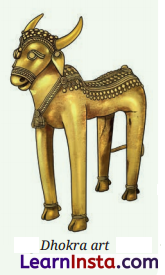
→ Use of Elements and Alloys in Art: The traditional Indian craft, Dhokra art, uses alloys like brass and bronze. A wax model is covered with clay to make a mould. The wax is melted, and molten metal or alloy is poured into the mould. Thesculptures are inspired by nature and reflect tribal art and tradition.
→ Matter and Non-Matter: Not everything around us is matter. Light, heat, electricity, and even thoughts and feelings are not made of matter.