These Class 6 Science Curiosity Worksheet and Class 6 Science Chapter 5 Measurement of Length and Motion Worksheet with Answers are excellent for board exam practice.
Class 6 Science Chapter 5 Measurement of Length and Motion Worksheet
Class 6 Measurement of Length and Motion Worksheet
Worksheet On Measurement of Length and Motion Class 6 – Measurement of Length and Motion Worksheet Class 6
A. Objective Type Questions
Multiple Choice Questions
Question 1.
The distance between Delhi and Mumbai is usually expressed in unit of
(a) decametre
(b) metre
(c) centimeter
(d) kilometre
Answer:
(d) kilometre
Question 2.
Which of the following does not express a time interval?
(a) A day
(b) A second
(c) A school period
(d) Time of the first bell in the school
Answer:
(d) Time of the first bell in the school

Question 3.
Figure shows a measuring scale which is usually supplied with a geometry box. Which of the following distance cannot be measured with this scale by using it only once?

(a) 0.1 m
(b) 0.15 m
(c) 0.2 m
(d) 0.05 m
Answer:
(c) 0.2 m
Question 4.
A piece of ribbon folded five times is placed along a 30 cm long measuring scale as shown in figure.

The length of the ribbon is between
(a) 1.15 m – 1.25 m
(b) 1.25 m – 1.35 m
(c) 1.50 m – 1.60 m
(d) 1.60 m – 1.70 m
Answer:
(b) 1.25 m – 1.35 m
Question 5.
Paheli moves on a straight road from point A to point C. She takes 20 minutes to cover a certain distance AB and 30 minutes to cover the rest of distance BC. Then she turns back and takes 30 minutes to cover the distance CB and 20 minutes to cover the rest of the distance to her starting point. She makes 5 rounds on the road the same way. Paheli concludes that her motion is
(a) only rectilinear motion
(b) only periodic motion
(c) rectilinear and periodic both
(d) neither rectilinear nor periodic
Answer:
(b) only periodic motion
Question 6.
Bholu and Golu are playing in a ground. They start running from the same point A on the ground and reach point B at the same time by following the paths marked 1 and 2 respectively, as shown in figure. Which of the following is true for the given situation?
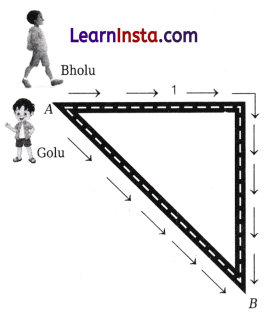
As compared to Golu, Bholu covers a
(a) longer distance with a lower speed
(b) longer distance with a higher speed
(c) shorter distance with a lower speed
(d) shorter distance with a higher speed
Answer:
(b) longer distance with a higher speed
Question 7.
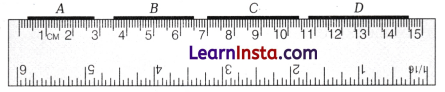
Four pieces of wooden sticks A, B, C and D are placed along the length of 30 cm long scale as shown in figure. Which one of them is 3.4 cm in length?
(a) A
(b) B
(c) C
(d) D
Answer:
(c) C
Question 8.
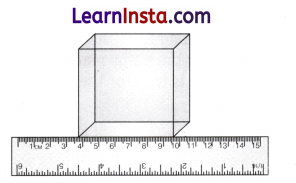
Which of the following figure shows the correct placement of a block along a scale for measuring its length?

Answer:
(c)
Question 9.
You are provided three scales A, B and C as shown in figure to measure a length of 10 cm.

For the correct measurement of the length you will use the scale
(a) A only
(b) B only
(c) C only
(d) Any of the three scales
Answer:
(d) Any of the three scales
Question 10.
The fixed quantity of measurement is called
(a) foot
(b) pound
(c) unit
(d) gallon
Answer:
(c) unit
Question 11.
The system of standard units of measurements is the
(a) SI system
(b) FPS system
(c) MKS system
(d) IUPAC system
Answer:
(a) SI system
Fill in the Blanks
Question 1.
Complete the below statements by using word of your own study, based on NCERT.
(a) Motion of an object or a part of it around a fixed point in a circular path is known as ____ motion.
(b) A body repeating its motion after certain interval of time is in ____ motion.
(c) In linear motion, object moves along a ____ line.
(d) SI unit of length is ____.
Answer:
(a) circular
(b) periodic
(c) straight
(d) meter
Question 2.
Classify the following motions as straight line, circular or oscillatory.
(a) Hand motion while sprinting. ________
(b) The motion of a horse while pulling a cart along a straight road. ________
(c) Movement of a child on a merry-go-round. ________
(d) A child swinging on a see-saw. ________
(e) The motion of an electric bell’s hammer. ________
(f) The motion of a train on a straight bridge. ________
Answer:
(a) oscillatory
(b) Straight line
(c) Circular
(d) oscillatory
(e) oscillatory
(f) Straight line
Question 3.
Name the device used to measure the following, you have to fill the two boxes given below.

(a) Size of your shoulder.
(b) Size of your wrist.
(c) Your height.
(d) Your weight.
(e) Cloth for curtain.
(f) Circumference of round table
Answer:
(a) Measuring tape
(b) Measuring tape
(c) Measuring tape
(d) Weighing balance
(e) Measuring tape
(f) Measuring tape
True/False
Check whether the given below statements are correct or not, if correct mark it correct with green colour and if not put a cross with red colour.
Question 1.
The motion of the Earth is periodic.
Answer:
True
Question 2.
The distance between Delhi and Kolkata is usually expressed in units of millimeter.
Answer:
False
Question 3.
The motion of a swing is an example of linear motion.
Answer:
False
Question 4.
The height of a human can be measured in either feet or metre.
Answer:
True
Question 5.
Handspan can be used as a basic unit of measurement.
Answer:
False
Question 6.
1 kilometre is equal to 100000 centimetres.
Answer:
True
Match the Following
Question 1.
Match the following.
| Column I | Column II |
| (a) Distance between Delhi and Jaipur | (i) m |
| (b) Thickness of a coin | (ii) km |
| (c) Length of eraser | (iii) cm |
| (d) Length of your shoe lace | (iv) mm |
Answer:
(a) (ii)
(b) (iv)
(c) (iii)
(d) (i)
Assertion-Reason Questions
In the following questions, two statements are given, one is labelled as Assertion (A) and the other is labelled as Reason (R). Read the statements carefully and choose the correct alternative (a), (b), (c) and (d) as given below.
(a) Both A and R are true and R is correct explanation of A.
(b) Both A and R are true, but R is not the correct explanation of A.
(c) A is true, but R is false.
(d) A is false, but R is true.
Question 1.
Assertion (A) Motion of moon around the Earth is a circular motion.
Reason (R) In a circular motion, the distance of object from a fixed point remains the same.
Answer:
(d) A is false, but R is true.
Motion of moon around the Earth is elliptical.
Question 2.
Assertion (A) Length of tyre of a cycle can not be measured by a scale.
Answer:
(b) Both A and R are true, but R is not the correct explanation of A.
Tyres of a cycle are curved while a scale is straight, so it can not be used for measuring length of tyres.
Question 3.
Assertion (A) The motion of a ball rolling on the ground is nothing but a rectilinear motion.
Reason (R) The motion of ball rolling on the ground is a combination of different types of motion.
Answer:
(d) A is false, but R is true.
Motion of ball rolling on the ground is combination of rotational and rectilinear motion.
Question 4.
Assertion (A) If an object travels in such a way that it comes back to the starting position, then the displacement is zero but, the distance travelled is not zero.
Reason (R) The displacement is the shortest distance between the initial and final position of the body, whereas distance is the actual path length covered by an object.
Answer:
(a) Both A and R are true and R is correct explanation of A.
Question 5.
Assertion (A) While measuring the length, the eye of the observer should be exactly above that point of measurement to avoid the parallax error.
Reason (R) The scale used to measure the length of the object must be greater than the length of the object.
Answer:
(c) A is true, but R is false.
The observer’s eye should be exactly above the point of measurement to avotd parallax error is true, but the reason that the scale used measure the length of the objéct must be greaters than the length of the object is false.
Case Based Questions
Observe a tailor working on a sewing machine. The sewing machine remains at the same location while its wheel moves with a circular motion. It also has a needle that moves up and down continuously, as long as wheel rotates.
Question 1.
Select the one that remains at rest when you were making the above observation.
(a) Tailor
(b) Sewing machine
(c) Both tailor and sewing machine
(d) None of these
Answer:
(b) Sewing machine
Question 2.
In this observation the circular motion was observed in
(a) wheel of machine
(b) needle of machine
(c) Both (a) and (b)
(d) None of these
Answer:
(a) wheel of machine
Question 3.
The up and down motion of the needle of sewing machine can be classified as
(a) rotatory motion
(b) circular motion
(c) periodic motion
(d) None of these
Answer:
(c) periodic motion
B. Subjective Type Questions
Define the following terms
Question 1.
Metre
Question 2.
Measurement
Question 3.
Circular motion
Answer:
Question 4.
Rest
Answer:
Question 5.
Motion
Answer:
Very Short Answer Type Questions
Question 1.
If you are sitting in a moving car, are you at rest or in motion?
Question 2.
Which invention leads to the development of railroads?
Question 3.
Write one multiple and sub multiple units of lengths.
Question 4.
The hour hand of clock takes 12 hours to complete one full circle. What kind of motion does it exhibit?
Question 5.
Are senses reliable for accurate measurement?
Question 6.
While using a scale, you notice that the starting point is not zero. How will this affect your measurement and what should you do to ensure accuracy?
Question 7.
Name the measuring device which can be used for measuring the girth of a tree.
Question 8.
Name the types of motion in which a body moves along a straight path.
Question 9.
Arrange the following in increasing order: 1 km, 5 cm, 10 mm.
Question 10.
The distance between Ram’s house and Ravi’s house is 3000 m. Express it in km.
Question 11.
What is the difference between motion of a falling stone and motion of a stone tied to a thread and whirled with hand?
Question 12.
A thread is 2 m long. Express its length in cm and mm.
Question 13.
A playground has a swing set that is 4 meters away from a slide. If a child plays on the swing and then decides to go to the slide, how far will they travel?
Question 14.
A fan rotates around its axis while running. What type of motion does this represent, and how can you demonstrate this type of motion in a different example?
Short Answer Type Questions
Question 1.
Why can’t we use a finger or a fist as standard unit of measurement of length?
Question 2.
State any two precautions to be observed while measuring the length with the help of a metre scale.
Question 3.
Is it possible for a body to undergo both rotational motion and rectilinear motion at the same time? Justify?
Question 4.
A carpenter is fixing a curtain rod on the wall by tightening a screw. How many different kinds of motion is the screw undergoing?
Question 5.
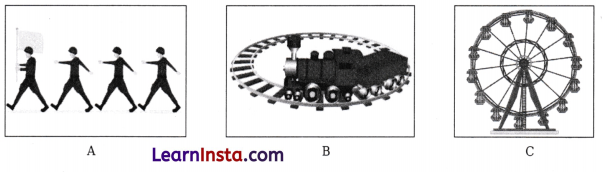
Observe the pictures given below and write down the type of motion exhibited by each.
Question 6.
Correct the following.
(i) The motion of a swing is an example of rectilinear motion.
(ii) 1 m = 1000 cm
Question 7.
If a train travels around a circular tract at a constant speed, what type of motion is it exhibiting? Explain how this motion is different from simply moving forward in a straight line and provide an example.
Question 8.
Consider a marathon race that is measured in kilometers. If a runner completes 5 kilometers, how might you express this distance in meters? Discuss how knowing different units helps in everyday scenarios.
Question 9.
What is the difference between motion of ceiling fan and motion of a pendulum?
Question 10.
Why can’t we use elastic tape to measure distance?
Question 11.
What is the difference between rectilinear and circular motion?
Question 12.
What is the difference between kilometres and kilogram?
Question 13.
Why do we say that the distance of the stone (held with a string) from your hand is the same when we whirl it around?
Question 4.
How can the thickness of a coin be measured?
Long Answer Type Questions
Question 1.
Why do we need standard units for measurement?
Question 2.
How are the motions of a wheel of a moving bicycle and a mark on the blade of a moving electric fan different? Explain.

Question 3.
Three students measured the length of a corridor and reported their measurements. The values of their measurements were different. What could be the reason for difference in their measurements? (Mention any three.)
Question 4.
Malli was riding on his bicycle along a straight road. He classified the motion of various parts of the bicycle as
(i) linear motion,
(ii) circular motion and
(iii) both linear as well as circular motion.
Can you list one part of the bicycle for each type of motion? Support your answer with reason.
Question 5.
Four children measured the length of a table which was about 2 m. Each of them used different ways to measure it.
(i) Sam measured it with a half metre long thread.
(ii) Gurmeet measured it with a 15 cm scale.
(iii) Reena measured it using her handspan.
(iv) Salim measured it using a 5 m long measuring tape.
Which one of them would get the most accurate length? Give reason for your answer.
Question 6.
What do such kilometre stones indicate? How could Padma conclude that she was getting closer to her destination?

Skill Based Activities
Question 1.
Complete the crossword with the help of clues provided.

Across
3. The movement of a snail on the ground is a _____ motion.
6. SI stands for International ____ of Unit.
7. ____ and Mutthi was used as units of small measurement in ancient time period.
Down
1. The strings of the guitar is an example of ____ motion
2. The whirling of stone tied with a thread is an example of ____ motion
4. When the object does not move with time, it is said to be at ____
5. When the object moves with time, it is said to be at ____
Question 2.
Identify the different types of motion in the following word diagram given as in the figure.

Question 3.
Vivek visited a stationary store near to his house. He was fascinated to see several new things in the store. He saw that measurement tools are made of flexible material, he was unable to understand logic behind it. Why are some length measuring devices made up of flexible materials?
Question 4.
Suppose you are travelling on a ship somewhere near Canada, which is moving at a constant speed along a straight line on a calm sea. Suppose there is no window on the ship. Is there any way that you can determine whether the ship is moving or is stationary?
Answer:
Question 5.
Discuss with elders in your community, what units were used for measurement of length in the olden days. Also, using the internet, try to find out about the length scales found in excavations of archaeological sites in India.
Answer:
Question 6.
Can you find the thickness of a single page of your notebook or textbook using a scale? Think of a way and write it. Carry out the activity and report your result.