These Class 7 Science Curiosity Worksheet and Class 7 Science Chapter 9 Life Processes in Animals Worksheet with Answers are excellent for board exam practice.
Class 7 Science Chapter 9 Life Processes in Animals Worksheet
Class 7 Life Processes in Animals Worksheet
Worksheet On Life Processes in Animals Class 7 – Life Processes in Animals Worksheet Class 7
A. Multiple-Choice Questions
Question 1.
Where does the exchange of oxygen and carbon dioxide occur in the lungs?
(a) Bronchi
(b) Trachea
(c) Alveoli
(d) Diaphragm
Question 2.
Which of the following is not a ruminant?
(a) Cow
(b) Buffalo
(c) Goat
(d) Tiger

Question 3.
Which part of a bird’s body helps in grinding food?
(a) Beak
(b) Crop
(c) Gizzard
(d) Intestine
Question 4.
This question consists of an Assertion (A) and a Reason (R). Read the Assertion and Reason and choose the appropriate answer.
Assertion (A): The absorption of nutrients takes place in the large intestine.
Reason (R): The small intestine has finger-like projections that increase surface area for nutrient absorption.
(a) Both A and R are true, and R is the correct explanation of A.
(b) Both A and R are true but R is not the correct explanation of A.
(c) A is true but R is false.
(d) A is false, but R is true.
Question 5.
This question consists of an Assertion (A) and a Reason (R). Read the Assertion and Reason and choose the appropriate answer.
Assertion (A): Breathing and respiration are different processes.
Reason (R): Both involve taking in oxygen and giving out carbon dioxide.
(a) Both A and R are true, and R is the correct explanation of A.
(b) Both A and R are true but R is not the correct explanation of A.
(c) A is true but R is false.
(d) A is false, but R is true.
B. State True (T) or False (F).
1. We can live for several hours without breathing.
2. Fermented foods are good for a healthy digestive system.
3. When you breathe out, the ribs move down and inwards.
4. Grit or small stones help birds in the process of digestion.
5. Smoking is harmful to health.
C. Fill in the blanks.
1. The ______________ secretes bile, which is slightly basic in nature.
2. The large intestine is about ______________ metres in length.
3. The process of inhaling and exhaling air is called ______________
4. The tadpoles breathe through their ______________
5. Earthworms exchange gases with their moist ______________
D. Assign one word to the following terms.
1. The dome-shaped muscle below the lungs. ______________
2. The sticky substance in the nose that traps dust. ______________
3. The physical process of inhaling and exhaling air. ______________
4. The scientist who treated Alexis St. Martin’s shotgun wound to learn about digestion. ______________
5. A protein found in wheat, barley, and rye. ______________
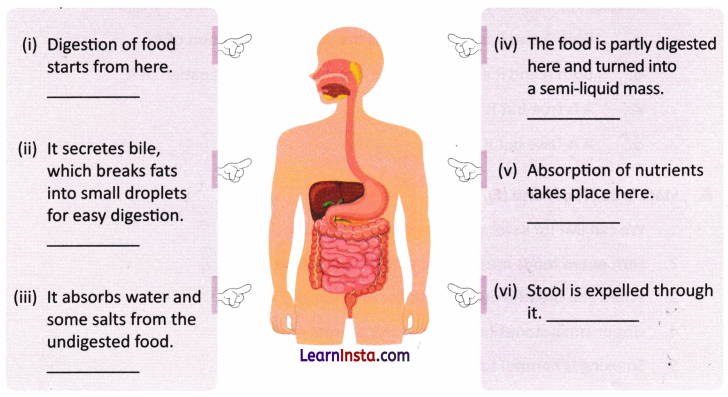
E. Look at the picture and use the clues to identify the different parts of the digestive system. Now, match their names correctly to the parts shown in the image.
F. Match the terms in Column I with the correct explanation given in Column II.
| Column I | Column II |
| (i) Ruminants | (a) Process by which undigested food is removed from the body |
| (ii) Gizzard | (b) Ancient ayurvedic text |
| (iii) Celiac Disease | (c) Breathing practices to improve respiratory health |
| (iv) Egestion | (d) Process by which nutrients are converted into usable energy |
| (v) Respiration | (e) Grinding organ found in birds |
| (vi) Pranayama and Tummo | (f) Animals like cows and buffaloes |
| (vii) Charaka Samhita | (g) Condition in which the body reacts to gluten |
Wonder Why?
A. Ankur, Fatima, and Nilu each took a small piece of chapati. Ankur swallowed the piece without chewing. Fatima chewed the chapati for about 10 seconds before swallowing. Nilu chewed hers for over a minute and noticed it began to taste sweet. While conducting this experiment, their elders also reminded them about the importance of good oral hygiene, ensuring a healthy mouth for proper digestion.
Question 1.
Why did Nilu feel a sweet taste after chewing for a longer time?
______________________________________________________
______________________________________________________
Question 2.
Why Ankur and Fatima did not notice any sweet taste?
______________________________________________________
______________________________________________________
Question 3.
What points must Ankur, Fatima and Nilu follow to maintain good oral hygiene?
______________________________________________________
______________________________________________________
B. Alina has been feeling weak and tired often. Her doctor told her that she has celiac disease and she must stop eating foods like wheat, barley, and rye. Instead, she was advised to eat millets like jowar, bajra, and ragi.
Question 1.
Why was Alina told to avoid wheat, barley, and rye?
______________________________________________________
______________________________________________________
Question 2.
Why does celiac disease affect the small intestine?
______________________________________________________
______________________________________________________
Question 3.
Why are millets safe for Alina to eat?
______________________________________________________
______________________________________________________
C. Look at the given image. Label its parts and answer the following questions.

Question 1.
Why is cow called a ruminant?
______________________________________________________
______________________________________________________
Question 2.
What happens to the grass after a cow first swallows it?
______________________________________________________
______________________________________________________
Question 3.
For how many hours a day does a cow chew its food?
______________________________________________________
______________________________________________________
D. Look at the diagrams and answer the questions.
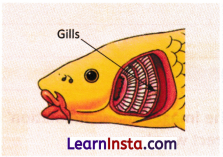
Question 1.
What is the function of gills?
______________________________________________________
______________________________________________________
______________________________________________________
______________________________________________________
Question 2.
Identify the image and write its function.

______________________________________________________
______________________________________________________
______________________________________________________
______________________________________________________
Question 3.
What is the function of the gizzard?

______________________________________________________
______________________________________________________
______________________________________________________
______________________________________________________
Learn By Being
A. Observe the activity and answer the following questions.

Question 1.
What does the milky appearance of lime water indicate?
______________________________________________________
______________________________________________________
______________________________________________________
Question 2.
How is this activity useful in understanding human breathing?
______________________________________________________
______________________________________________________
______________________________________________________
B. Look at the images below. Circle whether the images show ‘inhalation’ or ‘exhalation’. Then, complete the paragraph using the correct words.

Complete the paragraph:
The rib cage moves ______________ and ______________ when we inhale. The diaphragm moves ______________. The chest space ______________, and air enters the lungs. The percentage of oxygen and carbon dioxide is ______________ and ______________. When we exhale, the rib cage moves ______________ and ______________. The diaphragm moves ______________. The chest space ______________, and air is pushed out of the lungs. The percentage of oxygen and carbon dioxide is ______________ and ______________.
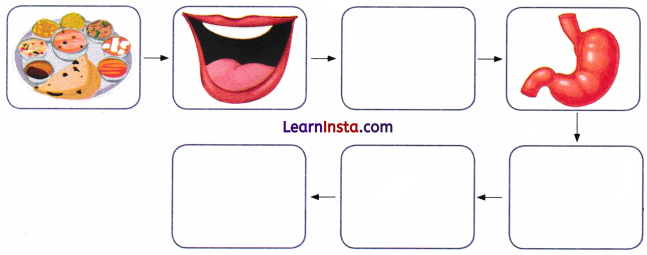
C. Complete the journey of food through the alimentary canal by pasting the images in the boxes with the appropriate parts.
Explore with Curiosity
A. Carefully observe what happens when you are near dust, pepper, or a strong-smelling flower. Without putting anything inside your nose, gently bring the item close and notice if you feel the urge to sneeze. Why do you think this happens?
______________________________________________________
______________________________________________________
______________________________________________________
B. Go outside and do some running for a few minutes. Pay attention to how your breathing changes before, during, and after the run. Why do you think your breathing becomes faster when you run?
______________________________________________________
______________________________________________________
______________________________________________________
Word Puzzle
Find out ten words related to this chapter in the given word search puzzle.

Activities
A. Find out what air quality and AQI mean. Choose any two jobs like farmers, factory workers, or street vendors, and explore how the air they breathe affects their lungs. Share your findings in a short report, chart, or poster. Include what AQI shows, how bad air can harm the lungs, and simple ways to stay safe.
B. Take a spray bottle and release small droplets (like a cough or sneeze). Observe how they move in the air and where they go. Then, research how the SARS-CoV-2 virus spreads through the air and its effects on the lungs and breathing. Create a poster explaining how the virus enters the body and why it affects the respiratory system.