These Class 8 Science Curiosity Worksheet and Class 8 Science Chapter 11 Keeping Time with the Skies Worksheet with Answers are excellent for board exam practice.
Class 8 Science Chapter 11 Keeping Time with the Skies Worksheet
Class 8 Keeping Time with the Skies Worksheet
Worksheet On Keeping Time with the Skies Class 8 – Keeping Time with the Skies Worksheet Class 8
Let’s Begin
A. Multiple Choice Questions
Question 1.
During the waning period of the Moon, the bright portion of the Moon
(a) Increases from a new Moon to a full moon
(b) Decreases from a full Moon to a new Moon
(c) Stays the same throughout the period
(d) Changes randomly without a pattern.
Question 2.
What fraction of the Moon always faces the Earth?
(a) One fourth
(b) The whole Moon
(c) Only the illuminated part
(d) One half
Question 3.
What causes the phases of the Moon?
(a) Relative position of the Sun, Moon, and Earth
(b) Rotation of Earth
(c) Sun revolving around the Moon
(d) Earth’s shadow on the Moon
Question 4.
This question consists of an Assertion (A) and a Reason (R). Read the Assertion and Reason and choose the appropriate answer.
Assertion (A): A solar year is defined as the time Earth takes to complete one revolution around the Sun.
Reason (R): The Earth undergoes one complete cycle of seasons during its revolution around the Sun, which takes nearly 365% days.
(a) Both A and R are true and R is the correct explanation of A.
(b) Both A and R are true but R is not the correct explanation of A.
(c) A is true but R is false.
(d) A is false but R is true.
Question 5.
This question consists of an Assertion (A) and a Reason (R). Read the Assertion and Reason and choose the appropriate answer.
Assertion (A): Lunar calendars keep the seasons synchronised with the same lunar months every year.
Reason (R): The lunar year is about 354 days long, while seasons repeat in approximately 365 days.
(a) Both A and R are true and R is the correct explanation of A.
(b) Both A and R are true but R is not the correct explanation of A.
(c) A is true but R is false.
(d) A is false but R is true.

Question 6.
This question consists of an Assertion (A) and a Reason (R). Read the Assertion and Reason and choose the appropriate answer.
Assertion (A): A waxing Moon is easiest to spot at sunrise, and a waning Moon at sunset.
Reason (R): The Moon always rises and sets at different times than the Sun.
(a) Both A and R are true and R is the correct explanation of A.
(b) Both A and R are true but R is not the correct explanation of A.
(c) A is true but R is false.
(d) A is false but R is true.
B. State True (T) or False (F).
1. The day when the Moon appears as a full bright circle is known as Am a vasy(a)
2. On a full Moon day, the Moon sets in the West direction.
3. The Moon takes 7 days to complete one revolution around the Earth.
4. The changing phases of the Moon are natural periodic event.
5. The Moon shines with its own light.
6. The portion of the Moon facing the Earth is not always its illuminated part.
7. The shadow is shortest when the Sun is at the highest point in the sky.
Fill in the blanks.
1. An _______ month is added in some luni-solar calendars every few years to match the lunar year with the solar year.
2. Holi is celebrated on the _______ of Phalguna.
3. Buddha Purnima is observed on the _______ of Vaisokho.
4. The waxing period of the Moon in India is known as _______.
5. In luni-solar calendars, an _______ month is added every few years to correct the difference between the lunar and solar year.
D. Assign one word to the following terms.
1. Changing shapes of the Moon’s bright portion as seen from Earth. _______
2. Phase in which more than half of the Moon’s visible surface is illuminated. _______
3. Day on which the Moon is closest to the Sun and not visible from Earth. _______
5. Average time taken by the Sun to return to its highest point in the sky on consecutive days. _______
6. Vikram Sarabhai Space Centre (VSSC) is situated at. _______
E. Match the Columns.
Question 1.
Match the terms given in Column I with their descriptions given in Column II.
| Column I | Column II |
| (i) Crescent phase | (a) New Moon day |
| (ii) Full Moon day | (b) Day and night |
| (iii) Solar eclipse | (c) Moon less than half visible |
| (iv) Moon’s phases | (d) Moon fully illuminated |
| (v) Rotation of Earth | (e) 29.5 days |
Question 2.
Match the pictures given in Column I with their correct statements given in Column II, and write their names below each picture.

Wonder Why?
A. Give reasons for the following.
1. The stars that rise at sunset change throughout the year.
______________________________________________
______________________________________________
2. Festivals like Diwali, and Holi fall on different dates of the Gregorian calendar each year.
______________________________________________
______________________________________________
3. The Moon rises and sets at different times than the Sun.
______________________________________________
______________________________________________
4. Eshani saw a lunar eclipse on her birthday, 15th August, but she will not see a lunar eclipse on her birthday every year.
______________________________________________
______________________________________________
5. Space debris is considered dangerous.
______________________________________________
______________________________________________
B. Read the paragraph and answer the following questions. Analyse
Vedant enjoyed observing the Moon each night. He noticed that its shape kept changing, sometimes it appeared full, sometimes half, sometimes as a thin crescent, and sometimes completely dark as a new Moon. He recalled his teacher explaining that the Moon does not emit its own light but shines by reflecting sunlight. The phases of the Moon occur because it revolves around the Earth, and we see different portions of its illuminated half and its phases change as it revolves around the Earth, showing different illuminated portions. The Moon rises at different times each day because it moves ahead in its orbit while Earth completes one rotation in 24 hours, making Earth rotate a little extra for the Moon to appear in the same spot.
Question 1.
What change did Vedant notice in the Moon?
______________________________________________
______________________________________________
Question 2.
What causes the Moon’s Phases?
______________________________________________
______________________________________________
Question 3.
Why does the Moon rise at different times each day?
______________________________________________
______________________________________________
Question 4.
Why must Earth rotate a little more each day?
______________________________________________
______________________________________________
Question 5.
If Moon rises at 3:15 p.m on 15th of October, 2025 then at what time Moon will rise on 21st October, 2025?
______________________________________________
______________________________________________
C. If we stop adding leap years, after about how many years would Christmas fall in the summer?

______________________________________________
______________________________________________
Learn By Doing
A. Choose a location with a clear view of the sky, away from tall trees or buildings. Go outside before sunrise or after sunset. Look carefully for any fast-moving points of light that shine steadily or flicker as they move across the sky. These could be artificial satellites. Try spotting these satellites with your naked eye or use binoculars to get a closer view. Use a mobile app or website that shows when and where satellites will be visible from your location.
Question 1.
Where should you go to watch artificial satellite?
______________________________________________
______________________________________________
Question 2.
When is the best time to observe satellites?
______________________________________________
______________________________________________
Question 3.
How can you identify an artificial satellite in the sky?
______________________________________________
______________________________________________
Question 4.
What tools can help you see satellites better?
______________________________________________
______________________________________________
B. One day in class, the teacher was talking about how the Moon has inspired art and culture in Indi(a) After the discussion, a group of friends — Aarav, Meera, Rohan, Sanya, Dev and Tara-started sharing what they knew. Discuss/Analyse
Aarav: Did you know there are rogos in Indian classical music named after the Moon? For example, Chondrokouns, Chcmdranandan and even Shubhapantuvorali, which means ‘auspicious moon.
Meera: That is interesting! In Bharatanatyam, there are mudras like Chandrakala and Ardhachandran that also represent the Moon.
Rohan: It is not just Bharatanatyam. Other dance forms like Kathak, Odissi, and Kuchipudi also use Moon-related expressions.
Sanya: I read that the Moon and the Sun are common in painting styles too. Madhubani and Warli paintings often show them.
Dev: Yes, and even tribal art forms, like those of the Saura and Gond communities, include Moon and Sun motifs in their sculpture and pottery.
Tara: It looks like the Moon and Sun are really important symbols in people’s daily life and traditions. That’s why they appear so much in music, dance and art.
Now, based on their discussion, answer the following questions.
Question 1.
Name a few rogos in Indian classical music that are inspired by the Moon.
______________________________________________
______________________________________________
Question 2.
Which classical dance form includes mudras like Chondrakola and Ardhochandran that relate to the Moon?
______________________________________________
______________________________________________
Question 3.
Besides Bharatanatyam, which other dance forms depict the Moon through their gestures and expressions?
______________________________________________
______________________________________________
Question 4.
Which traditional painting styles prominently show depictions of the Moon and the Sun?
______________________________________________
______________________________________________
Question 5.
Why do you think the Moon and Sun hold such significance in Indian art, music, and dance traditions?
______________________________________________
______________________________________________
Explore With Curiosity
A. Read the paragraph and answer the following questions.
Amit is observing the night sky and notices that the Moon appears different on different nights. These changes are called the phases of the Moon. Each phase depends on the position of the Moon in its orbit around the Earth. The pictures below (I to VIII) show the sequence of these phases, starting from a new Moon and moving through waxing, full Moon, and waning phases.

Question 1.
Which phase of Moon is three days after full Moon?
______________________________________________
______________________________________________
Question 2.
Which phase of the Moon occurs after 7 days from new Moon?
______________________________________________
______________________________________________
Question 3.
Which phase of Moon occurs after 29.5 days from full Moon?
______________________________________________
______________________________________________
Question 4.
Which phase of the Moon is never seen from Earth?
______________________________________________
______________________________________________
B. Complete the conversation between Aanya and Sanya based on their observations.
Aanya and Sanya were discussing how movement of Sun and Moon is used to create calendars. These calendars helped them decide when to plant crops, celebrate festivals, and track seasons.

Aanya: Do you know about lunar calendars?
Sanya: ______________________________________________
Aanya: Oh! So that is why lunar months do not match the same
seasons every year?
Sanya: ______________________________________________
Aanya: And what about solar calendars?
Sanya: ______________________________________________
Aanya: Solar calendars add an extra day after every four years. Why?
Sanya: ______________________________________________
C. Read the following paragraph and choose the correct word. Rewrite the paragraph in the space provided.
Ravi observed that the Sun appears to rise in the eastward/westward direction and set in the eastward/westward direction every day. This regular pattern is not because the Sun moves around the Earth, but because of the rotation/revolution of the Earth around its own axis from west to east. As the Earth rotates, different places face the Sun, resulting in day/month, while the opposite side experiences night. The time taken by the Sun to return from its highest position in the sky back to the same position is 24 hours/7 days, and this period is called a mean solar day/mean lunar day. The highest position of the Sun during the day can be identified by measuring the length of a shadow/light. The shadow is the shortest/longest at this time, which usually occurs around noon, when the Sun is closest to being overhead. Ancient people used this observation to create sundials/calendars, which helped them tell the time of day.
______________________________________________
______________________________________________
Word Puzzle
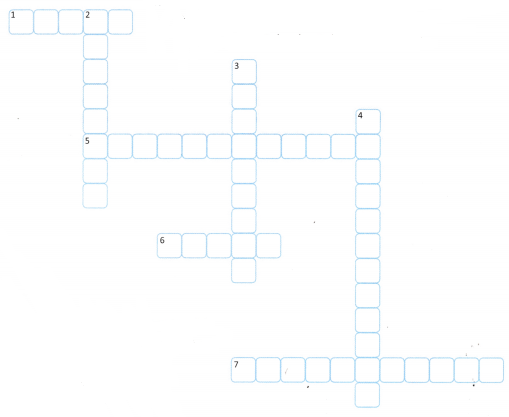
Complete the crossword with the help of the given clues.
ACROSS
1. Calendars used to synchronise with seasons
5. Time required for the same stars to rise again at sunset
6. Calendars based on phases of the Moon
7. Chairperson of Calendar Reform Committee
DOWN
2. Day when the Moon is not visible
3. Sun’s northward movement from December to June 7
4. Time between successive spring equinoxes
Suggested Activities
A. India has many cultures, and different states celebrate important festivals based on various traditional calendars. Create a colourful chart or poster for any 10 states, listing the name of the festival and the state in the first column, the type of calendar (lunar, solar, or luni-solar) in the second column, and one special custom or tradition followed during the festival in the third column. Use this chart to show how different festivals are celebrated across India with respect to their calendar systems and unique customs.
B. Go outside every evening for seven consecutive days and observe the Moon in the sky. Each day, record the date and time of your observation and draw the Moon’s shape exactly as you see it in your notebook. Note whether the visible part of the Moon is growing larger (waxing) or getting smaller (waning). After the week, describe how the Moon’s illuminated portion has change(d) Use your observations to explain why the Moon appears to change shape even though it is always the same. Then, discuss with your classmates how the changing positions of the Moon, Earth, and Sun cause these changes in the Moon’s appearance.
C. Choose a spot with a clear view of the eastern horizon and find fixed landmarks like trees, poles, or buildings to help you observe. On a piece of paper or in your notebook, draw a simple horizon line including these landmarks. Each month, visit the same spot around sunrise and mark the exact position where the Sun rises on your drawing, labelling each mark with the month’s name. After several months, connect these marks to see the path that the Sun follows along the horizon throughout the year. Identify the northernmost and southernmost points on your drawing and colour the path between these points and label the northward movement as Uttoroyon and the southward movement as Dakshinayan.