Students revise important topics using Class 7 Social Science Extra Questions and Class 7 SST Part 2 Chapter 2 India and Her Neighbours Important Extra Questions before exams.
India and Her Neighbours Class 7 Extra Question Answer
Extra Questions of India and Her Neighbours Class 7 SST Chapter 2
India and Her Neighbours Class 7 Very Short Question Answer
Question 1.
Who are India’s maritime neighbours mentioned in the chapter?
Answer:
India’s immediate maritime neighbours are Sri Lanka and the Maldives. Countries like Iran, Oman, Thailand, Malaysia, Singapore, and Indonesia are part of India’s wider maritime neighbourhood.
Question 2.
What is meant by an open border?
Answer:
open border is one where people can cross without visas or passports. India and Nepal share such an open border, which allows easy movement for work, trade, and pilgrimage.
Question 3.
Why is Bangladesh called a “newborn neighbour”?
Answer:
Bangladesh became an independent country in 1971, which makes it relatively new compared to older states.
Question 4.
What is Gross National Happiness?
Answer:
Gross National Happiness is Bhutan’s way of measuring progress. It focuses on people’s wellbeing, culture, environment, and good governance rather than only money.

Question 5.
Why is Myanmar called India’s gateway to Southeast Asia?
Answer:
Myanmar connects India’s northeastern states to countries further east. It allows overland and maritime links to Southeast Asia.
Question 6.
What is SAARC?
Answer:
SAARC stands for the South Asian Association for Regional Cooperation. It is a group of South Asian countries formed to promote socio-cultural and economic cooperation.
Question 7.
Why is the Sundarban important for India and Bangladesh?
Answer:
The Sundarban is the world’s largest mangrove forest shared by both countries. It protects their coasts from cyclones and supports rich biodiversity.
Question 8.
How did Buddhism move from India to other countries?
Answer:
Buddhism spread mainly through monks, traders, and pilgrims travelling along land and sea routes.
It reached places like Sri Lanka, Myanmar, China, and Indonesia.
Question 9.
What role did ancient trade routes like the Uttarapatha play?
Answer:
They connected the Ganga plains of India to Central Asia through Afghanistan. Along these routes, people exchanged goods, religions, and cultural ideas.
Question 10.
Why is the Indian Ocean important to India?
Answer:
It is a major route for world shipping and trade. India’s central location in this ocean gives her strategic and economic advantages.
India and Her Neighbours Class 7 Short Question Answer
Question 1.
Explain the difference between a land neighbour and a maritime neighbour of India.
Answer:
A land neighbour shares a physical land boundary with India, such as Nepal or Pakistan. These borders pass through mountains, plains, deserts, and rivers. A maritime neighbour is connected to India across the sea or ocean, like Sri Lanka or the Maldives. Both types of neighbours are important for trade, security, and cultural exchange.
Question 2.
Describe the main features of India’s relationship with China.
Answer:
India and China share a long Himalayan border and are two large Asian powers. Buddhism created early cultural links between them as monks and scholars travelled both ways. Today they have strong trade ties, though the trade balance favours China. At the same time, they face border tensions, making the relationship complex.
Question 3.
How has Partition affected India-Pakistan relations?
Answer:
Partition in 1947 divided British India into India and Pakistan, largely on religious lines. Since then, the two countries have fought several wars and faced frequent tensions, including terrorism. The border is both a symbol of shared heritage and painful separation. Efforts like the Kartarpur Corridor show that people still seek peaceful contact.
Question 4.
Why is the Sundarban region significant for India and Bangladesh?
Answer:
The Sundarban is the largest mangrove forest in the world, shared by both countries. It provides a habitat to the Bengal tiger and many other species. Its mangroves act as a natural barrier against cyclones and storms. Climate change and rising sea levels threaten this fragile ecosystem, demanding joint protection.
Question 5.
What are the main features of the India-Nepal relationship?
Answer:
India and Nepal share an open border that allows easy movement of people. They are linked by shared religious traditions, festivals, and pilgrimage centres like Pashupatinatha temple. The 1950 Treaty of Peace and Friendship supports their political and economic ties. India remains Nepal’s largest trading partner, supplying many essential goods.
Question 6.
How do India and Bhutan cooperate with each other?
Answer:
Bhutan and India share a border in the eastern Himalayas. Bhutan uses its rivers to generate hydropower with Indian help, exporting electricity to India. The two countries are tied by a shared Buddhist heritage and pilgrimages. Bhutan’s idea of Gross National Happiness also influences discussions on development.
Question 7.
Explain why Myanmar is important for India.
Answer:
Myanmar shares both a land and maritime boundary with India, especially with the northeastern states. It serves as India’s gateway to Southeast Asia, enabling road and trade connections. The India- Myanmar-Thailand Trilateral Highway is a key project in-this regard. India has also helped restore Myanmar’s cultural sites and deepen people-to- people links.
Question 8.
What historical links connect India and Afghanistan?
Answer:
Ancient trade routes like the Uttarapatha connected the Ganga plains with Central Asia via Afghanistan. Before Islam arrived, the region had Buddhist and Hindu kingdoms similar to Indian polities. The Buddhas of Bamiyan were symbols of the spread of Mahayana Buddhism from India. In modem times, India has built roads and the Afghan Parliament to support Afghanistan’s development.
Question 9.
Discuss the nature of India-Sri Lanka relations.
Answer:
Sri Lanka lies just across the Palk Strait from India, making it a close maritime neighbour. Buddhism reached Sri Lanka from India in the 3rd century BCE, and Hindu influences also travelled there. The civil war in Sri Lanka led many Tamils to seek refuge in India, affecting relations. Today the two countries maintain cultural, economic, and strategic cooperation.
Question 10.
How is India connected to the Maldives?
Answer:
The Maldives lies close to Minicoy in Lakshadweep, making it an important Indian Ocean neighbour. Historical trade, shared cultural practices, and language influences link the two. India has often acted as a first responder, helping during the tsunami, water crises, and COVID-19. Both countries also work together on environmental and renewable energy issues.
India and Her Neighbours Class 7 Long Question Answer
Question 1.
Explain how India’s geographical location influences her relationships with neighbours.
Answer:
India is located at the centre of South Asia, between the Himalayas in the north and the Indian Ocean in the south. This position gives her many land neighbours, such as Pakistan, China, Nepal, Bhutan, Bangladesh, Myanmar, and Afghanistan.
At the same time, her long coastline and peninsular shape bring her close to maritime neighbours like Sri Lanka and the Maldives. The Indian Ocean, Arabian Sea, and Bay of Bengal connect India to Iran. Oman, and Southeast Asian countries. These land and sea routes have supported trade, migration, and cultural exchange for centuries. As a result, India’s foreign relations are strongly shaped by this strategic geography.
Question 2.
Describe in detail the cultural and economic ties between India and China.
Answer:
India and China are two ancient civilisations with a long history of contact, especially through Buddhism. Monks like Xuanzang travelled from China to Indian centres of learning, while Indian monks carried Buddhist teachings to China. Indian traders and even Hindu merchants left carvings of Visnu and Siva in Chinese temples like Kaiyuan.
In modem times, economic ties have become very significant, with India exporting iron ore, chemicals, and cotton yarn. India imports electronic items and industrial goods from China, making China’s exports to India much larger in value. Despite this cultural closeness and economic interdependence, the two countries also face border tensions and strategic rivalry.
Question 3.
Discuss the main aspects of India-Pakistan relations as presented in the chapter.
Answer:
India and Pakistan emerged as separate countries after the Partition of 1947, which divided British India. This division was painful and led to large- scale migration and violence, leaving lasting scars on both societies. Since independence, the two countries have fought several wars and have often faced tensions, especially around the border and terrorism.
At the same time, shared languages, music, food, and religious sites remind people of common cultural roots. Initiatives like the Kartarpur Corridor show that despite political problems, there is a desire for peaceful religious contact. Overall, their relationship is marked by both deep connections and serious conflicts.
Question 4.
Explain the importance of Bangladesh for India in terms of geography, culture, and environment.
Answer:
Bangladesh shares one of the longest land borders with India, touching several northeastern states. The two countries are linked by river systems of the Ganga and Brahmaputra, which are vital for agriculture and transport. They share the Sundarban, the largest mangrove forest, which protects coasts from cyclones and supports rich wildlife.
Culturally, Bangla language and literature connect Bangladesh with West Bengal in India. Their cooperation includes trade, connectivity, and joint work on environmental challenges like floods and sea-level rise. Thus, Bangladesh is central to India’s eastern neighbourhood in both human and ecological terms.
Question 5.
Describe how cultural and religious ties strengthen India’s relations with Nepal and Bhutan.
Answer:
Nepal and India share strong Hindu ties, with common deities, festivals, and pilgrimage sites such as Pashupatinatha. An open border allows people from both countries to travel easily for worship, work, and family visits. Bhutan and India share a deep Buddhist heritage, especially through the teachings of Guru Padmasambhava.
Bhutanese pilgrims regularly visit Indian Buddhist sites like Bodh Gaya and Nalanda. These shared religious traditions create trust and familiarity beyond political agreements. They help make Nepal and Bhutan some of India’s closest and most friendly neighbours.
Question 6.
Explain why Myanmar is called India’s gateway to Southeast Asia and how they cooperate.
Answer:
Myanmar sits between India and the rest of Southeast Asia, connecting India’s northeast to countries further east. Through Myanmar, road projects like the India-Myanmar-Thailand Trilateral Highway aim to link markets and peoples. Myanmar and India share a land border and a maritime boundary in the Bay of Bengal, supporting trade and security ties.
Culturally, Myanmar values India as the birthplace of Buddhism, and its pilgrims visit Indian holy sites. India has helped restore important Buddhist temples in Myanmar, including the Ananda temple in Bagan. These geographic, economic, and cultural links justify calling Myanmar India’s gateway to Southeast Asia.
Question 7.
How has India supported Afghanistan, and why is Afghanistan important historically?
Answer:
Historically, Afghanistan lay on the Uttarapatha trade route, connecting India’s Ganga plains to Central Asia. The region once hosted Buddhist and Hindu kingdoms, and the Buddhas of Bamiyan testified to India’s cultural influence. In modern times, the creation of Pakistan made India’s direct access to Afghanistan more difficult.
Despite this, India has built key infrastructure such as the Afghan Parliament and the Zaranj Delaram road. India has also supported education and healthcare projects to help Afghan society. These efforts show that India wishes to maintain and strengthen its old links with Afghanistan.
Question 8.
Discuss India’s relations with Sri Lanka, including cultural links and challenges.
Answer:
Sri Lanka lies very close to India across the Palk Strait, making it an important maritime neighbour. Buddhism was introduced to Sri Lanka from India by Emperor Asoka’s children, and Hindu influences also spread there.
These shared religious traditions have created long-lasting cultural bonds between the two countries. However, Sri Lanka’s civil war especially involving the Tamil minority, led many refugees to cross into India. This conflict created political and humanitarian challenges for both sides. After the war, India and Sri Lanka continue to cooperate in trade, culture, and regional securin’.
Question 9.
Explain the significance of the Maldives in India’s maritime neighbourhood.
Answer:
The Maldives is a nation of over a thousand small islands located close to India’s Lakshadweep. Historically, sea trade and cultural links tied the Maldives to coastal regions of India. Dhivehi. the Maldivian language, carries influences from Sanskrit, Tamil, Malayalam, and Hindi.
India has often acted as a first responder to the Maldives during crises like the tsunami, a water shortage, and the pandemic. The two countries also work together on issues of climate change and renewable energy, especially solar power. Because of its location and vulnerability, the Maldives is a key partner for India in the Indian Ocean.
Question 10.
Describe how Indian culture influenced Thailand and how this appears today.
Answer:
Indian traders and monks reached Thailand by sea. bringing religious ideas and epics. Kingdoms such as Dvaravat and Ayutthaya took their names from Indian concepts and sacred cities like Dvaraka and Ayodhya. Theravada Buddhism, rooted in early Indian teachings, is widely practised in Thailand.
Hindu stories and deities appear in Thai royal rituals, temple art, and classical dances. The sculpture of samudra manthana at Bangkok airport is a vivid example of Indian mythology in Thai public life. These elements show that Indian cultural influence remains visible in modem Thailand.
India and Her Neighbours Class 7 Source Based Questions
Read the below sources and answer the questions that follow:
Question 1.
India has a long coastline of about 11,100 km and is surrounded by the sea on three sides. This peninsular shape gives India a central position in the Indian Ocean. Major sea routes connecting Asia, Africa, and Europe pass close to India. Because of this, India has played an important role in trade, travel, and cultural exchange for centuries. The sea has acted as a natural bridge between India and its maritime neighbours.
(i) What makes India a maritime nation?
Answer:
India is surrounded by the sea on three sides and has a long coastline.
(ii) Name one region connected to India through sea routes.
Answer:
Southeast Asia / Africa / West Asia (any one)
(iii) Why is India’s location in the Indian Ocean important?
Answer:
India lies on major sea routes that connect different continents. This helped India develop trade, cultural exchange, and strong relations with many countries.
Question 2.
India and Bangladesh share a long land border and a common history. Bangladesh became independent in 1971 with India’s support. Both countries share language, culture, rivers, and traditions. Many rivers of the Ganga-Brahmaputra system flow through both countries. The Sundarbans mangrove forest lies partly in India and partly in Bangladesh and protects the region from cyclones.
(i) In which year did Bangladesh become independent?
Answer:
1971
(ii) Name one river system shared by India and Bangladesh.
Answer:
Ganga-Brahmaputra River system.
(iii) How does the Sundarbans help both countries?
Answer:
The Sundarbans protects coastal areas from cyclones and storms and supports rich wildlife, benefiting both India and Bangladesh.
Question 3.
India and Nepal share a long open border that allows people to move freely without passports or visas. The relationship between the two countries is based on shared history, culture, and religion. Festivals like Diwali, Holi, and Dashain are celebrated in both countries. India is Nepal’s largest trading partner and supplies important goods such as fuel and medicines.
(i) What kind of border do India and Nepal share?
Answer:
An open border.
(ii) Name one festival celebrated in both India and Nepal.
Answer:
Diwali/Holi/Dashain (any one)
(iii) Mention two ways in which India and Nepal are connected.
Answer:
They are connected through culture and religion, and through trade, with India being Nepal’s main trading partner.
India and Her Neighbours Class 7 Picture Based Questions
Look at the pictures and answer the questions that follow.
Question 1.
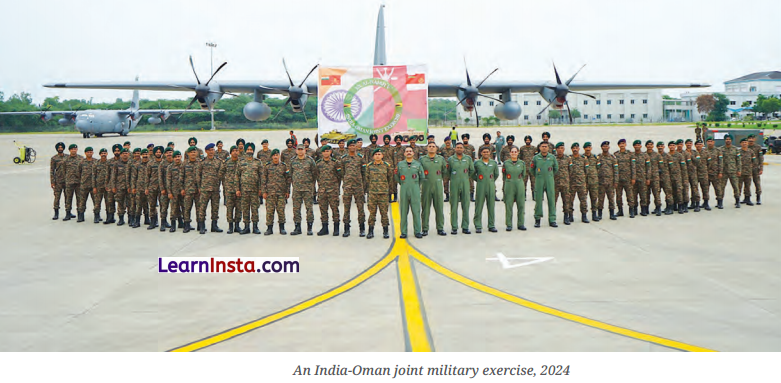
(i) Identify the event shown in the picture.
Answer:
The picture shows an India-Oman joint military exercise involving the armed forces.
(ii) Which three branches of the armed forces take part in the India-Oman joint military exercise?
Answer:
The Army, Navy, and Air Force take part in the joint military exercise.
(iii) Mention any two reasons why this joint military exercises were conducted.
Answer:
India and Oman conducted joint military exercises:
- To strengthen defence readiness and security cooperation between the two countries.
- To ensure maritime safety and protect important sea routes in the Indian Ocean.
Question 2.
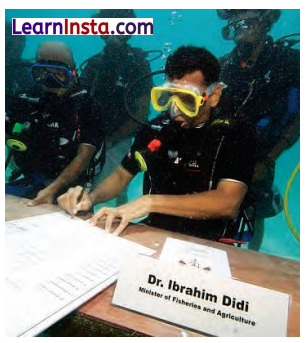
(i) What important event related to climate change is shown in the picture?
Answer:
The picture shows an underwater cabinet meeting held by the Maldivian government to highlight the dangers of climate change.
(ii) Why is the Maldives considered one of the most vulnerable countries to climate change?
Answer:
The Maldives is vulnerable because it is made up of low-lying islands that are threatened by rising sea levels.
(iii) How do India and the Maldives cooperate to build a sustainable future? Mention any two ways.
Answer:
India and the Maldives cooperate to build a sustainable future:
- The Maldives is a member of the International Solar Alliance led by India, which promotes solar energy.
- India supports the Maldives during environmental and humanitarian crises, helping build a sustainable and friendly partnership.
The Story of Indian Farming Class 7 Map based Question
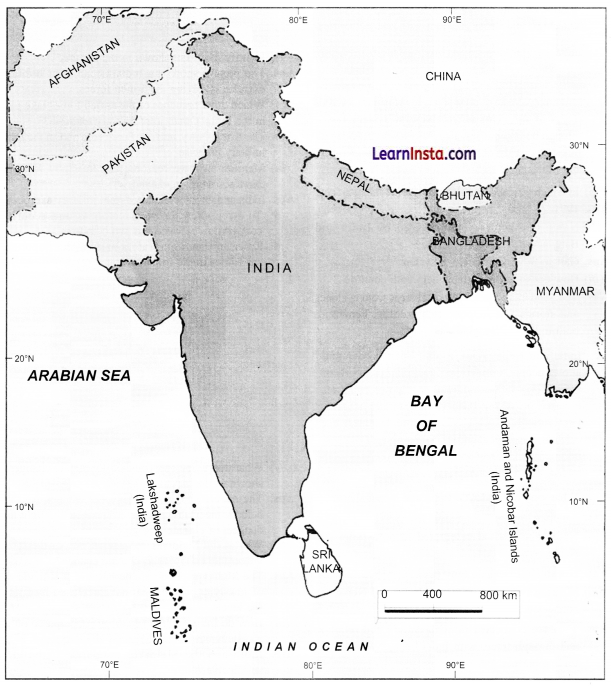
On the map of India, mark and locate the following neighbouring countries:
- Afghanistan
- Pakistan
- China
- Nepal
- Bhutan
- Maldives
- Bangladesh
- Sri Lanka
- Myanmar
Answer:
Class 7 India and Her Neighbours Extra Questions for Practice
Multiple Choice Questions
Question 1.
The Buddhas of Bamiyan were located in …………….
(a) Sri Lanka
(b) Afghanistan
(c) Indonesia
(d) Iran
Question 2.
The Kartarpur Corridor connects Indian pilgrims to a gurdwara in …………….
(a) Bangladesh
(b) Sri Lanka
(c) Pakistan
(d) Nepal
Question 3.
The Sundarban is a shared mangrove region between India and …………….
(a) Oman
(b) Bangladesh
(c) Iran
(d) Maldives
Question 4.
The Maldives lies close to which Indian island group?
(a) Andaman and Nicobar Islands
(b) Lakshadweep (near Minicoy)
(c) Sri Lanka
(d) Rajasthan deserts
Question 5.
Assertion (A): Oman is called the “Land of Copper.”
Reason (R): Ancient Indian traders brought copper from Oman for use in the Harappan civilisation.
(a) Both ( A ) and ( R ) are true and ( R ) is the correct explanation of ( A ).
(b) Both ( A ) and ( R ) are true but ( R ) is not the correct explanation of ( A ).
(c) (A) is true but (R) is false.
(d) (A) is false but (R) is true.
Very Short Answer Type Questions
Question 1.
What happened during the 2004 tsunami?
Question 2.
What is the Kartarpur Corridor used for?
Question 3.
What is an archipelago? Give one example from the chapter.
Question 4.
Why is Oman called the “Land of Copper” in the chapter?
Question 5.
How is Singapore linked to India culturally?
Short Answer Type Questions
Question 1.
Describe India’s connections with Thailand.
Question 2.
Explain the historical links between India and Malaysia.
Question 3.
What are the main features of India-Singapore relations?
Question 4.
How are India and Indonesia connected in the chapter?
Question 5.
Why are Iran and Oman important neighbours for India?
Long Answer Type Questions
Question 1.
Explain the main historical and modern links between India and Malaysia.
Question 2.
Discuss the nature of India-Singapore relations.
Question 3.
How are India and Indonesia connected through culture, trade, and disaster management?
Question 4.
Explain the historical and strategic importance of Iran for India.
Question 5.
Describe India’s ancient and modern links with Oman.