Morning Star ICSE Total English Class 10 Solutions Specimen Paper make the process easier for students by providing all grammar-related topics.
Total English Class 10 ICSE Solutions Specimen Paper
Question 1.
Do not spend more than 30 minutes on this question
(Write a composition 300- 350 words) on any one of the following.
i. Write an original story entitled, “A narrow escape.”
Answer:
The sun beat down on my back as I hiked up the mountain trail. I was tired, but I was determined to reach the summit. I had been planning this hike for months, and I wasn’t going to let anything stop me.
As I got closer to the top, the trail became steeper and more treacherous. I had to scramble over rocks and boulders, and I was careful not to slip. Finally, I reached the summit and stood there for a moment, catching my breath.
The view from the top was amazing. I could see for miles in every direction. The mountains were covered in a blanket of green trees, and the valleys were dotted with small towns and villages. I took a deep breath of the fresh air and smiled. I had made it.
I started to make my way back down the trail, but I wasn’t as careful as I should have been. I slipped on a rock and fell down a steep embankment. I landed hard on my back, and the wind was knocked out of me.
I lay there for a moment, stunned. I could feel the pain in my back, but I was more worried about the fact that I couldn’t move. I tried to get up, but my legs wouldn’t cooperate. I was paralyzed.
I started to panic. I was all alone, and no one knew where I was. I didn’t know how long I would have to lie there before someone found me.
I closed my eyes and tried to stay calm. I knew that I had to stay positive if I w.anted to si/rvive. I thought about my family and friends, and I knew that I had to get back to them.
I opened my eyes and looked around. I saw a tree branch a few feet away. I reached out and grabbed it, and then I slowly pulled myself up. I was still in pain, but I was able to stand up.
I started to walk down the trail, one step at a time. It was slow going, but I was determined to get back to safety.
After what seemed like an eternity, I finally reached the bottom of the mountain. I was exhausted, but I was also relieved. I had survived my narrow escape.
I made my way back to my car and drove home. I was so grateful to be alive, and I vowed to never take my life for granted again.

ii. Have you ever forgiven someone when it was hard to do so? Explain what helped you to forgive them and the positive impact it had. What did you learn from the experience?
Answer:
Yes, I have forgiven someone when it was hard to do so. It was my best friend, who had betrayed me in the worst possible way. She had told my deepest, darkest secrets to the entire school, and I was devastated. I felt like I couldn’t trust anyone anymore, and I didn’t know how to move on.
But then I realized thaf I couldn’t let her betrayal define me. I had to forgive her, not for her sake, but for my own. I had to let go of the anger and resentment that was eating me up inside.
It wasn’t easy, but I eventually did forgive her. I realized that she was just a human being, and that everyone makes mistakes. I also realized that I didn’t want to carry around the burden of anger and resentment for the rest of my life.
Forgiving my best friend was one of the hardest things I’ve ever done, but it was also one of the most rewarding. It allowed me to move on with my life and to finally start healing. I learned that forgiveness is not about condoning someone’s actions. It’s about letting go of the anger and resentment that is holding you back.
I also learned that forgiveness is a gift that you give yourself. It’s a way to free yourself from the past and to open yourself up to the possibility of happiness.
If you’re struggling to forgive someone, know that you’re not alone. It’s a difficult process, but it’s one that is worth it. Forgiveness can set you free.
iii. ‘Competition hampers the overall development of students.’ Express your views either for or against the statement.
Answer:
For
Competition is an integral part of our lives. It is present in every sphere of our existence, from the classroom to the workplace to the sports field. While competition can be a motivating force, it can also have a negative impact on our overall development. This is especially true for students, who are still in the process of forming their identities and developing their skills.
One of the main drawbacks of competition is that it can lead to excessive stress and anxiety. When students are constantly under pressure to outperform their peers, they can experience a range of negative emotions, such as worry, fear, and self-doubt. This can have a detrimental impact on their mental health and well-being. In some cases, it can even lead to more serious problems, such as depression and anxiety disorders.
Another problem with competition is that it can encourage unethical behaviour. In order to win, some students may be tempted to cheat or plagiarize. They may also resort to bullying or other forms of intimidation in order to gain an advantage over their peers. This type of behaviour is not only harmful to the students involved, but it also undermines the integrity of the educational system.
In addition to these negative consequences, competition can also hinder the overall development of students. When students are focused on winning, they may be less likely to take risks or try new things. They may also be less likely to collaborate with others or share their ideas. This can limit their creativity and problem-solving skills.
It is important to remember that competition should not be the only focus of education. Students should also be encouraged to learn for the sake of learning, to explore their interests, and to develop their own unique talents.
In conclusion, I believe that competition can have a negative impact on the overall development of students. It can lead to excessive stress and anxiety, encourage unethical behaviour, and hinder creativity and problem-solving skills. While competition can be a motivating force, it is important to remember that it should not be the only focus of education. Students should also be encouraged to learn for the sake of learning, to explore their interests, and to develop their own unique talents.
Against-
Competition is an inevitable part of life. It is present in all aspects of our lives, from the classroom to the workplace. While some people believe that competition is harmful to students, I believe that it can actually be beneficial.
One of the main benefits of competition is that it can motivate students to work harder. When students are competing against each other, they are more likely to push themselves to achieve their goals. This can lead to improved grades, better test scores, and a greater understanding of the material.
Another benefit of competition is that it can teach students how to deal with failure. In a competitive environment, students will inevitably experience failure at some point. However, this can be a valuable learning experience. By learning how to deal with failure in a healthy way, students can become more resilient and better equipped to handle the challenges they will face in life.
Competition can also help students to develop important social skills. When students work together to achieve a common goal, they learn how to communicate effectively, collaborate with others, and resolve conflict. These skills are essential for success in both the academic and professional worlds.
It can motivate students to work hard and achieve their goals. It can also help them to develop important skills, such as resilience and determination.
Of course, competition can also have some negative consequences. For example, it can lead to stress, anxiety, and unhealthy comparisons. However, I believe that the benefits of competition outweigh the risks. When competition is managed in a healthy way, it can be a powerful tool for student development.
In conclusion, I believe that competition does not hamper the overall development of students. In fact, I believe that it can be beneficial in a number of ways. Competition can motivate students to work harder, teach them how to deal with failure, and help them to develop important social skills. While competition can have some negative consequences, I believe that the benefits outweigh the risks. When competition is managed in a healthy way, it can be a powerful tool for student development.
iv. You are taking a leisurely stroll in a beautiful garden. Describe what you see around you, adding details about the sounds and scents.
Answer:
It was a beautiful spring day, and I decided to take a leisurely stroll in the garden. The sun was shining brightly, and the birds were singing merrily. The air was filled with the sweet scent of flowers, and I could see butterflies fluttering from bloom to bloom.
As I walked, I admired the colourful flowers that were in bloom. There were roses of every color, tulips, daffodils, and lilies. The flowers were all so beautiful, and I could not help but smile.
I also noticed the different sounds in the garden. I could hear the birds singing, the bees buzzing, and the wind rustling through the leaves. The sounds were all so peaceful, and I felt very relaxed.
I continued my stroll, and I came to a small pond. The water was clear and still, and I could see the fish swimming below. I sat down on a bench and watched the fish for a while. It was so peaceful and relaxing.
After a while, I got up and continued my stroll. I walked through the garden for a while longer, enjoying the scenery and the sounds. I felt so happy and relaxed.
Finally, I came to the end of the garden. I took one last look at the beautiful flowers and the peaceful pond. Then I turned and walked back home.
I had such a wonderful time taking a leisurely stroll in the garden. It was the perfect way to relax and enjoy the beautiful spring day.
I would recommend taking a leisurely stroll in the garden to anyone who is feeling stressed or overwhelmed. It is a great way to relax and clear your head. You will be amazed at how much better you feel after spending some time in nature.
v. Study the picture given below/ next page. Write a story or a description or an account of what the picture suggests to you. Your composition may be about the subject of the picture or may take suggestions from it; however, there must be a clear connection between the picture and your composition.
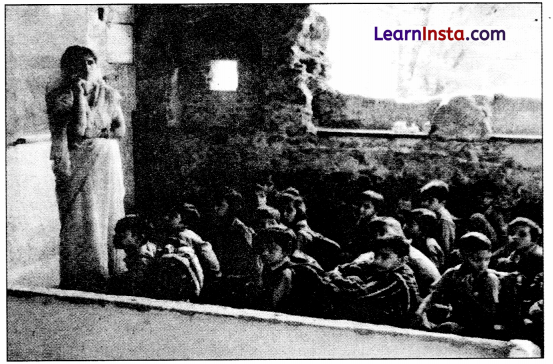
Answer:
The village school was a small, one-room building made of mud and bricks. The roof was thatched with straw, and the walls were plastered with mud. The floor was made of hard- packed earth. There were no windows, and the only light came from the door.
The school was located in a small village in a remote part of the country. The village was very poor, and the people could not afford to build a better school. The children in the village were eager to learn, but they had to make do with what they had.
The teacher was a young woman named Fatima. She was very dedicated to her job, and she loved her students. She did her best to teach them everything she knew, even though the conditions were difficult.
The students in the village school were very bright and hardworking. They were eager to learn, and they made the most of their opportunities. They knew that education was their only way out of poverty.
One day, a group of visitors came to the village. They were from a large city, and they had come to see the school. They were shocked by the condition of the building. They could not believe that children were being taught in such a place.
The visitors decided to help the village. They raised money to build a new school. The new school was a large, two-story building with all the latest facilities. The students were overjoyed. They could not believe that they would finally have a proper school to learn in.
The new school made a big difference in the lives of the children in the village. They were, now able to learn in a safe and comfortable environment. They had access to all the resources they needed, and they were able to reach their full potential.
The village school is a symbol of hope. It shows that even in the poorest of villages, there is always hope for a better future. The children in the village school are proof that education is the key to success.
Question 2.
Do not spend more than 20 minutes on this question.
Select one of the following.
i. Your school is hosting an inter-school debate competition. Write a notice informing the students at your school about the event.
Answer:
St John High School
Notice
Inter -School Debate Competition
All students are hereby informed that an Inter – School Debate Competition will be held on 14th August 2024 at 10.30 a.m in the school auditorium to celebrate our country’s 75th Independence Day. All interested students must submit their names to the undersigned by 8th August 2024. A selection round will be conducted on the 12th August 2024 in the auditorium and only the selected students will participate in the final competition. Each team will speak for and against the topic.
The topics for debate are as follows:
- Is the spirit of patriotism important in the present scenario.
- Teachers should/ should not tell their pupils which party they will vote for.
- Stikes should be banned.
- Freedom of speech is the right of citizens
Thanking you
Kartik Chauhan
Head Boy
ii. Write an e-mail to the Principal of a neighbouring school informing him/her about the event and requesting him/her to send a team of students to participate.
Answer:
[email protected] Subject: Request to send team.
Dear Madam/Sir,
St John’s High School is organising an Inter – School Debate Competition which will be held on 14th August 2024 at 10.30 a.m in the school auditorium to celebrate our country’s 75th Independence Day. Each team will speak for and against the topic.
The topics for debate are as follows:
- Is the spirit of patriotism important in the present scenario.
- Teachers should/ should not tell their pupils which party they will vote for.
- Stikes should be banned.
- Freedom of speech is the right of citizens
You are requested to send a team of students from your school to participate in the same. You are requested to confirm to the undersigned latest byl2th August 2024. A teacher must accompany the team from your school.
Thanking you,
Yours faithfully
Kartik Chauhan
Head Boy
St John’s High School
Question 3.
Read the following passage carefully and answer the questions that follow:
Tiger Talk:
It was still a busy hour in the city when I entered Market Road. People ran for their lives at the sight of me. As 1 progressed through shutters were pulled down, and people hid themselves under culverts, on trees, behind pillars. The population was melting out of sight. At the circus I had had no chance to study human behaviour.
Outside the circus ring they sat in their seats placidly while I cowered before Captain’s whip. I got a totally wrong notion of human beings at that angle. I had thought that they were sturdy and fearless. But now I found them fleeing before me like a herd of deer, although I had no intention of attacking them.
When I paused in front of a tailor’s shop, he abandoned his machine and shut himself in a cupboard, wailing, ‘Alas, I am undone, won’t someone shoot that tiger?’ A prisoner between two constables, who had been caught for murder and was just emerging from the Court House, got his chance to escape when the constables fled, abandoning him with his handcuffs. I tore a horse from its jutka and enjoyed the sight of the passengers spilling out of it and running for their lives. A couple of street dogs invited destruction when they barked madly, instead of minding their business.
Later, I learnt from my master of the chaos that befell the city when it became known that Captain had been destroyed and that I was somewhere in the city. Sheer hopelessness seems to have seized the townspeople. They withdrew to their homes and even there remained nervous. All doors and windows everywhere were shut, bolted, and sealed. Some even thought that I was some extraordinary creature who might pass through the walls and lie in wait on the roof or in the loft or basement.
Poor people living in huts had real cause to worry: I could have taken any of their homes apart. But why should I? One could understand their fears, but why should those living in brick and cement feel nervous? It was due to their general lack of a sense of security and an irrational dread of losing their assets. Why should a simple tiger have any interest in them either to destroy or to safeguard?
I rested for a moment at the door of Anand Bhavan, on Market Road, where coffee drinkers and tiffin eaters at their tables sat transfixed, uttering low moans on seeing me. I wanted to assure them, ‘Don’t fear, I am not out to trouble you. Eat your tiffin in peace, don’t mind me. You, nearest to me, hugging the cash box, you are craven with fear, afraid even to breathe.
Go on, count the cash, if that’s your pleasure. I just want to watch, that’s all . If my tail trails down to the street, if I am blocking your threshold, it is because, I’m told, I’m eleven feet tip to tail. I can’t help it. I’m not out to kill. I’m too full – found a green pasture teeming with food on the way. Won’t need any for several days to come, won’t stir, not until I feel hungry again. Tigers attack only when they feel hungry, unlike human beings who slaughter one another without purpose or hunger .’
– A Tiger in the School, R. K. Narayanan
i. For each of the word given below choose the correct meaning as used in the passage. from the options provided.
Question 1.
sturdy line 6.
a. brave
b. strong
c. compassionate
d. fixed
Answer:
b. strong .
Question 2.
basement (line 19)
a. room at the top of a house
b. library
c. the ground floor
d. a room at the bottom of the house
Answer:
d. a room at the bottom of the house
ii. Which word in the passage means the opposite of the word ‘liabilities’?
a. threshold
b. chaos
c. assets
d. cash box
Answer:
c. assets
iii. Answer the questions briefly in your own words.
a. Which sentence in the passage tells us that the people were fast disappearing?
Answer:
The sentence in the passage that tells us that the people were fast disappearingis, “The population was melting out of sight.’
b. Why was the prisoner lucky on that day?
Answer:
The prisoner, who had been caught for murder, got lucky on that day when the constables holding him fled abandoning him with his handcuffs. So he got his chance to escape.
c. What reason does the tiger give to explain why people in brick and cement houses are nervous?
Answer:
The tiger is unable to understand the fears of people living in brick and cement houses. Then the reason he gives for their fear is that it is due to their general lack of a sense of security and an irrational dread of losing their assets.
d. The passage describes a man who is shivering with fear and lutching his cash box. What kind of a person do you think he was?
Answer:
It seems that the man was a money lender or a miser who loved his money more than, anything and wanted to keep it safe. But he did not realise that the tiger had no use for his money.
e. How would you have reacted if a tiger walked into the street outside your school?
Answer:
If a tiger walked into the street outside my school I too would have sought a place of safety and been fearful yet curious about the tiger.
iv. In not more than 50 words describe the tiger’s thoughts on how differently people behave inside and outside the circus.
Answer:
The people outside the circus ring sat calmly while the tiger cowered before the Captain’s whip. But in the streets the people fled in fear and hid behind bolted doors, terrified even when all doors and windows were shut and bolted, as if he would attack them by passing through walls.
Question 5.
a. Fill in each of the numbered blanks with the correct form of the word given in the brackets. Do not copy the passage but write in the correct serial order, the word or phrase appropriate to the blank space.
Rikki-tikki ….0…. know. better than to waste time in staring.Rikki-tikki was angry. He sat back on his tail and hind legs, and …..1…. look. all round him, ….2….. chatter. with rage. But Nag and Nagina …..3….. disappear. already into the grass. When a snake misses its stroke, it never ….4…. say. anything or 5 give. any sign of what it means to do next. Rikki-tikki did not care to follow them, for he did not …..6…. feel. sure that he …..7…. can. manage two snakes at once. So, he trotted off to the gravel path, and sat down to think. It …..8…. is. a serious matter for him.
Answer:
Rikki-tikki knew better than to waste time in staring. Rikki-tikki was angry. He sat back on his tail and hind legs, and looked all round him, chattering with rage. But Nag and Nagina had disappeared already into the grass. When a snake misses its stroke, it never says anything or gives any sign of what it means to do next. Rikki-tikki did not care to follow them, for he did not feel sure that he could manage two snakes at once. So, he trotted off to the gravel path, and sat down to think. It was a serious matter for him.
ii. Fill in the blanks with appropriate words.
a. My sister and I get very well with each other.
Answer:
My sister and I get along ____very well with each other.
b. Mini plays basketball her friends every day.
Answer:
Mini plays basketball with ____her friends every day.
C. It has been twenty years ____she graduated from college.
Answer:
It has been twenty years since she graduated from college.
d. Growing up, wejwere looked ____and brought up by our grandparents.
Answer:
Growing up, we were looked after and brought up by our grandparents.
e. Most students take the bus ____school as it reaches the premises on time.
Answer:
Most students take the bus to school as it reaches the premises on time.
f. The cricket match was put ____because of torrential rains.
Answer:
The cricket match was put off because of torrential rains.
g. Roy backed ____of the competition at the last minute.
Answer:
Roy backed out of the competition at the last minute.
h. I have been training under her ____the past two years.
Answer:
I have been training under her for the past two years.
iii. Join the following sentences to make one complete sentence without using and, but or so. Choose the correct option.
Question 1.
We placed our order late. We received the food on time.
a. Despite placed our order late, the food was received on time.
b. Despite placing our order late, we received the food on time.
c. Despite we placed our order late, the food was received on time. *
d. Despite of us placing our order late, we receiving the food on time.
Answer:
b. Despite placing our order late, we received our food on time.
Question 2.
The music stopped. The audience left the auditorium.
a. Hardly had the music stopped so the audience left the auditorium.
b. Hardly had the music stopped then the audience left the auditorium.
c. Hardly had the music stopped since the audience left the auditorium.
d. Hardly had the music stopped when the audience left the auditorium.
Answer:
d. Hardly had the music stopped when the audience left the auditorium.
Question 3.
You cannot enter the club. You do not have a membership.
a. You cannot enter the club unless you have a membership.
b. You cannot enter the club since you have a membership.
c. You cannot enter the club whereas you have a membership.
d. You cannot enter the club if you have a membership.
Answer:
a. You cannot enter the club unless you have a membership.
Question 4.
She was very late. She could not catch the train.
a. She was to late to catch the train.
b. She was so late to catch the train.
c. She was too late to catch the train.
d. She was as late so as to catch the train.
Answer:
c. She was too late to catch the train.
iv. Choose the correct option to rewrite the following according to the instructions given after each sentence.
1. The burglar ran away the moment he saw the guard. (Begin with: No sooner)
a. No sooner has the burglar seen the guard, he ran away.
b. No sooner than the burglar saw the guard, he ran away.
c. No sooner did the burglar see the guard when he ran away.
d. No sooner had the burglar seen the guard than he ran away.
Answer:
d. No sooner did the burglar see the guard than he ran away.
Question 2.
The parents have trained their children well. (Begin with: The children)
a. The children were trained well by their parents.
b. The children is being trained well by their parents.
The children had been trained well by their parents.
d. The children have been trained well by their parents.
Answer:
d. The children have been trained well by their parents.
Question 3.
My cousins returned home one month ago. (Begin with: It has’)
a. It has been one month for my cousins’ return home.
b. It has been one month since my cousins returned home.
c. It has been one month when my cousins returned home.
d. It has been one month ago that my cousins returned home.
Answer:
b. It has been one month since my cousins returned home.
Question 4.
Your form will be accepted if it is submitted on time. (Use:’unless)
a. Your form will be accepted unless it is submitted on time.
b. Unless your form is submitted on time, it will not be accepted.
c. Unless the form is accepted, it should be submitted on time.
d. Your form will be accepted unless it is not submitted on time.
Answer:
b. Unless your form is submitted on time, it will not be accepted.
Question 5.
The house needs a thorough cleaning again. (Use: thoroughly)
a. The house needs a thoroughly cleaning again.
b. The house needed a cleaning thoroughly again.
c. The house needs to be cleaned thoroughly again.
d. The house needed to be thoroughly clean yet again.
Answer:
c. The house needs to be cleaned thoroughly again.
Question 6.
My sister offered me a new job in her company. (Begin with: A new job)
a. A new job was offered to me by my sister in her company.
b. A new job has been offered to me by my sister in her company.
c. A new job had been offered to me by my sister in her company.
d. A new job was being offered to me by my sister in her company.
Answer:
b. A new job has been offered to me by my sister in her company.
Question 7.
“I am going to witch my friend’s play tomorrow,” she said. (Begin with: She said)
a. She said that she is going to watch her friend’s play tomorrow.
b. She said that she will be going to watch her friend’s play tomorrow.
c. She said that she was going to watch my friend’s play the following day.
d. She said that she was going to watch her friend’s play the following day.
Answer:
d. She said that she was going to watch her friend’s play the following day.
Question 8.
Nithin is more talented than most of the professional musicians I know. (Use: few)
a. Professional musicians I know have few talents as Nithin.
b. Few professional musicians I know are as talented as Nithin.
c. Few professional musicians I know are not as talented as Nithin.
d. Professional musicians I know do not have as few talents as Nithin.
Answer:
b. Few professional musicians I know are as talented as Nithin.
Aural and Oral English
Paper 1 English Language
B. Listening Skills in English Language
Sample Passage
Choose the most appropriate answer and write (a), (b) or (c) in the circle near each question.
Question 1.
How did the tiger get out of the cage?
(a) It forced the door of the cage open.
(b) The lock of the cage was opened.
(c) The lock of the cage had not been shut.
Answer:
(b) The lock of tfye cage was opened.
Question 2.
What did the writer expect the tiger to do when it came out of its cage?
(a) Jump and roll about.
(b) Behave in a dignified manner.
(c) Struggle with its trainer.
Answer:
(b) Behave in a dignified manner.
Question 3.
What precaution had been taken to prevent the tiger from running away during filming?
(a) Two assistants and a trainer were in charge of the tiger.
(b) It was kept in a strong cage.
(c) .It was held with a wire tied to its collar.
Answer:
(c) It was held with a wire tied to its collar.
Question 4.
Bom in a circus, which of the following was the tiger not used to:
(a) The company of people.
(b) Freedom in natural surroundings.
(c) Control by his trainer.
Answer:
(b) Freedom in natural surroundings.
Question 5.
Once the tiger calmed down
(a) the director took all the shots he needed for the film.
(b) the trainer got it back into its cage.
(c) it began to play with the film crew.
Answer:
(a) the director took all the shots he needed for the film.
Question 6.
Mr. Thorat went blue in the face saying, ‘Up!’ but the tiger ignored him completely. The t expression, went blue in the face means that Mr. Thorat.
(a) became very angry.
(b) fell ill on account of strain.
(c) tried hard but was unsuccessful.
Answer:
(c) tried hard but was unsuccessful.
Question 7.
Which of these words best describes the tiger:
(a) unpredictable
(b) vicious
(c) tame
Answer:
(a) unpredictable.
Question 8.
What un-tiger-like behaviour did the writer try to film?
(a) Its jumping and rolling about.
(b) Its refusal to obey its trainer.
(c) Its chewing leaves in the bamboo grove.
Answer:
(c) Its chewing l,eaves in the bamboo grove.
Question 9.
Give one instance when the tiger actually did what it was told.
(a) When it was called out of its cage.
(b) When it was made to stop jumping about.
(c) When it got back into its cage.
Answer:
(a) When it was called out of its cage.
Question 10.
What is this passage about?
(a) The difficulty of filming a scene with a circus tiger.
(b) The danger of filming a wild animal.
(c) The behaviour of a tiger in the wild.
Answer:
(a) The difficulty of filming a scene with a circus tiger.
C. Practice for Listening Skills
1. Bhopal Reclaimed 37 Acres of Wasteland
Choose the most appropriate option and write (a), (b) or (c) in the circle.
Question 1.
Which of the following adds to the fame of ‘the city of Lakes’?
(a) Culinary delights
(b) Cultural heritage
(c) All of the above
Answer:
(c) All of the above
Question 2.
Which company joined Bhopal Municipal Corporation to carry out bioremediation at Bhanpur Khanti?
(a) Saurashtra Projects Pvt. Ltd.
(b) Saurashtra Enviro Projects Pvt. Ltd.
(c) Bhopal Enviro Projects Pvt. Ltd.
Answer:
(b) Saurashtra Enviro Projects Pvt. Ltd.
Question 3.
What was the quantum of waste that had to be treated at the dumpsite?
(a) 16 million tonnes
(b) 21 million tonnes
(c) 7.5 million tonnes
Answer:
(c) 7.5 million tonnes.
Question 4.
How much waste was extracted using bio-mining?
(a) 1.8 million tonnes
(b) 2.1 tonnes
(c) 1.6 million tonnes
Answer:
(a) 1.8 million tonnes
Question 5.
Bio-capping involves which process?
(a) Burying of waste deep in the ground
(b) Scientific sealing of the waste
(c) Covering the waste with polythene liner.
Answer:
(b) scientific sealing of the waste.
Question 6.
Bio-mining involves mining by utilising the action of on the waste.
(a) Chemicals
(b) Micro-organisms
(c) Water
Answer:
(b) micro organisms
Question 7.
Out of 37 acres how much was capped?
(a) 16 acres
(b) 5 acres
(c) 7.5 acres
Answer:
(a) 16 acres
Question 8.
After digging the pit what is done to ensure minimisation of environmental hazard?
(a) Treatment of leachate
(b) Using a high-density polythene liner
(c) Treatment of gases from the dumpsite
Answer:
(b) using a high density polythene liner.
Question 9.
What practice does BMC employ to ensure source segregation of waste?
(a) Door-to-door segregation
(b) Reclaiming land
(c) Physiochemical characterisation.
Answer:
(a) door to door segregation
Question 10.
How does BMC ensure that every step of waste management is carried out?
(a) By ensuring door-to-door segregation
(b) By promoting home-composting
(c) By using GPS-based tracking technologies.
Answer:
(c) by using GPS-based tracking technologies.
2. Attaining Peace – John F Kennedy
Choose the most appropriate option and write (a), (b) or (c) in the circle.
Question 1.
Which of the following would ensure that world peace is practical and attainable?
(a) Sudden revolution in human nature
(b) Gradual evolution in human institutions
(c) Rise of a great leader
Answer:
(b) Gradual evolution in human institutions
Question 2.
Peace is a process that is
(a) Dynamic
(b) Static
(c) Absolute
Answer:
(a) Dynamic
Question 3.
Genuine peace requires
(a) Concrete actions by concerned parties
(b) Effective agreements in the interest of those concerned
(c) Both (a) and (b)
Answer:
(c) both (a) and (b)
Question 4.
Which of the following is NOT required for world peace?
(a) Total absence of disputes
(b) Mutual tolerance
(c) Amicable settlement of disputes
Answer:
(a) total absence of disputes
Question 5.
Besides America which other country would become the primary target of a total war?
(a) China
(b) Russia
(c) India
Answer:
(b) Russia
Question 6.
The massive sums of money spent on weaponry could be devoted to which of the following?
(a) Combating ignorance, poverty and disease
(b) Ensuring tolerance and peaceful dispute settlement
(c) All of the above
Answer:
(a) Combating ignorance, poverty and disease
Question 7.
What is the basic common link that makes us work towards peace?
(a) We are mortal
(b) We breathe the same air
(c) All of the above.
Answer:
(c) All of the above
Question 8.
Which of the following is NOT a basic link between the USA and Russia?
(a) Cherish offspring’s future
(b) Communism
(c) Inhabitants of the same planet.
Answer:
(b) Communism
Question 9.
What can America do towards convincing its enemies to work for peace?
(a) Conduct its affairs keeping the Communists interest in mind
(b) Conduct its affairs such that the Communists feel peace is in their interest
(c) Conduct its affairs ensuring the safety of its allies.
Answer:
(b) Conduct its affairs such that the communists feel peace is in their interest.
Question 10.
Direct confrontation would lead to two outcomes either nuclear war or
(a) collective death-wish
(b) humiliating retreat
(c) bankruptcy.
Answer:
(b) humiliating retreat
Question 11.
In case the two super powers fail to work towards peace, especially in the nuclear age, what would be the outcome?
(a) Humiliation
(b) Collective-death wish for the world
(c) Bankruptcy
Answer:
(b) Collective death wish for the world.
3. Understanding Potassium
Choose the most appropriate option and write (a), (b) or (c) in the circle.
Question 1.
Potassium is an electrolyte meaning it carries
(a) a fluid
(b) an electric charge
(c) a neuron
Answer:
(b) an electric charge
Question 2.
The recommended intake of potassium in milligrams for an adult is
(a) 900 to 1500
(b) 2500 to 3400
(c) 1500 to 2400
Answer:
(b) 2500 to 3400
Question 3.
Potassium is an essential mineral along with
(a) Sodium
(b) Nitrogen
(c) Neurons
Answer:
(a) sodium
Question 4.
Electrolyte balance is crucial for
(a) Muscle contraction
(b) Nerve transmission
(c) Both (a) and (b)
Answer:
(c) both (a) and (b)
Question 5.
What role does potassium play in muscle cells?
(a) Helps in contraction and relaxation
(b) Helps in expansion and action
(c) None of the above
Answer:
(a) Helps in contraction and relaxation.
Question 6.
Name the muscle responsible for pumping blood in the body.
(a) Lungs
(b) Liver
(c) Heart
Answer:
(c) Heart
Question 7.
Maintaining the acid base balance in the body ensures
(a) optimisation of enzyme action
(b) flow of blood
(c) exchange of body fluids.
Answer:
(a) optimization of enzyme action
Question 8.
Nerve cells use the sodium-potassium balance for which purpose?
(a) Flow of fluids in the body
(b) Generation and propagation of signals
(c) Generation of electric impulses.
Answer:
(b) Generation and propagation of signals
Question 9.
Name the source of potassium which is known to be the best.
(a) Potatoes
(b) Citrus fruits
(c) Bananas
Answer:
(c) Bananas
Question 10.
Hyperkalemia leads to
(a) arrhythmias
(b) muscle weakness and fatigue
(c) kidney dysfunction
Answer:
(b) muscle weakness and fatigue
4. Drought in the Amazon Rainforest
Choose the most appropriate option and write (a), (b) or (c) in the circle.
Question 1.
What is commonly referred to as the lungs of the earth?
(a) The Amazon
(b) Australia
(c) Brazil.
Answer:
(a) The Amazon
Question 2.
Covering an area as much as the continent of Australia, how much carbon does the Amazon store?
(a) 15 billion tonnes
(b) 150 billion metric tonnes
(c) 150 million metric tonnes
Answer:
(b) 150 billion metric tonnes
Question 3.
What are river dolphins called in the local language?
(a) moto
(b) doto
(c) boto
Answer:
(c) boto
Question 4.
Which of the following is not a use of the rivers in the Amazon?
(a) Travel
(b) Medicine
(c) Hydropower generation
Answer:
(b) medicine
Question 5.
What has contaminated the water supply?
(a) Rotting carcases
(b) Increased Salinity
(c) Effluent discharge.
Answer:
(a) Rotting carcasses
Question 6.
Which of the following is NOT true of the city of Manaus?
(a) It is a city in the Amazon
(b) Smoke from wildfires has caused severe air pollution
(c) It has a population of half a billion
Answer:
(c) It has a population of half a billion
Question 7.
Name the largest river by discharge levels in the Amazon?
(a) Rio Negro
(b) Negro
(c) Rio
Answer:
(a) Rio Negro
Question 8.
The Amazonas stajte has withessed the hightest number of blazes of forest fires in the month of October in the last how many years?
(a) 28 years
(b) 25 years
(c) 5 years
Answer:
(b) 25 years
Question 9.
Which of the following is a cause for the drought in the Amazon?
(a) Warm air inhibiting cloud formation
(b) Rising levels of air pollution
(c) Frequent forest fires
Answer:
(a) Warm air inhibiting cloud formation
Question 10.
El Nino is the abnormal warming of surface waters in the leading to extreme heat
conditions in many parts of the world.
(a) Equatorial Pacific Ocean
(b) Tropical Atlantic Ocean
(c) Tropical Pacific Ocean
Answer:
(a) Equatorial Pacific Ocean
5. E-Quating Endurance
Choose the most appropriate option and write (a), (b) or (c) in the circle.
Question 1.
According to the passage, what are the scientists investigating?
(a) The limits of an athlete’s spirits
(b) The limits of an athlete’s endurance in sports
(c) The limits of an athlete’s stamina.
Answer:
(b) the limits of an athlete’s endurance in sports
Question 2.
What does the e-pill measure?
(a) Weight of an athlete
(b) Core body temperature of an athlete
(c) Water retention in an athlete’s body.
Answer:
(b) Core body temperature of an athlete
Question 3.
What is the weight of an e-pill?
(a) 1.7 grams
(b) 1 gram
(c) 2.5 grams
Answer:
(a) 1.7 grams
Question 4.
Which another instrument for measuring body temperature is mentioned in the passage?
(a) Barometer
(b) Pedometer
(c) Thermometer.
Answer:
(c) Thermometer
Question 5.
Name the organisation which is conducting research measuring the endurance level of athletes?
(a) International Association of Sports
(b) International Association of Athletics Federation
(c) International Association of Olympics.
Answer:
(b) International Association of Athletics Federation
Question 6.
Besides, the athletes who used the e-pill?
(a) Australian hockey team
(b) Footballers at French club Nantes
(c) Both (a) and (b)
Answer:
(c) both (a) and (b)
Question 7.
Who has developed the technology for transmitting the information from e-pills?
(a) Yannis Pitsiladis
(b) Iannis Brighton
(c) Yannis Nantes
Answer:
(a) Yannis Pitsiladis
Question 8.
How can the e-pill be identified?
(a) Through its colour
(b) Through its unique number
(c) None of the above
Answer:
(b) Through its unique number
Question 9.
What do the e-pills send after being activated in human body?
(a) Radio waves of high frequency
(b) Radio waves of low frequency
(c) Both (a) and (b).
Answer:
(b) Radio waves of low frequency
Question 10.
The results of on the ongoing research can be transmitted from the e-pill on a (a) transmitter
(b) smart wrist band
(c) smart watch
Answer:
(b) smart wrist band
6. The National War Memorial
Choose the most appropriate option and write (a), (b) or (c) in the circle.
Question 1.
Name the monument near which the National War Museum is located?
(a) Taj Mahal
(b) India Gate
(c) Gateway of India
Answer:
(b) India Gate
Question 2.
Which company did the entire stonework of the memorial?
(a) Star Formations
(b) Star Designs
(c) Star Mercantile
Answer:
(c) Star Mercantile
Question 3.
Which two stones are mainly used in the construction of the memorial?
(a) Granite and marble
(b) Granite and sandstone
(c) Marble and sandstone
Answer:
(b) Granite and sandstone
Question 4.
The design of the four concentric circles draw inspiration from which ancient Indian war formation?
(a) Padmavyuha
(b) Garudavyuha
(c) Chakravyuha
Answer:
(c) Charavyuha
Question 5.
What does the Amar Chakra contain?
(a) Obelisk with eternal flame
(b) Bronze busts of Martyrs
(c) Trees
Answer:
(a) Obelisk with eternal flame
Question 6.
What is the Veerta Chakra?
(a) A gallery depicting battle scenes fought by the Indian armed forces.
(b) Medals won by the brave soldiers.
(c) A gallery depicting India’s military strength in terms of weapons, fighter aircraft, missiles, etc.
Answer:
(a) A gallery depicting battle scenes fought by the Indian armed forces.
Question 7.
What do the granite bricks in Tyag Chakra show?
(a) Picture of martyrs
(b) Names of martyrs
(c) Weapons used by Army
Answer:
(b) Names of martyrs
Question 8.
What does the Rakshak Chakra symbolise?
(a) The army officers who lead from the front.
(b) More than six hundred trees that act as a wall symbolising the soldiers who protect our country.
(c) The supreme sacrifice of the freedom fighters who laid down their lives for India’s f independence
Answer:
(b) More than six hundred trees that act as a wall symbolising the soldiers who protect our country.
Question 9.
What does the Param Yodha Sthal have?
(a) Bronze busts of Kings and Warriors
(b) Bronze busts of Param Vir Chakra Awardees
(c) Bronze busts of Ashok Chakra Awardees
Answer:
(b) Bronze busts of Param Vir Chakra Awardees
Question 10.
At which of the following places there is no war memorial?
(a) Bhopal
(b) Drass
(c) Mumbai
Answer:
(c) Mumbai
7. Iodine
Choose the most appropriate option and write (a), (b) or (c) in the circle.
Question 1.
How much iodine is required daily for the normal growth and development of human body?
(a) 50-75 micrograms
(b) 75-100 micrograms
(c) 100-150 micrograms.
Answer:
(c) 100-150 micrograms
Question 2.
Which of the following is not caused by iodine deficiency?
(a) Mental retardation
(b) Stunted growth
(c) Night Blindness.
Answer:
(c) Night blindness
Question 3.
Lack of iodine in pregnant women results in
(a) stillbirths. (b) abortions.
(c) both (a) and (b).
Answer:
(c) both (a) and (b)
Question 4.
An irreversible form of mental retardation caused by iodine deficiency is
(a) Cretinism.
(b) Goitre.
(c) Rheumatism.
Answer:
(a) Cretiism
Question 5.
Why is it said that iodine deficiency is an inexpensive nutrient disorder?
(a) Because it can be cured by medicines which are cheap
(b) Because it can be cured without medication
(c) Because it can be cured by regular consumption of iodised salt.
Answer:
(c) Because it can be cured by regular consumption of iodised salt
Question 6.
Ijjn the USA, iodine intake levels are
(a) increasing.
(b) decreasing.
(c) fluctuating.
Answer:
(b) decreasing
Question 7.
How many people are affected by iodine deficiency worldwide?
(a) one in ten
(b) one in five
(c) one in three.
Answer:
(c) one in three
Question 8.
How many people in India are suffering from Iodine Deficiency Disorder?
(a) 71 million
(b) 61 million
(c) 51 million.
Answer:
(a) 71 million
Question 9.
In how many districts of India, out of 324 surveyed, IDD is endemic?
(a) 320
(b) 265
(c)263.
Answer:
(c) 263
Question 10.
Why do we need to consume small amounts of iodine regularly?
(a) Because foods containing iodine are expensive
(b) Because iodine is available only in small amounts
(c) Because the thyroitl gland in the human body cannot store large amounts of iodine.
Answer:
(c) Because the thyroid gland in the human body cannot store large amounts of iodine.
8. Dinosaurs
Choose the most appropriate option and write (a), (b) or (c) in the circle.
Question 1.
During which Era did Dinosaurs live on the earth?
(a) Palaeolithic Era
(b) Mesozoic Era
(c) Neolithic Era.
Answer:
(b) Mesozoic Era
Question 2.
To which category did Dinosaurs belong?
(a) Birds
(b) Mammals
(c) Reptiles.
Answer:
(c) Reptiles
Question 3.
The Dinosaurs could
(a) walk on two legs.
(b) walk on four legs.
(c) both (a) and (b).
Answer:
(c) both (a) and (b)
Question 4.
The Dinosaurs which walked speedily were .
(a) Velociraptor.
(b) Ankylosaurus.
(c) Seismosaurus.
Answer:
(a) Velociraptor
Question 5.
Which of the following was not possessed by the Dinosaurs?
(a) Crests
(b) Spikes
(c) Wings.
Answer:
(c) Wings
Question 6.
What was the height of the largest Dinosaur?
(a) 100 feet
(b) 60 feet
(c) 50 feet.
Answer:
(c) 50 feet
Question 7.
The Dinosaurs emerged on the land from
(a) underground.
(b) universe.
(c) swampy waters.
Answer:
(c) swampy waters
Question 8.
According to the scientists, before 1970s the Dinosaurs were
(a) sluggish.
(b) intelligent.
(c) warm-blooded
Answer:
(a) sluggish
Question 9.
For how many years did Dinosaurs exist on the earth?
(a) 65 million years
(b) 75 million years
(c) 165 million years.
Answer:
(c) 165 million years
Question 10.
The Dinosaurs became extinct due to
(a) volcanic activity.
(b) asteroid crash.
(c) heavy floods.
Answer:
(b) asteroid crash