Students rely on Class 8 Science Extra Questions and Class 8th Curiosity Chapter 12 How Nature Works in Harmony Extra Question Answer to improve their grades.
Class 8 Science Chapter 12 How Nature Works in Harmony Extra Questions
Class 8 Science Chapter 12 Extra Questions on How Nature Works in Harmony
How Nature Works in Harmony Class 8 Very Short Question Answer
Question 1.
Manya wrote a food chain in the following way:
Frog → Eagle → Insects → Grass → Snake
The chain is not in the correct order. Help her to write the food chain correctly.
Answer: The correct order of the food chain is:
Grass → Insects → frog → Snake → Eagle.

Question 2.
Read the clues and fill up the blanks given below each of them.
(i) Honeybees suck from flower.
N — T — R
(ii) Animals which eat other animals.
— A — N — V — R — S
(iii) Animals which eat only plants and plant products.
H E — B — E —
(iv) Animals which eat both plants and animals.
— M N I — O —
(NCERT Exemplar)
Answer:
(i) NECTAR
(ii) CARNIVORES
(iii) HERBIVORES
(iv) OMNIVORES
Question 3.
What is parasitism?
Answer:
A relationship where one organism benefits and the other is harmed.
Question 4.
Define saprotrophs with examples.
Answer:
Saprotrophs are organisms that feed on dead organic matter, e.g., bacteria, fungi.
Question 5.
Give two reasons why pollinators are decreasing in some areas.
Answer:
(i) Use of pesticides
(ii) Habitat loss, which reduces pollinator populations like bees and butterflies.
Question 6.
What is mutualism? Give one example.
Answer:
Mutualism is a relationship where both organisms benefit, like bees and flowers.
Question 7.
Why did the Government of India ban the export of frog legs?
Answer:
The Government of India ban the export of frog legs to prevent further ecological imbalance caused by the loss of frogs from natural ecosystems.
Question 8.
What is the role of sunlight in an ecosystem?
Answer:
Sunlight is the primary source of energy for plants to carry out photosynthesis, which supports the entire food chain.
Question 9.
Why do organisms compete for common resources?
Answer:
Organisms compete for common resources like food, water, physical space, or sunlight to survive. This competition helps control population size and keeps the ecosystem balanced. Without it, one species could multiply too much causing an imbalance in the ecosystem.
Question 10.
What do forests provide us?
Answer:
Air, soil, food, fibres, timber, and medicines.
How Nature Works in Harmony Class 8 Short Question Answer
Question 1.
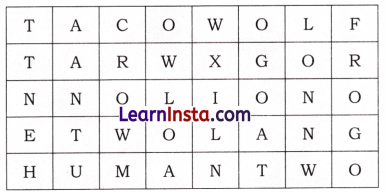
Identify the animals in the grid given below and categorise them into herbivore, carnivore and omnivore. (NCERT Exemplar)
Answer:
Herbivore: COW, GOAT, HEN
Carnivore: WOLF, LION, FROG
Omnivore: CAT, RAT, CROW, HUMAN, ANT, OWL
Question 2.
How are even small animals important in an ecosystem? (NCERT Exemplar)
Answer:
Small animals play a vital role in the food chain and food web. They help in pollination, decomposition, and serve as food for larger animals, maintaining ecological balance.
Question 3.
A new species X is introduced in a forest. How is it likely to affect the local species of that area? (NCERT Exemplar)
Answer:
Introducing new species to an area may affect the survival of the existing species due to increased competition for sunlight, water and nutrients.
Question 4.
What role does flora play in a forest ecosystem?
Answer:
- Flora maintains the natural forest ecosystem.
- All animals depend on flora for their food.
- All plants give out oxygen required for respiration in all living organisms.
- Flora provides shelter to most of the animals in the forest.
Question 5.
What makes the Sundarbans ecosystem special? Why is it under threat?
Answer:
The Sundarbans is the world’s largest mangrove forest and is home to many rare and endangered species. It protects coastal regions from floods and storms and absorbs carbon dioxide. However, it is under threat from deforestation, illegal hunting, pollution, and overuse of resources. Conservation efforts are needed to protect this valuable ecosystem.
How Nature Works in Harmony Class 8 Long Question Answer
Question 1.
People say that nothing goes to waste in a forest. Can you explain how? (NCERT Exemplar)
Answer:
- In a forest, dry leaves and dead animals are converted into humus by the action of decomposers, which provides the essential nutrients to plants.
- The dead remains of animals serve as food for vultures, crows, jackals and insects.
- The broken branches serve as fuel for the people living nearby forest.
- Forests provide fresh air, fertile soil, food, fibres, timber, and medicines.
Question 2.
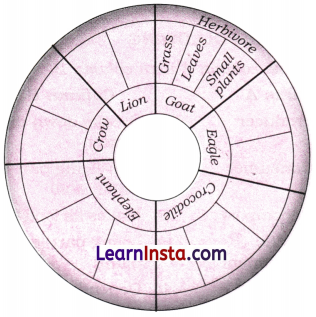
Read the names of animals written in the inner ring of the given figure. Within the second ring, write the types of food they eat and the category to which they belong (based on the eating habit) in the outermost ring. One example has been worked out for you. Use red, green and blue colours for writing. (NCERT Exemplar)
Answer:
Eagle-birds/small animals/meat-Carnivore Crocodile- fish/snake/animals living near the river banks of river-Carnivore
Elephant-grass/sugarcane/leaves/coconutHerbivore
Crow- food grains/rat/meat/food items/ insects-Omnivore
Lion- deer/rabbit/zebra/giraffe/cow/others animals- Carnivore
Question 3.
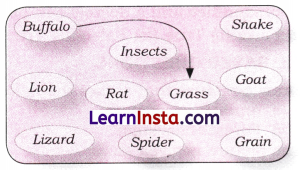
Connect the animal with the food it eats by an arrow using different colours in the given figure. One is done for you. (NCERT Exemplar)
Answer:
- Lion → Goat, Buffalo, Rat
- Lizard → Insects, Spider
- Rat → Grain
- Snake → Rat/Lizard
- Goat → Grain/grass
How Nature Works in Harmony Class 8 Skill-Based Questions
Question 1.
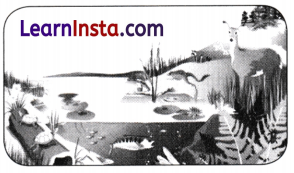
Draw a picture that shows the following:
(i) Aquatic ecosystem
(ii) Forest ecosystem
Answer:
The picture is given as:
Question 2.
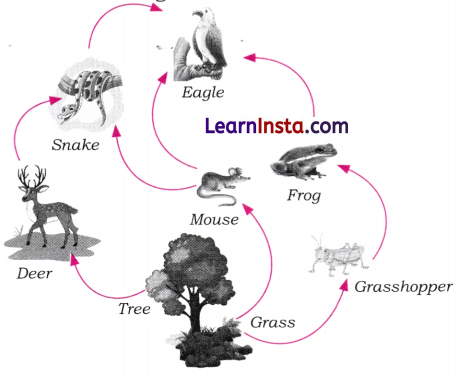
Create a food web using 5-7 organisms from a forest ecosystem.
Answer:
A food web is given as:
How Nature Works in Harmony Class 8 Quiz Questions
Question 1.
Name the famous Indian wildlife biologist who helped understand forest ecosystems through the eyes of animals.
Answer:
Asir Jawahar Thomas Johnsingh (A.J.T. Johnsingh)
Question 2.
Identify the type of interaction where one organism benefits while the other is harmed, such as a tick feeding on a dog and causing skin irritation.
Answer:
Parasitism
Question 3.
What do we call organisms that make their food?
Answer:
Producers/Autotrophs
Question 4.
Name the ecosystem where mangrove trees are found.
Answer:
Sundarbans
Question 5.
Which level of the food pyramid do herbivores occupy?
Answer:
Second trophic level
Question 6.
Name any two abiotic factors essential for plant growth.
Answer:
Sunlight and soil
Question 7.
Name one migratory bird mentioned in the chapter.
Answer:
Demoiselle Crane
Question 8.
What happens when frogs disappear from a pond?
Answer:
Insect population increases, disrupting the food chain.
Question 9.
Name one insect that helps in pollination.
Answer:
Butterfly/Bee
Question 10.
Name one aquatic ecosystem.
Answer:
Pond/Lake/River
How Nature Works in Harmony Class 8 Case Based Questions
Question 1.
Tina lived near a forest full of animals, birds, and useful plants. Over time, she noticed that many trees were cut for road construction and farming. A forest fire also destroyed a large area. As a result, fewer birds were seen, and animals started entering the village. In school, Tina learned that this is called deforestation, which harms biodiversity and destroys habitats.
I. What is deforestation?
II. How did deforestation affect the forest near Tina’s village?
III. What caused deforestation in Tina’s village? OR Why should we conserve forests and wildlife?
Answer:
I. Deforestation is the cutting down or clearing of trees on a large scale, often for roads and farming.
II. It reduced the number of birds and forced animals to enter the village due to loss of their natural habitat.
III. Trees were cut for road construction and farming, and a forest fire destroyed a large area.
OR
We should conserve forests and wildlife to protect biodiversity, maintain ecological balance, and ensure the survival of all living organisms.
Question 2.
In Sundarpur village, people noticed that frogs in the nearby ponds were disappearing. Soon after, there were more flies and mosquitoes. To control these pests, farmers began using chemical pesticides. Over time, they observed fewer bees and butterflies in their fields. This led to poor pollination and reduced flowering and seed production in crops. The villagers became concerned about their harvest and the health of the environment.
I. What role did frogs play in Sundarpur’s ecosystem?
II. How did chemical pesticides affect pollinators in the village?
III. What was the result of poor pollination in the fields?
OR
Suggest one natural method to control insect pests.
Answer:
I. Frogs ate insects like mosquitoes and flies and helped keep their population under control.
II. The pesticides harmed bees and butterflies, which are important pollinators for crops.
III. Poor pollination led to less flowering and reduced seed production in the crops.
OR
Farmers can use insect-eating animals like frogs or birds to control insect pests naturally.
How Nature Works in Harmony Extra Questions for Practice
Multiple Choice Questions
Question 1.
What role do pollinators like bees and butterflies play in nature?
(a) They eat seeds
(b) They compete with birds
(c) They help plants reproduce
(d) They clean the water
Question 2.
In which type of relationship do both organisms benefit?
(a) Commensalism
(b) Parasitism
(c) Competition
(d) Mutualism
Question 3.
Which type of ecosystem includes ponds and lakes?
(a) Terrestrial
(b) Marine
(c) Aquatic
(d) Grassland
Question 4.
Read the given statements and select the correct option.
Assertion (A): Fish can influence seed production in plants around a pond.
Reason (R): Fish eat dragonfly larvae, reducing the number of dragonflies, which helps increase pollinators like bees and butterflies.
(a) Both A and R are true, and R is the correct explanation of A
(b) Both A and R are true, but R is not the correct explanation of A
(c) A is true but R is false.
(d) A is false, but R is true.
Question 5.
Match the following:
Column I — Column II
(i) Mangrove Forest — (p) Park
(ii) Human-made Ecosystem — (q) Sundarbans
(iii) Aquatic Ecosystem — (r) Grassland
(iv) Terrestrial Ecosystem — (s) Pond
(a) (i) -r (ii)-p (iii)-s (iv)-q
(b) (i) -p (ii)-q (iii)-r (ii)-s
(c) (i) -s (ii)-r ( iii )-q (iv)-p
(d) (i) -q (ii)-p (iii)-s (i)-r
Very Short Answer Type Questions
Question 1.
Why are pollinators important for plants?
Question 2.
What is commensalism?
Question 3.
Which organisms are at the top of a food pyramid?
Question 4.
What is an ecosystem?
Question 5.
What is the importance of mushrooms in nature?
Short Answer Type-I Questions
Question 1.
What is meant by migration in animals?
Question 2.
Define overfishing.
Question 3.
What are trophic levels in a food chain?
Question 4.
Give two differences between herbivores and carnivores.
Question 5.
Explain the food chain, giving suitable examples.
Short Answer Type-II Questions
Question 1.
How can human-made changes disturb ecosystems?
Question 2.
Draw and label a simple food chain found in a pond ecosystem.
Question 3.
How do organisms in a pond ecosystem interact with each other?
Question 4.
How do bees and butterflies help in the growth of flowering plants?
Question 5.
Why should monoculture be avoided in farming?
Long Answer Type Questions
Question 1.
What are the different types of relationships seen in ecosystems? Give one example of each.
Question 2.
How do human activities like deforestation and pesticide use impact ecosystems?
Question 3.
What are protected areas, and how do they help in conserving nature?
Suggested Projects And Activities
Question 1.
Visit a nearby garden or pond and observe the living and non-living components. Make a list of biotic and abiotic components you find there.
Question 2.
Grow a flowering plant at home or in school. Observe and record which insects visit it and note their role (pollinator, predator, etc,).
Question 3.
Find out about a few Indian tribes that have a special bond with any animal. Write down your points in your notebook and show them to your class.