Students can use Our Wondrous World Class 4 Solutions Chapter 4 Growing up with Nature Class 4 Questions and Answers as a quick reference guide.
Class 4 EVS Chapter 4 Growing up with Nature Question Answer
Growing up with Nature Class 4 EVS Question Answer
Our Wondrous World Class 4 EVS Chapter 4 Question Answer – Class 4 EVS Growing up with Nature Question Answer
Discuss (Page 63)
Question 1.
What things should be kept in a first-aid box?
Answer:
Things that should be kept in a first-aid box are: bandages, antiseptic cream, cotton, scissors, adhesive tape, thermometer, pain relief tablets, mosquito repellent (natural or market-bought), and basic medicines (e.g., for fever or allergies).

Question 2.
Why do you think providing first-aid is important if someone gets injured?
Answer:
First-aid prevents infections, reduces pain, stabilises the injury, and can save lives by providing immediate care before medical help arrives.
Discuss (Page 65)
Imagine if there is no light in your area for two days. What changes will you see in your life?
Answer:
If there is no light for two days then following difficulty have to be faced:
- In studying or working at night.
- Increase in use of candles or torches, may pose fire risks.
- Electrical appliances (e.g., fans, chargers) will not work and effect daily life.
- Social gatherings may reduce due to lack of lighting.
- Greater reliance on natural light, altering daily routines.
Activity 1 (Page 58)
Question 1.
Write names of five colourful flowers in your area. For example, Palash is called Kesuda in Gujarat.
Answer:
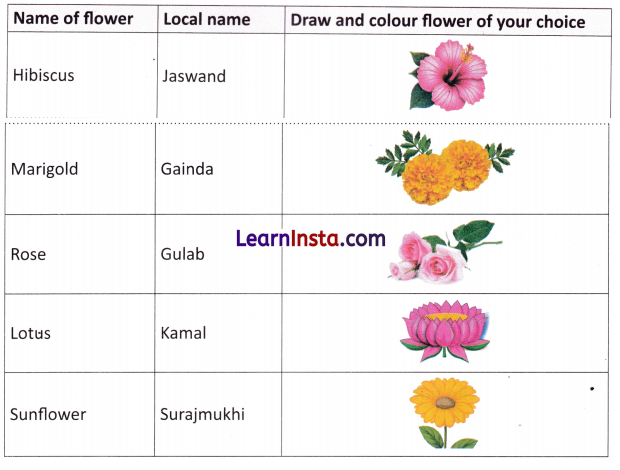
Note: Students should sketch and colour these flowers based on their appearance.
Activity 2 (Page 60)
Make the model of a house using materials from nature such as clay, wooden sticks, hay, grass, leaves, etc. Decorate it with an art form of your choice.
Answer:
(Suggestive answer) Students to do themselves.
Materials: Collect clay (for walls), wooden sticks (for structure), hay (for roofing), grass (for texture), and leaves (for decoration).
Steps:
- Mould clay into small bricks or walls to form the house base.
- Use wooden sticks to create a frame for the roof and support.
- Lay hay over the roof frame to mimic thatching.
- Paste grass and leaves on the walls for a natural look.
- Decorate with Gond art-inspired patterns (trees, birds, animals) using natural dyes (e.g., from marigold or beetroot, as described on Page 4).
Art Form: Gond art, painting nature-inspired designs with natural dyes.
Note: This is a hands-on activity; students should follow the steps with adult supervision for safety.
Activity 3 (Page 60)
Let us prepare a natural dye
Step 1. Collect some flowers, leaves, barks, and roots, such as beetroot, hibiscus, and marigold that have colouring properties.

Step 2. Boil any of the collected plant parts in approximately 1-2 litres of water for 30 minutes to an hour covering the container with a plate. (Please take help from your teacher or an elder.)

Step 3. Strain the liquid to remove the plant materials, leaving behind the natural dye.

Now, try to paint a piece of cloth such as a light-coloured handkerchief or hand towel using the dye you have prepared. Note that you need to soak the cloth overnight, squeeze it and dry it the next morning.
Answer:
(Suggestive answer) Students to do themselves the supervision of parents, teacher or guardian.
Steps to Prepare and Use a Natural Dye
1. Collect Materials:
- Choose plant parts with colouring properties:
- Hibiscus flowers (for red dye).
- Marigold flowers (for yellow dye).
- Beetroot (for purple-red dye).
Quantity: About 1-2 cups of plant material.
Additional items:
- 1-2 litres of water.
- A pot with a lid.
- A stove.
- A strainer.
- A light-coloured cotton cloth (e.g., handkerchief or hand towel).
2. Boil the Plant Parts:
- Place the chosen plant material (e.g., marigold flowers) in a pot with 1-2 litres of water.
- Cover the pot to preserve the colour.
- Boil on medium heat for 30 minutes to 1 hour until the water becomes richly coloured.
3. Strain the Liquid:
- Allow the mixture to cool slightly.
- Use a strainer to separate the coloured liquid (dye) from the plant material.
- Collect the dye in a clean container and discard the boiled plant parts.
4. Dye the Cloth:
- Submerge the light-coloured cotton cloth in the dye.
- Soak it overnight (8-12 hours) for the colour to set.
- The next morning, remove the cloth, gently squeeze out excess dye, and hang it to dry in the shade.
5. Optional Painting:
- Before soaking, you can use a brush to apply the dye to create patterns (e.g., Gond art-inspired designs like trees or birds, as mentioned on Page 4).
- After drying, the cloth can be used as a decorative piece or displayed.
Outcome:
- The cloth will take on the natural colour (e.g., yellow from marigold, red from hibiscus, purple-red from beetroot).
- The activity demonstrates the use of natural materials for dyeing, aligning with the document’s theme of connecting with nature.
Tips:
- Cotton cloth works best for absorbing natural dyes.
- Try multiple plants for different colours (e.g., turmeric for yellow, spinach for green).
- Avoid direct sunlight when drying to prevent colour fading.
Activity 4 (Page 62)
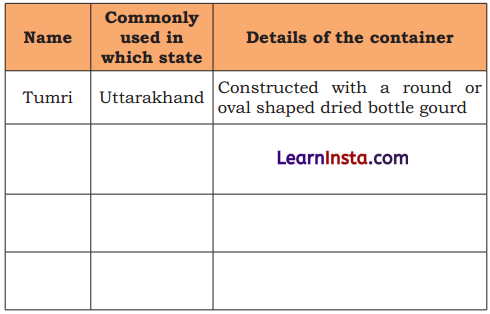
Find out some traditional ways of preserving grains and vegetables at your place, and fill the following table. One example is given.
Answer:
| Name | Commonly used in which state | Details of the container |
| Tumri | Uttarakhand | Constructed with a round or oval-shaped dried bottle gourd |
| Kothi | Punjab | Large clay or mud bins coated with cow dung to protect grains |
| Pusa Bin | Uttar Pradesh | Airtight metal or plastic bins for storing grains |
| Bamboo Basket | Assam | Woven bamboo baskets lined with neem leaves |
| Earthen Pot | Rajasthan | Clay pots with neem leaves to store pulses |
Note: These are examples based on common Indian practices. Students should research local methods with elders or community members.
Activity 5 (Page 63)
Question 1.
Discuss with the elders in your family and write the name of the plant, its parts, and its uses, in the table given below.

Answer:
| Name of the plant | Parts of the plant | Use(s) |
| Indian basil (Tulsi) | Leaves | Treats cough, cold, boosts immunity |
| Carom seeds (Ajwain) | Seeds | Relieves indigestion, stomach pain |
| Neem | Leaves, Oil | Repels mosquitoes, treats skin issues |
| Aloe Vera | Gel (Leaves) | Soothes burns, moisturises skin |
| Turmeric | Root | Anti-inflammatory, heals wounds |
Activity 6 (Page 65)
Find out the traditional dances and songs of your region. Perform a traditional dance with the help of your classmates and teachers for the Annual Day of your school.
Answer:
Region (Example: Maharashtra):
Traditional Dance: Lavani (graceful dance with vibrant music) or Tamasha (folk drama with dance).
Traditional Song: Powada (ballads praising warriors) or Bharud (devotional folk songs).
Performance Plan:
- Coordinate with classmates to choose Lavani for the Annual Day:
- Practice under teacher guidance with traditional costumes (e.g., nine-yard saree for girls).
- Use instruments like dholki and harmonium for authenticity.
- Perform a 5-minute choreography showcasing regional culture.
Note: Students should select dances/songs specific to their region (e.g., Bhangra for Punjab, Garba for Gujarat) and rehearse with school support.
Activity 7 (Page 66)
Talk to your elders and find out the rituals in connection to animals and plants which are celebrated in your locality. A few examples are given below.

Answer:
| Name of the festival | Plants/Animals associated | Activity |
| Vat Purnima | Banyan tree | Worshipping |
| Hari Jiroti | Fruit-hearing trees | Plantation |
| Kaziranga Elephant Festival | Elephant | Awareness drive |
| Nag Panchami | Snake | Worshipping for protection |
| Pola | Bullocks | Decorating and honouring cattle |
Note: These are a few examples. Students should consult elders for local festivals (e.g., Pongal in Tamil Nadu for cattle or Tulsi Vivah for basil plants).
Let us Reflect (Pages 67-68)
Question 1.
What are the things that we use from nature in our daily life?

Answer:
| Activities | Collected from nature |
| Eating | Fruits, vegetables, grains |
| Clothing | Cotton, silk, wool |
| Healthcare | Neem, Tulsi, aloe vera |
| Any other | Wood (furniture), water, sunlight |
Question 2.
What challenges arise when we overuse natural resources? For example, if we overuse wood from nature, our forests deplete.
Water: ……………………………
Soil: ……………………………
Sea Products: ……………………………
Any other (Forests): ……………………………
Answer:
Following challenges will arise if we overuse natural resources.
- Water: Scarcity, droughts, reduced groundwater levels.
- Soil: Erosion, loss of fertility, desertification.
- Sea products: Overfishing, depletion of marine life, ecosystem imbalance.
- Any other (Forests): Deforestation, loss of biodiversity, climate change.
Question 3.
How can we protect the natural environment around us?

Answer:
We can protect the natural environment around us by the following methods.
- At home: Use energy-efficient appliances, reduce water wastage, recycle waste.
- At school: Plant trees, organise eco-clubs, avoid littering.
- In parks: Avoid damaging plants, use dustbins, promote cleanliness.
- In our locality: Conduct clean-up drives, spread awareness, reduce plastic use.
Question 4.
Design your herbal garden

Answer:
(Suggestive answer) Students to do draw the pictures themselves.
Herbs to Draw and Name:
- Tulsi (Indian basil) – Place in the centre for its medicinal value.
- Mint – Near the edge for easy access in cooking.
- Aloe Vera – In a sunny corner for skin care uses.
- Lemongrass – Along the border for its aroma.
- Coriander – In a small patch for culinary use.
Less Preferred Herb:
Fenugreek (bitter taste) – Place in a small corner.
- Design: Draw a circular garden with labelled sections for each herb, using green for leaves and appropriate colours for flowers (e.g., purple for Tulsi flowers).
Note: Students should sketch the garden layout with labelled herbs, ensuring both liked and less-liked herbs are included.