These Class 6 Social Science Worksheet and Class 6 SST Chapter 9 Family and Community Worksheet with Answers are excellent for board exam practice.
Class 6 SST Chapter 9 Family and Community Worksheet
Class 6 Family and Community Worksheet
Worksheet On Family and Community Class 6 – Family and Community Worksheet Class 6
Multiple Choice Questions (Mcqs)
Question 1.
What is a nuclear family?
(a) A family with more than two generations living together
(b) A couple and their children living together
(c) A family without children
(d) Only grandparents and their grandchildren
Question 2.
Who is involved in making rules for the Residents’ Welfare Association?
(a) Only government officials
(b) The people living in the community
(c) Police officers
(d) Outsiders
Question 3.
What is the role of Tenzing’s father in his family?
(a) Only earning for the family
(b) Taking care of household chores along with his work
(c) Doing social work full-time
(d) Staying at home without any role
Question 4.
How does Shalini demonstrate sacrifice in her family?
(a) She gives up her toys
(b) She accepts a simpler dress to allow others to receive new clothes
(c) She stops going to school
(d) She refuses to help with household chores
Question 5.
Which of the following is a reason for opting for a nuclear family?
(a) Financial constraints
(b) Desire for independence
(c) Tradition
(d) External pressure
Question 6.
What does the term ‘community’ imply in the context of family and society?
(a) Isolated living
(b) Group of people living in harmony
(c) A family without a mother
(d) A group of unrelated people
Question 7.
Why is saving money for unexpected needs important in a family?
(a) To ensure basic necessities
(b) To prepare for future emergencies
(c) To spend extravagantly
(d) To drite to charity

Fill in the blanks
1. A family that consists of parents and children is known as a _____________ family.
2. Joint families often include multiple _____________ living together.
3 involves giving up personal needs for the family’s benefit.
4. In Hindi, a father’s younger brother is called _____________
5. A community is a group of people connected by common values or goals.
6. In Tenzing’s family, his father helps with _____________ chores.
7. Parents are responsible for teaching _____________ to their children.
8. A Residents’ Welfare Association manages rules in _____________ areas.
9. _____________ is the act of charity and giving in Indian families.
10. In many families, decisions about spending are made _____________.
Find the correct words in the wordsearch based on the given clues
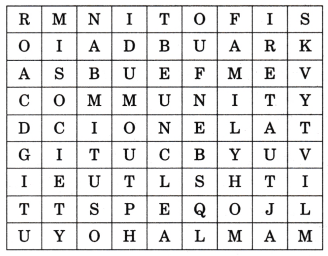
1. A practice followed by Bhil tribes in Madhya Pradesh to help each other without request or demand in the hour of need _____________
2. Basic unit of any society______________
3. It is a group of connected people. _____________
4. Hindi word for a relation who is your father’s sister. _____________
5. It is a collective name given to our set-up where people live together and are connected with some common norms and functions. _____________
6. Single name used in English to address, chacha, Tau, Mama, Mausa _____________
Relationship-based question
Identify which diagram will represent the relationship between them in the correct manner.
1. Family, parents, children

2. Grandfather, father, son

3. Parents, son, daughter, cousin

4. Parents, son, daughter, maternal cousin sister and paternal cousin brother

Assertion Reason-based Questions
Choose the correct option after analysing both the statements of assertion and reason.
(a) Both assertion and reason are correct, and reason is the correct explanation for the assertion.
(b) Both assertion and reason are correct, but reason is not the correct explanation for the assertion.
(c) The assertion is correct, but the reason is incorrect.
(d) The assertion is incorrect, but the reason is correct.
Assertion: In joint families, all children are considered brothers and sisters.
Reason: Cousins share close bonds in Indian families.
Tick (✓) on the actions you would like and support to have for happy and harmonious community living.
1. Someone cleaning his home and throwing his garbage on your door.
2. Your neighbour, offering you fresh water and tea on your return after a weeklong trip.
3. Your father, going to look after the arrangements of the community function, after coming from his office
4. Your grandmother, shooing away all the children playing in the neighbourhood.
5. Your next-door neighbour is playing loud music at midnight while everyone else is sleeping and another neighbour has an old age patient
6. Your mother, taking a break from her work to take part in community service in your society
Short Answer Questions
Question 1.
What is the difference between a nuclear and a joint family?
________________________________________
________________________________________
Question 2.
What role does cooperation play in family relationships?
________________________________________
________________________________________
Question 3.
Define the term ‘dana’ in the context of family values.
________________________________________
________________________________________
Question 4.
What is the significance of‘halma’ in the Bhil community?
________________________________________
________________________________________
Long Answer Questions
Question 1.
Explain the concept of dharma and its importance in family life.
________________________________________
________________________________________
Question 2.
What do you understand and learn from the practice of Bhil community’s tradition of halma?
________________________________________
________________________________________
Question 3.
Describe the role of cooperation and shared responsibilities in a family.
________________________________________
________________________________________
Logical Thinking Questions
Why do you think Indian languages have more specific terms for family members than English?
________________________________________
________________________________________
Application-based questions
If some family has recently moved into your neighbourhood. What help would you offer them to make their settlement easy and smooth at the new place?
________________________________________
________________________________________
Picture based question
Look at the given picture and answer the following questions:

(a) Identify the picture and describe what is happening in this picture.
________________________________________
________________________________________
(b) What is this practice called in Madhya Pradesh?
________________________________________
________________________________________
(c) Why are so many people working together in a group? What could be the reason?
________________________________________
________________________________________
(d) What purpose will these trenches serve for them?
________________________________________
________________________________________
(e) Write three instances when a community came forward to help people in need.
________________________________________
________________________________________
Case study based questions
“The concept of empathy and consideration in Japanese culture is called ‘omoiyari.’ Omoiyari is the sympathy and empathy for others that leads to thoughtful action. The key points are anticipating someone’s needs and providing for them in advance. To practice omoiyari, you have to think by putting yourself in the other’s shoes and give them what they need without verbally expressing it to you. Omoiyari is not always about doing something. Sometimes, not doing or saying something is also omoiyari. That is why this concept is related to ‘kuuki wo yomu’ or ‘reading the room.’ If you can read the situation, you must understand what to do and what not to do to accommodate someone’s needs. The practice of omoiyari can be found in daily occurrences in Japanese society. It’s not about superiors helping people beneath them, but voluntary help to anyone in need. Omoiyari, along with other characters, is taught to children from an early age.”
Read the given excerpt and answer the following questions:
Question 1.
Which country does Omoiyari culture belong to?
________________________________________
________________________________________
Question 2.
What is the name of a similar practice followed by the tribal community of Bhils in Madhya Pradesh, India?
________________________________________
________________________________________
Question 3.
What is the meaning of Omoiyari in Japan?
________________________________________
________________________________________
Question 4.
Write one such situation when a person facing a problem can be helped by this practice of omoiyari?
________________________________________
________________________________________
Question 5.
Have you ever faced a situation where you expected other people to come forward to help you?
________________________________________
________________________________________
Diagram-based question
Draw a family tree of yours covering three generations and all your uncles and aunts from both sides. Now start drawing with arrows.

________________________________________
________________________________________