Students rely on Class 9 Science Extra Questions and Class 9th Exploration Chapter 5 Extra Question Answer Exploring Mixtures and Their Separation to improve their grades.
Class 9 Science Chapter 5 Exploring Mixtures and Their Separation Extra Questions
Class 9 Science Chapter 5 Extra Questions on Exploring Mixtures and Their Separation
Exploring Mixtures and Their Separation Class 9 Very Short Question Answer
Question 1.
Give an example of mixture which is separated by filtration.
Answer:
A mixture of sand and water is separated by filtration.
Question 2.
Identify the separation technique used to separate the components of the blood, such as red blood cells and plasma.
Answer:
Centrifugation is widely used to separate components of blood, such as red blood cells and plasma.
Question 3.
Name the white crystalline chemical substance used in water purification.
Answer:
Alum is a white crystalline chemical substance used in water purification.
Question 4.
Categorise tea leaves in water into true solution, colloid or suspension.
Answer:
Tea leaves in water is categorised as suspension.

Question 5.
Give an example of two immiscible liquids.
Answer:
The oil and water mixture do not mix and are called immiscible liquids.
Question 6.
Smoke is an example of solid particles suspended in air. True or false.
Answer:
True.
Question 7.
What is the full form of LPG?
Answer:
The full form of LPG is Liquified Petroleum Gas.
Question 8.
Name two miscible liquids.
Answer:
Two miscible liquids are acetone and water.
Question 9.
Name the technique used to separate pure substances (crystals) from homogeneous mixtures.
Answer:
Crystallisation is a common technique used to separate pure substances (crystals) from homogeneous mixtures.
Question 10.
Is it possible to separate the mixture of two miscible liquids (water and ethyl alcohol) and obtain both the liquids?
Answer:
Yes, it is possible to separate the mixture of two miscible liquids (water and ethyl alcohol) and both get the liquid. The process is called distillation.
Question 11.
What are the two components of a solution? Write two properties of a solution.
Answer:
Two components of a solution:
Solute and Solvent.
Two properties of a solution:
(i) Homogeneous
(ii) Transparent.
Question 12.
(a) Differentiate between a saturated solution and an unsaturated solution. How will you test whether a given solution is saturated or not?
(b) What happens when a saturated solution is heated.
Answer:
(a) Saturated solution: A solution in which no more of the solid (solute) can be dissolved at a given temperature is called a saturated solution.
Unsaturated solution: A solution in which more of the solid can be dissolved at the given temperature is called an unsaturated solution.
(b) A saturated solution becomes unsaturated on heating.
Question 13.
What makes water as a universal solvent?
Answer:
Water acts as a solvent due to
(i) the polar nature of its molecules
(ii) its ability to produce soluble salt on interaction with a large number of substances.
Question 14.
A solution of salt in water has been prepared by mixing 150 gm of salt with 600 gm of water. Calculate the concentrations of the solution.
Answer:
Weight of solution = 150 + 600 = 750 gm
Mass percentage of solution = \(\frac{150}{750}\) × 100 = 20 %
Question 15.
A mixture is homogeneous and light is not visible on passing through it. State, what can you infer about the nature of the mixture and size of its particles?
Answer:
Since the mixture is homogeneous, it must be a solution. The particles of a solution are smaller than 1 nm diameter and cannot scatter beam of light.
Exploring Mixtures and Their Separation Class 9 Short Question Answer
Question 1.
What happens when a beam of light is passed through canopy of a dense forest ?
Answer:
Tyndall effect is that scattering of light is observed when a beam of light is passed through a dense forest.
Question 2.
Differentiate between True solution/solutions, colloids and suspensions on the basis of size of particles.
Answer:
- True solutions: Solution have smallest particle size less than 1 nm.
- Colloids: have larger particle size (1 – 100 mm).
- In suspensions particle size is greater than 100 mm.
Question 3.
Name the two components of a colloid.
Answer:
The two components of a colloid are called the dispersed phase and the dispersion medium.
Question 4.
Name and define the process associated with the following:
Milk is churned to separate cream from it.
Answer:
Centrifugation is used to separate cream from milk: Centrifugation is the process in which denses particles are forced to bottom and lighter particles stay at the top when spun rapidly.
Question 5.
Is the dye in black ink a single colour. Name the process used to separate colours in a dye.
Answer:
No, dye in black ink is not a single colour. It is a mixture of two or more colours. Chromatography is used to separate colours of dye in black ink.
Question 6.
Write the principle used to separate two immiscible liquids (water and oil).
Answer:
The principle is that immiscible liquids separate out in layers depending on densities.
Question 7.
What is meant by saturated solution?
Answer:
Saturated solution is a solution in which no more solute can be dissolved in a solution at a temperature.
Question 8.
List the various types of homogeneous and heterogeneous mixtures with examples.
Answer:
(i) Homogeneous mixtures
(a) Solid solution: Alloys, e.g., brass, steel, bronze.
(b) Liquid solution: Sugar dissolved in water, sea water, alcohol in water.
(c) Gaseous solution: Air, natural gas.
(ii) Heterogeneous mixtures
| (a) Solid + Solid | Sugar and sand, iron filings and sulphur, copper sulphate and potassium permanganate |
| (b) Solid + Liquid | Pastes, suspensions, etc. |
| (c) Solid + Gas | Smoke |
| (d) Liquid + Liquid | Milk, emulsions |
| (e) Liquid + Gas | Soap bubbles |
Question 9.
Define the following terms:
(i) True solution
(ii) Solute
(iii) Solvent
(iv) Solubility.
Answer:
(i) True solution:
A true solution is defined as a homogeneous mixture of two or more substances. The term homogeneous means that every portion of the solution has the same properties, e.g., sugar dissolved in water, iodine in ethyl alcohol (tincture).
(ii) Solute:
The substance(s) present in smaller proportion in a solution is called solute.
(iii) Solvent:
The substance present in larger proportion in a solution is called solvent.
If a homogeneous mixture or a solution is formed by dissolving 2 g salt in 100 g water, then salt is the solute and water is the solvent.
(iv) Solubility;
The maximum amount of the solid that can be dissolved in a given amount of the solvent (water) is termed its solubility at that temperature.
Question 10.
Give reasons: (1 each)
(i) Path of beam of light is not visible through a solution.
(ii) Particles of solution cannot be seen with a naked eye.
Answer:
(i) The particles of a solution are smaller than 10-9 metre in diameter. Such small particles do not scatter a beam of light passing through them. So, the path of light is not visible in a solution.
(ii) Particles of a solution are too small, i.e., less than 1 nm to be seen by a naked eye.
Question 11.
An alloy cannot be separated into its constituents by physical methods but still it is considered a homogeneous mixture. Explain.
Answer:
Alloys are considered as homogeneous mixtures because
(i) The composition of an alloy is uniform throughout its mass.
(ii) It shows the properties of its constituents and can have variable composition of its constituents.
Question 12.
During an experiment, the students were asked to prepare a 10 % (Mass/mass) solution of salt in water. Rahul dissolved 10 g of salt in 100 g of water while Priya prepared it by dissolving 10 g of salt in water to make 100 g of solution.
(a) Do the two solutions have same concentration?
(b) Calculate mass/mass percentage in each case.
(c) Whose measurements are correct for the experiment?
Answer:
Rahul Solution.
Total weight of solution = 10 + 100 = 110 g
Mass percentage = \(\frac{10}{110}\) × 100 = 9.09%
Priya Solution.
Total weight of solution = 100 g
Weight of salt = 10 g
Mass percentage = \(\frac{10}{110}\) × 100 = 10%
(a) Both solutions have different solutions.
(b) See above
(c) Priya did the correct measurement.
Question 13.
Solubility of potassium nitrate at 313 K is 62 g. What mass of potassium nitrate would be needed to produce a saturated solution of KNO3 in 50 g of water at 313 K? What is the effect of change of temperature on the solubility of a salt?
Answer:
The solubility of potassium nitrate is 62 g at 313 K.
It means it is the max. amount soluble at 313 K in 100 g of solution.
∴ Amount of salt = 62 g
Amount of water = 100 – 62 = 38 g
∴ Amount of KNO3 in 50 g water = \(\frac{62}{38}\) × \(\frac{50}{1}\) = 81.58 g
The solubility of a salt increases with rise in temperature.
Question 14.
How much water should be mixed with 12 mL of alcohol so as to obtain 12 % of alcohol solution ? Calculate.
Answer:
Amount of alcohol in 100 mL solution = 12 mL
∴ Amount of water = 100 – 12 = 88 mL.
∴ 88 mL of water and 12 mL of alcohol are to be mixed with to get 12% of alcohol.
Question 15.
What is a suspension?
Answer:
A suspension is a heterogeneous mixture of a solid in a liquid. A suspension is formed when a liquid contains small solid particles which are not soluble in it but are visible to naked eyes. If such a mixture is left undisturbed, the solid particles slowly settle down to the bottom under the effect of gravity. If the particle size of the solid is greater than 10-7 metres (100 nm) and it is insoluble in the given liquid, then the solid particles remain suspended in the liquid. This is called a suspension. For example, mud water, sand water, coarse lime stone particles in water.
Question 16.
Explain dispersed phase and dispersion medium in relation to colloidal solution.
Answer:
A colloidal solution is said to be intermediate state of the solution and the suspension. It is neither a true solution nor a suspension. In colloidal solution, the particle size is between 1 nm to 100 nm. For example, a solution of soap in water, milk, blood, writing inks are some of the colloidal solutions. Though these particles are 10 to 1000 times the size of a single small molecule, these are not visible to naked eyes. But these are large enough to scatter the light that passes through the dispersion medium.
The medium of colloidal solution is known as dispersion phase (dispersion medium) and the particles dissolved are called dispersed phase. In milk, water is dispersion phase and fats, proteins etc. are dispersed phase. In fog, water droplets form the dispersed phase and air is dispersing medium.
Question 17.
Give two examples from daily life where Tyndall effect is observed.
Answer:
- When a beam of light enters a room through a hole, it gets illuminated because light beam is scattered by randomly moving dust particles in the room.
- In dense forest, particularly in the early morning, there is a fog, tiny water droplets are suspended in air. These droplets are large enough to scatter beam of light. This is why Tyndall effect is observed when sunlight passes through dense forests.
Question 18.
(a) What is the effect of temperature on the solubility of a solid in liquid?
(b) Why is it possible to distinguish the particles of solute from those of solvent in a suspension?
Answer:
(a) The solubility of a solid in a liquid increases with rise of temperature.
(b) The particles of a solute are quite large compared to the particles of the solvent in a suspension.
Exploring Mixtures and Their Separation Class 9 Long Question Answer
Question 1.
(a) What is ‘Tyndall effect’? Describe an activity to show that a true solution does not show Tyndall effect.
(b) Which of the following will show Tyndall effect? Give a reason also:
(i) Milk
(ii) Salt solution
(iii) Sugar solution
(iv) Starch solution
(v) Air
(vi) Tincture iodine
Answer:
(a) The illumination of beam of light due to scattering on collision with certain particles is called Tyndall effect. If a beam of light is passed through a true solution, the solution is not illuminated and light passes unaffected.
(b) (i) Milk, (iv) Starch solution, (vi) Tincture iodine.
In these solutions the size of particles is large enough to scatter a beam of light.
Question 2.
Giving example, state the use of a solution, a colloid and a suspension in our daily life.
Answer:
Solutions:
When two reacting substances are kept in contact, the reaction does not take place or is very slow. But when their solutions are mixed, the reaction takes place very fast. This happens because in solutions, reacting substances come in contact with each other at molecular level. When solid washing soda is poured over clothes, it does not wash but when clothes are mixed with solution of washing soda, clothes are easily cleaned.
Colloids:
Some insoluble substances particularly in pharmaceuticals become more effective when administered in colloidal form. Many medicines are insoluble in water but are used in the form of colloids.
Suspensions:
Many substances insoluble or sparingly soluble in dispersing medium become useful for analytical purposes when dispersed temporarily. For example, sparingly soluble barium sulphate dispersed in water is an opaque medium and is used for diagnostic X-rays.
Question 3.
“Tyndall effect can be observed, when sunlight passes through the canopy of dense forest. ” Explain, how this occurs?
Answer:
The illumination of beam of light due to scattering on collision with certain particles is called Tyndall effect.
In dense forest, particularly in the early morning, there is fog, i.e., tiny water droplets are suspended in air. These droplets are large enough to scatter beam of light. This is why Tyndall effect can be observed when sunlight passes through dense forest.
Question 4.
(a) Define solution. If 10 mL of H2SO4 is dissolved in 90 mL of H2O, calculate the concentration of H2SO4 in the solution.
(b) Rain water stored in a tank contains sand grains, unfiltrable clay particles, calcium carbonate, pieces of paper and some air bubbles. Select one example each of a solvent, solute, a colloid and a suspension present in the rain water.
Answer:
(a) A solution is a homogeneous mixture of two or more substances.
Concentration of sulphuric acid solution = \(\frac{10}{100}\) × 100
= 10% = volume by volume.
(b) Solvent – water
Solution – salt solution
Suspension – sand grains
Colloid – unfiltrable clay particles.
Question 5.
What are colloids? State their characteristics.
Answer:
If the size of the particles of the solute (also called dispersed phase) is between 1 nm and 100 nm and the particles remain suspended in the dispersing medium, then these are called colloids. Their solutions are known as colloidal solutions. The colloids exhibit the following characteristic properties:
(i) Brownian motion:
Colloidal particles move at random in zig-zag paths like gas particles. This is called Brownian motion. This type of motion is caused due to the collisions between the particles of the dispersion medium and the dispersed phase.
(ii) Tyndall effect:
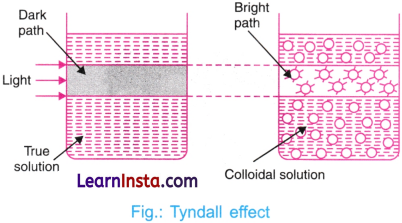
When strong beam of light is passed through a true solution taken in a beaker placed in a dark room, the path of light through the solution is dark. But if the light is passed through a colloidal solution under conditions as above, the path of light through the colloidal solution becomes visible. This is called Tyndall effect. The colloidal particles become illuminated because they scatter the light falling on them in all directions.
(iii) Electrophoresis:
When an electric current is passed through a colloidal solution, the particles move either towards the positive or negative electrode. This phenomenon is known as electrophoresis. By the direction of the movement of colloidal particles, we can know the nature of the charge on them.
Question 6.
How do you express concentration of a solution?
Answer:
Concentration of a solution may be expressed in terms of percentage by mass of solute per 100 gram of the solution.
% Conc. of Solution = \(\frac{\text { Mass of solute }}{\text { Mass of solution }}\) × 100
Thus, if a solution is 5 %, it means it is 5 gram of a solute dissolved in 100 gram of the solution or it contains 5 gram solute and 95 gram solvent.
Concentration of a solution may also be expressed as mass of solute dissolved in 100 cm3 of the solution. Thus, 10 % sugar solution by volume means 10 g sugar dissolved in 100 cm3 of solution.
If there is a solution of two miscible liquids then it is convenient to express volume by volume percentage of a solution. Thus if 5 mL acetone is mixed with 80 mL of water, then
Volume by volume percentage of solution = \(\frac{5}{80+5}\) × 100
= \(\frac{5}{85}\) × 100 = 5.88.
Exploring Mixtures and Their Separation Class 9 Case Based Questions
For our daily use we buy various consumables from the market, e.g., milk, ghee, butter, salt, spices, fruits, vegetables, mineral water, juice etc. We buy them as pure substances. These come as gaseous, solids or liquids. But from the scientist point of view none of these substances is pure. To get a pure sample we apply several procedures, such as filtration, distillation, sublimation, ultracentrifugation, chromatography, etc

Look at the picture above and answer the following questions:
Question 1.
What is a pure substance from the scientist point of view?
Answer:
All the constituent particles of a pure substance are similar in their chemical nature.
Question 2.
When do we apply the process of sublimation?
Answer:
When out of mixture of two one substance on heating directly converts from solid to vapour.
Question 3.
What should be the minimum temperature difference between boiling points of a mixture of two liquids?
Answer:
20°C.
Question 4.
Give one mixture where centrifugation is used to separate a mixture.
Answer:
From milk, butter is separated by centrifugation.
Exploring Mixtures and Their Separation Extra Questions for Practice
Very Short Answer Type Questions
Question 1.
Acetone (boiling point 56°C) is added by mistake to a solution of salt in water. Name the technique used to get back the acetone.
Question 2.
What is the size solute of particles in a colloidal solution and in a suspension?
Question 3.
Give one example of a mixture that can be separated by the technique of crystallization.
Question 4.
Name the technique used to obtain salt from its solution other than evaporation.
Question 5.
What is the difference between smoke and fog?
Question 6.
Define the Tyndall effect.
Question 7.
Give one example each of a true solution, a colloid, and a suspension.
Question 8.
Name the solute and solvent present when 21 g of potassium nitrate is dissolved in 100 g of water at 10°C.
Question 9.
Brass is a homogeneous mixture of zinc and copper. Why is it regarded as a mixture?
Question 10.
Classify each of the following as homogeneous or heterogeneous mixtures: vinegar, filtered tea, wood, and soil.
Short Answer Type Questions
Question 1.
How will you separate the following mixtures?
(a) Two miscible liquids whose boiling points differ by more than 25°C.
(b) Two miscible liquids whose boiling points differ by less than 25°C.
Question 2.
Which separation technique will you apply in the following cases?’
(a) Small pieces of metal in the engine oil of a car
(b) Butter from milk
(c) Ammonium chloride from a mixture containing sodium chloride and ammonium chloride
Question 3.
Write briefly the process of obtaining pure copper sulphate crystals from an impure solution of copper sulphate.
Question 4.
Distinguish between pure and impure substances.
Question 5.
Define the following:
(a) Saturated solution
(b) Unsaturated solution
(c) Solubility of a substance
Question 6.
Aerated water (soda water) is an example of a homogeneous mixture. Justify.
Question 7.
A solution contains 20 mL of acetic acid and 250 mL of water. What is the concentration (v/v %) of the acetic acid solution?
Long Answer Type Questions
Table: Solubilities of different substances in water
| Solute | Solubility |
| 1. Sodium chloride | 36 g/100 g of water |
| 2. Potassium | 24 g/100 g of water |
| 3. chloride Copper | 21 g/110 g of water |
| 4. chloride Copper | 204 g/100 g of water |
| 5. Potassium nitrate | 32 g/100 g of water |
Question 1.
Table above shows the solubility of different substances at 283 K in 100 g of water. Study the table carefully and answer the following questions:
(a) Write down the solubility of each substance at 283 K. Which substance has the highest solubility at this temperature?
(b) What is the solubility of sodium chloride in 50 g of water at the same temperature?
(c) On cooling the solution of sugar, what would be observed? What happens to the solubility of sugar on cooling the solution? Explain.
(d) What is the effect of change of temperature on the solubility of a salt? Explain your answer.
Question 2.
A mixture of sand, iron filings, ammonium chloride, and sodium chloride was given to Rahul. Describe the separation techniques that would be used by him to separate these constituents from the mixture.
Question 3.
Rahul and Raj prepared the solutions during an experiment. Rahul dissolved 10 g of sugar in 100 g of water, while Raj prepared a solution by dissolving 10 g of glucose to make 100 g of solution.
(a) Are the two solutions of the same concentration? Justify your answer.
(b) Compare the mass percentage of the two solutions.
Question 4.
Teacher Kamla showed the phenomena to the students by taking an old rectangular cardboard box and covering it with the black paper from all the sides. She fixed a source of light, a torch at one end of the box by making a hole in it, and made another hole on the other side to view the light. She placed a milk sample contained in a beaker in the box and asked the students to observe. Students were amazed to see that milk taken in the tumbler was illuminated. They tried the same activity by taking a salt solution but found that the light simply passed through it.
(a) Explain why the milk sample was illuminated. Name the phenomena involved.
(b) Salt solution, when taken, were not showing the same results. Explain.
(c) Can you suggest two more solutions which would show the same effect as shown by the milk solution?
Question 5.
The sea water can be classified as a homogeneous as well as heterogeneous mixture. Comment.
Question 6.
(a) What is a true solution? State three characteristics of a true solution.
(b) Give three differences between a colloidal solution and a suspension.
(c) Give one example of each of the following types of solutions
(i) solid-solid solution
(ii) solid-liquid solution
(iii) liquid-liquid solution
(iv liquid-gas solution
(v) gas-gas solution.
Question 7.
Give an example each for mixtures having the following characteristics and also suggest a suitable method to separate their components:
(a) Components get separated by using coagulant.
(b) Mixture of two immiscible liquids.
(c) Mixture of two volatile components with appreciable difference in boiling points.
(d) Mixture oftwo or more coloured constituents soluble in the same solvent.
(e) Mixture of a volatile and a non-volatile component.
Case/Source Based Questions
Read the following and answer any four questions from (i) to (v).
A homogeneous mixture is a type of mixture with a uniform composition. Thus, the constituent substances cannot be distinguished easily from one another. A homogeneous mixture of two or more substances is called a solution. Some examples of solutions are salt solution, rubbing alcohol and sugar dissolved in water.
If we take a glass full of water and mix sand in it, it will form a heterogeneous mixture. We can easily identify the component of this mixture. When the mixture of sand and water is kept undisturbed for some time, we will observe that particles of sand settle down due to gravity. This shows that it is an unstable mixture. A heterogeneous mixture of insoluble particles of solute, spreads throughout a solvent, is called a suspension. The particles in suspension are larger than the particles in a solution.
A colloid is an intermediate between solution and suspension. Colloids can be distinguished from solutions using the Tyndall effect. Tyndall effect is defined as scattering of light beam through a colloidal solution. A heterogeneous solution in which the solute particles neither dissolve nor settle down in the solvent, is called a colloidal solution.
Question (i)
A homogeneous mixture of two or more substances is called a ________.
Question (ii)
Why is a mixture of sand and water called a heterogeneous mixture?
Question (iii)
What happens when a mixture of sand and water is left undisturbed for some time?
Question (iv)
Chalk powder in water is a suspension, why?
Question (v)
Why is Tyndall effect not observed in Tincture of iodine?