Students rely on Class 9 Science Extra Questions and Class 9th Exploration Chapter 3 Extra Question Answer Tissues in Action to improve their grades.
Class 9 Science Chapter 3 Tissues in Action Extra Questions
Class 9 Science Chapter 3 Extra Questions on Tissues in Action
Tissues in Action Class 9 Very Short Question Answer
Question 1.
What is a tissue?
Answer:
A group of cells similar in structure that work together to perform a specific function.
Question 2.
Why do plant cells have a cell wall?
Answer:
To provide rigidity and strength, as plants are fixed and need support to stay upright.
Question 3.
Name the tissue that transports food in plants.
Answer:
Phloem
Question 4.
What is division of labour in a multicellular organism?
Answer:
Different groups of cells perform different specialised functions in the organism.
Question 5.
Why can animal cells change shape easily?
Answer:
Because animal cells lack a rigid cell wall.

Question 6.
What is differentiation in plants?
Answer:
The process by which meristematic cells lose the ability to divide and become specialised permanent tissue cells.
Question 7.
Where is the apical meristem located?
Answer:
At the tips of roots and shoots.
Question 8.
Name the tissue that has dead cells with thick lignified walls.
Answer:
Sclerenchyma.
Question 9.
What is the function of stomata?
Answer:
Stomata allow gaseous exchange and transpiration.
Question 10.
Name the only living component of xylem.
Answer:
Xylem parenchyma.
Question 11.
Name the protein that gives blood its red colour.
Answer:
Haemoglobin.
Question 12.
What type of muscle is found in the stomach wall?
Answer:
Smooth muscle (involuntary muscle).
Question 13.
What are neurons?
Answer:
Neurons are the cells of nervous tissue, specialised to receive, process and transmit messages.
Question 14.
Which blood component helps in clotting?
Answer:
Platelets.
Question 15.
Name the connective tissue that connects bone to bone.
Answer:
Ligament.
Question 16.
What connects muscles to bones?
Answer:
Tendons.
Question 17.
Name the type of joint found in the skull.
Answer:
Fixed joint.
Question 18.
How many pairs of ribs does a human have?
Answer:
12 pairs.
Question 19.
What is a joint?
Answer:
A junction between two or more bones that allows movement.
Question 20.
What is the function ofthe vertebral column ?
Answer:
It supports the body, helps us stand upright and protects the spinal cord.
Tissues in Action Class 9 Short Question Answer
Question 1.
Explain why plant and animal tissues are different from each other.
Answer:
Plant and animal tissues differ because of their different needs.
Plants are stationary, so they have tissues with rigid cell walls for support (like sclerenchyma). Animals are mobile, so they have flexible and contractile tissues (like muscles).
Plants make food by photosynthesis and need tissues like chlorenchyma, while animals need tissues for digestion and movement.
Question 2.
What is the hierarchy of organisation in a multicellular organism?
Answer:
In multicellular organisms, cells of similar type group together to form tissues. Tissues combine to form orgAnswer: Different organs form organ systems, and organ systems together form the complete organism. This hierarchy increases the efficiency of the body.
Question 3.
Differentiate between parenchyma, collenchyma and sclerenchyma.
Answer:
- Parenchyma has thin-walled, living cells with intercellular spaces; it stores food and performs photosynthesis.
- Collenchyma has living cells with unevenly thickened comers (pectin); it provides flexibility.
- Sclerenchyma has mostly dead cells with thick, lignified walls; it provides strength and hardness.
Question 4.
How does lateral meristem help in the growth ofplants?
Answer:
Lateral meristem is located along the sides of the stem in a ring. Its cells divide and produce new cells both inward and outward in a concentric manner. This leads to an increase in the diameter of the stem. The annual rings seen in a tree trunk are formed by the activity of the lateral meristem.
Question 5.
Describe the structure and function of phloem.
Answer:
Phloem is a complex permanent tissue that transports food from leaves to other parts of the plant. It is mainly made of living cells except phloem fibres. It consists of sieve tubes (transport food), companion cells (regulate loading and unloading of sugars), phloem parenchyma (store food) and phloem fibres (provide strength).
Question 6.
Differentiate between tendons and ligaments.
Answer:
| Tendons | Ligaments |
| 1. Tendons are inelastic. | (a) Ligaments are elastic. |
| 2. Tendons connect muscles to bones. | (b) Ligaments connect bones to bones. |
| 3. They are made up of white fibres. | (c) They are made up of both white and yellow fibres. |
Question 7.
Compare the three types of muscles in animals.
Answer:
| Feature | Striated or Skeletion or voluntary muscles | Unstriated or smooth or involuntary muscles | Cardiac muscles |
| Shape | Long, non tapering cylindrical unbranched striated with alternate light and dark bands or striations. | Elongated, spindle shaped, unbranched, unstriated (Without striations or light and dark bands. | Cylindrical, non tapering branched fibres with striations and branches join to form a network. (Striations are faint) |
| Number of nuclei | Multinucleated | Uninucleated | Uninucleated |
| Position of nuclei | Peripheral nuclei which are long cigar like | Central nucleus | Nuclei central |
| Action | Voluntary | Involuntary | Involuntary |
| Location | Present in the limbs | In the wall of stomach, intestine ureter, bronchi | Present in the wall of the heart |
Question 8.
Differentiate between ball and socket joint and hinge joint.
Answer:
- In a ball and socket joint, the rounded end of one bone fits into a cup-shaped hollow of another, allowing movement in all directions (e.g., shoulder, hip).
- In a hinge joint, bones move in one direction only, like a door hinge (e.g., elbow, knee).
- Ball and socket joints give more freedom of movement than hinge joints.
Question 9.
Explain how the rib cage helps in breathing.
Answer:
- The rib cage is made of 12 pairs of ribs connected to the vertebral column (spine) at the back and the sternum (breast bone) at the front by flexible cartilage.
- This flexibility allows the rib cage to expand and contract.
- During inhalation, the rib cage expands, increasing the space in the chest so air enters the lungs.
- During exhalation, the rib cage contracts, pushing air out.
Tissues in Action Class 9 Long Question Answer
Question 1.
Describe how the structure and functions of tissues in plants and animals are related to their different modes of life.
Answer:
A. Plants:
(i) Plants are fixed and do not move, so they need strong support tissues.
(ii) Plant cells have a rigid cell wall.
(iii) Tissues like sclerenchyma and xylem provide structural strength.
(iv) Plants make their own food through photosynthesis, so they have specialised tissues like chlorenchyma (parenchyma with chloroplasts).
(v) They have conducting tissues (xylem and phloem) for transport of water and food.
B. Animals:
(i) Animals are mobile and need flexible tissues.
(ii) Animal cells lack a cell wall, so they can change shape.
(iii) Muscular tissue allows movement, nervous tissue allows coordination and sensation, and epithelial tissue provides protection.
(iv) Connective tissues like blood transport nutrients and gases.
This shows that the structure of each tissue in both plants and animals is adapted to its specific function.
Question 2.
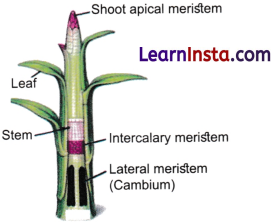
Explain the three types of meristematic tissues in plants with their location and function.
Answer:
Plants have three types of meristematic tissues.
(i) Apical meristem:
It is located at the tips of roots and shoots. It helps the plant grow in length.
(ii) Lateral meristem:
It is located along the circumference of stems between xylem and phloem. It helps the plant grow in girth by dividing and adding new cells in a concentric manner, forming annual growth rings.
(iii) Intercalary meristem:
It is located at the base of intemodes or just above the nodes in certain plants like grasses. It helps plants regrow after being cut or grazed by animals.
Together, these three meristems account for growth in length, girth and branching in plants.
Question 3.
Describe the three tissue systems in plants and explain their functions.
Answer:
Plant tissues are organised into three tissue systems.
(i) Dermal tissue system: It forms the outer covering (epidermis). It protects the inner parts, reduces water loss through the cuticle and allows gaseous exchange through stomata.
(ii) Ground tissue system: It forms the main body of the plant. It includes parenchyma (food storage, photosynthesis), collenchyma (flexibility) and sclerenchyma (strength and support).
(iii) Vascular tissue system: It consists of xylem and phloem. Xylem transports water and minerals from roots upward. Phloem transports food from leaves to all other parts.
These three systems work together to keep the plant alive and healthy.
Question 4.
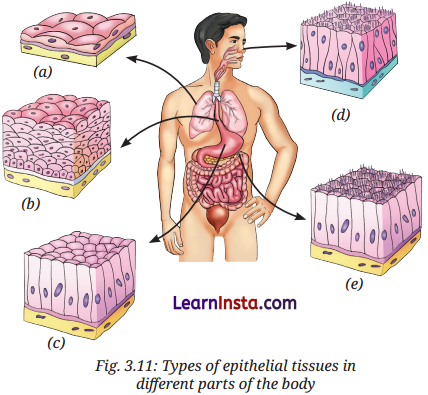
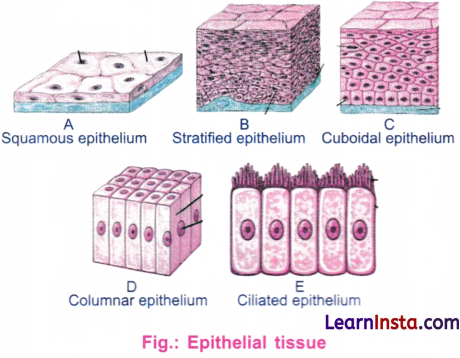
Describe the different types of epithelial tissues, their structure, function and location.
Answer:
Epithelial tissues form the covering and lining of the body and orgAnswer:
It is of five types:
(i) Squamous epithelium:
It has a single layer of thin, flat cells and helps in rapid diffusion of gases and liquids. Found in blood vessels and lungs.
(ii) Stratified epithelium:
It has many layers of cells, with the outer cells being flat and tightly packed. It protects against mechanical injury and friction. Found in skin, mouth and oesophagus.
(iii) Glandular epithelium:
It has cells specialised for secretion of substances like mucus, enzymes and hormones. Found in salivary glands, sweat glands and stomach lining.
(iv) Ciliated or Sensory epithelium:
It has receptor cells with hair-like cilia for detecting smell, taste and sound. Found in nostrils, taste buds and inner ear.
(v) Columnar epithelium:
It has a single layer of tall, pillar-like cells for efficient absorption. Found in the lining of the small intestine.
Question 5.
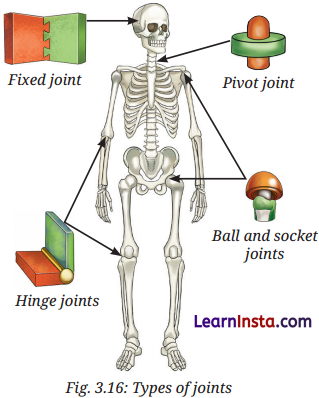
Describe the different types of joints in the human body. Give examples and the type of movement each allows.
Answer:
There are four main types of joints in the human body.
(i) Ball and socket joint:
The rounded top of one bone fits into a hollow of another bone. It allows movement in all directions. Examples: shoulder joint, hip joint.
(ii) Hinge joint:
It allows movement in one direction only, like a door hinge. Examples: elbow and knee. The knee is protected by a small bone called the kneecap.
(iii) Pivot joint:
It allows side-to-side rotational movement. Example: the joint between the skull and the first vertebra allows the head to turn left and right.
(iv) Fixed joint:
It does not allow any movement. Example: joints between the bones of the skull, which protect the brain.
Cell The Building Block of Life Class 9 Case Based Questions
Case I.
In 1958, F. C. Steward demonstrated that even single cells from the phloem of a carrot could regenerate a complete plant. He grew phloem cells in a nutrient medium containing simple sugars and hormones under suitable conditions. The cells divided to form a mass of unspecialised cells, which then differentiated into roots, shoots and eventually a complete carrot plant. This property of mature plant cells to dedifferentiate, divide and redifferentiate into a new plant is called totipotency.
Answer the following questions:
Question 1.
What did F C. Steward demonstrate about plant cells?
Answer:
He demonstrated that even mature, single phloem cells of a carrot can regenerate a complete new plant when grown in a suitable nutrient medium.
Question 2.
What is totipotency?
Answer:
The ability of a mature plant cell to dedifferentiate, divide and redifferentiate to develop into a complete new plant under specific conditions.
Question 3.
What did the phloem cells first form before becoming a complete plant?
Answer:
A mass of unspecialised (undifferentiated) cells, which then differentiated into roots, shoots and eventually a complete plant.
Question 4.
Mention any two commercial applications of this finding.
Answer:
Production of disease-free plants through tissue culture and mass propagation of commercially important crop plants for agriculture.
Case II.
Ravi noticed that during exercise he started breathing faster and his heart was beating rapidly. After some time, his friend tripped and got a small cut on the knee. Red blood oozed out, but after a few minutes a clot formed and the bleeding stopped.
Answer the following questions:
Question 1.
Why does breathing become faster during exercise?
Answer:
Muscles need more oxygen and produce more carbon dioxide. Faster breathing supplies more oxygen and removes excess carbon dioxide.
Question 2.
Which component of blood helps in clotting?
Answer:
Platelets or thrombocytes help in clotting of the blood.
Question 3.
What gives blood its red colour?
Answer:
The blood is red in colour due to haemoglobin, an iron-rich protein present in Red Blood Cells (RBCs).
Case III.
A gardener observed that after pruning the top of a hedge, the hedge grew back bushier than before. He also noticed that grass on the lawn, which was regularly mowed, kept regrowing. However, when he accidentally removed the roots of a plant, it did not grow back.
Answer the following questions:
Question 1.
Why does the hedge grow back bushier after pruning?
Answer:
After the top is cut, new branches arise from the nodes of the stem due to the activity of intercalary meristem present at or near the nodes. This gives the hedge a bushy appearance.
Question 2.
How does grass regrow after being mowed?
Answer:
Grass has intercalary meristem at the nodes of its stem. Even after the top portion is mowed, the intercalary meristem continues to divide and produces new grass plants.
Question 3.
Why did the plant not grow back after its roots were removed?
Answer:
Roots are essential for absorbing water and minerals from the soil. They give anchorage to the plant. Without roots, the plant cannot survive. With the removal of the roots, apical meristem is also completely removed, so further plant growth is not possible.
Question 4.
Which type of meristematic tissue is responsible for the regrowth in the hedge and grass?
Answer:
Intercalary meristem.
Tissues in Action Extra Questions for Practice
Very Short Answer Type Questions
Question 1.
What is the function of root hair?
Question 2.
Name the tissue responsible for transporting water in plants.
Question 3.
What type of muscle is spindle-shaped with a single nucleus?
Question 4.
Which part of a neuron transmits signals to other cells?
Question 5.
Name the joint that allows the head to move side to side.
Question 6.
What is the function ofplatelets in blood?
Question 7.
Name the tissue that forms the bark of a tree.
Question 8
What type of joint is found in the elbow?
Question 9.
What is the other term given to breast bone?
Question 10.
Which meristematic tissue causes increase in stem girth?
Short Answer Type Questions
Question 1.
Explain the role of the epidermis in plants.
Question 2.
What is the difference between simple and complex permanent tissues? Give examples.
Question 3.
Describe the structure and function of cardiac muscle.
Question 4.
Explain why bones are hard but cartilage is flexible.
Question 5.
How does transpiration help in the transport of water in plants?
Question 6.
Differentiate between voluntary and involuntary movements. Give examples.
Question 7.
What is totipotency? Give an example.
Long Answer Type Questions
Question 1.
Describe the different types of connective tissues found in the human body. Give their structure, function and location.
Question 2.
Explain the structure and functions of xylem and phloem. How do they differ from each other?
Question 3.
Describe the skeletal system of the human body. Explain the role of the rib cage.
Question 4.
Explain the three types of plant tissue systems with their components and functions.
Question 5.
How do epithelial tissues in animals differ in structure and function based on their location in the body? Describe at least four types.
Question 6.
Describe how the musculoskeletal system helps in the movements which works under the control of the nervous system.
Question 7.
(a) How do meristematic tissues give rise to permanent tissues?
(b) Explain briefly complex permanent tissues.