Students rely on Class 9 Science Extra Questions and Class 9th Exploration Chapter 4 Extra Question Answer Describing Motion Around Us to improve their grades.
Class 9 Science Chapter 4 Describing Motion Around Us Extra Questions
Class 9 Science Chapter 4 Extra Questions on Describing Motion Around Us
Describing Motion Around Us Class 9 Very Short Question Answer
Question 1.
Can a body have a constant speed but continuously changing velocity?
Answer:
Yes, in case of circular motion.
Question 2.
Give an example of a body moving with a uniform speed but variable velocity.
Answer:
Revolution of the earth around the Sun.
Question 3.
In which condition will the displacement and distance have the same magnitude?
Answer:
When the object has uniform motion.
Question 4.
What is the meaning of a straight rising slope in a distance-time graph?
Answer:
This represents a uniform motion.
Question 5.
A velocity-time graph shows a straight line, parallel to x-axis. What does it mean regarding acceleration?
Answer:
This shows that there is no change in the rate of velocity i.e., acceleration is zero.

Question 6.
Express the relationship between the distance (s) and time (t) for a body moving with uniform velocity (v).
Answer:
s = vt
Question 7.
What does the slope of a position-time graph represent?
Answer:
The slope of a position-time graph represents the magnitude of average velocity of the object. A steeper slope means higher velocity. A horizontal slope (zero slope) means the object is at rest. A straight line slope means constant velocity.
Question 8.
When is average velocity zero?
Answer:
Average velocity is zero when the displacement of the object is zero, that is, when the object returns to its starting position. For example, an object that goes from A to B and comes back to A has zero displacement and therefore zero average velocity, even though it has moved and has a non-zero average speed.
Question 9.
What is uniform motion?
Answer:
Uniform motion is the motion in which an object covers equal distances in equal time intervals, for all possible choices of time intervals. In uniform motion, the speed (and for straight-line motion, the velocity) of the object is constant. The object has zero acceleration in uniform motion.
Question 10.
What is the displacement of a stone tied to a string and whirled in a horizontal circle after one complete revolution?
Answer:
The displacement is zero. After one complete revolution, the stone returns to its exact starting position. Since displacement is the net change in position (final position – initial position), and both are the same point, the displacement = 0. However, the distance travelled is equal to the circumference of the circle = 2πR.
Question 11.
Can an object have zero velocity but non¬zero acceleration? Give an example.
Answer:
Yes. When a ball is thrown vertically upward, at the highest point its velocity is momentarily zero (it has stopped going up and is about to start coming down). However, the acceleration due to gravity (9.8 ms-2 downward) is still acting on it. So at that instant, velocity = 0 but acceleration = 9.8 ms-2 downward. This is a perfect example of zero velocity with non-zero acceleration.
Question 12.
Write the formula for average speed of an object in uniform circular motion.
Answer:
In uniform circular motion, if the object takes time T to complete one revolution in a circle of radius
Average speed = \(\frac{\text { circumference }}{\text { time period }}\)
= \(\frac{2 \pi R}{T}\)
Since the object returns to its starting point after one revolution, the displacement = 0,
and therefore average velocity = 0,
while average speed = \(\frac{2 \pi R}{T}\) (non-zero).
Describing Motion Around Us Class 9 Short Question Answer
Question 1.
Distinguish between distance and displacement with an example.
Answer:
- Distance is the total length of the actual path covered by an object. It is always positive and is a scalar quantity.
- Displacement is the net change in position of an object between two points in time. It is a vector quantity and can be positive, negative, or zero.
Example:
An athlete runs 100 m from O to A, then turns and runs 60 m back to reach point B (which is 40 m from O). Distance = 100 + 60 = 160 m. Displacement = OB = 40 m (in the direction from O to A). The magnitude of displacement (40 m) is less than the total distance (160 m).
Question 2.
How is velocity different from speed? Under what conditions are they equal in magnitude?
Answer:
Speed is the rate at which distance is covered (total distance divided by time). It is a scalar quantity. Velocity is the rate of change of position (displacement divided by time). It is a vector quantity. Speed is always positive or zero; velocity can be positive, negative, or zero. The magnitude of average velocity equals average speed only when the object moves in one direction throughout the time interval without turning back. In that case, distance = magnitude of displacement, so both give the same value.
Question 3.
What is the difference between uniform and non-uniform motion? How can you identify them from a position-time graph?
Answer:
In uniform motion, the object covers equal distances in equal time intervals. Its speed is constant and its position-time graph is a straight line (inclined to the time axis). In non-uniform motion, the object covers unequal distances in equal time intervals. Its speed keeps changing and its position-time graph is a curved line. A straight line on the position-time graph = uniform motion. A curve (getting steeper or flatter) = non-uniform motion.
Question 4.
A bus starts from rest and attains a velocity of 54 kmh-1 in 15 seconds. Find its acceleration.
Answer:
Given:
Initial velocity u = 0 ms-1 (starts from rest),
final velocity v = 54 kmh-1
= \(\frac{54 \times 1000}{3600}\) = 15 ms-1,
time t = 15 s. 3600
(∵ 1 km = 1000 m and 1 h = 60 × 60 second)
Using the formula
a = \(\frac{v-u}{t}\)
= \(\frac{15-0}{15}\) = 1 ms-2.
The bus has a uniform acceleration of 1 ms-2.
Question 5.
A car starts from rest and accelerates uniformly at 2 ms-2 for 10 seconds. Find the final velocity and the distance covered.
Answer:
Given:
u = 0 ms-1,
a = 2 ms-2,
t = 10 s.
For final velocity, using
v = u + at
⇒ v = 0 + 2 × 10 = 20 ms-1.
For distance covered, using
s = ut + ½ at2
s = 0 × 10 + ½ × 2 × (102)
= 0 + 1 × 100 = 100 m.
Final velocity = 20 ms-1 and
distance covered = 100 m.
Question 6.
A train moving at 30 ms-1 applies brakes and decelerates at 5 ms-1squared. How long does it take to stop, and what distance does it cover before stopping?
Answer:
Given:
u = 30 ms-1,
v = 0 ms-1 (stops),
a = – 5 ms-2 (negative because it is decelerating).
For time:
using v = u + at
⇒ 0 = 30 + (- 5) × t.
⇒ 5t = 30
⇒ t = 6 seconds.
For distance:
using v2 = u2 + 2as
⇒ 0 = (302) + 2 × (- 5) × 5
⇒ 0 = 900 – 10 s
⇒ 10 s = 900
⇒ s = 90 m.
The train takes 6 seconds to stop and covers 90 m before stopping.
Question 7.
A scooter acquires a velocity of 36 kmh-1 in 10 s after the start. Assuming uniform acceleration, calculate:
(i) the acceleration in ms-2,
(ii) the distance covered in this time, and
(iii) the velocity at the end of 5 s.
Answer:
Given:
u = 0 ms-1 (starts from rest),
v = 36 km-1
= 36 × \(\frac{5}{18}\) = 10 m-1,
t = 10 s.
(i) Acceleration a = \(\frac{v-u}{t}\)
= \(\frac{10-0}{10}\) = 1 ms-2
(ii) Distance s = ut + ½ at2
= 0 + ½ × 1 × (102) = 50 m.
(iii) Velocity at t = 5 s:
v = u + at
= 0 + 1 × 5 = 5 ms-1.
Question 8.
A train X’ travels a distance of 150 km in 3 hours. Another train ‘Y’ travels a distance of 160 km in 4 hours. According to you, which train travels faster?
Answer:
We know that,
Distance travelled Speed = \(\frac{\text { Distance travelled }}{\text { Time taken }}\)
Given that, Distance travelled by train ‘X’ = 150 km
Time taken by train ‘X’ = 3 h
Speed of train ‘X’ = \(\frac{150 \mathrm{~km}}{3 \mathrm{~h}}\) = 50 kmh-1 …………..(1)
Again, Speed = \(\frac{\text { Distance travelled }}{\text { Time taken }}\)
Given that, Distance travelled by train ‘Y’ = 160 km
Time taken by train ‘Y’ = 4 h
Speed of train ‘Y’= \(\frac{160 \mathrm{~km}}{4 \mathrm{~h}}\) = 40 kmh-1………….(2)
It is clear that the train ‘X’ travels a distance of 50 kilometres in one hour whereas the train ‘ Y’ travels a distance of 40 kilometres in one hour.
Since, the speed of train ‘X’ is higher, therefore, train ‘X’ has travelled faster.
Question 9.
A car starting from rest moves with a uniform acceleration of 0.2 ms-2 for 3 minutes. Find:
(i) the speed acquired,
(ii) the distance travelled.
Answer:
(i) Given that, Initial speed (u) = 0 ms-1;
Acceleration of car (a) = 0.2 ms-2
Time taken (t) = 3 min = 3 × 60 = 180 s;
Final velocity = ?;
Distance covered (s) = ?
We know that, v = u + at
= 0 + 0.2 × 180 = 36 ms-1
(ii) Now from the second equation of motion,
s = ut + ½ at2
= 0 + \(\frac{0.2 \times(180)^2}{2}\)
= \(\frac{0.2 \times 32400}{2}\) = 3240 m
Question 10.
A cricket ball is thrown upwards with a velocity of 60 m s-1 (g = – 10 m s-2). Calculate:
(a) the time taken by the ball to reach the maximum height,
(b) the maximum height reached by the ball.
Answer:
Given that initial velocity u = 60 m s-1 ;
Final velocity, v = 0 (At maximum height, the v becomes zero);
a = g = – 10 ms-2
Using 1st eQuestion of motion,
v = u + at
⇒ 0 = 60 – 10 × t
⇒ t = 6 s
(a) Time taken by the ball is 6 s.
(b) The maximum height reached by the ball, using the IInd eQuestion of motion,
h = ut + ½ gt2 (∵ s = h and a = g)
= 60 × 6 + ½ (- 10) × 6 × 6
= 360 – 180 = 180 m
Question 11.
Explain what information can be obtained from a velocity-time graph.
Answer:
Two important pieces of information can be obtained from a velocity-time graph. First, the slope of the straight line gives the acceleration of the object. If the slope is positive (line going up), the object has positive acceleration (speeding up). If the slope is negative (line going down), the object is decelerating. If the slope is zero (horizontal line), acceleration is zero (constant velocity).
Second, the area enclosed between the velocity-time line and the time axis gives the displacement of the object in that time interval. For a rectangle (constant velocity), area = velocity × time = displacement. For a triangle or trapezium (changing velocity), the area is calculated accordingly.
Question 12.
Explain why uniform circular motion is considered an example of accelerated motion even though the speed remains constant.
Answer:
Acceleration is defined as the rate of change of velocity. Velocity is a vector quantity, meaning it has both magnitude (speed) and direction. In uniform circular motion, although the speed (magnitude of velocity) remains constant at every point, the Direction of velocity keeps changing continuously (it is always tangential to the circle at the point where the object is). Since the direction of velocity changes, the velocity as a vector changes. And since velocity changes, by definition, the object is accelerating. This acceleration (called centripetal acceleration) is always directed towards the centre of the circular path. So uniform circular motion is accelerated motion due to change in direction alone.
Describing Motion Around Us Class 9 Long Question Answer
Question 1.
A train travels on a 120 km track. It covers first 30 km, at a uniform speed of 60 km/h. How fast must the train travel the next 90 km so as to make average 60 km/h for the entire journey?
Answer:
In this question we have been given the total distance travelled by the train (which is 120 km), and the average speed of the train for the whole journey (which is 60 km/h). From these two values we can calculate the total time taken by the train for the entire journey.
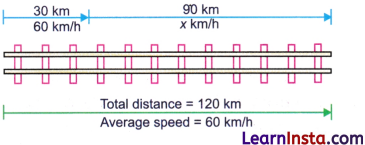
Average speed = \(\frac{\text { Total distance travelled }}{\text { Total time taken }}\)
So, 60 = \(\frac{120}{\text { Total time taken }}\)
Total time taken = \(\frac{1}{2}\) = 2 hours
We will now calculate the time taken by the train for the first 30 km journey, and the next 90 km journey, separately.
(i) For the first part of the train journey, we have:
Speed = 60 km/h;
Distance = 30 km;
Time = ? (To be calculated)
Time taken = \(\frac{\text { Distance travelled }}{\text { Speed }}\)
= \(\frac{30}{60}\)
= \(\frac{1}{2}\) hour
(ii) For the second part of the train journey, let us suppose that the speed of the train is x km/h.
So, Speed = x kmh-1 (Supposed);
Distance = 90 km;
Time = ? (To be calculated)
Now, Speed = \(\frac{\text { Distance travelled }}{\text { Time taken }}\)
So, x = \(\frac{90}{\text { Time taken }}\)
Time taken = \(\frac{90}{x}\) hours
We know that total time taken by the train = Time taken in first journey + Time taken in second journey
Therefore, Total time taken = \(\frac{1}{2}\) + \(\frac{90}{x}\) hours
We already know that the total time taken for the entire journey is 2 hours.
So, we get
\(\frac{1}{2}\) + \(\frac{90}{x}\) = 2
⇒ \(\frac{x+180}{2 x}\) = 2
⇒ x + 180 = 4x
⇒ 3x = 180
⇒ x = 60 kmh-1
Thus, the train should travel the next 90 km distance at a speed of 60 kmh-1.
Question 2.
A car is moving on a straight road with uniform acceleration. The following table gives the speed of car at various instants of time.

Draw the speed-time graph by using convenient scale. Calculate:
(i) the acceleration of car;
(ii) the distance travelled by the car in 15 seconds.
Answer:
For graph of the table:
Let 1 cm = 3 sec on x-axis;
Let 1 cm = 5 m s-1 on y-axis
Plot time values and corresponding values of speed and obtained in Fig.
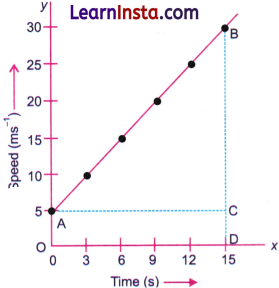
From the graph:
(i) Acceleration means slope of speed-time graph in triangle ABC,
Slope = \(\frac{\text { Perpendicular }}{\text { Base }}\), which is
a = \(\frac{BC}{AC}\)
= \(\frac{30-5}{15-0}\)
= \(\frac{25}{15}\) = 1.67 ms-2
Now, acceleration a = \(\frac{v-u}{t_2-t_1}\)
= \(\frac{30-5}{15-0}\)
= \(\frac{25}{15}\) = 1.67 ms-2
(ii) Distance travelled by the car,
s = Area of trapezium AODCB
= Area of rectangle AODC + Area of triangle ABC
= AO × OD + ½ (AC × BC)
= 5 × 15 + ½ (15 × 25)
= 75 + 187.5 = 262.5 m.
Question 3.
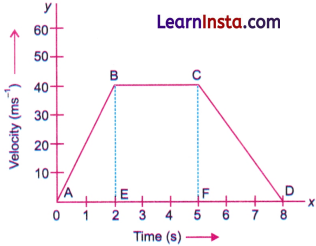
The velocity-time graph for a bus is shown in Fig. Using this graph and find:
(i) Acceleration during first two seconds and last three seconds,
(ii) Acceleration of the bus between second and fifth seconds,
(iii) The total distance travelled by the bus.
Answer:
(i) In the first two seconds: The bus moves A to B in straight line with uniform acceleration
From AB part of the graph:
At A, t1 = 0, u = 0
At B, t2 = 2 s, v = 40 ms-1
Using a = \(\frac{v-u}{t_2-t_1}\)
= \(\frac{40-0}{2-0}\)
= 20 ms-2
In the last three seconds:
In this time interval, the bus moves from 40 ms-1 (point C) to 0 ms-1 (point D).
At C, t1 = 5 sec, u = 40ms-1
At D, t2 = 8 sec, v = 0 ms-1
Now using a = \(\frac{v-u}{t_2-t_1}\)
= \(\frac{0-40}{8-5}\)
= \(-\frac{40}{3}\) ms-2
= – 13.33 ms-2
The negative sign shows that the bus is under retardation in the last three seconds.
(ii) During BC, graph is a straight line parallel to the time axis. Hence, motion is uniform, so acceleration is equal to zero.
(iii) Total distance travelled,
s = Total area under the velocity – time graph
= Area of triangle ABE + Area of rectangle BCFE + Area of triangle CFD
= (½ × AE × BE) + (BE × BC) + (½ × FD × FC)
= (½ × 2 × 40) + (40 × 3) + (½ × 3 × 40)
= 40 + 120 + 60 = 220 m.
Question 4.
Derive the three kinematic equations for uniformly accelerated motion from a velocity-time graph.
Answer:
1. First equation for velocity-time relation
The first equation of motion is v = u + at
From this graph, it is clear that initial velocity of the object is u (at point A).
Velocity increases to final velocity v (at point B) in time t.
The rate of change of velocity is uniform (straight line) i.e., uniform acceleration a.
Draw two perpendicular lines BC and BE on the time axis (x-axis) and the velocity axis (y-axis) respectively. Also draw AD parallel to OC.
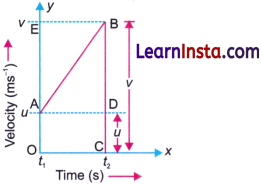
As a result, initial velocity u is represented by OA, the final velocity v is represented by BC and the time interval t is represented by OC.
BD = BC – CD, represents the change in velocity in time interval t.
In the velocity-time graph the straight line represents the acceleration. Its magnitude is equal to change in velocity per unit of time, i.e.,
a = \(\frac{\text { Change in velocity }}{\text { Time interval }}\)
= \(\frac{BD}{AD}\)
= \(\frac{BC-CD}{AD}\)
Since, BC = v,
CD = OA = u
and AD = OC = t
Therefore,
a = \(\frac{v-u}{t}\)
⇒ v – u = at
⇒ v = u + at ………………(1)
2. Second equation for position-time relation
The second equation of motion is s = ut + ½ at2.
With a uniform acceleration, the object covers distance 5 in time t.
The area under velocity-time graph gives the distance moved by the object.
Consider the velocity-time graph as shown in above Fig.
The distance travelled by the object (as in the graph) can be determined by the area enclosed within OABC.
Distance travelled,
s = Area OABC(which is a trapezium)
= Area of the rectangle OADC + Area of the triangle ABD
= OA × OC + ½ (AD × BD)
Since, OA = u, OC = AD = t
Acceleration, a = \(\frac{BD}{AD}=\frac{BD}{OC}\)
Therefore, BD = at
Substituting, s = u × t + ½ × t × a × t
⇒ s = ut + ½ at2 ………….(2)
3. Third equation for position-velocity relation
The third equation of motion is 2as = v2 – u2
Consider the velocity-time graph as shown in figure.
With a uniform acceleration a and velocity change (v – u), the object covers distance s.
The distance travelled by the object (as in the graph) can be determined by the area enclosed within OABC.
s = Area OABC (Which is a trapezium)
Area of trapezium = (Sum of parallel sides) × ½ Height
From the velocity-time graph shown in Fig., we can put the values,
s = (OA + BC) × ½ OC
Substituting, OA = u, BC = v and OC = t (v + u)t
we get, s = \(\frac{(v+u) t}{2}\)
From first velocity-time relation equation (1), v-u
t = \(\frac{(v-u) }{a}\)
Putting this value of t in equation (i), we have
s = \(\frac{(v+u) (v-u) }{2 a}\)
We know that, (a + b)(a – b) = a2 – b2, so we have
s = \(\frac{v^2-u^2}{2 a}\)
⇒ 2as = v2 – u2
⇒ v2 = u2 + las
⇒ v2 – u2 = 2as …………………. (3)
Question 5.
What are position-time graphs? Explain what different shapes of position-time graphs tell us about the motion of an object. Include graph descriptions.
Answer:
A position-time graph is a graphical representation of the motion of an object where position is plotted on the y-axis and time is plotted on the x-axis. These graphs help us visualise how position changes with time.
Graph Shape 1: Straight line inclined to the time axis (x-axis).
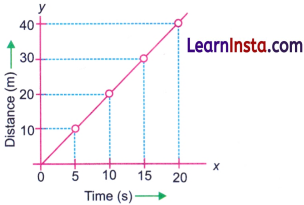
Description:
A straight line starts from the origin (or any point on the y-axis) and goes upward to the right at a constant angle. The object is moving with constant velocity (uniform motion). Equal changes in position happen in equal time intervals.
The slope of this line = velocity. A steeper line = higher velocity. A less steep line = lower velocity.
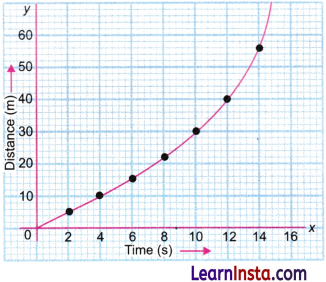
Graph Shape 2: Curved line (parabola-like, getting steeper with time).
Description:
A curve that starts relatively flat and becomes progressively steeper as time increases. The spacing between equal time intervals on the position axis keeps increasing. The velocity is increasing with time, so the object is in accelerated motion (non¬uniform motion). The object covers more and more distance in equal time intervals.
Graph Shape 3: Horizontal straight line (parallel to the x-axis).
Description:
A perfectly horizontal line at a fixed position value, parallel to the time axis. The position of the object is not changing with time, the object is at rest. Velocity = 0 (slope is zero).
Question 6.
Describe uniform circular motion. Give examples. Explain why speed is constant but velocity is not constant in this type of motion. Write the formula for average speed in uniform circular motion.
Answer:
Uniform circular motion is the motion of an object along a circular path with constant (uniform) speed. The object maintains the same magnitude of speed at every point on its circular path, but the direction of its velocity keeps changing.
Examples:
- A satellite orbiting the Earth in a circular orbit at constant speed.
- An athlete running at constant speed along a circular track.
- A stone tied to a thread and whirled in a horizontal circle at constant speed.
- The tip of a clock’s second hand moving at constant speed.
Why speed is constant but velocity is not:
Speed is a scalar quantity (only magnitude). In uniform circular motion, the object covers equal arc lengths (distances) in equal time intervals, so its speed remains constant. Velocity, however, is a vector quantity (both magnitude and direction). At every point on the circle, the direction of motion is along the tangent to the circle at that point. Since the direction of the tangent keeps changing as the object moves around the circle, the direction of velocity keeps changing. Even though the magnitude (speed) stays the same, the direction change means velocity is not constant. Changing velocity means there is acceleration (even with constant speed).
Formula for average speed in uniform circular motion:
If R is the radius of the circular path and T is the time period (time for one complete revolution), then:
distance in one revolution = circumference = 2 πR.
Average speed = 2 πR/T.
Note:
After one complete revolution, displacement = 0 (object returns to start),
so average velocity = 0,
but average speed = 2 πR/T is not zero.
Question 7.
A bus is moving on a long straight highway with velocity of 36 kmhr1. The driver presses the accelerator for 10 s and velocity increases to 54 kmhr1. The bus then moves at constant velocity. Then the driver notices an obstacle and presses the brake. The bus stops in a time interval of 5 s. Find:
(i) acceleration when accelerator was pressed,
(ii) acceleration when brakes were applied,
(iii) distance covered while accelerating,
(iv) distance covered while braking.
Answer:
Here,
36 kmh-1 = 36 × \(\frac{1000}{3600}\) = 10 ms-1 and
54 kmh-1 = 54 × \(\frac{1000}{3600}\) = 15 ms-1
(i) u = 10 ms-1,
v = 15 ms-1,
t = 10 s.
a = \(\frac{v-u}{t}\)
= \(\frac{15-10}{10}\)
= \(\frac{5}{10}\)
= 0.5 ms-2
The acceleration acts in the direction of velocity (forward direction).
(ii) Acceleration when brakes pressed:
u = 15 ms-1,
v = 0 ms-1 (stops),
t = 5 s.
a = \(\frac{0-15}{5}\)
= \(\frac{-15}{5}\) = – 3 ms-2
The negative sign means the acceleration is opposite to velocity (deceleration of 3 ms-2).
(iii) Distance while accelerating:
s = ut + ½ at2
= 10 × 10 + ½ × 0.5 × 100
= 100 + 25 = 125 m.
(iv) Distance while braking:
Using v2 = u2 + 2as
⇒ 0 = (152) + 2 (- 3) 5
⇒ 0 = 225 – 6s
⇒ 6s = 225
⇒ s = 37.5 m.
Question 8.
A ball is thrown vertically upward with an initial velocity of 20 ms-1. Taking g = 10 ms-2 (downward), find:
(i) the time to reach the maximum height,
(ii) the maximum height reached,
(iii) the total time of flight, and
(iv) the velocity when it returns to the starting point.
Answer:
Take upward as positive.
Given:
u = + 20 ms-1,
a = – 10 ms-2 (g acts downward),
v = 0 at highest point.
(i) Time to reach maximum height: using v = u + at:
⇒ 0 = 20 + (- 10 ) × t
⇒ 10t = 20
⇒ t = 2 seconds.
(ii) Maximum height:
using v2 = u2 + 2as
⇒ 0 = (202) + 2(- 10) s
⇒ 0 = 400 – 20s
⇒ 20s = 400
⇒ s = 20 m.
Maximum height = 20 m.
(iii) Total time of flight:
By symmetry of motion (same magnitude of acceleration going up and coming down), the time to come back down equals the time to go up = 2s.
Total time of flight = 2 + 2 = 4 seconds.
(iv) Velocity on return:
Using v = u + at for the downward journey: u = 0 (starts from rest at top),
a = – 10 ms-2,
t = 2s.
v= 0 + (- 10) (2) = – 20 ms-1.
The magnitude is 20 ms-1, same as the initial speed, but direction is now downward (negative).
This shows the ball returns with the same speed (20 ms-1) but opposite direction.
Describing Motion Around Us Class 9 Case Based Questions
Case I.
Meera and her family were on a road trip. They started from Delhi and drove to a town 150 km north of Delhi, then turned around and drove 80 km south to reach their final destination, a hill resort. The total journey took 3 hours. At the resort, Meera’s brother explained that the family car had a speedometer that always showed a positive reading, while the GPS navigation showed both speed and direction of travel. Meera noted that at one point during the return drive, the speedometer showed 60 kmh-1 while the GPS showed the car moving south at 60 kmh-1.
Answer the following questions:
Question 1.
What is the total distance covered by the family in this trip?
Answer:
Total distance = 150 km (going north) + 80 km (going south) = 230 km.
Distance is always the total path length covered regardless of direction.
Question 2.
What is the displacement of the family from Delhi to their final destination?
Answer:
Final position =150 km north – 80 km south = 70 km north of Delhi.
Displacement = 70 km in the northward direction from Delhi.
Displacement is the net change in position from start to end.
Question 3.
Find the average speed and average velocity for the entire trip.
Answer:
Average speed = \(\frac{\text { Total distance }}{\text { Total time }}\)
= \(\frac{230 \mathrm{~km}}{3 \mathrm{~h}}\)
= 76.67 kmh-1 approximately.
Average velocity = \(\frac{\text { Displacement }}{\text { Total time }}\)
= 70 km (north) / 3h
= 23.33 kmh-1 in the northward direction.
Question 4.
The speedometer shows 60 kmh-1 and the GPS shows 60 kmh-1 south. What is the difference in what these instruments represent?
Answer:
The speedometer shows the magnitude of instantaneous velocity (the speed), which is a scalar quantity. It only gives the how fast value (60 kmh-1). The GPS shows the velocity, which is a vector quantity with both magnitude (60 kmh-1) and direction (south). Speed has no direction while velocity does. When the reading is 60 kmh-1 south, the speed is 60 kmh-1 but velocity is 60 kmh-1 in the southward direction.
Case II.
Arjun was studying the motion of a toy car on a straight horizontal track. He recorded the position of the toy car at regular time intervals and plotted a position-time graph. For the first 4 seconds,
the graph was a straight line going upward. From 4 s to 6 s, the line was horizontal (flat). From 6 s to 10 s, the line went upward again but much more steeply than the first part. His teacher asked him to analyse the graph and answer questions about it. From the graph, Arjun found: at t = 0, position = 0 m; at t = 4 s, position = 20 m; at t = 6 s, position = 20 m; at t = 10 s, position – 60 m.
Answer the following questions:
Question 1.
What was the nature of motion of the toy car during 0 to 4 s?
Answer:
During 0 to 4 s, the position-time graph is a straight line (inclined upward). This means the car was in uniform motion (constant velocity). It covered equal distances in equal time intervals.
Question 2.
What was the velocity during 0 to 4 s and during 6 to 10 s?
Answer:
Velocity during 0 to 4 s = \(\frac{\text { change in position }}{\text { change in time }}\)
= \(\frac{(20-0) \mathrm{m}}{(4-0) \mathrm{s}}\)
= \(\frac{20}{4}\) = 5 ms-1
Velocity during 6 to 10 s = \(\frac{(60-20) \mathrm{m}}{(10-6) \mathrm{s}}\)
= \(\frac{40}{4}\)= 10 ms-1.
The car was moving twice as fast in the second phase.
Question 3.
What was the car doing between 4 s and 6 s?
Answer:
Between 4 s and 6 s, the position-time graph is a horizontal straight line (parallel to the time axis). This means the position of the car was not changing during this period. The car was at rest between 4 s and 6 s. Its velocity was zero during this interval.
Question 4.
What was the total distance covered and the displacement from t = 0 to t = 10 s?
Answer:
Total distance = distance in 0 to 4 s + distance in 4 s to 6 s + distance in 6 s to 10 s
= 20 m + 0 m + 40 m = 60 m.
Displacement = final position – initial position
= 60 m – 0 m = 60 m in the positive direction.
In this case, both are equal (60 m) because the car always moved in the same (positive) direction and never turned back.
Case III.
Riya is participating in a science fair project about road safety. She reads that when brakes are applied to a moving vehicle, the vehicle does not stop instantly but travels a distance before stopping. This distance is called the stopping distance or braking distance. She learns that the stopping distance depends on the initial speed of the vehicle and the braking deceleration (negative acceleration) caused by the brakes. She calculates that a car moving at 54 kmh-1(15 ms-1) with a braking deceleration of 3 ms-2 takes a certain distance to stop. She also calculates the stopping distance for the same car moving at 108 kmh-1 (30 ms-1) with the same brakes.
Answer the following questions:
Question 1.
Calculate the stopping distance when the car is moving at 54 kmh-1 (15 ms-1).
Answer:
Given:
u = 15 ms-1,
v = 0 ms-1 (stops),
a = – 3 ms-2.
Using v2 = u2 + 2as:
⇒ 0 = (152) + 2 × (- 3) × s
⇒ 0 = 225 – 6s
⇒ 6s = 225
⇒ s = 37.5 m.
The car needs 37.5 m to stop from 54 kmh-1.
Question 2.
Calculate the stopping distance when the car is moving at 108 kmh-1 (30 ms-1).
Answer:
Given: u = 30 ms-1,
v = 0 ms-1,
a = – 3 m-2.
Using v2 = u2 + 2as:
0 = 302 + 2 × (-3) × s.
⇒ 0 = 900 – 6s.
⇒ 6s = 900
⇒ s = 150 m.
The car needs 150 m to stop from 108 kmh-1.
Question 3.
By what factor does the stopping distance increase when speed is doubled?
Answer:
At 54 kmh-1: stopping distance = 37.5 m.
At 108 kmh-1 (double the speed): stopping distance 150 = 150 m.
Factor = \(\frac{150}{37.5}\) = 4.
The stopping distance increases by a factor of 4 when speed is doubled.
This is because stopping distance is proportional to √u (from the formula s = √u divided by 2 times deceleration).
When u doubles, u2 becomes 4 times larger.
Question 4.
What is the road safety lesson from this calculation?
Answer:
The road safety lesson is extremely important: doubling your speed quadruples your braking distance. Driving at high speeds is far more dangerous than it may seem because the stopping distance increases as the square of the speed. This is why speed limits exist on roads, and why maintaining a large safe distance from the vehicle ahead is essential at high speeds. Even a small increase in speed can dramatically increase the distance needed to stop in an emergency.
Describing Motion Around Us Extra Questions for Practice
Very Short Answer Type Questions
Question 1.
During an experiment, a signal from a spaceship reached the ground station in five minutes. What was the distance of the spaceship from the ground station? The signal travels at the speed of light, that is, 3 × 10⁸ ms-1
Question 2.
A 200 m long train crosses a 400 m bridge with a velocity of 54 kmh-1. Calculate the time taken by the train to cross the bridge.
Question 3.
What can you say about the motion of an object if its speed-time graph is a straight line parallel to the time axis?
Question 4.
What does the slope of a velocity-time graph represent?
Question 5.
Give one example each of uniform and non-uniform motion.
Question 6.
What is the quantity which measured by the area occupied below the velocity-time graph?
Short Answer Type Questions
Question 1.
A scooter starts from rest and attains a velocity of 20 ms-1 in 10 seconds. Calculate its acceleration and distance covered.
Question 2.
Explain why average velocity can be zero even when an object has been moving. Give an example.
Question 3.
A cyclist rides 400 m around a circular track of radius 100 m. What is the distance and displacement covered when she has completed one full lap?
Question 4.
The velocity-time graph for two objects A and B are straight lines. Object A s line is steeper. Which object has greater acceleration? Explain.
Question 5.
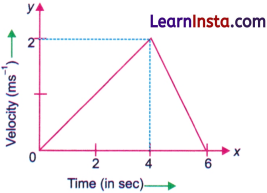
The velocity-time graph of a particle moving along a straight line is shown in Fig. (a) Is the motion uniform? (b) Find the distances covered from 0 to 4s and from 4 to 6s.
Question 6.
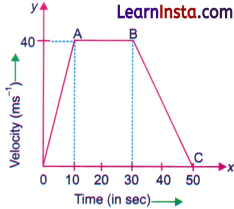
Study the velocity-time graph of a car and answer the following questions:
(i) What is the acceleration of the car from O to A?
(ii) What is the acceleration of the car from A to B?
(iii) What is the retardation of the car from B to C?
Long Answer Type Questions
Question 1.
A ball is droppedfrom the top of a building 80 m high. Taking g -10 ms 2 and starting from rest:
(i) find the velocity when it hits the ground,
(ii) find the time taken to reach the ground, and
(iii) draw a rough velocity-time graph for this motion (describe the shape and key values).
Question 2.
Explain the difference between uniform and non-uniform motion with examples. How can you determine the nature of motion from: (a) a position-time graph and (b) a velocity-time graph?
Question 3.
Derive the kinematic equation v2 = u2 + 2as from a velocity-time graph. Also explain what physical quantity is represented by the slope and the area of the velocity-time graph.
Case/ Source Based Questions
I. Rahul went for a morning jog. He started from his home (point O), jogged 400 m east to a park (point A), rested for 5 minutes, then jogged 300 m south to a foun-tain (point B). Then he jogged directly back home along the shortest possible path. The total time for the entire trip (excluding rest) was 30 minutes (1800 seconds).
Answer the following questions:
Question 1.
Calculate the total distance Rahul covered (excluding the rest).
Question 2.
Calculate the displacement from O to B (give magnitude and direction).
Question 3.
Find the average speed (in ms1) for the jogging portion.
Question 4.
If Rahul jogged back home directly in 10 minutes, and his speed was constant, what was his speed on the return journey?
II. A physics teacher demonstrated motion graphs to her class. She showed three velocity-time graphs.
Graph 1: A horizontal straight line at v = 10 ms-1 from t = 0 to t = 5 s.
Graph 2: A straight line starting from v = 0 at t = 0 and reaching v = 20 ms-1 at t = 10 s.
Graph 3: A straight line starting from v = 15 ms-1 at t = 0 and reaching v = 0 ms-1 at t = 5 s.
Answer the following questions:
Question 1.
What type of motion does each graph represent?
Question 2.
Calculate the acceleration for Graph 2 and Graph 3.
Question 3.
Calculate the displacement for Graph 1 (using area method).
Question 4.
Find the displacement for Graph 2 (using area of a triangle method).