These Class 6 Science Curiosity Worksheet and Class 6 Science Chapter 4 Exploring Magnets Worksheet with Answers are excellent for board exam practice.
Class 6 Science Chapter 4 Exploring Magnets Worksheet
Class 6 Exploring Magnets Worksheet
Worksheet On Exploring Magnets Class 6 – Exploring Magnets Worksheet Class 6
A. Objective Type Questions
Multiple Choice Questions
Question 1.
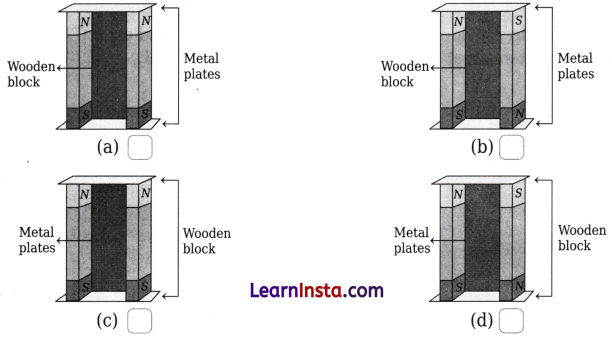
The arrangement to store two magnets is shown in figures (a), (b), (c) and (d).Which one of them is the correct arrangement?
Answer:
(b)

Question 2.
Three magnets A, B and C, were dipped one by one in a heap of iron filing. Figure shows the amount of iron filing sticking to them.

The strength of these magnets will be
(a) A > B > C
(b) A < B < C
(c) A = B = C
(d) A < B > C
Answer:
(a) A > B > C

Question 3.
When a magnet is suspended freely, it always aligns itself in
(a) north
(b) N-S
(c) N-W
(d) N-E
Answer:
(a) north
Question 4.
The North end of the freely suspended magnet points towards
(a) geographical North
(b) geographical South
(c) geographical East
(d) geographical West
Answer:
(a) geographical North
Question 5.
In which of the following a permanent magnet is not used?
(a) Magnetic door catchers
(b) Loudspeakers
(c) Compass
(d) Electric iron
Answer:
(d) Electric iron
Question 6.
Magnets lose their properties significantly if
(a) left in open
(b) touched with hot iron
(c) dropped from a height repeatedly
(d) None of these
Answer:
(a) left in open
Question 7.
A bar magnet is immersed in a heap of iron filings and pulled out. The amount of iron filing clinging to the
(a) North pole is almost equal to the South pole
(b) North pole is much more than the South pole
(c) North pole is much less than the South pole
(d) Magnet will be the same all along its length
Answer:
(b) North pole is much more than the South pole
Question 8.
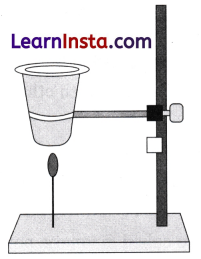
A paper clip hanging in air; the possible reason could be
(a) black magic
(b) there is a magnet in the paper cup
(c) there is water in the cup
(d) the water in the cup is hot
Answer:
(b) there is a magnet in the paper cup
Question 9.
Attraction is seen between the poles of two bar magnets in the case of
(a) N-pole of one magnet with N-pole of other
(b) N-pole of one magnet with S-pole of other
(c) S-pole of one magnet with S-pole of other
(d) All of these cases will show attraction
Answer:
(b) N-pole of one magnet with S-pole of other
Question 10.
How many North and South poles are present in a magnet, if it is broken into 6 pieces without loss of magnetism?
(a) Six
(b) Twelve
(c) Two
(d) Zero
Answer:
(a) Six
Question 11.
Which of the following cannot be used to make a magnet?
(a) Cobalt
(b) Iron
(c) Ebonite
(d) Steel
Answer:
(c) Ebonite
Question 12.
Observe pictures A and B, given in figure, carefully.
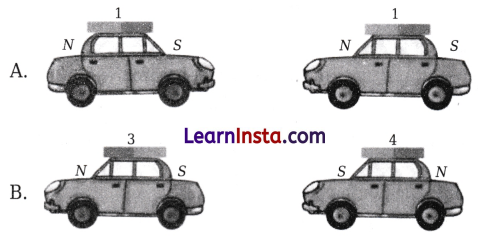
Which of the following statement is correct for the above given pictures?
(a) In A, cars 1 and 2 will come closer, and in B, cars 3 and 4 will come closer.
(b) In A, cars 1 and 2 will move away from each other, and in B, cars 3 and 4 will move away.
(c) In A, cars 1 and 2 will move away, and in B, 3 and 4 will come closer to each other.
(d) In A, cars 1 and 2 will come closer to each other and in B, 3 and 4 will move away from each other.
Answer:
(a) In A, cars 1 and 2 will come closer, and in B, cars 3 and 4 will come closer.
Question 13.
In ancient time rocks containing magnets are called
(a) magnet
(b) magnetite
(c) iron
(d) freeze
Answer:
(b) magnetite
Question 14.
Which two ends of a magnet are called magnetic poles?
(a) North pole
(b) South pole
(c) North and South pole
(d) Self-demagnetisation
Answer:
(c) North and South pole
Fill in the Blanks
Choose the correct word from the below box and put it at the appropriate place.
bar magnet, cylindrical magnet, magnetic, two, horse-shoe magnet, magnetic materials, bar magnet
Question 1.
Artificial magnets are made in different shapes such as ____, ____, and ____.
Answer:
bar magnet, cyifridrical magnet, horse-shoe magnet
Question 2.
The materials which are attracted towards a magnet are called _____.
Answer:
magnetic materials
Question 3.
Paper is not a ____ material.
Answer:
magnetic
Question 4.
In olden days, sailors used to find direction by suspending a piece of ____.
Answer:
barmagnet
Question 5.
A magnet always has ____ poles.
Answer:
two
True/False
Vivek is provided with certain statements in the test, he has to write ‘T’ for the correct statement and ‘F’ for incorrect statement in the given space.
Question 1.
Repulsion is a sure test of magnetism.
Answer:
False
Question 2.
It is possible to obtain an isolated north pole of a magnet.
Answer:
False
Question 3.
Copper cannot be magnetised.
Answer:
False
Question 4.
A magnet loses its magnetism when heated strongly and kept it in the east-west direction.
Answer:
True
Question 5.
A compass is used to find direction.
Answer:
True
Question 6.
A wooden material can be magnetised.
Answer:
False
Question 7.
Poles of a bar magnet are located in the middle.
Answer:
False
Question 8.
Two poles of a magnet can be separated from each other.
Answer:
Flase
Question 9.
Each magnet has two magnetic poles.
Answer:
True
Match the Following
Question 1.
Column I shows different positions in which one pole of a magnet is placed near the other. Column II indicates the resulting action between them for each situation. Fill the blanks:

Answer:
Repulsion, S, attraction, S
Question 2.
Match the Column I with Column II.

Answer:
(a) – (iii),
(b) – (iv),
(c) – (ii),
(d) – (i)
Assertion-Reason Questions
In the following questions, two statements are given- one is labelled as Assertion (A) and the other is labelled as Reason (R). Read the statements carefully and choose the correct alternative (A), (B), (C) and (D) as given below.
(A) Both A and R are true and R is correct explanation of A.
(B) Both A and R are true, but R is not the correct explanation of A.
(C) A is true, but R is false.
(D) A is false, but R is true.
Question 1.
Assertion (A) Magnet attracts materials like iron, nickel, cobalt is called magnetic materials.
Reason (R) All magnetic materials have north and south pole.
Answer:
(C) A is true, but R is false.
A is true, but R is false. R can be corrected as Iron, nickel, cobalt are magnetic materials, but they do not have poles.
Question 2.
Assertion (A) Alloy of a magnetic substance is used to make artificial magnets.
Reason (R) Alloy makes strong magnets.
Answer:
(A) Both A and R are true and R is correct explanation of A.
Question 3.
Assertion (A) A freely suspended magnet always aligns in N-S direction.
Reason (R) Opposite pole of two magnets attract each other whereas, similar pole repels one another.
Answer:
(B) Both A and R are true, but R is not the correct explanation of A.
A freely suspended magnet get aligned along N-S direction because Earth also acts as a magnet.
Question 4.
Assertion (A) A magnetic needle is inserted inside a cork and left float in a water bowl can be used to determine direction.
Answer:
(A) Both A and R are true and R is correct explanation of A.
Question 5.
Assertion (A) A magnet can influence another magnet to move, without the physical contact between the two magnets.
Reason (R) Magnetic force is a non-contact force.
Answer:
(A) Both A and R are true and R is correct explanation of A.
Case Based Questions
Case 1
Magnets are pieces of iron or other materials which exhibit the properties of magnetism i.e. the ability to attract other objects that contain iron. Compass needles, fridge magnets and MRI scanners are some common examples of magnets. These days, magnets come in different shapes and forms such as: horseshoe magnet, bar magnet, cylindrical or a ball-ended magnet, needle magnet etc. A great property of a magnet is that it can prove extremely helpful in navigating directions. This is because a freely suspended magnet always points in the North-South direction. This property of magnet is used to make a compass. A magnetic needle is placed inside a box with directions marked on it. It is allowed to rotate freely so that when the compass is kept at the position of rest, the needle points towards the north and south direction.
Question 1.
Study the given statements.
(i) A compass is used to show directions.
(ii) The needle of a compass is magnetic.
(iii) The needle of a compass always indicates the N and the S directions of the earth. Identify the correct statements.
(a) Only (i) and (ii)
(b) Only (ii) and (iii)
(c) Only (i) and (iii)
(d) All of the three
Answer:
(d) All of the three
Question 2.
Which property of magnet is used to make a magnetic compass?
(a) A magnet attracts magnetic materials
(b) Like poles repel
(c) A magnet can induce magnetism
(d) A freely suspended magnet aligns in N-S direction
Answer:
(c) A magnet can induce magnetism
Question 3.
How is a compass useful to us?
(a) In finding the altitude of a place
(b) In finding only the north of a place
(c) In finding all the directions of a place
(d) In making artificial magnets
Answer:
(c) In finding all the directions of a place
Question 4.
Neha is standing in the middle of a cross road with a compass. The red portion of the compass needle is pointing towards her. She wants to go towards the east, then she should turn
(a) right and then go straight
(b) left and then go straight
(c) right and then turn left
(d) left and then turn right
Answer:
(b) left and then go straight
Case 2
Raj suspended a bar magnet on a string as shown in the diagram below. He brought 3 bar-shaped objects P, Q and R towards the bar magnet. He placed the ends (X and Y) of each object, near the north pole of the bar magnet and recorded his observations in the table below.
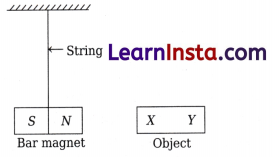
| Objects | End X brought near to N-pole | End Y brought near to N-pole |
| P | N-pole repelled | N-pole attracted |
| Q | N-pole attracted | N-pole repelled |
| R | N-pole remains stationary | N-pole remains stationary |
(i) Which of the following statement is true?
(a) Object P is non-magnetic
(b) Object Q is non-magnetic
(c) Object R is non-magnetic
(d) Object P and R are non-magnetic
Answer:
(c) Object R is non-magnetic
(ii) Which pole is marked as ‘X’ in object P?
(a) North
(b) South
(c) East
(d) West
Answer:
(a) North
(iii) Which pole is marked as ‘Y’ in object P?
(a) North
(b) South
(c) East
(d) West
Answer:
(b) South
(iv) Which pole is marked as ‘X’ in object Q?
(a) North
(b) South
(c) East
(d) West
Answer:
(b) South
(v) Which pole is marked as ‘Y in object Q?
(a) North
(b) South
(c) East
(d) West
Answer:
(b) South
B. Subjective Type Questions
Define the following
Question 1.
Magnetic materials
Question 2.
Non-magnetic materials
Question 3.
North pole
Question 4.
South pole
Question 5.
Magnetic compass
Very Short Answer Type Questions
Question 1.
Pamela and her friends were decorating the class bulletin board. She dropped the box of stainless steel pins by mistake. She tried to collect the pins using a magnet. She could not succeed. What could be the reason for this?
Question 2.
How will you test that ‘tea dust’ is not adulterated
Question 3.
Malli dipped a bar magnet in a heap of iron filings and pulled it out. H found that iron filings got stuck to the magnet as shown in figure.
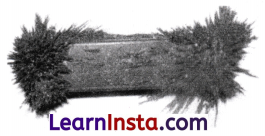
(a) Which regions of the magnet have more iron filings sticking to it?
(b) What are these regions called?
Question 4.
If the Earth is itself a magnet, can you guess the poles of Earth’s magnet by looking at the direction of magnetic compass?
Question 5.
If a horse wears a horse shoe magnet, what will happen to the magnet?
Question 6.
A bar magnet has no markings to indicate its poles. How would you find out near which end its North pole is located without using other magnets?
Question 7.
Which material is used to make a permanent magnet?
Question 8.
If we gently break a bar magnet from its centre, will two poles get free?
Question 9.
What happens when the north pole of a magnet is placed near the North pole of another magnet?
Question 10.
Which magnet is used in an electric bell?
Question 11.
In which direction does a freely suspended magnet align itself?
Question 12.
Why do magnets stick to the refrigerator?
Short Answer Type Questions
Question 1.
What happens when a bar magnet is left to move freely?
Question 2.
Name two magnetic materials other than iron and steel.
Question 3.
What are the precautions to be taken care of handling magnets?
Question 4.
Imagine you want to demonstrate the concept of magnetic poles. How would you do this using two magnets?
Question 5.
Which of the following are stored in pairs: horseshoe magnets or bar magnets?
Question 6.
You are given two rods. Out of these, one is an iron rod and the other one is magnet, how will you identify these rods?
Question 7.
Artificial magnets are made in different shapes. Name these shapes and draw their sketches.
Question 8.
What is the difference between a natural magnet and an artificial magnet?
Question 9.
Identify magnetic and non-magnetic substances from the list given below: Iron, Steel, Nickel, Plastic, Wood, Copper and a Stainless Steel spoon
Question 10.
Write main properties of a magnet.
Question 11.
Write two methods by which a magnet can be demagnetised.
Question 12.
It is advised to keep the magnets away from television, mobiles, CD and computers Explain why?
Question 13.
Few iron nails and screws got mixed with the wooden shavings while a carpenter was working with them. How can you help him in getting the nails and screws back from the scrap without wasting his time in searching with his hands?
Question 14.
It is said that repulsion is a sure test for magnetism. Why is it so?
Question 15.
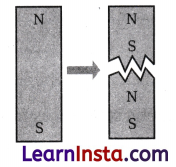
What happens when a magnet is broken into smaller pieces?
Long Answer Type Questions
Question 1.
Reshma bought three identical metal bars from the market. Out of these bars, two were magnets and one was just a piece of iron. How will she identify which two amongst the three could be magnets (without using any other material)?
Question 2.
While a mechanic was repairing a gadget using a screw driver, the steel screws kept falling down. Suggest a way to solve the problem of the mechanic on the basis of what you have learnt in this chapter.
Question 3.
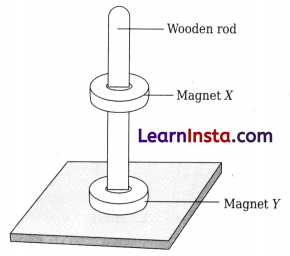
Two ring magnets X and Y are arranged as shown in figure. It is observed that the magnet X does not move down further. What could be the possible reason? Suggest a way to bring the magnet X in contact with magnet Y, without pushing either of the magnets.
Question 4.
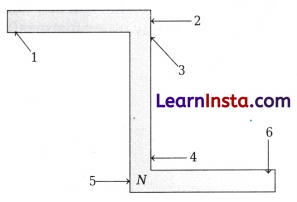
Three magnets are arranged on a table in the form of the shape shown in figure. What is the polarity, N or S, at the ends 1, 2, 3, 4 and 6 of the magnets? Polarity of one end (5) is given for you.
Question 5.
Three identical iron bars are kept on a table. Two out of three bars are magnets. In one of the magnets the north-south poles are marked. How will you find out which of the other two bars are a magnet? Identify the poles of this magnet.
Question 6.
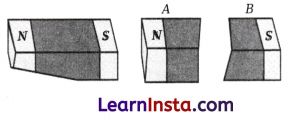
A bar magnet is cut into two pieces A and B, from the middle, as shown in Fig. A Will the two pieces act as individual magnets? Mark the poles of these two pieces. Suggest an activity to verify your answer.
Question 7.
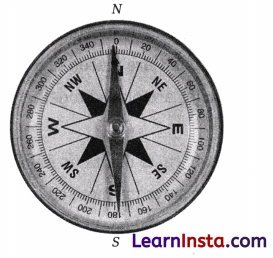
Figure below shows a magnetic compass. What will happen to the position of its needle, if you bring a bar magnet near it? Draw a diagram to show the effect on the needle on bringing the bar magnet near it. Also, draw the diagram.
Skill Based Activities
Question 1.
Complete the crossword with the help of clues provided.
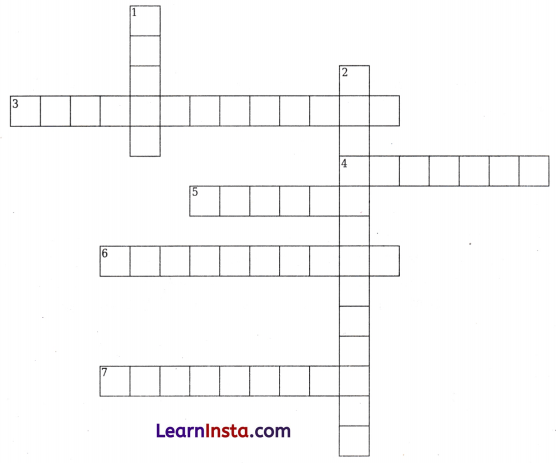
Across
3. A region of magnetic force surrounding a magnet.
4. Its needle is a tiny magnet that moves about a pivot and tells directions.
5. An object that attracts material made of iron, nickel, and cobalt, and their ores.
6. This happens when ‘unlike’ poles are placed together.
7. This happens when ‘like’ poles are placed together.
Down
1. The place on the magnet, where its magnetic field is strongest.
2. An example of a magnet that stays magnetised for a short period of time.
Question 2.
Magnets were believed to have magical healing power. Queen of Greece Cleopetra used to sleep on a block of magnetite. Find out the reason and explain it.
Question 3.
Radhika’s mother was arranging her stitching box. Suddenly, the stitching box slipped from her hand and all the needles in the box got scattered on the ground. How can she collect all the needles without wasting much of her time?
Question 4.
Riddle : I can help you find your way, but I’m not a map. I always point North and that’s a fact! What am I?
Question 5.
Bhawna witnessed an interesting game at the fair. A duck was floating in a tub. When a plate containing some grains of rice was brought close to the duck, the duck moved towards the plate. But, when a plate containing some pebbles was brought close to the duck, it moved away from the plate. Explain how this could have been possible?
Question 6.
The increased use of electricity in modern appliances is causing a continuous shift in the magnetic poles of the earth. Why?
Question 7.
Rahul was trying to hang his steel keys on a wooden board, but they kept falling. His friend suggested using a magnet help him solve this problem?
Question 8.
A toy company from Japan exports magnetic toys to many countries, including India. How does this demonstrate globalization and the use of magnets in daily life?