Students rely on Class 8 Science Extra Questions and Class 8th Curiosity Chapter 5 Exploring Forces Important Extra Question Answer to improve their grades.
Class 8 Science Chapter 5 Exploring Forces Extra Questions
Class 8 Science Chapter 5 Extra Questions on Exploring Forces
Exploring Forces Class 8 Very Short Question Answer
Question 1.
What is the requirement for a force to come into play?
Answer:
Interaction between two objects is required for a force to come into play.
Question 2.
What effect of force is seen when rolling a chapati?
Answer:
The shape of the dough changes.

Question 3.
What is the SI unit of force?
Answer:
The SI unit of force is newton (N).
Question 4.
Give two examples of muscular force.
Answer:
Bending our body and kicking the ball.
Question 5.
What causes friction between two surfaces?
Answer:
Irregularities between the surfaces cause friction.
Question 6.
Does friction acts only in solid?
Answer:
No, friction also acts in liquid and gases.
Question 7.
What are non-contact forces?
Answer:
Forces that act from a distance without physical contact are called non-contact forces.
Question 8.
What happens when two magnetic poles interact?
Answer:
(i) Like poles repel each other.
(ii) Unlike poles attract each other.
Question 9.
What kind of path does a freely falling object take?
Answer:
A straight vertically downward path.
Question 10.
Define mass.
Answer:
Mass is the amount of matter present in an object.
Exploring Forces Class 8 Short Question Answer
Question 1.
You might have noticed that when used for a long time, slippers with rubber soles become slippery. Explain the reason. (NCERT Exemplar)
Answer:
This happens because the surfaces of the slippers wear out due to friction and become smooth, reducing the friction between the sole and the floor.
Question 2.
What is muscular force? Why is it called contact force?
Answer:
Muscular force is the force applied by our muscles. It is called contact force because it acts only when two bodies come in physical contact with each other.
Question 3.
What is the effect of force on the shape of an object?
Answer:
A force can change or try to change the shape of an object. The change may be smaller or large depending on the amount of force applied.
Question 4.
The handle of a cricket bat or a badminton racquet is usually rough. Explain the reason. (NCERT Exemplar)
Answer:
The handle of a cricket bat or a badminton racquet is usually rough to increase the force of friction between handle of the bat or a badminton racquet and hands, to get a better grip.
Question 5.
How does muscular force help in digestion?
Answer:
Muscular force helps in chewing food and pushing it through the alimentary canal during digestion.
Question 6.
What happens to the balloon and the woollen cloth after rubbing them together, and why?
Answer:
When a balloon is rubbed with woollen cloth, both become electrically charged. As they develop opposite charges, they attract each other due to electrostatic force.
Question 7.
How do you calculate the smallest weight that a spring balance can measure?
Answer:
To calculate the smallest measurable weight, subtract the values of two bigger marks on the scale and divide the result by the number of smaller divisions between them.
Exploring Forces Class 8 Long Question Answer
Question 1.
Explain that forces are due to an interaction between objects.
Answer:
Imagine, a man is standing behind a stationary car. The car does not move just because he is not in contact with the car.
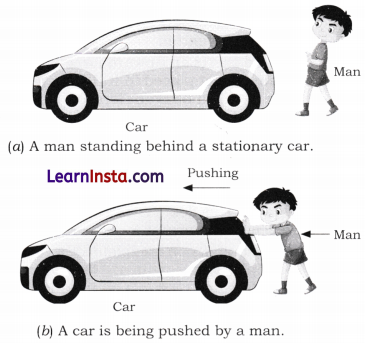
Now, if the man pushes the car, he applies a force on it. The car may begin to move in the direction of the applied force. This shows that force comes into play only when two objects interact with each other. Hence, at least two objects must interact for a force to be exerted.
Question 2.
What do you understand by the force of friction? Why is it called contact force? Give examples of friction in daily life.
Answer:
The force that comes into play when an object moves or tries to move over another surface is called the force of friction and it always acts in the direction opposite to the motion.
Since friction arises due to contact between two surfaces, it is called a contact force.
Examples:
- A ball slows down when rolled on the ground.
- We are able to walk because of friction between our feet and the ground.
- Brakes stop a moving bicycle due to friction.
Question 3.
What is a spring balance? How does it help in measuring weight? Describe its working principle.
Answer:
A spring balance is a device used to measure force or weight. It has a spring fixed at one end and a hook at the other end. When an object is hung from the hook, the spring stretches.
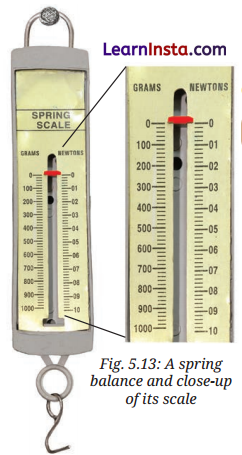
The amount of stretching moves a pointer on a graduated scale, which shows the weight of the object in newton. Some spring balances also show the mass in grams, assuming the measurement is taken on Earth.
Question 4.
Which force helps objects float on water? Explain with an activity and name the principle behind it.
Answer:
A liquid exerts an upward force on any object placed in it. This force is called buoyant force or upthrust. When an empty plastic bottle is pushed into a bucket of water, it experiences an upward force and bounces back to the surface of water.
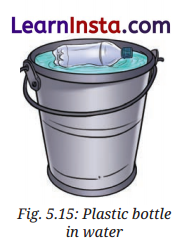
This demonstrates the presence of buoyant force. This phenomenon is explained by Archimedes’ Principle, which states: “An object fully or partially immersed in a liquid experiences an upward force equal to the weight of the liquid it displaces.”
Question 5.
What are non-contact forces? Explain the different non-contact forces.
Answer:
The forces which can be exerted from a distance, without establishing a physical contact between the objects are called non-contact forces. Some non-contact forces are:
(i) Magnetic force: A magnet can attract or repel another magnet or magnetic material like iron without touching it. Since the force acts from a distance, magnetic force is a non-contact force.
(ii) Electrostatic force: The force exerted by a charged body on other charged or uncharged body is called electrostatic force. Electrostatic force also acts without making a direct contact with other charged or uncharged body. So it is also a non-contact force.
(iii) Force of gravity: Earth pulls every object towards itself. The force of attraction exerted by Earth on any object is called force of gravity. This is also a non-contact force as it acts from a distance.
Exploring Forces Class 8 Skill-Based Questions
Question 1.
Observe the following figures. (a) has no cloth on the table while (b) has cloth on it. Now answer the following questions.
(i) In which case the pencil cell covers more distance?
(ii) Give the reason of covering different distances in both cases.

Answer:
(i) In case (a), pencil cell covers more distance than case (b).
(ii) In case (a), there is less friction due to smooth surface, while in case (b), cloth makes the surface rough due to which more frictional force is exerted on the pencil cell.
Question 2.
Observe the following figure and answer the questions:
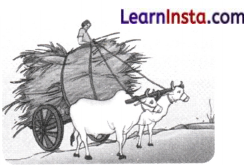
(i) What are the bullocks doing?
(ii) What types of forces are applied by bullocks?
(iii) Is such type of force a contact or noncontact force?
Answer:
(i) The two bullocks are pulling a cart having load.
(ii) The bullocks applied the muscular force.
(iii) This type of force is a contact force because the bullocks are in direct contact with the cart.
Exploring Forces Class 8 Quiz Questions
Question 1.
What does a spring balance measures?
Answer:
The magnitude of the force or weight
Question 2.
In which direction frictional force acts on a moving object?
Answer:
Frictional force acts in opposite direction of a moving object.
Question 3.
Is the friction same for all the surfaces?
Answer:
No, it depends on the roughness/ smoothness of the surfaces.
Question 4.
Why are objects like aeroplanes, ships, boats, or high-speed trains designed with special shapes?
Answer:
To reduce the force of friction from air or water
Question 5.
What is the minimum number of objects needed to apply a force?
Answer:
At least two objects
Question 6.
What do you call the force that is exerted by one object on another through physical contact?
Answer:
Contact force
Question 7.
What is the SI unit of weight?
Answer:
newton (N)
Question 8.
How much is the weight of an object on the Moon compared to its weight on Earth?
Answer:
One-sixth of its weight on Earth
Question 9.
Which principle states that an object fully or partially immersed in a liquid experiences an upward force equal to the weight of the displaced liquid?
Answer:
Archimedes Principle
Question 10.
Name a rock that can float on water.
Answer:
Pumice
Exploring Forces Class 8 Case Based Questions
Question 1.
One day, Rahul noticed that his toy car gradually came to a stop. Anaya explained that this happened because of friction, a force that opposes motion between two surfaces in contact.
Later, both Rahul and Anaya observed how some forces can act without physical contact. They experimented with a magnet attracting iron nails and a charged plastic comb pulling small bits of paper. Anaya told Rahul that these were examples of magnetic and electrostatic forces, which act at a distance. While they were talking, a mango fell from a tree nearby. Anaya pointed to it and said, “That’s the force of gravity-it pulls everything towards the Earth.”
I. Which force made the toy car stop?
II. Why did the mango fall down?
III. Which force pulled the paper to the balloon?
OR
Name the forces which act without contact.
Answer:
I. Friction
II. Due to gravity
III. Electrostatic force
OR
Magnetic force and electrostatic force
Question 2.
Tina and Aryan used a spring balance to weigh a water bottle. Tina said the bottle weighs 5 newton. Aryan asked if its mass would change on the Moon. Tina replied, “No, only its weight changes because gravity is less on the Moon.
I. What instrument did Tina and Aryan use to measure weight?
II. Will the mass of the bottle change on the Moon?
III. Why does the weight change on the Moon?
OR
What is the relation between weight and gravity?
Ans.
I. Spring balance
II. No, mass remains the same everywhere.
III. Because gravity on the Moon is less than on the Earth.
OR
Weight depends on the force of gravity acting on an object’s mass.
Exploring Forces Extra Questions for Practice
Multiple Choice Questions
Question 1.
Friction is more on which type of surface?
(a) Smooth surface
(b) Rough surface
(c) Glass surface
(d) Polished surface
Question 2. Due to which force small paper pieces stick to a balloon after it is rubbed with a woollen cloth?
(a) Friction
(b) Magnetic force
(c) Electrostatic force
(d) Buoyant force
Question 3. Why are objects like aeroplanes, ships, boats, or high-speed trains designed with specific shapes?
(a) To look more attractive
(b) To carry more passengers
(c) To reduce the effect of gravity
(d) To reduce the force of friction caused by air or water
Question 4.
Read the given statements and select the correct option.
Assertion (A): An object floats in water if it displaces an amount of water equal to its own weight.
Reason (R): According to Archimedes’ Principle, a body immersed in a fluid experiences an upward force equal to the weight of the fluid displaced.
(a) Both A and R are true and R is the correct explanation of A .
(b) Both A and R are true but R is not the correct explanation of A .
(c) A is true but R is false.
(d) A is false but R is true.
Question 5.
Match the items in column A with those in column B.
Column A — Column B
(i) Muscular force — (p) Magnet attracting iron nails
(ii) Friction — (q) Charged balloon attracting paper bits
(iii) Magnetic force — (r) Walking on the road
(iv) Electrostatic force — (s) Lifting a school bag with hands
(a) (i)-(q), (ii)-(p), (iii)-(s), (iv)-(r)
(b) (i) -(s), (ii) -(r), (iii)-(p),(iv)-(q)
(c) (i)-(s), (ii)-(q), (iii)-(r), (iv)-(p)
(d) (i)-(r), (ii)-(s), (iii)-(q), (iv) – (p)
Very Short Answer Type Questions
Question 1.
Give an example of a non-contact force.
Question 2.
Name the force due to which every object falls on the Earth.
Question 3.
Is muscular force a type of contact force?
Question 4.
What do you mean by electrostatic force?
Question 5.
Does the spring stretch equally for all objects?
Short Answer Type-I Questions
Question 1.
What are the effects of force?
Question 2.
Push the book on a table. You observe that after some time it stops. Explain why?
Question 3.
How friction depends on the smoothness of surface?
Question 4.
What happens when two similarly charged balloons are brought closer?
Question 5.
State Archimedes’ principle.
Short Answer Type-II Questions
Question 1.
Differentiate between contact and non-contact forces.
Question 2.
Why do you need more force to move a heavy box on a rough floor than on a smooth floor?
Question 3.
You throw a ball upward. At the topmost point, it stops for a moment. Is any force acting on it then? Explain your answer.
Question 4.
Why do some objects float while others sink when placed in water? Explain with reason.
Question 5.
Why do we shape aeroplanes like that of a bird?
Long Answer Type Questions
Question 1.
Observe the actions described in the table below. Identify the type of action and group it as a push or pull.

Question 2.
Prove that the force of friction depends on the nature of the two surfaces in contact.
Question 3.
How is weight different from mass? How are they measured? Name the instrument used for measuring weight and explain how it works.
Suggested Projects And Activities
Question 1.
Create a colourful poster with the title “Gravity-The Invisible Hero”. Add a slogan and neat drawing showing how gravity works in daily life. Use clear labels, attractive colours, and creative design to make your poster informative and eye-catching. Also, include a short note on what might happen if gravity disappears for some time.
Question 2.
With your teacher’s help, make a simple spring balance using a spring, a hook, and a scale. Use it to measure the weight of different small objects. Then calculate the ratio of the weight and mass of different objects. Record your findings and observe if there is any pattern.
Question 3.
Build your own electroscope in class with your teacher’s guidance using simple materials like foil, a jar, and copper wire. Use the device to test whether different objects become electrically charged after rubbing them. Observe and record your observations.