Students often refer to Maths Mela Class 4 Solutions Chapter 9 Equal Groups Question Answer NCERT Solutions to verify their answers.
Class 4 Maths Chapter 9 Equal Groups Question Answer Solutions
Equal Groups Class 4 Maths Solutions
Class 4 Maths Chapter 9 Solutions
Animal Jumps (Pages 128-130)
Fill in the blank spaces with the appropriate numbers. Find how many jumps the animal needs to take to reach its food.
Question 1.
The frog jumps 3 steps at time. Which numbers will the frog touch? Will it touch 67 ?

Answer:
The frog jumps 3 steps at a time.
Numbers touched by the frog are multiples of 3.
∴ The frog will touch the numbers
3, 6, 9, 12, 15, 18, ….. and so on.
Now number 67 is not divisible by 3. Hence frog will not touch number 67.

Question 2.
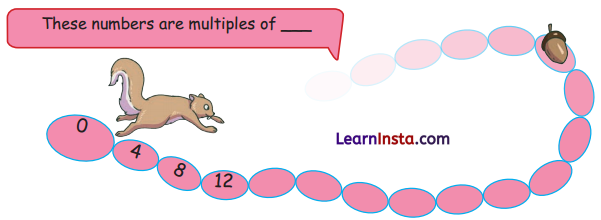
The squirrel jumps 4 steps at a time. Which numbers will the squirrel touch? How many times should the squirrel jump to reach 60 ?
Answer:
The squirrel jumps 4 steps at a time.
Numbers touched by the squirrel are multiples of 4.
∴ The squirrel will touch the numbers
4, 8, 12, 16, 20, 24, ….. and so on.
Now dividing 60 by 4 =\(\frac{60}{4}\) = 15
∴ No. of jumps to reach 60 = 15
These numbers are multiples of 4.
Question 3.
The rabbit jumps 6 steps at a time.
Which numbers will the rabbit touch?
What is the smallest 3 -digit number on which the rabbit will land?
How many times did the rabbit jump to reach this number?

Answer:
The rabbit will touch multiples of 6. Numbers are 6, 12, 18, 24, 30, 36, …..
Smallest 3 digit number = 100
and smallest 3 digit multiple of 6 is 102
Now dividing 102 by 6 = \(\frac{102}{6}\) = 17 times
These numbers are multiples of 6 .
Question 4.
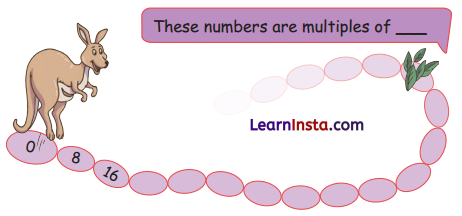
The kangaroo jumps 8 steps at a time. Which numbers will the kangaroo touch?
Are there numbers that both the rabbit and the kangaroo will touch?
Answer:
The kangaroo will touch multiples of 8
The numbers are 8, 16, 24, 32, 40, 48, 56, …..
These numbers are multiples of 8.
0, 8, 16, 24, 32, 40, 48, 56, 64, 72, 80, 88, 96, 104, 112, 120, 128, 136.
Now for numbers that both rabbit and the Kangaroo will touch we have to find the multiples of both 6 and 8.
Now multiples of 6,8

LCM of 6 and 8 = 2 × 3 × 4 = 24
Hence Rabbit and Kangaroo will touch numbers 24,48,72, ….. and so on.
Question 5.
To reach 48, how many times did the rabbit jump? _____

How many times did the Kangaroo jump to reach the same number? _____
What did you observe? Share your thoughts.
Answer:
To reach 48, No. of jumps by rabbit
= \(\frac{48}{6}\) = 8
To reach 48, No. of jumps by Kangaroo
= \(\frac{48}{8}\) = 6
Clearly Kangaroo is faster than rabbit.
Question 6.
To reach 60 , how many times did the frog jump? _____ How many times did the rabbit jump to reach the same number?
What do you observe? Share your thoughts.
Answer:
To reach 60 , No. of jumps by frog
=\(\frac{60}{3}\) = 20
To reach 60, No. of jumps by rabbit
= \(\frac{60}{6}\) = 10
Clearly rabbit is faster than frog.
Common Multiples (Page 130)
Question 1.
Which numbers do both the frog and the squirrel touch? A few common multiples of 3 and 4 are _____ .
Answer:
The numbers that both the frog and the squirrel touch
= common multiples of 3 and 4
= 12
∴ These numbers are 12,24,36,48, …..
Question 2.
Which numbers do both the rabbit and the kangaroo touch?A few common multiples of 6 and 8 are _____ .
Answer:
The numbers that both the rabbit and the Kangaroo touch
= common multiples of 6 and 8
= 24
∴ These numbers are 24, 48, 72, 96, …..
Question 7.
If the cat and the rat land on the same number, the cat will catch the rat.
The cat is now on 6 and the rat on 12. When the cat jumps 3 steps forward, the rat jumps 2 steps forward. Will the cat catch the rat? If yes, at which number?

Answer:
The cat is at position 6 . The rat is at position 12 . The cat jumps 3 steps forward and the rat jumps 4 steps forward.
The difference in jump lengths = 3 – 2 = 1
Now L.C.M. of 3 and 2 = 6
The least common multiples of the jump length is 6.
Adding the L.C.M. to the initial position of the cat = 6 + 6 = 12
The cat and rat will meet at position 12.
Question 8.
Find multiplication and division sentences below.
Shade the sentences.
How many can you find?
Two examples are done for you.

Answer:

Gulabo’s Garden (Pages 131-133)
Question 1.
Gulabo’s garden has lily flowers. Each lily flower has 3 petals. How many petals are there in 12 flowers? Show how you found your answer.
Gulabo will have 12 × 3 petals.
Petals in 10 lilies 10 × 3 petals = 30 petals
Petals in 2 lilies _____
Petals in 12 lilies _____

Answer:
Petals in 2 lilies = 2 × 3 = 6 petals
Petals in 12 lilies = 12 × 3
= (10 + 2) × 3
= 10 × 3 + 2 × 3 = 30 + 6 = 36 petals.
Question 2.
In a hibiscus flower there are 5 petals. Gulabo counted all the petals and found them to be 80. How many flowers did she have?
Gulabo has 80 ÷ 5 flowers.
5 petals is 1 flower.
10 petals are 2 flowers.
50 petals are 10 flowers.
Then, 80 petals are _____ flowers.

Answer:
Gulabo has 5 petals in 1 flower
∴ 10 petals are 2 flowers
20 petals are 4 flowers
40 petals are 8 flowers
50 petals are 10 flowers
80 petals are 16 flowers
Question 3.
Gulabo plants some marigold saplings in a box as shown in the picture.
There are _____ saplings in each row.
There are _____ rows.
How many saplings has she planted?
How did you calculate it?
Mathematical Statement _____

Answer:
There are 11 saplings in each row.
There are 3 rows.
Now no. of saplings = 11 × 3
= (10 + 1) 3 = 10 × 3 + 1 × 3
= 30 + 3 = 33
Mathematical statement.
No. of saplings (Multiplier)
11 × 3 = 33 (Product)
↑ group size (Multiplicand)
Question 4.
“Dailyfresh” supermarket has kept boxes of strawberries in a big tray.
How many boxes of strawberries does the supermarket have? Show how you found them.
There are _____ columns of strawberry boxes.
There are _____ boxes in each column.
There are _____ boxes in all.
Mathematical Statement _____

Answer:
There are 16 columns of strawberry boxes.
There are 6 boxes in each column.
There are 16 × 6 = (10 + 6) × 6
= 10 × 6 + 6 × 6 = 60 + 36
= 96 boxes in all
Mathematical statement:
No. of boxes (Multiplier)
16 × 6 = 96 (Product)
↑
group size (Multiplicand)
Question 5.
Radha runs a bakery shop. She bakes 18 cupcakes in one tray of the size shown below.
(a) Complete arranging the cupcakes in the two trays given below.

(b) She can use two such trays in her oven at a time. How many cupcakes can she make in one attempt? _____
(c) Today she has received a special order. She has made 108 cupcakes. How many trays has she baked?
(d) She has another square baking tray. She can bake 36 mini cupcakes in such a tray. Complete the arrangement below.
Number of columns: _____
Number of cupcakes in each column: _____
Multiplication statement _____

Find different ways of arranging the following numbers of cupcakes in rows and columns in your notebook.
36,8,12, and 24
Answer:
(a)

(b) No. of cupcakes = 2 × 18 = 36 cupcakes
(c) No. of trays baked =\(\frac{108}{18}\) = 6
(d) No. of columns = 6
No. of cupcakes in each column = 6
Mathematical statement:
No. of cupcakes (Multiplier)
-6 × 6 group size = 36 (Product)
Different ways
36 – 6 × 6, 4 × 9,3 × 12, 2 × 18, 1 × 36, 9 × 4, 12 × 3, 18 × 2, 36 × 1
8 -2 × 4, 1 × 8, 4 × 2, 8 × 1
12 – 3 × 4, 2 × 6, 1 × 12, 4 × 3, 6 × 2, 12 × 1
24 – 4 × 6, 3 × 8, 2 × 12, 1 × 24, 6 × 4, 8 × 3, 12 × 2, 24 × 1
The Doubling Magic (Pages 133-136)
Magician Anvi came one day,
To Gulabo’s house, ready to play.
From her coat, with a grand display,
She pulled out 23 flowers, bright and gay!

She smiled and said, “Now watch and see,
How many flowers will there be?”
How many flowers are there now? _____

Answer:
No. of flowers are there now = 23 × 2 = 46
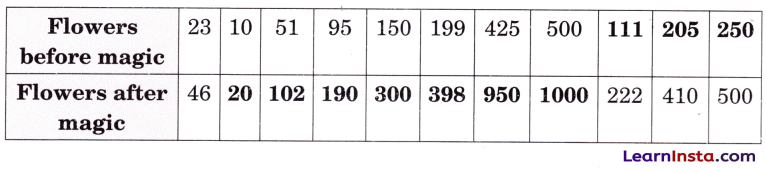
(a) Double of 32 = 64
(b) Double of 14 = 28
(c) Double of 26 = 52
(d) Double of 17 = 34
(e) Double of 39 = 78
(f) Double of 45 = 90
Question 1.
Guess what will be the ones digit of the following numbers when doubled.
Write the ones digit in the space provided.
(a) 28 _____
(b) 56 _____
(c) 45 _____
(d) 17 _____
Answer:
(a) 28 × 2 = 56 ones digit = 6
(b) 56 × 2 = 112 ones digit = 2
(c) 45 × 2 = 90 ones digit = 0
(d) 17 × 2 = 34 ones digit = 4
Question 2.
Give examples of numbers that when doubled give the following digits in the ones place.
(a) 0 _____
(b) 2 _____
(c) 4 _____
(d) 6 _____
(e) 8 _____
What do we notice about the numbers that we get after doubling? Even or Odd?
Answer:
(a) 5, 10, 15 for example 5 × 2 = 10
(b) 1, 6, 11 for example 1 × 2 = 2
(c) 2, 7, 12 for example 2 × 2 = 4
(d) 3, 8, 13 for example 3 × 2 = 6
(e) 4, 9, 14 for example 4 × 2 = 8
We get even numbers after doubling.
Fill each square in the chart by multiplying the row number by the column number


What do you notice about the numbers shaded in green? Why is this happening?
Question 1.
Share the patterns that you notice in the table.
Answer:
Diagonal – 1 × 1,2 × 2,
Squares 1,4,9
Commutative a × b = b × a for example
3 × 4 = 4 × 3
Multiplication increases across rows/columns.
Question 2.
Are the numbers in row 7 the same as the numbers in column 7? In general, are the numbers in a given row the same as the numbers in the corresponding column? Why does this happen?
Answer:
Yes row 7 = column 7(7 × 1, 7 × 2 = 1)
(1 × 7, 2 × 7 = …..)
In general row n = column n
Due to commutative property
a × b = b × a
Question 3.
Is there a row where all answers (products) are even numbers? Which rows have this property?
Answer:
Rows 2, 4, 6, 8
Multiples of 2, 4, 6, 8 are even numbers.
Question 4.
Is there a row having only odd numbers as products?
Answer:
No, odd row (e.g.7) has even products (7 × 2 = 14).
Question 5.
Are there rows that have both even and odd numbers? What do you notice? Why is it so?
Answer:
Odd rows (e.g. 3, 3 × 1 = 3 (odd), 3 × 2 = 6 (even))
Question 6.
Are there more even numbers in the chart or odd numbers? How do you know?
Answer:
More even, even rows dominate and odd rows have even products.
Question 7.
Colour the common multiples of the following numbers. Use different colours for each item.
(a) 2 and 3
(b) 4 and 8
(c) 7 and 9
Share your observations regarding the numbers that are common multiples in each case.
Answer:
(a) 2 and 3. Here LCM (2,3) = 6 ____ Multiples = 6,12,18, …..
(b) 4 and 8. Here LCM(4,8) = 8 ____ Multiples = 8,16,24, …..
(c) 7 and 9, LCM(7,9) = 63 ____ Multiples = 63,126,189, …..
Common multiples are less frequent for larger numbers.
Question 8.
Observe the pattern in the ones digits of the products in row 5 ? Observe the ones digit of the products in other rows also. What patterns do you notice?
Answer:
Row 5 ____ 5, 10, 15, ones digit = 5, 0, 5, 0, ….. (repeats)
Row 8 8, 6, 4, 2, 0 (repeats every 5)
Pattern ones digits cycle based on multiplier.
Question 9.
Here is row 8 of the chart: 8, 16, 24, 32, 40, 48, 56, 64, 72, 80
The ones digit of the products are: 8, 6, 4, 2, 0, 8, 6, 4, 2, 0
Do you see a repeating pattern here?
Guess the ones digit of the following products. Verify your answer by multiplying. Write the digit in the space given.
11 × 8 _____
12 × 8 _____
13 × 8 _____
Answer:
(a) 11 × 8 = Pattern repeats 8, 6, 4, 2, 0
11th is 8. Verify 11 × 8 = 88 (8)
(b) 12 × 8 = 12 th : 6 Verify 12 × 8 = 96 (6)
(c) 13 × 8 = 13 th : 4 Verify 13 × 8 = 104 (4)
Question 10.
In row 8 of the chart, there is no number whose ones digit is 1. What other digits do not appear as the ones digit?
Answer:
Row 8 8 ,6, 4, 2, 0 Missing no. 1, 3, 5, 7, 9.
Question 11.
Is there a row in which all the digits from 0 to 9 appear as the ones digit? Which rows have this property?
Answer:
No. row each row’s ones digits cycle in a pattern (e.g. row 8, 6, 4, 2, 0)
Question 12.
It can be seen. in row 8 that 0 appears as the ones digit two times.
 × 8 gives 0 as the ones digit.
What numbers can go in the box? Give 5 examples of such numbers.
Answer:
5, 10, 15, 20, 25 [e.g. (5 × 8 = 40)]
Question 13.
Is there a row in which 0 appears as the ones digit only once? Which rows have this property?
Answer:
Row 10(10, 20, 30, ….. 100) only 100 has 0.
Question 14.
What do you notice about the answers for Questions 11 and 13? Share in the grade.
Answer:
No row has all 0-9.
Row 10 has 0 once due to single multiple of 10.
Multiples of Tens (Page 137)
Question 1.
Let us count the number of wheels in tricycles.

Number of wheels in 10 tricycles with 3 wheels in each is 10 × 3 wheels = _____ wheels.
Number of wheels in 10 more tricycles with 3 wheels in each is 10 × 3 wheels = _____ wheels.
Number of wheels in 20 tricycles with 3 wheels in each is 20 × 3 wheels = _____ + _____ = _____ 10 × 3 =
20 × 3 = _____ wheels.
Answer:
(a) No. of wheels in 10 tricycles with 3 wheels in each is 10 × 3 wheels = 30 wheels
(b) No. of wheels in 10 more tricycles with 3 wheels in each is 10 × 3 = 30 wheels
(c) No. of wheels in 20 tricycles with 3 wheels in each is 20 × 3 wheels = 30 + 30 = 60 wheels
Question 2.
Let us count the number of wheels in cars.

Number of wheels in 10 cars with 4 wheels in each is 10 × 4 wheels = _____ wheels.
Number of wheels in 30 cars with 4 wheels in each is 30 × 4 wheels = _____ + _____ + _____ = _____ wheels.

Solve the following in a similar way. Share how you found the answers.
(a) 10 × 6 = _____
(b) 40 × 6 = _____
(c) 10 × 8 = _____
(d) 60 × 8 = _____
(e) 6 × 8 = _____
(f) 60 × 8 = _____
(g) 4 × 6 = _____
(h) 40 × 8 = _____
Answer:
No. of wheels in 10 cars with 4 wheels in each is 10 × 4 = 40 wheels. No. of wheels in 30 cars with 4 wheels in each is 30 × 4 = 30 + 30 + 30. + 30 = 120 wheels
(a) 10 × 6
Multiplication 10 × 6 means 10 groups of 6
I know that 10 × 6 = 60 using basic multiplication facts
Alternatively think of it as adding 6 ten times
6 + 6 + 6 + 6 + 6 + 6 + 6 + 6 + 6 + 6 = 60
(b) 40 × 6
Break it down 404 × 10, so 40 × 6 = 4 × 10 × 6
Now 4 × 6 = 24 then multiply by 10
24 × 10 = 240
Alternatively
40 × 6 = 40 + 40 + 40 + 40 + 40 + 40 = 240
(c) 10 × 8
Multiplication 10 × 8 means 10 groups of 8 we know 10 × 8 = 80
Alternatively. Add 8 ten times
8 + 8 + 8 + 8 + 8 + 8 + 8 + 8 + 8 + 8 = 80
(d) 60 × 8
Break it down 60 = 6 × 10, ____
∴ 60 × 8 = (6 × 10 × 8)
Now 6 × 8 = 48
Then multiply by = 10,48 × 10 = 480
Alternatively 60 × 8- Add 60,8 times
60 + 60 + 60 + 60 + 60 + 60 + 60 + 60 = 480
(e) 6 × 8
Multiplication 6 × 8 means 6 groups of 8 we know 6 × 8 = 48
Alternatively. Add 8, 6 times
8 + 8 + 8 + 8 + 8 + 8 + 8 + 8 = 48
(f) 60 × 8
Break it down 60 = 6 × 10, ____
∴ 60 × 8 = (6 × 10 × 8)
Now 6 × 8 = 48
Then multiply by = 10,48 × 10 = 480
Alternatively 60 × 8- Add 60, 8 times
60 + 60 + 60 + 60 + 60 + 60 + 60 + 60 = 480
(g) 4 × 6
Multiplication 4 × 6 means 4 groups of 6 we know 4 × 6 = 24
Alternatively. Add 6, 4 times
6 + 6 + 6 + 6 = 24
(h) 40 × 8
Multiplication 40 × 8 = (4 × 10) × 8
Now 4 × 8 = 32
Now multiply by 10 . 32 × 10 = 320
6 + 6 + 6 + 6 = 24
Alternatively
Add 40, 8 times
40 + 40 + 40 + 40 + 40 + 40 + 40 + 40 = 320
Multiplying Using 10s (Pages 138-139)
Question 1.
Radha is packing cupcakes in boxes of 4. She has packed 18 boxes. How many cupcakes are there in the packed boxes?

18 boxes have 4 cupcakes in each.
So, there are 18 × 4 cupcakes.
10 boxes with 4 cupcakes in each contain 10 × 4 cupcakes = _____ cupcakes.
8 boxes with 4 cupcakes in each contain 8 × 4 cupcakes = _____ cupcakes.
18 boxes with 4 cupcakes in each contain _____ + _____ cupcakes = _____ cupcakes.

Answer:
First, we calculate for 10 boxes.
10 boxes with 4 cupcakes each = 10 × 4 = 40 cupcakes
Now we calculate for 8 boxes
8 boxes with 4 cupcakes each = 8 × 4 = 32 cupcakes
Now add the cupcakes for all 10 boxes
= 40 + 32 = 72 cupcakes.
Question 2.
8 bamboo rods are needed to make a bullock cart. How many bamboo rods are needed for 23 carts?

One cart needs 8 bamboo rods. 23 carts need 23 × 8 rods.
20 carts with 8 rods in each need
20 × 8 rods = _____ rods.
3 carts with 8 rods in each need
3 × 8 rods = _____ rods.

Answer:
First, we calculate for 20 carts
20 carts with 8 bamboo rods each = 20 × 8 = 160 rods
Now we calculate for 3 carts
3 carts with 8 bamboo rods each
= 3 × 8 = 24 rods
Now add the rods for all 23 carts
= 160 + 24 = 184 rods
∴ 184 bamboo rods are needed for 23 carts.
Let Us Solve (Page 139)
Question 1.
A flock of 25 geese and 12 sheep have gathered around a pond. Chippi the lizard sees many legs. How many legs does it see?

Answer:
Geese = 25 × 2 = 50 legs
Sheep = 12 × 4 = 48 legs
Total = 50 + 48 = 98 legs
Question 2.
In an auditorium, 8 children are sitting in each row. There are 15 such rows in the school auditorium. How many children are in the auditorium?
Answer:
No. of children in auditorium
= 15 × 8 = (10 + 5) × 8
= 10 × 8 + 5 × 8 = 80 + 40 = 120 children
Question 3.
A book shop has kept 9 books in each pile. There are 14 such piles. How many books does the shop have?
Answer:
No. of books = 9 × 14
= 9 ×(10 + 4) = 9 × 10 + 9 × 4
= 90 + 36 = 126
Question 4.
Surya is making a patch work with beads of two colours as shown in the picture. How many beads has he used? How many each of golden colour beads and white colour beads has he used in making this patch work?

Answer:
Let 4 × 3 grid, alternating colours
Total = 4 × 3 = 12 beads
Golden = 6, white 6 (alternate)
Question 5.
For each of the following multiplication problems, make your own stories as above. Then find out the product.
(a) 34 × 3
(b) 75 × 5
(c) 46 × 6
(d) 50 × 9
Answer:
(a) Story. There are 34 trees in a field. Each tree has three mangoes. Find the total no. of mangoes.
Total mangoes = 34 × 3 = 102
(b) Story. There are 75 boxes in a carton. Each box has five pencils. Find the total no. of pencils.
Total pencils = 75 × 5 = 375
(c) Story. There are 46 rows in a bus. Each row has 6 seats. Find the total no. of seats.
Total seats = 46 × 6 = 276
(d) Story. There are 50 bags in a classroom. Each bags has 9 pens. Find the total no. of pens.
Total pens = 50 × 9 = 450
Division (Pages 140-141)
Question 1.
A factory has ordered 58 wheels for the small tempos that they make. Each tempo has 3 wheels.
In how many tempos can they fix the wheels? Discuss your thinking in each step.

Answer:

58 ÷ 3 = 19 tempos; 1 wheel left
10 tempos; 30 wheels; 58 – 30 = 28 left
5 tempos; 15 wheels 28 – 15 = 13 left
3 tempos; 9 wheels 13 – 9 = 4 left
1 tempo, 3 wheels 4 – 3 = 1 left
Total = 10 + 5 + 3 + 1 = 19 tempos, 1 wheel left
Question 2.
A dairy farm has many cows. Chippi the lizard is surprised to see 88 legs.
How many cows are there in the farm? Write appropriate sentences as above to show your thinking.

Number of legs of a cow:
Number of cows is 88 ÷ _____
Show your work using the table.

Answer:
Number of legs of a cow = 4
Number of cows is 88 ÷ 4 = 22

∴ Total number of cows = 10 + 10 + 2 = 22 cows
Let Us Solve (Page 141)
Question 1.
In a big aquarium, Jolly fish sees 72 legs of octopuses. How many octopuses are there in the aquarium?

Answer:
No. of legs of a octopuse = 8
No. of octopuses = 72 ÷ 8 = 9

∴ No. of octopuses = 5 + 4 = 9
Question 2.
A sports store packs 4 shuttlecocks in a bigger box. They have 50 shuttlecocks. How many boxes will they need to pack all of them? Can they pack all the shuttlecocks in the boxes? How many are left?
Answer:
50 ÷ 4 = 12 boxes, 2 left
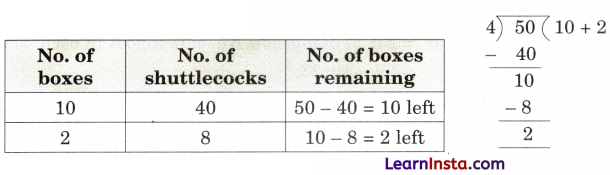
∴ 12 boxes; 2 shuttlecocks left
Question 3.
Rakul Chachi uses a part of her farm to grow flowering plants for the upcoming festive season. She has planted 75 saplings of roses. Each row has 5 saplings. How many rows of saplings has she planted?
Answer:
No. of rows = 75 ÷ 5 = 15 rows

Question 4.
Make stories for the following problems and solve them:
(a) 70 ÷ 5
(c) 69 ÷ 3
(b) 84 ÷ 7
(d) 93 ÷ 6
Answer:
(a) Story: Pintu has 70 toffees. He wants to distribute 5 toffees to each of his friends. How many friends does he have?
No. of friends = No. of toffees ÷ No. of toffees to each friend.
= 70 ÷ 5 = 14.
(b) Story: 84 books are arranged with 7 books per shelf. How many shelves are there?
No. of shelves = No. of books ÷ No. of books per shelf.
= 84 ÷ 7 = 12.
(c) Story: 69 mangoes are packed with 3 mangoes per box in a carton. How many boxes are there in the carton?
No. of boxes = No. of mangoes ÷ No. of mangoes in each box.
= 69 ÷ 3 = 23.
(d) Story: A classroom has 93 seats with 6 seats per bench. How many benches are there in the classroom?
No. of benches = No. of seats ÷ No. of seats per bench.
= 93 ÷ 6 = 15 bench with 3 seats left.
Multiples of 100 (Pages 142-143)

100 bikes with 2 people on each have 100 × 2 people = _____ people.
Answer:
100 × 2 = 200 people
200 bikes with 2 people on each have _____ people.
How did you find it?
Answer:
200 × 2 = 400 people
100 cars with 4 people in each have
100 × 4 people = _____ people.
Answer:
100 × 4 = 400 people
500 cars with 4 people in each have _____ people.
How did you find it?

Answer:
500 × 4 = 2000 people
(Method: Multiply single digit result by 100 (e.g. 2 × 100 = 200)

Answer:

Observe the pattern and complete the answers.
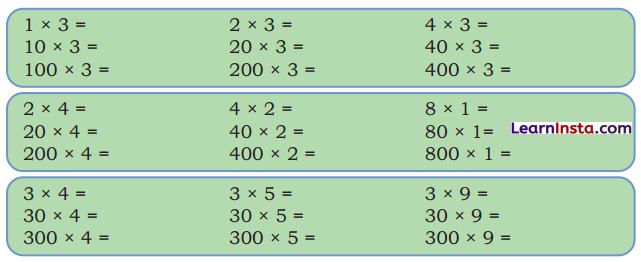
Answer:

More Multiplication (Pages 143-144)
Question 1.
Big electric autorickshaws run in small towns of India and can carry 8 passengers. How many people can travel in 125 such autos in a single round?

The total number of passengers 125 × 8.
100 autorickshaws with 8 passengers in each have 100 × 8 passengers = 80 0 passengers.
20 autorickshaws with 8 passengers in each have 20 × 8 passengers = 160 passengers.
5 autorickshaws with 8 passengers in each have 5 × 8 passengers = 40 passengers.
125 autorickshaws with 8 passengers in each have 800 + 160 + 40 = 1000 passengers.

Answer:
Total no. of people = 125 × 8 = (100 + 20 + 5) 8
= 100 × 8 + 20 × 8 + 5 × 8
= 800 + 160 + 40
= 1000
Question 2.
Kahlu and Rabia are potters and make earthen pots (kulhad) for trains.

They pack 6 kulhads in a box and have packed 174 boxes for delivery.
How many kulhads have they made?
The total number of kulhads is _____ .

Answer:
Total number of kulhads = 174 × 6
= (100 + 70 + 4) 6
= 600 + 420 + 24 = 1044

Let Us Solve (Pages 144-145)
Question 1.
BP Girl’s school has decided to give all its students two pencils on the first day of school.
It has 4 6 5 students.
How many pencils does the school need to buy?
Answer:
No. of pencils = (465 × 2)
= (400 + 60 + 5) × 2
= 400 × 2 + 60 × 2 + 5 × 2
= 800 + 120 + 10
= 930

Question 2.
234 children of a school have decided to organise a school mela. Each child contributes ₹ 5 for the organisation of the mela. How much money do they collect?
Answer:
Total money = 234 × 5
= (200 + 30 + 4) × 5
= 200 × 5 + 30 × 5 + 4 × 5
= 1000 + 150 + 20
= 1170

Question 3.
Make stories for the following problems and solve them.
(a) 439 × 4
(b) 514 × 8
(c) 356 × 5
(d) 623 × 7
Answer:
(a) Story
Each of the 439 saplings has 4 leaves. How many leaves are there in total?
leaves = 439 × 4
= (400 + 30 + 9) × 4
= 1600 + 120 + 36 = 1756
(b) Story
Each of the 514 buses has 8 seats. How many seats are there in total?
seats = 514 × 8 = 4112
(c) Story
Each of the 356 boxes contains 5 apples. How many apples are there in total?
apples = 356 × 5 = 1780
(d) Story
Each of the 623 trays carries 7 cakes. How many apples are there in total?
cakes ____ = 623 × 7 = 4361
More Division (Page 145)
9 boats have to ferry 108 people waiting along the banks of the Cauvery River. Every boat carries the same number of people. How many people should be ferried in each boat?
108 people are to be ferried in 9 boats.
In 1 boat, the number of people ferried is 108 ÷ 9.
If 5 people sit in each of the boats, then 45 people can be ferried in 9 boats.
If 5 more people sit along with them in each of the boats (total 10), then 90 people can be ferried in the 9 boats.
The remaining 18 people have to be adjusted in the 9 boats. 2 more people will have to sit in each of the boats.
So, the 9 boats need to take 12 people each.
Answer:
108 ÷ 9

5 × 9 = 45
5 × 9 = 45
2 × 9 = 18
∴ 45 + 45 + 18 = 108
and _____ 5 + 5 + 2 = 12
Hence 12 people per boat.
Patterns in Division (Page 146)
How much money will each get? Draw arrows linking the money and the children to answer the questions.

1. ₹ 30 shared equally among 3 children _____
2. ₹ 900 shared equally among 3 children _____
Answer:
1. Here 30 ÷ 3 = 10
2. 900 ÷ 3 = 300
Using the above way of thinking, solve the following problems.
Observe and explain the patterns that you notice below.

Answer:

Question 1.
A load carrying truck has 6 tyres. Chippi the lizard sees 60 tyres. How many trucks are there?
Answer:
Total trucks = 60 ÷ 6 = 10 trucks.
Question 2.
Chippi sees 80 wheels in a car parking space. How many cars are standing in the parking space?
Answer:
Total cars = 80 ÷ 4 = 20 cars.
Question 3.
Chippi sees 600 legs of ants walking towards the anthill. How many ants are there?
Answer:
Total ants = 600 ÷ 6 = 100 ants.
Question 4.
A fancy shop has packed 800 rubber bands in several packets. Each packet has 4 rubber bands.
How many packets of rubber bands does the shop have?
Answer:
Total packets = 800 ÷ 4 = 200.
Let Us Solve (Pages 147-148)
Question 1.
A school bus hires 7 buses to take 245 children to the transport museum. Each bus carry the same number of children. How many children are traveling in each bus?
Answer:
No. of chil en = 245 ÷ 7
= 35

Question 2.
The Darjeeling Himalayan Railway is fondly called the “Toy Train”. This toy train ride is also a UNESCO World Heritage Site.
This amazing train runs between New Jalpaiguri and Darjeeling and it also passes through one of the highest stations in the world, namely, Ghum. It runs 88 km daily. How much distance does it travel in a week?

Answer:
Total distance = 88 × 7
= (80 + 8) × 7
= 80 × 7 + 8 × 7
= 560 + 56 = 616 km
Question 3.
The 16 Km river rafting from Shivpuri to Rishikesh in the Ganga provides the most interesting rafting opportunity. In the summer months, VentureOut company took 259 people for rafting. Each raft can take 7 people. How many rafts did it take?
Answer:
No. of rafts = 259 ÷ 7
= 30 + 7
= 37

Question 4.
Anu saves ₹ 45 every month by putting it in her piggy bank.
(a) How much money will Anu save in 6 months?
(b) She distributes the total money saved after 6 months among 6 of her friends. How much does each friend get?
(c) If she decides to distribute the saved money among 3 friends after 6 months, how much money will each get?
Answer:
(a) Total money = 45 × 6 = (40 + 5) × 6
= 240 + 30
= ₹ 270
(b) Each friend get = 270 ÷ 6 = 45 rupees
(c) Each friend get = 270 ÷ 3 = 90 rupees
Question 5.
Raju drives an auto in his village and takes people to the bus stand. He makes 8 trips in a day. Which of the following questions can be exactly calculated with the above statement?
(a) How much money does he make in a day?
(b) How many trips does he make in 7 days?
(c) How much time does one trip take?
(d) How many trips does he make in 4 weeks?
Answer:
(a) No (fare unknown)
(b) Yes, 8 × 7 = 56 trips
(c) No (time unknown)
(d) Yes, 4 × 7 × 8 = 244 trips
Question 6.
Solve
(a) 45 × 9
(b) 507 × 7
(c) 94 ÷ 4
(d) 778 ÷ 6
(e) 94 × 5
(f) 396 × 4
(g) 83 ÷ 3
(h) 635 ÷ 5
Answer:
(a) 45 × 9 = (40 + 5) × 9 = 40 × 9 + 5 × 9
= 360 + 45 = 405
(b) 507 × 7 = (500 + 7) × 7 = 500 × 7 + 7 × 7
= 3500 + 49
= 3549
(c) 94 ÷ 4
= 23, remainder = 2

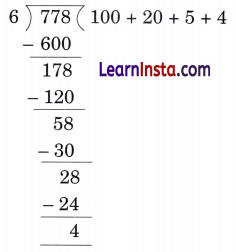
(d) 778 ÷ 6
= 100 + 20 + 5 + 4
= 129, remainder = 4
(e) 94 × 5 = (90 + 4) × 5
= 90 × 5 + 4 × 5
= 450 + 20 = 470
(f) 396 × 4 = (300 + 90 + 6) × 4
= 300 × 4 + 90 × 4 + 6 × 4
= 1200 + 360 + 24
= 1584
(g) 83 ÷ 3 = 20 + 5 + 2, remainder = 2
= 27, remainder = 2

(h) 635 ÷ 5 = 100 + 20 + 7 = 127

Question 7.
In mathematics, some statements are always true, some are sometimes true, and some are never true. Tick (✓) in the appropriate column.

Answer:
