Students rely on Class 8 Science Extra Questions and Class 8th Curiosity Chapter 4 Electricity: Magnetic and Heating Effects Important Extra Question Answer to improve their grades.
Class 8 Science Chapter 4 Electricity: Magnetic and Heating Effects Extra Questions
Class 8 Science Chapter 4 Extra Questions on Electricity: Magnetic and Heating Effects
Electricity: Magnetic and Heating Effects Class 8 Very Short Question Answer
Question 1.
How does Earth’s magnetic field protect life on Earth?
Answer:
By acting as a shield against harmful space particles.
Question 2.
What does the deflection of the compass needle indicate?
Answer:
It indicates that the current-carrying wire produces a magnetic effect/field.

Question 3.
Why is a dry cell a single-use cell?
Answer:
The dry cell is a single use cell, because once it is used up, it has to be disposed of.
Question 4.
What is formed when a wire is tightly wound around an iron nail and connected to a cell?
Answer:
An electromagnet is formed when a wire is tightly wound around an iron nail and connected to a cell.
Question 5.
Why do the paper clips fall off the nail when the electric current is stopped?
Answer:
Because the magnetic field disappears when the current stops.
Question 6.
Why does an incandescent lamp glow?
Answer:
An incandescent lamp glows because its filament is heated by an electric current.
Question 7.
What makes Earth behave like a giant magnet?
Answer:
Movement of liquid iron in Earth’s core.
Question 8.
If the north pole of a compass is attracted to end A of an electromagnet, what is the polarity of end A?
Answer:
South pole.
Question 9.
What effect of electric current is used in electric bells and motors?
Answer:
Magnetic effect of electric current.
Question 10.
How can the poles of an electromagnet be reversed?
Answer:
By changing the direction of the current.
Electricity: Magnetic and Heating Effects Class 8 Short Question Answer
Question 1.
What is a Voltaic cell, and how does it produce electricity?
Answer:
A Voltaic cell, also known as a Galvanic cell, consists of two metal plates (electrodes) made of different materials, partly dipped in an electrolyte (a weak acid or salt solution) inside a container. A chemical reaction between the electrodes and the electrolyte generates electricity, causing current to flow when a circuit is connected.
Question 2.
What happens when the chemicals in a Voltaic cell are used up?
Answer:
When the chemicals in a Voltaic cell are used up, the cell can no longer produce electricity. It is then called a “dead” cell and stops working.
Question 3.
List three factors on which the heat produced in a wire depends.
Answer:
The factors on which the heat produced in a wire depends:
- Material of the wire
- Thickness and length of the wire
- Duration for which current flows
Question 4.
What is a lifting electromagnet and how does it work?
Answer:
A lifting electromagnet is a strong electromagnet attached to cranes to move, lift, and sort heavy metal items. It works by passing electric current through a coil to create a magnetic field. The crane operator can control the magnet by switching the current ON and OFF. When the current is ON, it attracts iron or steel objects. When the current is OFF, the magnetic field disappears, and the objects are released.
Question 5.
Why does the LED glow when connected to the lemon battery?
Answer:
The LED glows because the chemical reaction between the copper and iron electrodes in the lemon juice produces an electric current, which flows through the LED, causing it to emit light.
Electricity: Magnetic and Heating Effects Class 8 Long Question Answer
Question 1.
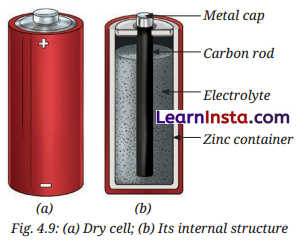
What is a dry cell? Draw its diagram and explain its structure.
Answer:
A dry cell is a type of electric cell that changes chemical energy into electrical energy. It is called a ‘dry’ cell because the electrolyte is in the form of a moist paste, not a liquid. The structure of a dry cell consists of a zinc container which acts as the negative terminal. Inside the cell, there is a central carbon rod covered with a metal cap, which serves as the positive terminal. The space between the carbon rod and zinc container is filled with a moist paste-like electrolyte.
Question 2.
What are rechargeable batteries and where they are commonly used?
Answer:
A type of battery that can be recharged and reused multiple times, unlike dry cells, which are single-use and must be disposed of after use. There are many different kinds of rechargeable batteries that are used for different applications – from small batteries used in watches and phones to larger batteries used in laptops and tablets to even bigger batteries that run inverters or drive electric vehicles.
Question 3.
Explain the heating effect of electric current in detail. How is it useful and what are the precautions to be taken?
Answer:
The heating effect of electric current occurs when current flows through a conductor, and the resistance in the wire converts electrical energy into heat. This effect is useful in many appliances like electric heaters, irons, kettles, and immersion rods. It is also used in industrial furnaces for melting steel. However, if not managed properly, it can lead to energy loss, overheating, and even fires. To avoid these problems, appropriate wires, plugs, and safety devices like fuses should be used.
Electricity: Magnetic and Heating Effects Class 8 Skill-Based Questions
Question 1.
Observe the given figure and answer the following questions:
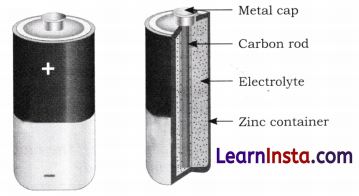
(i) What does this figure show?
(ii) Name the part that acts as a negative terminal.
(iii) What surrounds the positive terminal in the cell?
(iv) Write one use of this cell.
Answer:
(i) Dry cell
(ii) Zinc container
(iii) Electrolyte
(iv) They are used in TV remote controls.
Electricity: Magnetic and Heating Effects Class 8 Quiz Questions
Question 1.
Name a device that works on the magnetic effect of electricity.
Answer:
Electric bell
Question 2.
Write any two metal pairs for Voltaic cells.
Answer:
Copper and Zinc, Iron and Copper
Question 3.
What is the source of portable electricity?
Answer:
Battery
Question 4.
What material did Volta use instead of the frog’s leg to prove his idea about electricity?
Answer:
Saltwater-soaked paper
Question 5.
What happens to a Voltaic cell when the chemicals inside it are completely used up?
Answer:
The cell becomes “dead” and can no longer supply electricity.
Question 6.
What is the purpose of using a hightemperature furnace in steel industries?
Answer:
To melt and recycle scrap steel into usable steel.
Question 7.
Why should appropriate wires, plugs, and sockets be used in household switchboards?
Answer:
To prevent unnecessary heating and ensure safe operation.
Question 8.
What is the name of the wire or rod that produces heat in electrical appliances?
Answer:
Heating element
Question 9.
Who discovered the link between electricity and magnetism?
Answer:
Hans Christian Oersted
Question 10.
Which direction does a freely suspended magnet rest in?
Answer:
North-South
Electricity: Magnetic and Heating Effects Class 8 Case Based Questions
Question 1.
During a science project, Class 8 students created a magnetic sorting tool to separate iron nails from a pile of waste materials in the school workshop. They made a simple electromagnet by winding copper wire around an iron rod and connecting the ends to a battery through a switch. When the switch was ON, the tool picked up iron nails easily.
When the switch was OFF, the nails dropped off. They experimented with more cells and found that the electromagnet became stronger, lifting more nails. However, when the tool was left ON for too long, the iron rod stopped working properly, and the wire felt warm.
I. What is the name of the device created by the students?
II. Why did the iron rod attract iron nails only when the switch was ON?
III. What happens to the strength of the electromagnet when more cells are used?
OR
Give one real-life uses of electromagnet.
Answer:
I. The device is called an electromagnet.
II. The iron rod attracts nails only when the switch is ON because electric current is flowing through the coil, turning it into an electromagnet. When the switch is OFF, the current stops and the magnetic effect disappears.
III. When more cells are used, the current increases, which creates a stronger magnetic field in the coil. This makes the electromagnet stronger and able to lift more iron objects.
OR
Cranes in scrape yards
Electricity: Magnetic and Heating Effects Extra Questions for Practice
Multiple Choice Questions
Question 1.
What happen to the compass needle when electric current flows through a wire near it?
(a) It breaks
(b) It get deflected
(c) It glows
(d) It remains still
Question 2.
Who discovered the relationship between electricity and magnetism?
(a) Isaac Newton
(b) Thomas Edison
(c) Hans Christian Oersted
(d) Elbert Einstein
Question 3.
What happens when a current flows through a cylindrical coil?
(a) It becomes hot
(b) It behave like a magnet
(c) It produce light
(d) It makes a sound
Question 4.
Read the given statements and select the correct option.
Assertion (A): Overheating in electrical appliances is a serious concern and requires proper safety measures.
Reason (R): Most appliances are designed to operate safely within a limited range of electric current.
(a) Both A and R are true and R is the correct explanation of A
(b) Both A and R are true but R is not the correct explanation of A
(c) A is true but R is false.
(d) A is false but R is true.
Question 5.
Match the following terms with their correct descriptions:
Column A — Column B
(i) Voltaic cell — (p) Temporary magnet formed using electric current
(ii) Nichrome wire — (q) Indicates magnetic effect of electric current
(iii) Electromagnet — (r) Uses electromagnet to produce sound
(iv) Magnetic compass near a current-carrying wire — (s) Works on chemical reactions to produce electricity
(v) Electric bell — () Used in electric heaters and irons
(a) (i)-(s),(ii)-(t),(iii)-(p),(iv)-(q),(v)-(r)
(b) (i)-(t), (ii)-(q), (iii)-(r), (iv)-(p), (v)-(s)
(c) (i)-(s),(ii)-(q),(iii)-(p),(iv)-(r),(v)-(t)
(d) (i)-(p),(ii)-(r),(iii)-(s),(iv)-(q),(v)-(t)
Very Short Answer Type Questions
Question 1.
Define magnetic field.
Question 2.
Who invented the first battery?
Question 3.
What acts as the electrolytes in the lemon cell experiments?
Question 4.
Name the wire commonly used in electric heaters.
Question 5.
What is the thick paste inside a dry cell called?
Short Answer Type-I Questions
Question 1.
Explain the difference between dry cell and Voltaic cell.
Question 2.
Why do rechargeable batteries wear out over time?
Question 3.
Why Earth behaves like a giant magnet?
Question 4.
What causes a cell or battery to generate electric current?
Question 5.
How is the heating effect of electric current used in steel industries?
Short Answer Type-II Questions
Question 1.
What is an electromagnet and how is it made stronger for practicle use?
Question 2.
Why is the lithium-ion battery widely used in modern devices?
Question 3.
How can you identify the poles of an electromagnet using a magnetic compass?
Question 4.
Why do scientists want to improve rechargeable batteries?
Question 5.
Describe the activity that shows current-carrying wires produce heat.
Long Answer Type Questions
Question 1.
Explain the structure and working of a Voltaic cell.
Question 2.
Describe how Alessandro Volta’s experiment led to the invention of the first battery.
Question 3.
Define heating effect of electric current. Why does nichrome wire heat up more than copper? Name any four appliances that use this effect.
Suggested Projects And Activities
Question 1.
Wind coils with 20,40,60, and 80 turns of wire. Connect each coil to the same battery and place a small magnetic compass near the coil in a fixed position. Observe and record the deflection of the compass needle in each case and keep the compass at the same spot each time.
Question 2.
Make a simple electric cell at home with the help of an adult. Use common items like lemons, potatoes, or tomatoes. Take two nails made of different metals, such as zinc and copper or iron and copper, and insert them into the fruit or vegetable. Connect a small LED light to the nails to see if the cell is working. Try different combinations of fruits and metals to find out which one produces the electric current. Write down what you observe and share your results with your teacher.