Practice with Class 9 SST Extra Questions and Class 9 Social Science SST Chapter 4 Early Humans and Beginning of Civilisation Extra Questions and Answers to improve your exam performance.
Early Humans and Beginning of Civilisation Class 9 Extra Question Answer
Extra Questions of Early Humans and Beginning of Civilisation Class 9
Early Humans and Beginning of Civilisation Class 9 Very Short Question Answer
Question 1.
What is the difference between biological evolution and cultural evolution?
Answer:
Biological evolution refers to the gradual physical changes through which early human ancestors evolved into modem humans. Cultural evolution refers to the development of tools, technology, agriculture, language, and other skills that enabled humans to adapt better to their environment and improve their way of life.
Question 2.
Why is archaeology important for studying prehistory?
Answer:
Archaeology helps us understand prehistoric life by studying artefacts, fossils, tools, pottery, ornaments, bones, and other material remains. Since prehistoric people left no written records, these discoveries provide valuable evidence about their lifestyle, occupations, and technological progress.
Question 3.
Explain the importance of Mehrgarh in the history of the Indian subcontinent.
Answer:
Mehrgarh is the earliest known Neolithic farming settlement in the Indian subcontinent. Archaeological discoveries show that its people cultivated crops, domesticated animals, built mud- brick houses and granaries, made ornaments, and later began using copper, marking an important stage in human development.
Question 4.
What changes took place during the Neolithic Revolution?
Answer:
During the Neolithic Revolution, humans shifted from hunting and gathering to agriculture and animal domestication. They started living in permanent settlements, made polished stone tools and pottery, stored food, and established villages. These developments laid the foundation for the growth of civilisation.
Question 5.
Why were rivers important for the growth of early civilisations?
Answer:
Rivers supplied water for drinking and irrigation, deposited fertile soil suitable for agriculture, and provided routes for transport and trade. These advantages encouraged permanent settlements and supported the development of the Sindhu-SarasvatT, Mesopotamian, Egyptian, and Chinese civilisations.

Question 6.
How did the Harappans maintain efficient trade?
Answer:
The Harappans maintained efficient trade by using a standard system of weights and measures. They also produced seals, pottery, beads, and other craft items. These features helped in conducting trade within the civilisation as well as with neighbouring regions.
Question 7.
Mention any four achievements of the Mesopotamian civilisation.
Answer:
The Mesopotamians developed irrigation systems, built cities and ziggurats, invented the cuneiform writing system, and established organised administration. They also made significant progress in trade, mathematics, and astronomy, contributing greatly to the growth of early civilisation.
Question 8.
What evidence shows that early humans developed artistic skills?
Answer:
Early humans expressed themselves through cave paintings, engravings on bones and shells, body decoration using pigments, and ornaments made from stone, shell, and bone. These discoveries show that they possessed creativity, observation skills, and symbolic thinking.
Question 9.
Describe the importance of the Nile River to the Egyptian civilisation.
Answer:
The Nile River provided water for drinking and irrigation, while its annual floods deposited fertile soil for farming. These advantages supported agriculture, encouraged permanent settlements, and enabled the Egyptian civilisation to flourish along its banks.
Question 10.
Why is the Harappan script important even though it has not been deciphered?
Answer:
The Harappan script is one of the earliest writing systems of the Indian subcontinent. Although it has not yet been deciphered, it appears on seals, pottery, and other objects, indicating that writing was used in Harappan society. Deciphering it would reveal valuable information about their civilisation.
Early Humans and Beginning of Civilisation Class 9 Short Question Answer
Question 1.
Explain how the use of fire changed the lives of early humans.
Answer:
The discovery of fire was an important step in human development. Early humans used fire for warmth, protection from wild animals, and cooking food. It also enabled them to live iri\colder regions and gather around a common place, improving their daily life and chances of survival.
Question 2.
Describe the evidence that shows early humans had developed artistic and symbolic abilities.”
Answer:
Archaeological discoveries show that early humans created cave paintings, engraved designs on bones and shells, decorated their bodies with pigments, and made ornaments from stone, shell, and bone. These discoveries indicate that they possessed creativity, observation skills, and symbolic thinking in addition to making tools for survival.
Question 3.
Describe the important discoveries made at Mehrgarh.
Answer:
Excavations at Mehrgarh have revealed mud- brick houses, granaries, evidence of wheat and barley cultivation, domesticated sheep, goats, and cattle, pottery, ornaments made from shells and semi-precious stones, and later the use of copper. These discoveries show the gradual development of agriculture and settled village life in the Indian subcontinent.
Question 4.
How did the Early Harappan settlements contribute to the rise of the Mature Harappan Civilisation?
Answer:
The Early Harappan settlements introduced important features such as pottery making, bead making, shell working, copper working, planned settlements, seals, and early writing. These developments gradually expanded and became more advanced during the Mature Harappan Phase, leading to the growth of well-planned urban centres and an organised civilisation.
Question 5.
Why is the Fertile Crescent considered important in world history?
Answer:
The Fertile Crescent, located in West Asia between the Tigris and Euphrates rivers, had fertile land suitable for agriculture. It supported the growth of permanent settlements and gave rise to the Mesopotamian civilisation. The region became an important centre for farming, trade, writing, and the development of early cities.
Question 6.
Explain the significance of cuneiform writing in the Mesopotamian civilisation.
Answer:
Cuneiform was one of the earliest writing systems, developed by the Sumerians. It was written on clay tablets using wedge-shaped symbols. It enabled people to record trade, administration, religious beliefs, and other important information, making it easier to preserve knowledge and organise society.
Question 7.
Describe the religious beliefs and burial practices of the ancient Egyptians.
Answer:
The ancieht Egyptians believed in life after death and thought that a person’s actions during life determined their fate after death. They practised mummification to preserve the dead and buried them with objects they might need in the afterlife. They also believed in the judgement of the heart before entering the afterlife.
Question 8.
What were the main features of the Chinese civilisation during the Shang period?
Answer:
During the Shang period, the Chinese civilisation developed organised kingdoms and advanced bronze metallurgy. The people practised ancestor worship and used one of the earliest Chinese writing systems. These achievements contributed to the growth of a well-organised civilisation in the Huang He River basin.
Question 9
Explain how trade connected the early civilisations.
Answer:
Trade enabled the exchange of goods, ideas, and technologies between different civilisations. The chapter mentions that the Harappans had strong trade contacts with Mesopotamia because of their geographical proximity. Such exchanges encouraged economic growth and the spread of cultural and technological developments.
Question 10.
Explain why the study of early humans and civilisations is important.
Answer:
The study of early humans and civilisations helps us understand how humans evolved physically and culturally over time. It explains the development of tools, agriculture, settlements, writing, trade, and organised societies. It also shows how these achievements laid the foundation for later civilisations and the modem world.
Early Humans and Beginning of Civilisation Class 9 Long Question Answer
Question 1.
Explain the stages of prehistoric human life from the Paleolithic Age to the Chalcolithic Age.
Answer:
Prehistoric human life developed gradually through several stages. During the Paleolithic Age, people lived as hunter-gatherers and used stone tools such as handaxes, cleavers, and scrapers. In the Mesolithic Age, they began using microliths, improved hunting techniques, and created rock paintings. During the Neolithic Age, people started cultivating crops, domesticating animals, making polished stone tools and pottery, and living in permanent settlements. The Chalcolithic Age marked the use of both stone and copper tools. These developments transformed human life and prepared the way for the rise of early civilisations.
Question 2.
Explain how improvements in technology transformed the lives of early humans. \
Answer:
Technology developed gradually as humans learnt to make better tools. Early humans first used, simple stone tools for hunting, cutting meat, scoping skins, and digging roots. Later, they made blades, burins, microliths, and invented the bow and arrow, making hunting more efficient. During the Neolithic Age, polished stone tools improved farming, while pottery helped store food. In the Chalcolithic Age,’ copper tools began to be used. These technological developments improved food production, increased efficiency, encouraged permanent settlements, and supported the growth of civilisation.
Question 3.
Describe the importance of Mehrgarh in understanding the beginning of agriculture in the Indian subcontinent.
Answer:
Mehrgarh is the earliest known Neolithic farming settlement in the Indian subcontinent. Excavations have revealed evidence of wheat and barley cultivation, domesticated sheep, goats, and cattle, mud-brick houses, granaries, pottery, burials, and ornaments made from shells and semi-precious stones. Around 4000 BCE, the people also began making copper objects. These discoveries show the gradual transition from hunting and gathering to farming and settled village life, making Mehrgarh an important source of information about early agriculture and human development.
Question 4.
Explain how the Early Harappan settlements developed into the Mature Harappan Civilisation.
Answer:
The Early Harappan settlements gradually developed into the Mature Harappan Civilisation over several centuries. Early communities practised agriculture, produced pottery, beads, shell ornaments, copper objects, seals, and early forms of writing. Planned settlements also became more organised. During the Mature Harappan Phase, large cities with well- planned streets, specialised crafts, standardised weights and measures, and extensive trade networks emerged. Improved farming techniques and organised administration supported urban life, making the Harappan Civilisation one of the earliest urban civilisations in the world.
Question 5.
Explain why writing was an important development in the history of civilisation.
Answer:
Writing was one of the greatest achievements of early civilisations because it enabled people to preserve and communicate information. The Sumerians developed cuneiform, the Egyptians used hieroglyphics, and the Harappans developed their own script, although it remains undeciphered.
Writing helped record trade, administration, religious beliefs, and important events. It enabled knowledge to be preserved and passed from one generation to another, marking the transition from prehistory to recorded history and supporting organised societies.
Question 6.
Explain how river valleys supported the growth of early civilisations.
Answer:
The four major Bronze Age civilisations developed near rivers because rivers provided water for drinking and irrigation, fertile soil for agriculture, and routes for transport and trade. These favourable conditions encouraged permanent settlements, increased agricultural production, and supported growing populations. River valleys also promoted communication and exchange between settlements. As agriculture expanded and food production increased, people specialised in different occupations, leading to organised societies and the growth of prosperous civilisations.
Question 7.
Describe the important features of the Harappan Civilisation mentioned in the chapter.
Answer:
The Harappan Civilisation was one of the earliest urban civilisations. The Harappans practised agriculture, produced pottery, beads, shell ornaments, and copper objects, and used a standard system of weights and measures for trade. They developed seals and a script that has not yet been deciphered. Archaeological evidence also shows planned settlements, specialised crafts, and trade with neighbouring regions such as Mesopotamia. These features reflect the organised and advanced nature of Harappan society.
Question 8.
Explain the major contributions of the Mesopotamian civilisation.
Answer:
Mesopotamia developed between the Tigris and Euphrates rivers in the Fertile Crescent. The Sumerians established city-states, built irrigation systems and ziggurats, and developed the cuneiform writing system. Later, the Akkadians, Assyrians, and Babylonians contributed to political organisation and administration. The Babylonians are especially known for the Code of Hammurabi. Mesopotamians also made important contributions to mathematics, astronomy, trade, and organised government, influencing later civilisations.
Question 9.
Explain the important beliefs and achievements of the Egyptian civilisation.
Answer:
The Egyptians believed in life after death and practised mummification to preserve the bodies of the dead. They believed that a person’s heart would be judged after death. Egyptian civilisation developed hieroglyphic writing and used papyrus for writing. They built pyramids and made important advances in mathematics, medicine, engineering, and architecture. The fertile Nile Riven supported agriculture, allowing Egyptian civilisation to flourish for many centuries.
Question 10.
Explain how the study of early humans and ancient civilisations helps us understand the past.
Answer:
The study of early humans and ancient civilisations helps us understand how humans evolved physically and culturally over time. Archaeological discoveries such as tools, fossils, pottery, ornaments, and settlements reveal how people lived before written records. They also show the gradual development of agriculture, permanent settlements, writing, trade, and organised societies. Studying these developments helps us understand the origins of civilisation and the achievements of early human communities.
Early Humans and Beginning of Civilisation Class 9 Source Based Questions
Read the sources given below and answer the questions that follow:
Question 1.
Around 12,000 years ago, humans gradually shifted from hunting and gathering to farming and animal domestication. This major change, known as the Neolithic Revolution, led to the establishment of permanent settlements. People cultivated crops, domesticated animals, made polished stone tools and pottery, and began storing surplus food. These developments laid the foundation for the growth of villages and, later, civilisations.
(i) What is the shift from hunting and gathering to farming known as?
Answer:
The shift from hunting and gathering to farming is known as the Neolithic Revolution.
(ii) Mention any one change that took place during the Neolithic Age.
Answer:
One major change was the establishment of permanent settlements.
(iii) Explain how the Neolithic Revolution changed the lives of early humans.
Answer:
The Neolithic Revolution transformed human life by introducing agriculture and animal domestication. People began living in permanent settlements, producing and storing food, making polished stone tools and pottery, and establishing villages. These developments provided a stable food supply and laid the foundation for the growth of early civilisations.
Question 2.
The Harappans followed a standard system of weights and measures. They also produced seals, pottery, beads, shell objects, and copper artefacts. These helped In trade within the Harappan region as well as with neighbouring regions such as Mesopotamia. The Elarappan script, found on seals and other objects, has not yet been deciphered.
(i) What standard system did the Harappans use to facilitate trade?
Answer:
The Harappans used a standard system of weights and measures.
(ii) Name one region with which the Harappans had trade contacts.
Answer:
The Harappans had trade contacts with Mesopotamia.
(iii) Explain how the Harappans’ use of standardised weights and measures helped in the growth of trade.
Answer:
The standard system of weights and measures ensured accuracy and fairness in buying and selling goods. It made trade more efficient within the Harappan Civilisation and with neighbouring regions such as Mesopotamia, contributing to the growth of economic activities.
Early Humans and Beginning of Civilisation Class 9 Picture Based Questions
Question 1.
Look at the pictures and answer the questions that follow:

(i) Identify the picture.
Answer:
The monument shown is the Great Wall of China,
(ii) Which ancient civilisation is associated with this monument?
Answer:
The monument is associated with the Chinese civilisation.
(iii) Explain the significance of this monument.
Answer:
The Great Wall of China is one of the greatest engineering achievements of the ancient Chinese civilisation. It reflects the skill, organisation, and technological progress of the people. The wall
Question 2.

(i) Identify the writing system shown in the picture.
Answer:
The writing system shown is Cuneiform.
(ii) Which ancient civilisation developed this writing system?
Answer:
The Sumerians of Mesopotamia developed the cuneiform writing system.
(iii) Explain its importance in the Mesopotamian civilisation.
Answer:
Cuneiform was one of the earliest writing systems and played an important role in Mesopotamian civilisation. It was used to record trade, administration, religious beliefs, laws, and other important events. Writing helped preserve knowledge and made the administration of cities and kingdoms more organised.
Early Humans and Beginning of Civilisation Class 9 Map based Question
Question 1.
On the political map of India, locate and label the following places:
(i) Dholavira
(ii) Kalibangan
(iii) Somnath
(iv) Lothal
Answer:
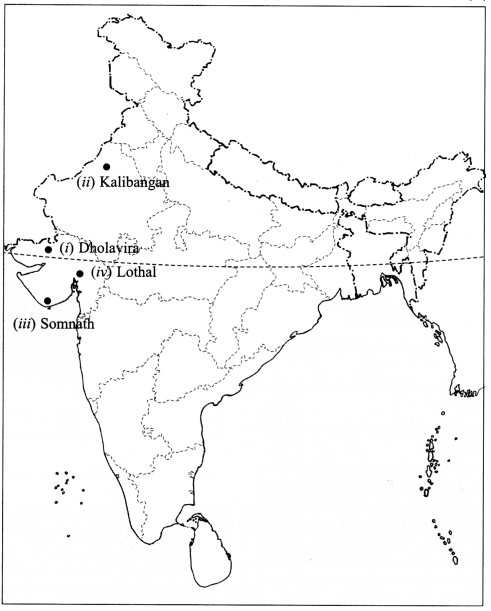
Class 9 Early Humans and Beginning of Civilisation Extra Questions for Practice
Multiple Choice Questions
Question 1.
Which of the following best explains why archaeologists study fossils and artefacts together?
(a) To identify ancient languages.
(b) To reconstruct the lives of early humans.
(c) To locate mineral resources.
(d) To study modem settlements
Question 2.
Which feature of the Harappan Civilisation best reflects an organised system of trade?
(a) Cave paintings
(b) Standardised weights and measures
(c) Mummification
(d) Oracle bones
Question 3.
Which of the following was a major characteristic of the Neolithic Age?
(a) Exclusive dependence on hunting.
(b) Use of iron tools.
(c) Agriculture and permanent settlements.
(d) Development of city-states.
Question 4.
Which ancient civilisation developed the earliest known cuneiform writing system?
(a) Egyptian
(b) Chinese
(c) Mesopotamian
(d) Harappan
Assertion & Reason Questions
Question 1.
Assertion (A): The four major Bronze Age civilisations developed near rivers.
Reason (R): Rivers provided fertile land, water, and routes for transport and trade.
Options:
(a) Both (A) and (R) are true and (R) is the correct explanation of (A).
(b) Both (A) and (R) are true but (R) is not the correct explanation of (A).
(c) (A) is true but (R) is false.
(d) (A) is false but (R) is true.
Fill in the Blanks
1. The preserved remains of ancient plants, animals, or humans are called__________.
2. ______________ is the earliest known Neolithic farming settlement in the Indian subcontinent.
3. The ancient Egyptians wrote on a material known as ______________
4. The stepped temple of Mesopotamia is called a ______________
5. The ______________ script of the Harappan Civilisation has not yet been deciphered.
Very Short Answer Type Questions
Question 1.
Why did Homo erectus occupy an important place in human evolution?
Question 2.
State any two features of the Mesolithic Age.
Question 3.
How did the Harappans ensure fairness in trade?
Question 4.
Why is the Fertile Crescent considered important in the history of early civilisations?
Short Answer Type Questions
Question 1.
Explain the importance of cave paintings in understanding the lives of early humans.
Question 2.
Describe the transition from food gathering to food production during the Neolithic Age.
Question 3.
Explain the role of seals in the Harappan Civilisation.
Question 4.
Describe the major features of Egyptian religious beliefs as mentioned in the chapter.
Long Answer Type Questions
Question 1.
Explain the gradual development of tool-making technology from the Paleolithic Age to the Chalcolithic Age.
Question 2.
Describe the important archaeological discoveries at Mehrgarh and explain what they reveal about early human life.
Question 3.
Compare the major features of the Sindhu-Sarasvatl, Mesopotamian, Egyptian, and Chinese civilisations.
Question 4.
Explain how the development of agriculture, writing, trade, and organised settlements contributed to the rise of early civilisations.