Students often refer to Maths Mela Class 5 Solutions Chapter 15 Data Through Pictures Question Answer NCERT Solutions to verify their answers.
Class 5 Maths Chapter 15 Data Through Pictures Question Answer Solutions
Data Through Pictures Class 5 Maths Solutions
Class 5 Maths Chapter 15 Solutions
Child TV Reporter (Pages 179-180)
Samaira and Kabir decided to act like reporters and collect information from their friends.

They collected data from 35 friends and recorded it in a notebook as shown below.


Answer:

Look at the table and answer the following questions:
Question 1.
How many children watch TV for more than half an hour?
Answer:
35 – 9 = 26 Children
Question 2.
How many children watch TV for less than two hours?
Answer:
9 + 13 + 7 = 29 Children

Question 3.
The number of children who watch TV for more than two hours is _____
Answer:
3 Children
Question 4.
More children watch TV for two hours than half an hour. (True/False)
Answer:
False
Stock-Taking in a Shop (Pages 180-181)
Dipesh, one of his helpers, suggested using one picture (icon) for every 5 items of each kind.
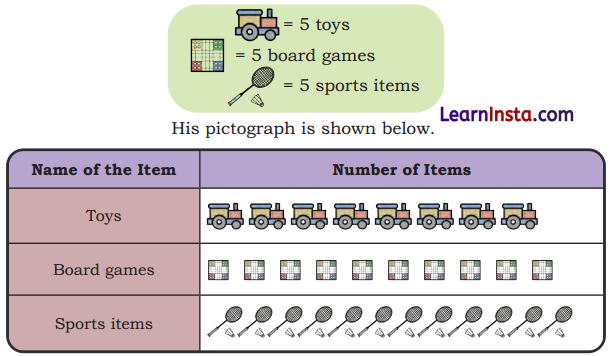
Dipesh used a scale while recording the items in the pictograph. A scale helps record a large number of things using fewer icons.
Now, answer the following questions based on the above pictograph.
(1) How many toys does Joseph Uncle have? _____
(2) How many board games does Joseph Uncle have? _____
(3) How many total play items does Joseph Uncle have? _____
Is there any other scale that you can use to make the pictograph? Choose your scale and show the same data using a pictograph in your notebook.
Answer:
(1) Total toys = 5 × 8 = 40
(2) Total board games = 5 × 10 = 50
(3) Total play items = 40 + 50 + 6 × 10 = 90 + 60 = 150

Two-wheelers on the Road
Deepti noted down the number of two-wheelers passing her house in one hour on three different days.
She used one icon to show 3 two-wheelers.
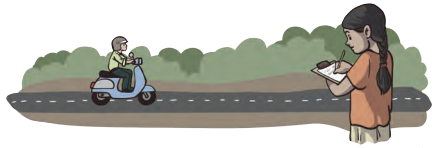

Observe the pictograph and answer the following questions.
1. Which day had the most two-wheelers passing her house? _____
Answer:
Friday
2. How many total two-wheelers did she record over three days? _____
Answer:
Total two wheelers = 3 × 24 = 72
3. How many fewer two-wheelers were seen on Wednesday than on Monday? _____
Answer:
Required two wheelers = (8 – 4) × 3 = 4 × 3 = 12
4. How many more two-wheelers were seen on Friday than on Wednesday? _____
Answer:
Required two wheelers = (12 – 4) × 3 = 8 × 3 = 24
5. Choose any other scale and represent the same data using a pictograph in your notebook.
Answer:

Recording a Day (Pages 182-183)
One day Raman and Sheela decided to record how they spent their day.
Raman recorded his daily routine in the table below.

Sheela recorded her routine in the following manner.

How is Sheela’s recording different from Raman’s recording? Discuss in class.
Answer:
Sheela’s way of recording the data is called a bar graph. And Raman’s way of recording the data is called pictograph.
Observe Raman’s and Sheela’s routines and answer the following questions.
1. Whose daily routine shows more time spent on sleeping? _____
Answer:
Raman
2. Who spends more hours in the school? _____
Answer:
Sheela
3. How many more hours does Sheela spend studying compared to Raman? _____
Answer:
Total time = 4 – 2 = 2 Hours
4. Is there any activity on which they spend the same amount of time? If yes, name the activity _____
Answer:
No such activity
5. Based on their data, whose routine do you think is more balanced? Why? _____
Answer:
Sheela because she is taking out ample amount of time for all the activities.
Day in My Life (Pages 183-184)
Record your daily routine (24 hours) in hours and minutes, as necessary. Note the time spent on activities like sleeping, studying, playing, eating, and others.

Answer:

Make a bar graph of the time you spend on different activities in the space given below.

Answer:

Food Wastage in the School Canteen (Pages 185-186)
Rani stays in a residential school. Her school’s dining hall displays the amount of food wasted and the number of children the food could have fed.

Answer:
Food wastage is when we throw away the food that we can eat. We can reduce it by only taking what we can finish and saving leftover for another meal. We can donate leftover food people.
Given below is the data collected over the weekdays for different food items.

Rani was shocked to see the data. What do you think about food wastage? How can we reduce the wastage of food? What can we do with the leftover food?
Observe the above graph and answer the following questions.
1. Which food item had the highest amount of wastage? _____
Answer:
Khichdi
2. Which food item had the least amount of wastage? _____
Answer:
Idli Sambhar
3. How much total food wastage was recorded in these days? _____
Answer:
Total wastage = 5 + 6 + 8 + 7 + 4 = 30kg
4. If 1 kg of food waste can feed 3 children, how many children could have been fed with the total food wasted? _____
Answer:
Total food wasted = 3 × 30 = 90 Children
5. _____ day had less food wastage than _____ day.
Answer:
Friday, Monday
6. If the same food items are to be repeated next week, can you predict which food item is likely to be wasted the most?
Answer:
Khichdi
True or False (Page 187)

Observe the above picture carefully. Based on your observation, find out which of the following statements are true or false.
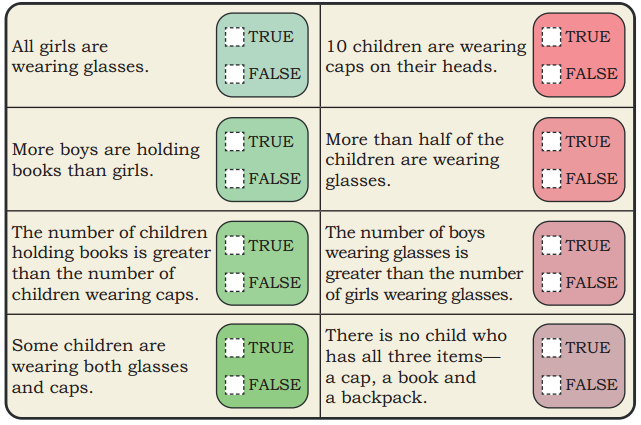
Answer:
