Teachers guide students to use Exploring Society India and Beyond Class 7 Solutions and Class 7 Social Science SST Chapter 3 Climates of India Question Answer NCERT Solutions for quick learning.
Class 7 Social Science Chapter 3 Question Answer Climates of India
NCERT Class 7 Social Science Chapter 3 Climates of India Questions and Answers Solutions
Climates of India Class 7 Question Answer (In-Text)
The Big Questions? (Page 1)
Question 1.
What makes India’s climate so diverse?
Answer:
India’s climate is so diverse because of its varied landforms and natural features. The Himalayas and Karakoram Range block cold winds from Central Asia, keeping northern India warmer in winter. India’s large north-south stretch causes temperature differences: southern regions are warmer, while northern regions are cooler. The monsoon winds bring heavy rain in summer and dry weather in winter. Coastal areas have mild climates due to the sea, while inland regions like Delhi experience extreme heat in summer and cold in winter. The Thar Desert is hot and diy, and the Deccan Plateau has a moderate climate. This mix of mountains, deserts, seas, and winds makes India’s climate diverse.
Question 2.
What are the monsoons? How are they formed?
Answer:
Monsoons are seasonal winds that bring heavy rain to India and South Asia. They occur due to temperature differences between the land and the sea. In summer, the land heats up faster, creating low pressure. Moist winds from the ocean blow towards the land, bringing rain from June to September. In winter, the land cools faster, creating high pressure. Dry winds blow from the land to the sea, causing little rain, along the Tamil Nadu coast. This change in wind direction between summer and winter creates the monsoon season.
Question 3.
What is the effect of climate on economy, culture and society?
Answer:
Climate has a significant impact on India’s economy, culture, and society:
- Economic Impact: Agriculture in India depends on the monsoon. Sufficient rainfall supports crops and rural employment, but a failed monsoon causes poor harvests, water shortages, higher food prices, and migration to cities for work.
- Cultural Impact: Many Indian festivals, such as Baisakhi, Pongal, and Onam, are closely linked to the seasons and agricultural cycles. These celebrations reflect the deep connection between climate and cultural traditions.
- Social Impact: Climate influences people’s daily lives, including their clothing, housing, and toutines. For instance, in colder regions, homes are built to retain heat and people wear warm clothes, while in hotter areas, people prefer light clothing and adjust their activities to avoid the midday heat.

Question 4.
How can understanding the climate help us to prepare for natural disasters?
Answer:
Understanding the climate helps us prepare for natural disasters because it tells us when bad weather might happen. For example, if we know the monsoon season is coming, we can get ready for heavy rain and floods by fixing river bank, and making sure the drainage systems are working. In areas where cyclones happen, knowing how the weather works can help us give warnings, so that people may move to safer places. Also, by understanding when droughts might occur, we can conserve water and plan its better use and save crops. So, knowing the climate helps us stay safe and protect our homes and farms.
Question 5.
What is climate change? What are its consequences?
Answer:
Climate change refers to long-term shifts in weather patterns, mainly caused by human activities like burning fossil fuels and deforestation. These activities release greenhouse gases, trapping heat and raising temperatures. The consequences of climate change are wide-ranging. Rising temperatures lead to heatwaves, while melting glaciers cause sea levels to rise. Extreme weather events like floods and droughts become more frequent. Agriculture faces challenges, resulting in crop failures and food insecurity. Climate change also threatens biodiversity, increases health risks, and poses significant challenges to the environment, economy, and human health.
Let’s explore
Question 1.
Which are your favourite seasons? Write a short essay explaining your reasons? (Page 47)
Answer:
I enjoy autumn and winter the most. Autumn. with its cool air and golden leaves, feels refreshing. The weather is just right, not too hot or cold, making it perfect for outdoor activities. I love how the leaves change colour, creating a beautiful atmosphere. Winter is another favourite of mine because it brings a sense of peace and warmth. I enjoy cosy drinks, wearing thick sweaters, and curling up in a blanket. Winter also means holidays and family gatherings, which make the season special. The quietness of winter offers a chance to relax and appreciate simpler things. Both seasons provide a welcome break from the heat and offer unique joys, making them the most enjoyable for me.
Question 2.
Discuss in groups of three or four and find out whether there are specific events connected to the seasons in your region. Collect information about them songs, feasts with specific types of food, practices in different seasons, etc. Document these and share your discoveries with your class. (Page 47)
Answer:
(Suggestive answer) We discussed seasonal festivals in our region and how they are linked to the changing weather and local traditions.
First, we discussed about Makar Sankranti. Makar Sankranti is a popular festival celebrated every year in January. The festival is dedicated to the Sun God and is considered very auspicious. People celebrate by flying kites, preparing traditional sweets like Ladoos made of sesame seeds and jaggely and taking holy dips in rivers. Different states have unique ways of celebrating it, I such as Pongal in Tamil Nadu and Lohri in Punjab. Makar Sankranti symbolises hope prosperity and new beginnings.
For spring, we discussed Basant Panchami. which celebrates the arrival of spring. People wear yellow clothes, fly kites, and pray to Goddess Saraswati. Yellow sweets and sweet rice are commonly prepared. Lastly, we talked about Onam, a harvest festival in Kerala that marks the end of the monsoon. It’s a time for thanksgiving for a good harvest. People decorate their homes with flower rangolis )Pookalam) and enjoy a grand feast, Onasadya. with traditional dishes. The festival also includes boat races and cultural performances.
Question 3.
Do you know which trees in your area change colours before the onset of winter? Are there trees that shed their leaves around this time? Why do you think this happens? Find out and document the local names of these trees. (Page 47)
Answer:
In Delhi. many trees change colour or shed their leaves before winter. The Amaltas (Cassia fistula), known for its yellow flowers, I begins to dry before winter. The Peepal (Ficus religiosa) sheds its leaves during the cold months to save water. Another is the Gulmohar (Delonix regia), which drops its leaves as temperatures fall. These trees, also called Ainaltas, Peepal. and Gulmohar locally, reflect seasonal changes and add to the natural beauty of Delhi.
Question 4.
Udhagamanda lam (Ooty) and Coimbatore are almost at the same latitude. The range of summer temperatures in Ooty is 10 – 25° while that in Coimbatore is 25 – 38°. Why do you think there is such a difference in temperature between these two places? (Page 51)
Answer:
Though Ooty and Coimbatore are at nearly the same latitude, their temperature difference is due to altitude. Ooty, located at a higher elevation, has cooler temperatures, ranging from 10 to 25°C, as higher altitudes are cooler. Coimbatore, at a lower altitude, experiences warmer temperatures, ranging from 25 to 38°C. The difference in altitude and the ability of cooler air to flow in the hills of Ooty explains the temperature variation.
Question 5.
Since the ability to predict the monsoon rainfall has been an important aspect of life in India, our ancestors observed nature around them carefully. They developed local traditional knowledge through their experience. Thistraditional knowledge is an important heritage we must preserve. For example, fishermen on the Konkan coast predict the onset of monsoon when fishes ha normally stay under water are seen at the surface; in parts of southern India monsoon is set to arrive within 50 days after Golden Shower tree (Cassia fistulo..) blossoms. Some communities also believe that when crows build their nests high on tree-tops it indicates less rainfall, whereas If the nests are lower, rainfall is likely to be heavy. Make a list of such local knowledge about rain, fog, snow, or hail in your area.
Answer:
In Delhi and nearby regions, traditional weather knowledge has been passed down through generations. For rain predictions, pigeons bathing in dust or sparrows chirping loudly often signal rain, while ants moving indoors and termite swarms in summer evenings are also signs of rainfall. A reddish sky at sunset suggests dry weather, while a greyish sky signals rain. In winter, heavy morning dew indicates clear weather, while no dew may mean fog. Sudden chilly winds in spring or dark greenish clouds are seen as signs of an approaching hailstorm. These observations reflect the wisdom of people who closely observed nature to predict weather changes.
Question 6.
Reach out to your grandparents or elders in your neighbourhood. Ask them about the traditional festivals and dances they remember from their childhood and youth, especially those related to agriculture and rain. What rituals did they participate In? Then organise a culturalfest with yourfrrends. You can showcase some of the dances, songs, and activities your elders shared with you. Whether it is a dance, harvest ritual, or a simple story about prayer to rain gods, bring these traditions to life for try to your classmates. (Page 56)
Answer:
(Suggestive Answer) I spoke to my grandparents and local elders about traditional festivals and dances related to agriculture and rain. They shared stories of festivals like Baisakhi and Makar Sankranti, where people celebrated the harvest and prayed for rain, Dances like Garba and Bhangra were performed, and rituals like praying to the rain god were common. These festivals are still celebrated today, but the practices have changed. After gathering this information, my friends and I organised a cultural fest where we performed dances, sang songs, and shared these traditions, keeping the customs alive for the next generation.
Question 7.
Have you seen or read about floods? Look at the physical map of India. Discuss in pairs why you think floods occur in the areas mentioned above. (Page 60)
Answer:
Yes, I have seen and read about floods. There can be many reasons for floods in these areas such as, excessive rainfalls, poor drainage, mismanagement of resources by the officials, low-lying areas are more prone to flooding as water collects there more easily. Urbanisation, construction in floodplains, deforestation, and blocking the natural flow of water can also worsen floods. Areas near rivers, such as the Ganges, the Brahmaputra, and the Yamuna, are particularly at risk as these rivers can overflow during heavy rain or when glaciers melt.
Question 8.
Observe fig. 3.15. Describe the effects they may have on people, plants, animals and economic life. (Page 62)
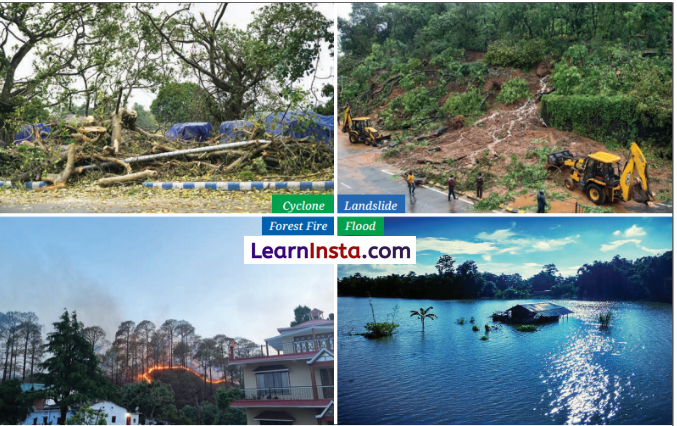
Answer:
Natural disasters cause widespread destruction. People may lose their lives, homes, and livelihoods. Plants. are uprooted or damaged, affecting crops and forest’s. Animals may die or loose their habitats. Economically, disasters disrupt industries, damage infrastructure and lead to heavy financial losses, affecting both local and national economies.
Question 9.
In groups of four or five, Identify in each of the above disasters the part of natural causes and the part of human causes. Compare your conclusions. (Page 62)
Answer:
The disasters shown in the pictures are: Cyclone, landslide, forest fire and flood. Cyclones are violent storms with strong winds and heavy rains. They cause massive destruction to homes, crops and infrastructure. Coastal areas face flooding and erosion. People may lose their lives or be displaced. Cyclones also harm animals and disrupt communication, transport and electricity, affecting the overall economy and daily life.
Landslides destroy houses, block roads, and uproot vegetation. They can injure people, displace wildlife, and cause costly damage to property and transport. Forest Fire destroy large areas of vegetation, killing plants and wildlife. They release harmful smoke, affecting air quality and human health. People living nearby may lose homes and livelihoods. Soil fertility reduces, and water sources get polluted. Forest fires also contribute to climate change by releasing carbon dioxide.
Floods damage homes, roads, and crops. People may face displacement and diseases, while plants rot, and animals lose habitats. Economically, floods disrupt agriculture and infrastructure. All these disasters pose serious risks, affecting lives, nature, and economies. Note: Students to compare their conclusions among themselves.
Question 10.
Discuss in the same groups series of preventive measures that could help avoid the above disasters. (Page 62)
Answer:
Preventive measures to avoid disasters. like cyclones, landslides, forest fires and floods are: Planting trees, avoiding deforestation and building strong ernbankments help prevent floods and landslides. Early warning systems and cyclone shelters save lives during cyclones. Controlled burning and firebreaks reduce forest fire risks. Proper drainage, awareness programs, and disaster management plans are essential to minimise the impact of such natural disasters.
Class 7 SST Chapter 3 Climates of India Question Answer (Exercise)
Questions and Activities (Page 65-66)
Question 1.
Match the climatic factors with their effects.
| Column A | Column B |
| 1 Latitude | (a) Brings wet air to India during summer |
| 2. Altitude | (b) Creates different climates in the north and south |
| 3. Proximity to the ocean | (c) Keeps higher places cooler |
| 4. Monsoon winds | (d) Moderates the temperature |
Answer:
| Column A | Column B |
| 1. Latitude | (b) Creates different climates in the north and south |
| 2. Altitude | (c) Keeps higher places cooler |
| 3. Proximity to the ocean | (d) Moderates the temperature |
| 4. Monsoon winds | (a) Brings wet air to India during summer |
Question 2.
Answer the following questions:
(a) What is the difference between weather and climate?
(b) Why do places near the ocean have milder temperatures than places far away from it?
(e) What role do monsoon winds play in affecting India’s climate?
(d) Why is Chennai warm or hot throughout the year, while Leh is cold?
Answer:
(a) Weather is the condition of the atmosphere in a place over a short period, like hours or days, and can change quickly. Climate is the average weather in a place over a long’ time, usually years, and follows a stable pattern.
(b) Places near the ocean have milder temperatures because the ocean heats up and cools down slowly. This helps keep coastal areas cooler in summer and warmer in winter, while places far from the ocean experience more extreme temperatures.
(c) Monsoon winds are very important for India’s climate. In summer, they blow from the ocean towards the land, bringing heavy rain that helps crops grow and fills rivers. In winter, they blow from the land towards the ocean, bringing cool and dry weather. These winds strongly affect India’s weather throughout the year.
(d) Chennai is hot throughout the year because it is very near to the equator and is at a low altitude. Moreover, its proximity to the sea keeps the weather warm. Leh, on the other hand, is in the mountains at a high altitude, where temperatures are colder because the air is cooler, and the region receives less heat from the sun.
Question 3.
Look at the map of India given at the end of the book. Identify the climate for these cities: Leh, Chennai, Delhi, Panaji, and Jaipur.
(a) Is the place near the sea, near the mountains, or in the desert?
(b) How do these factors affect the climate there?
Answer:
Here’s the climate identification for the cities Leh, Chennai, Delhi, Panaji, and Jaipur:
1. Leh: Location: In the mountains (Ladakh region, Himalayas)
Climate: Cold desert climate; very cold winters, dry and cool summers.
Effect of Location: High altitude leads to low temperatures and dry air. Snowfall in winter is common.
2. Chennal: Location: Near the sea (Bay of Bengal)
Climate: Tropical wet and dry; hot. and humid most of the year.
Effect of Location: Proximity to the sea keeps temperatures moderate but increases humidity. Rainfall from northeast monsoon is common.
3. Delhi: Location: Inland, on the plains
Climate: Extreme climate; very hot summers and very cold winters.
Effect of Location: Being inland, Delhi lacks moderating influence of the sea, leading to wide temperature variations.
4. Panaji: Location: Near the sea (Goa, Arabian Sea coast)
Climate: Tropical monsoon; hot and humid with heavy rainfall in monsoon.
Effect of Location: Sea moderates temperature; high humidity and heavy rain due to monsoons.
5. Jaipur: Location: Near the desert (Rajasthan, Thar Desert region)
Climate: Semi-arid; hot summers and mild winters.
Effect of Location: Desert proximity causes high summer temperatures and low humidity; rainfall is limited.
Question 4.
Draw the monsoon cycle In summers and winters on a map of India.
(a) Label where the winds blow in summer and winter.
(b) Show the direction of winds during the monsoon.
Answer:
(a) & (b)

Question 5.
Make a colourful poster showing festivals in India linked to farming and weather (e.g., Baisakhl, Onam). Add pictures or drawings of these festivals.
Answer:

Question 6.
Imagine you are a farmer In India. Write a short diary entry about how you would prepare for the rainy season.
Answer:
Dear Diary,
Today I started getting ready for the rainy season. I cleared the drains in my fields to stop water from flooding and made small ditches to carry extra water away. I added manure to make the soil better and tied my young trees to sticks so they don’t fall. I’m planting paddy and maize because they grow well in the rain. I have bought seeds, fertilisers, and made sure my tools are sharp. I also cleaned my cattle’s shelter, put in dry hay, and stored some extra fodder. I asked the village elders for advice. They told me to plant crops before the first heavy rain. I hope the monsoon arrives on time this year.
Question 7.
Identify a natural disaster (e.g.,cyclone, flood, landslide, or forest fire) and write a short essay that Includes the causes and Impacts. Suggest actions that individuals, communities and the government can take to reduce the impact.
Answer:
Cyclones are powerful storms with strong winds and heavy rain that form over warm ocean waters. They are caused by low-pressure systems that draw in moist air, which rises, cools, and forms clouds, creating a spinning storm. Cyclones can cause severe damage by flooding coastal areas, destroying homes, and uprooting trees. They can also lead to power cuts and loss of life. To reduce cyclone risks, people should stay informed through weather updates, secure their homes, and keep emergency supplies ready. Communities can build cyclone shelters and run awareness programmes. The government should develop strong warning systems, improve coastal protection, and ensure quick disaster response. Working together can help reduce cyclone damage.