Students can use Curiosity Class 8 Science Book Solutions Chapter 6 Pressure, Winds, Storms, and Cyclones Class 8 Question and Answer as a quick reference guide.
Class 8 Science Chapter 6 Pressure, Winds, Storms, and Cyclones Question Answer
Science Class 8 Chapter 6 Question Answer Pressure, Winds, Storms, and Cyclones
Pressure, Winds, Storms, and Cyclones Class 8 Question Answer (InText)
Question 1.
Probe and ponder (Page 80)
- Why are winds stronger on some days than on others?
- Why are water tanks usually placed at a height?
- Can air pressure really crush us?
- What causes storms and cyclones? If the Earth stopped rotating, would cyclones still form?
- Share your questions
……………………………………………………..
……………………………………………………..?
Answer:
(Questions may vary)
(i) Why are the walls of a dam thicker at the bottom than at the top?
(ii) Why does a cyclone lose strength after reaching land?
(iii) Why do people use cloth pads on their heads while carrying heavy loads?

Question 2.
What can you conclude from your observations in Table 6.1? (Page 82)
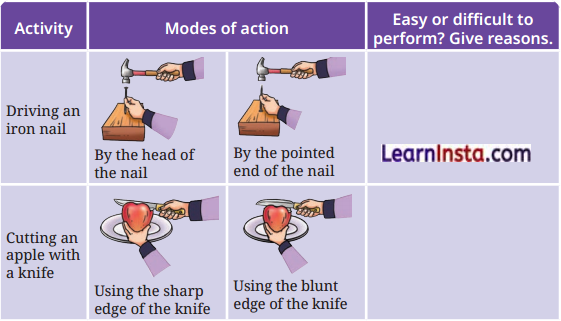
Answer:
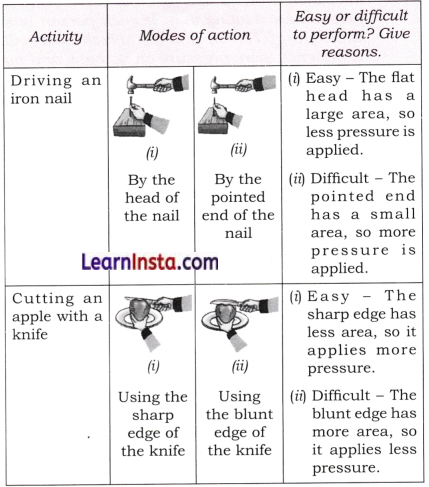
Question 3.
Do liquids also exert pressure? (Page 83)
Answer:
Yes, liquids exert pressure in all directions.
Question 4.
What will happen to the bulge of the balloon if we increase the height of the water column? (Page 84)
Answer:
If we increase the height of the water column, the bulge of the balloon increases because pressure at the bottom of the pipe increases with the height of the water.
Question 5.
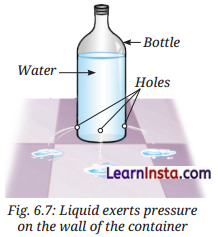
Do liquids also exert pressure on the walls of the container? (Page 84)
Answer:
Yes, liquids exert pressure not only at the bottom but also on the walls of the container.
Question 6.
Does the difference in air pressure have anything to do with the formation of winds? (Page 88)
Answer:
Yes, winds are formed due to the difference in air pressure. This movement of air from high pressure to low pressure creates wind.
Question 7.
How do winds form? (Page 88)
Answer:
Winds form because air moves from areas of high pressure to areas of low pressure. This movement of air causes the wind.
Question 8.
How can high-speed winds blow off roofs? (Page 89)
Answer:
High-speed winds create a low-pressure area above the roof, while the air pressure below the roof remains higher. This pressure difference can lift and blow off the roof.
NCERT Class 8 Science Chapter 6 Question Answer Pressure, Winds, Storms, and Cyclones (Exercise)
Keep the curiosity alive (Pages 63-65)
Question 1.
Choose the correct statement.
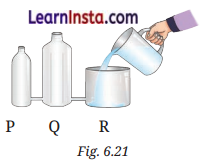
(i) Look at Fig. 6.21 carefully. Vessel $R$ is filled with water.
When pouring of water is stopped, the level of water will be ……………
(a) the highest in vessel P
(b) the highest in vessel Q
(c) the highest in vessel R
(d) equal in all three vessels
(ii) A rubber sucker (M) is pressed on a flat smooth surface and an identical sucker (N) is pressed on a rough surface:
(a) Both M and N will stick to their surfaces.
(b) Both M and N will not stick to their surfaces.
(c) M will stick but N will not stick.
(d) M will not stick but N will stick.
(iii) A water tank is placed on the roof of a building at a height ‘H’. To get water with more pressure on the ground floor, one has to…………..
(a) increase the height ‘H’ at which the tank is placed.
(b) decrease the height ‘H’ at which the tank is placed.
(c) replace the tank with another tank of the same height that can hold more water.
(d) replace the tank with another tank of the same height that can hold less water.
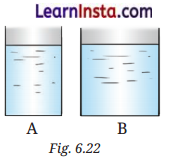
(iv) Two vessels, A and B contain water up to the same level as shown in Fig. 6.22. PA and PB is the pressure at the bottom of the vessels. FA and FB is the force exerted by the water at the bottom of the vessels A and B.
(a) PA=PB, FA=FB
(b) PA=PB, FA<FB
(c) PA<PB, FA=FB
(d) PA>PB, FA>FB
Answer:
(i) (d) equal in all three vessels
(ii) (c) M will stick but N will not stick.
(iii) (a) increase the height ‘ H ‘ at which the tank is placed.
(iv) (b) PA>PB, FA< FB
Question 2.
State whether the following statements are True [T] or False [F].
(i) Air flows from a region of higher pressure to a region of lower pressure. [ ]
Answer:
True
(ii) Liquids exert pressure only at the bottom of a container. [ ]
Answer:
False
(iii) Weather is stormy at the eye of a cyclone. [ ]
Answer:
False
(iv) During a thunderstorm, it is safer to be in a car. [ ]
Answer:
True
Question 3.
Fig. 6.23(a) shows a boy lying horizontally, and Fig. 6.23(b) shows the boys standing vertically on a loose sand bed. In which case does the boy sink more in sand? Give reasons.

Answer:
In Fig. 6.23 (b) When standing vertically, the boy’s weight is concentrated on a smaller area (his feet), which increases the pressure exerted on the sand. Higher pressure causes the sand to give way more, making him sink deeper. When lying horizontally, the boy’s weight is spread over a larger surface area, reducing the pressure on the sand and causing him to sink less.
Question 4.
An elephant stands on four feet. If the area covered by one foot is 0.25 m2, calculate the pressure exerted by the elephant on the ground if its weight is 20000 N.
Answer:
Given:
Weight (Force applied) of the elephant, F =20000N
Area of one foot, Afoot =0.25m2
Number of feet = 4
Total area of 4 feet in contact with the ground
Atotal=4 ×0.25=1.0m2
Now, Pressure =\(\frac{\text { Force }}{\text { Area }}\)
\(\mathrm{P}=\frac{\mathrm{F}}{\mathrm{~A}_{\text {total }}} \\\)
\(\mathrm{P}=\frac{20000 \mathrm{~N}}{1.0 \mathrm{~m}^2} \\\)
P=20000Pa
Hence, the pressure exerted by the elephant on the ground is 20000 Pascal (Pa).
Question 5.
There are two boats, A and B. Boat A has a base area of 7 m2, and 5 persons are seated in it. Boat B has a base area of 3.5 m2, and 3 persons are seating in it. If each person has a weight of 700 N , find out which boat will experience more pressure on its base and by how much?
Answer:
Given:
Boat A base area, AA=7m2
Number of persons in Boat A =5
Boat B base area, AB=3.5 m2
Number of persons in Boat B=3
Weight of each person =700 N
Total weight on Boat A: WA=5 ×700=3500N
Total weight on Boat B: WB=3 ×700=2100 N
The pressure exerted on the base of each boat
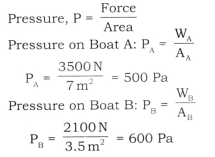
Hence, Boat B experiences more pressure on its base by 100 Pa.
Question 6.
Would lightning occur if air and clouds were good conductors of electricity? Give reasons for your answer.
Answer:
Lightning occurs because air usually acts as an insulator. This prevents the positive and negative charges from meeting immediately. Where the build-up of charges becomes very large, the insulating property of air breaks down, and a sudden flow of charges occurs – this is what we see as lightning. If air and clouds were good conductors, the charges would flow continuously and gradually instead of building up. Therefore, no sudden discharge would take place, and lightning would not occur.
Question 7.
What will happen to the two identical balloons A and B as shown in Fig. 6.24 when water is filled into the bottle up to a certain height. Will both the balloons bulge? If yes, will they bulge equally? Explain your answer.

Answer:
As water is poured into the bottle, it exerts equal pressure in all directions. This pressure causes air to be pushed into both balloons, making them bulge equally due to equal pressure being applied.
Question 8.
Explain how a storm becomes a cyclone.
Answer:
A storm becomes a cyclone through a continuous cycle of rising warm, moist air and the Earth’s rotation. It happens in the following steps.
- Warm ocean water heats the air above it.
- The warm, moist air rises, creating a lowpressure area.
- As the air rises, water vapour condenses into raindrops and releases heat.
- This released heat warms the surrounding air, causing more air to rise.
- Surrounding air rushes in to fill the lowpressure area, and this air also starts rising.
- The Earth’s rotation causes the moving air to spin.
- This process continues, creating a spinning system of clouds, wind, and rain-a cyclone.
- The eye of the cyclone is the region of the lowest pressure and is calm, while the surrounding areas experience strong winds and heavy rain.
Question 9.
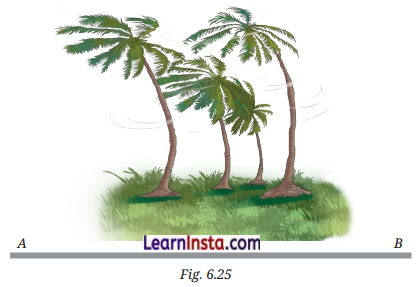
Fig. 6.25 shows trees along the sea coast in a summer afternoon. Identify which side is land – A or B. Explain your answer.
Answer:
During the day, land heats up faster than water. The air above the land in a summer afternoon (side A) becomes warmer and lighter, creating a low-pressure area.
The cooler, high-pressure air from the sea (side B ) blows towards the land, creating a sea breeze.
The direction in which the trees are bending indicates the wind is blowing from the sea (B) to the land (A).
Thus, based on wind direction and pressure differences, A is land and B is sea.
Question 10.
Describe an activity to show that air flows from a region of high pressure to a region of low pressure.
Answer:
Activity: Air flows from high to low pressure
- Take two balloons and a straw.
- Attach one balloon to each end of the straw
- Inflate one balloon, leave the other uninflated.
- Connect both tightly so no air escapes.
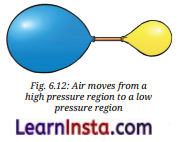
Observation: Air moves from the inflated (high-pressure) balloon to the uninflated (lowpressure) one. Both balloons eventually become similar in size.
Conclusion: Air flows from high pressure to low pressure.
Question 11.
What is a thunderstorm? Explain the process of its formation.
Answer:
A thunderstorm is a storm that is accompanied by lightning, thunder, strong winds, and rain. The process of formation is as follows:
- Warm and moist air rises, creating a low pressure area.
- Cool air from surrounding high-pressure areas moves in.
- The rising air expands and cools, and moisture condenses to form clouds.
- Water droplets combine to form heavier drops, which fall as rain, hail, or snow.
- Strong winds moving upwards and downwards cause rubbing of water droplets and ice particles.
- This rubbing produces electric charges in the clouds.
- When opposite charges collide within a clouds or between clouds and the ground it results in lightning which rapidly heats up the air around it. Causing air to expand and produce a loud thunder which along with storm results in a thunderstorm.
Question 12.
Explain the process that causes lightning.
Answer:
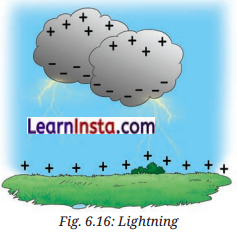
A flash of light caused by the sudden discharge of electricity between clouds or between a cloud and the Earth. During a storm, water droplets and ice inside clouds rub against each other and get charged. Positive charges collect at the top of the cloud and negative charges at the bottom. The negative charges at the bottom of the cloud attract positive charges on the ground. When the difference becomes large, electricity suddenly flows through the air, which acts as an electrical insulator, causing lightning.
Question 13.
Explain why holes are made in banners and hoardings.
Answer:
Holes are made in banners and hoardings to reduce air pressure on them. When wind blows, air exerts pressure on these surfaces. The holes allow air to pass through, reducing the force of wind and preventing the banners and hoardings from tearing or falling.
Class 8 Pressure, Winds, Storms, and Cyclones Question Answer (Activities)
Activity 6.1: Let Us Try And Find Out (Pages 83-84)
Aim: To investigate how the height of a liquid column affects the pressure it exerts, and to observe that this pressure is independent of the container’s diameter.
Case I: When the height of the liquid column is same in both pipes.

Observation:
- When both pipes are filled with water to the same height, the balloons at the bottom of both pipes bulge out.
- The extent of bulging is same in both balloons, even though the pipes have different diameters.
Conclusion:
- The bulging of the balloons is not due to the weight of the water, but due to the pressure exerted by the water column.
- Pressure in a liquid depends only on the height of the liquid column, not on the diameter.
Case II: When the height of the liquid column is different in both pipes.
Observation: As the water level rises in one of the pipes, the height of the water column increases, and the bulging of the balloon increases with the height.
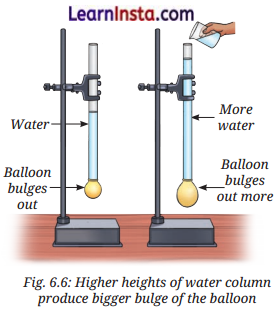
Conclusion: The bulge of the balloon increases as the height of the water column increases. Showing that the pressure exerted by a liquid at the bottom of the pipe increases as the height of the water column increases.
Activity 6.2: Let Us Find Out (Pages 84-85)
Aim: To find out whether liquids exert pressure only at the bottom or also on the sides of a container.
Observation: After removing the tape from all the holes at the same time, water flows out through the holes on the sides of the bottle.
Conclusion: Liquids exert pressure not only at the bottom of the container but also on its sides, indicating that liquids exert pressure in all directions.
Activity 6.3: Let Us Explore (Pages 85-86)
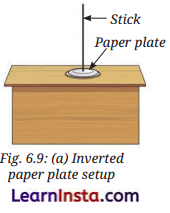
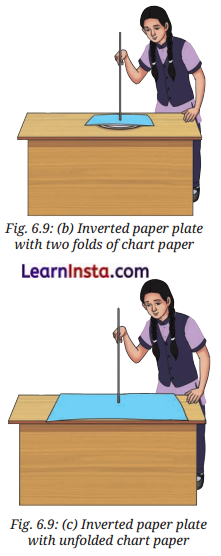
Aim: To explore how air pressure acts on objects and how it varies with surface area.
Observation:
- In Figure 6.9(b), when the paper plate was covered with folded chart paper, it was easier to lift.
- In Figure 6.9(c), when the paper plate was covered with the unfolded chart paper, more effort was required to lift the plate, even though the weight of both sheets was the same.
Conclusion: Air exerts pressure on all objects. When the surface area increases, the total force exerted by the air also increases. This shows that air pressure acts on every part of an object in contact with it.
Activity 6.4: Let Us Perform (Page 87)
Aim: To demonstrate the effect of air pressure by carrying out an activity with a rubber sucker.

Observation:
- When the rubber sucker was pressed firmly against a smooth flat surface, it got stuck to the surface.
- The sucker came off when a strong force was applied.
Conclusion:
- Pressing the rubber sucker pushes out most of the air between the sucker and the surface, which reduces the air pressure inside. The higher air pressure outside then holds the sucker tightly in place.
- To pull the sucker off the surface, the applied force must be strong enough to overcome the pressure difference between outside and inside of the sucker.
Activity 6.5: Let Us Observe (Page 88)
Aim: To observe the movement of air from a region of higher pressure to a region of lower pressure.
Observation:
- When the inflated balloon was connected to the uninflated balloon through a straw, air started moving from the inflated balloon to the uninflated one because the inflated balloon had higher air pressure.
- After some time, both balloons became nearly equal in size, and the air stopped moving.
Conclusion: Air moves from a region of high pressure region to a region of low pressure. The flow of air stops when pressure in both regions become equal.
Activity 6.6: Let Us Observe (Page 89)
Aim: To observe how high-speed winds are accompanied by reduced air pressure.
Observation:
- When air was blown into the space between the two inflated balloons, they started moving towards each other.
- When air was blown harder, the speed at which the balloons moved towards each other increased, the gap between them reduced further, and they came even closer.
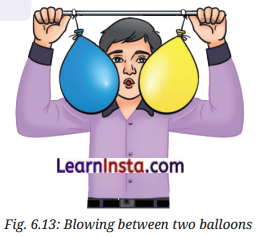
Conclusion:
- Blowing air between two balloons creates a lowpressure region, and the surrounding higher air pressure pushes the balloons toward this region, causing them to move closer.
- We infer that high speed winds are accompanied by a reduced air pressure.