Students can use Curiosity Class 8 Science Book Solutions Chapter 3 Health: The Ultimate Treasure Class 7 Question and Answer as a quick reference guide.
Class 8 Science Chapter 3 Health: The Ultimate Treasure Question Answer
Science Class 8 Chapter 3 Question Answer Health: The Ultimate Treasure
Health: The Ultimate Treasure Class 8 Question Answer (InText)
Question 1.
Probe and Ponder (Page 28)
- How does your body respond to an infection such as common cold?
- We rarely see cases of smallpox or polio these days, but diseases like diabetes and heart problems are more common. Why?
- Could climate change lead to new types of diseases?
Answer:
(Questions may vary)
- Why do some diseases spread faster in crowded areas?
- Can we get infected with the same disease twice? Why or why not?

Question 2.
Are diseases always caused by infections? (Page 35)
Answer:
No, diseases are not always caused by infections. Some diseases are caused by poor lifestyle, genetics, or environmental factors. For example, diabetes, cancer, asthma, etc.
Question 3.
What will happen if I take excess amount of Iodine? (Page 36)
Answer:
Taking too much iodine can cause problems in the thyroid gland, which controls many body functions. It may cause thyroid disorders like hyperthyroidism (when the thyroid becomes overactive) or other health issues such as swelling in the neck, weight loss, or fast heartbeat.
NCERT Class 8 Science Chapter 3 Question Answer Health: The Ultimate Treasure (Exercise)
Keep the curiosity alive(Pages 42-45)
Question 1.
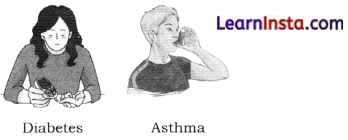
Group the diseases shown in the images as communicable or non-communicable.
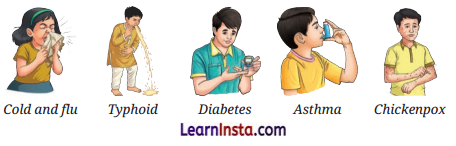
Answer:
Communicable diseases: These diseases can spread from one person to another.
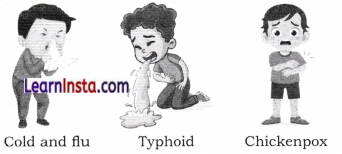
Non-communicable diseases: These diseases do not spread from person to person.
Question 2.
Diseases can be broadly grouped into communicable and non-communicable diseases. From the options given below, identify the non-communicable diseases.
(i) Typhoid
(ii) Asthma
(iii) Diabetes
(iv) Measles
(a) (i) and (ii)
(b) (ii) and (iii)
(c) (i) and (iv)
(d) (ii) and (iv)
Answer:
(b) (ii) and (iii)
Question 3.
There is a flu outbreak in your school. Several classmates are absent, while some are still coming to school coughing and sneezing.
(i) What immediate actions should the school take to prevent further spread?
(ii) If your classmate, who shares the bench with you, starts showing symptoms of the flu, how can you respond in a considerate way without being rude or hurtful?
(iii) How can you protect yourself and others from getting infected in this situation?
Answer:
(i) The school should:
- Inform parents about the flu outbreak.
- Ask all the sick students to stay at home and rest.
- Disinfect classrooms and toilets regularly.
- Remind students to cover their mouth and nose when coughing or sneezing.
- Encourage frequent handwashing and use of sanitisers.
(ii) I can respond in a considerate way by:
- Not making fun of them or being rude, because they might already be feeling uncomfortable.
- Offering to help them with class notes, if they need to rest at home.
- Avoiding close contact, but still being kind and caring.
(iii) I can protect myself and others by:
- Washing my hands regularly with soap or using hand sanitiser.
- Not touching my face frequently, especially my eyes, nose, and mouth.
- Wearing a mask if needed, especially around people who are sick.
- Keeping a safe distance from anyone showing flu symptoms.
- Eating healthy food and getting enough sleep to keep my immune system strong.
Question 4.
Your family is planning to travel to another city where malaria is prevalent.
(i) What precautions should you take before, during, and after the trip?
(ii) How can you explain the importance of mosquito nets or repellents to your sibling?
(iii) What could happen if travellers ignore health advisories in such areas?
Answer:
(i)
- Before the trip, I will ask my family members to pack mosquito nets, mosquito repellents (like creams or sprays), and full-sleeve clothes to wear.
- During the trip, I can use mosquito nets while sleeping and apply mosquito repellent on exposed skin. I can also wear full-sleeve shirts and pants, especially in the evening when mosquitoes are most active. I can ask my parents to avoid staying at places with stagnant water and make sure windows and doors are screened with netting.
- After the trip, I can watch for any signs of illness like fever and visit a doctor if I feel unwell.
(ii) I can explain to my sibling that mosquitoes can spread serious diseases like malaria and dengue. Using a mosquito net while sleeping can stop mosquitoes from biting us at night. Applying repellent on our skin keeps mosquitoes away. These simple preventive measures can protect us and keep us healthy.
(iii) If travellers ignore health advisories, they can get infected with diseases like malaria and dengue. It can also spread to others when they return home.
Question 5.
Your uncle has started smoking just to fit in with his friends, even though it is well known that smoking can seriously harm health and even cause death.
(i) What would you say to him to make him stop, without being rude?
(ii) What would you do if your friend offers you a cigarette at a party?
(iii) How can schools help prevent students from indulging in such harmful habits?
Answer:
(i) I can gently remind him that smoking causes serious diseases like cancer and can even lead to early death. I will explain him that he does not have to smoke to fit in. Real friends will like you for who you are, not for smoking.
(ii) If someone offers me a cigarette, I will politely refuse and say, ‘No, thank you. I do not want to harm my health’. Also, I will walk away from the situation or change the topic. I will also explain to my friend that smoking is dangerous and addictive, and I choose to stay healthy. If they keep forcing me, I will leave and tell a trusted adult later.
(iii) Schools can teach students about the harmful effects of smoking and other harmful habits during health classes. They can invite doctors or experts to give advice. They can plan some awareness campaigns on the dangers of smoking and substance use. Teachers and counsellors can talk to students who are at risk and guide them in the right direction.
Question 6.
Saniya claims to her friend Vinita that “Antibiotics can cure any infection, so we don’t need to worry about diseases.” What question(s) can Vinita ask her to help Saniya understand that her statement is incorrect?
Answer:
Vinita can ask Saniya the following questions to help her understand that antibiotics don’t cure every infection:
- If antibiotics could cure everything, why do some people still get sick even after taking them?
- What do doctors usually say when someone has a viral infection? Do they always prescribe antibiotics?
- Do you know that antibiotics only work against bacterial infections and not viral ones like the flu or common cold?
Question 7.
The following table contains information about the number of dengue cases reported in a hospital over a period of one year:
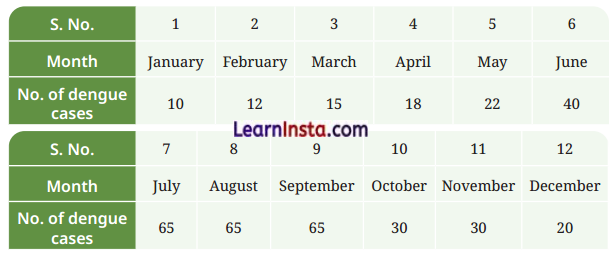
Make a bar graph of the number of cases on the Y-axis and the month on the X-axis. Critically analyse your findings and answer the following:
(i) In which three months were the dengue cases highest?
(ii) In which month(s) were the cases lowest?
(iii) What natural or environmental factors during the peak months might contribute to the increase in dengue cases?
(iv) Suggest a few preventive steps that the community or government can take before the peak season to reduce the spread of dengue.
Answer:
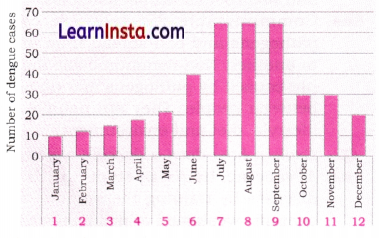
(i) The dengue cases were highest in July, August, and September.
(ii) The dengue cases were lowest in January, February, and March.
(iii) According to the data, the peak months for dengue cases are July, August, and September. These months fall during the monsoon season, when rainwater often collects in open areas, creating stagnant water where mosquitoes breed. The warm and humid weather also help mosquitoes grow faster. Poor drainage and waterlogging during this time increase mosquito breeding, which leads to more cases of dengue.
(iv) Before the peak season, the community and government can clean drains, remove stagnant water, and spray insecticides. People should be advised to cover water containers, use mosquito nets or repellents, and wear full-sleeve clothes. These steps help reduce mosquito breeding and prevent dengue.
Question 8.
Imagine you are in charge of a school health campaign. What key messages would you use to reduce communicable and non-communicable diseases?
Answer:
If I were in charge of a school health campaign, the key messages I would use to help reduce both communicable and non-communicable diseases are:
- Wash hands regularly.
- Cover my mouth when coughing or sneezing.
- Stay home when sick to prevent the spread of infections.
- Follow healthy habits like eating a balanced diet, exercising daily.
- Avoid junk food.
- Eat properly cooked food and drink boiled water.
- Be vaccinated properly.
- Do not smoke or use harmful substances.
I would also put up posters, organise talks, and hold cleanliness drives to spread awareness and keep everyone safe and healthy.
Question 9.
It is recommended that we should not take an antibiotic for a viral infection like a cold, a cough, or flu. Can you provide the possible reason for this recommendation?
Answer:
It is recommended not to take antibiotics for viral infections like cold, cough, or flu because antibiotics only work against bacteria, not viruses. They target the parts of bacterial cells that are different from human or other animal cells. Taking antibiotics when they are not needed can cause antibiotic resistance and the bacteria that were earlier killed are found to survive and multiply again. This makes the infections harder to treat. It can also harm the good bacteria that fight infections in our body. We should take antibiotics only when prescribed by a doctor.
Question 10.
Which disease(s) among the following may spread if drinking water gets contaminated by the excreta from an infected person? Hepatitis A, Tuberculosis, Poliomyelitis, Cholera, Chickenpox.
Answer:
The diseases that may spread if drinking water gets contaminated by the excreta from an infected person are Hepatitis A, Poliomyelitis, and Cholera.
Question 11.
When our body encounters a pathogen for the first time, the immune response is generally low but on exposure to the same pathogen again, the immune response by the body is much more compared to the first exposure. Why is it so?
Answer:
When our body encounters a pathogen for the first time, the immune response is slow and weak because the body takes time to recognise the germs and learn how to fight them. However, if the same pathogen enters the body again, the immune system remembers it and responds more quickly and strongly. This helps the body fight off the infection faster the second time.
Class 8 Health: The Ultimate Treasure Question Answer (Activities)
Activity 3.1 Let Us Read (Page 29)
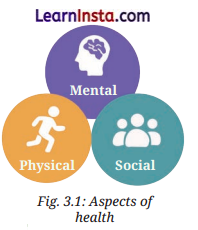
Aim: To understand how loneliness and excessive screen time can affect mental and physical health.
Question: Think and Reflect: What was the cause of the boy’s health problems?
How did his habits and surroundings affect his well-being?
Answer:
The boy’s health problems were caused by loneliness due to new environment, busy parents and too much screen time.
His new surroundings made him feel alone, and using social media more made him feel worse. This affected his sleep, eating, and mental health. Getting help from a counsellor, less screen time and making friends improved his well-being.
Activity 3.2: Let Us List (Page 30)
Aim: To identify good and bad habits that affect our physical and mental health and understand the importance of maintaining healthy habits.
Good habits encouraged by parents, teachers, or elders:
- Keep yourself clean and maintain personal hygiene.
- Eat a healthy and balanced diet.
- Exercise regularly.
- Make time to relax or meditate every day.
- Eat fruits, vegetables, and home-cooked meals.
- Go to bed early and get 7-9 hours of sleep.
- Spend time outdoors or play sports.
- Keep your room and school bag clean.
- Talk to your family and share how your day was.
- Stay calm and think positively, even during tough times.
Habits that are not good for health:
- Spending too much time on mobile phones or other digital screens.
- Eating fast food and other junk food every day.
- Sleeping very late or not getting enough sleep.
- Skipping meals, especially breakfast.
- Not drinking enough water during the day.
- Sitting for long hours without any physical activity.
- Watching TV or using the phone while eating,
- Ignoring studies or leaving things for the last minute
Question:
How many of these are already a part of your daily routine? Which ones would you like to start following?
Answer:
Do it yourself.
Activity 3.3: Let Us Compare (Page 31)
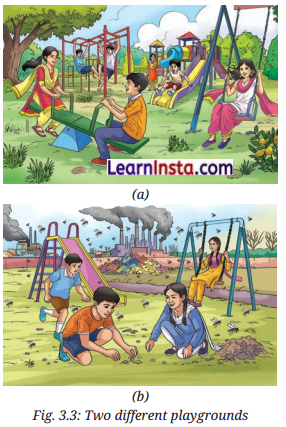
Aim: To compare two playgrounds and understand how cleanliness affects health and the environment.
Question:
Which playground would you like to play in, and why?
Answer:
I would like to play in the playground shown in Fig. (a) because it is clean, green, and safe. The fresh air, trees, and grass make the environment healthy and pleasant. Clean surroundings help prevent diseases and make me feel relaxed and happy while playing. On the other hand, the playground shown in Fig. (b) is dirty and located near a factory that releases a lot of smoke. There is garbage scattered everywhere, and it attracts flies and mosquitoes, which makes it unhygienic and unsafe. The polluted air can cause coughing, asthma and other breathing problems.
Activity 3.4: Let Us Find Out (Pages 33-35)
Aim: To identify common communicable diseases and learn simple steps to prevent their spread.
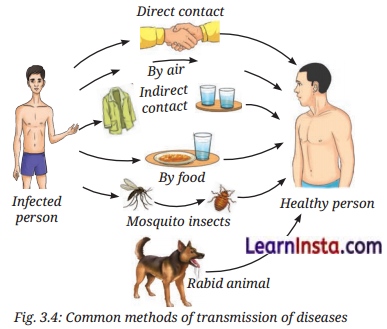
Observation: Do it yourself.
Activity 3.5: Let Us Survey (Page 36)
Aim: To identify common lifestyle-related diseases in the community and learn how lifestyle changes can help prevent or manage them.
Question:
Find out the three most common lifestyle-related diseases in your neighbourhood.
Answer:
- Diabetes
- High blood pressure (Hypertension)
- Obesity
Question:
Talk to a doctor, nurse, health worker or even a family member who knows about health and what kind of lifestyle changes can help prevent or manage these diseases.
Answer:
Do it yourself.
Question:
You can also consult trusted health websites, books, teachers, and doctors.
Answer:
Do it yourself.
Question:
Fill in Table 3.2 and learn more about lifestyle-related diseases.
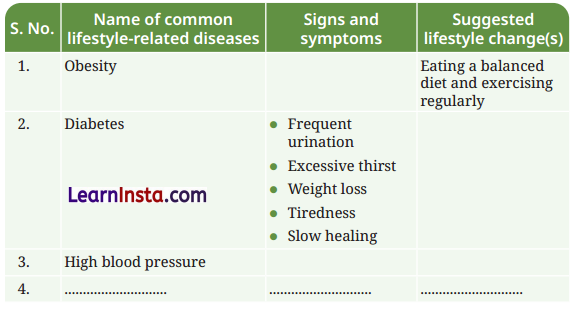
Table 3.2: Non-communicable diseases
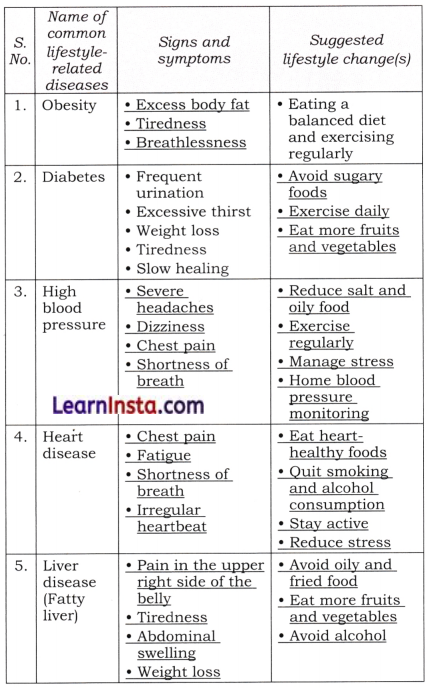
Activity 3.6: Let Us Read (Page 37)
Aim: To understand how community-led sanitation campaigns can improve public health by reducing the spread of communicable diseases.
Odisha – community-led sanitation campaign Do it yourself
Activity 3.7: Let Us Infer (Page 41)
Aim: To understand how antibiotic resistance develops in bacteria and learn precautions to prevent it.
Question:
How do you think the antibiotic resistance has been developed in bacterial pathogens? What precautions may be taken to reduce antibiotic resistance?
Answer:
Antibiotic resistance has developed in bacterial pathogens because some bacteria survive even after taking antibiotics. When we take antibiotics, they kill the bacteria that cause illness, but they also kill the good bacteria that protect our body from infections. Some bacteria can survive the antibiotic treatment by changing themselves.
These bacteria become resistant to the medicine, so the antibiotics no longer work on them. The resistant bacteria do not die, they grow and multiply, making the infection harder to treat. Some of these resistant bacteria can also pass their resistance to other bacteria. This causes more bacteria to become resistant causing serious health problems.
Precautions to reduce antibiotic resistance:
- Take antibiotics only when a doctor prescribes them.
- Complete the full course of antibiotics even if you feel better.
- Never use leftover antibiotics or share them with others.
- Do not take antibiotics for viral infections like common cold or flu.
- Maintain good hygiene to prevent infections.