Students can use Curiosity Class 8 Science Book Solutions Chapter 10 Light: Mirrors and Lenses Class 8 Question and Answer as a quick reference guide.
Class 8 Science Chapter 10 Light: Mirrors and Lenses Question Answer
Science Class 8 Chapter 10 Question Answer Light: Mirrors and Lenses
Light: Mirrors and Lenses Class 8 Question Answer (InText)
Question 1.
Probe and Ponder (Page 152)
- Can we make mirrors which can give enlarged or diminished images?
- On side-view mirrors of vehicles, there is a warning that says “Objects in mirror are closer than they appear”. Why is this warning written there?
- Why is there a curved line on some reading glasses?
- Share your questions
……………………………………………………..
…………………………………………………….. ?
Answer:
(Question may vary)
(i) Why does the same mirror show inverted and erect images?
(ii) Can we use mirrors to cook food using sunlight?

Question 2.
How can we distinguish between concave and convex mirrors? (Page 155)
Answer:
We can distinguish between concave and convex mirrors by looking at the shape of their reflecting surfaces. A concave mirror has a reflecting surface that curves inwards, like the inside of a bowl. While, a convex mirror has a reflecting surface that curves outwards, like the back of a spoon.
Question 3.
Where do we find concave and convex mirrors being used in our surroundings? (Page 156)
Answer:
- Concave mirrors are used in torches as reflectors, headlights of cars and scooters, and dental mirrors used by dentists to get a magnified view of the teeth.
- Convex mirrors are used as side-view mirrors on vehicles, at road intersections, sharp turns to prevent accidents, and in large stores for wide-area surveillance and to prevent theft.
Question 4.
We have observed images formed by three types of mirrors – plane, concave, and convex. But are there any laws which govern the image formation? (Page 157)
Answer:
Yes, the image formation by all types of mirrors-plane, concave, and convex, follows the laws of reflection of light.
These two laws are:
- The angle of incidence is equal to the angle of reflection.
- The incident ray, the reflected ray, and the normal all lie in the same plane.
Question 5.
Are laws of reflection applicable to spherical mirrors also? (Page 160)
Answer:
Yes, the laws of reflection is valid for spherical mirror.
Question 6.
Since the concave mirror converges the light beam, wouldn’t light get concentrated in a small area? (Page 161)
Answer:
Yes, a concave mirror converges light beam to a single point. When sunlight or any strong light source is reflected by a concave mirror, the rays concentrate at this point, producing a bright spot.
Question 7.
We explored the images of an object formed by curved mirrors. But how do objects look when viewed through transparent materials with curved surfaces? (Page 162)
Answer:
When viewed through transparent materials with curved surfaces, like drop of water put on a transparent strip with oily surface and paper is inserted below transparent strip. Now if we look through the water drop, the words on the paper look magnified this happens because the surface of the water drop is curved outward it acts like a simple lens, and making the text look bigger, similar to how a magnifying glass works.
Question 8.
What changes can be seen in the objects when viewed through lenses? (Page 163)
Answer:
When an object is viewed through a convex lens placed at a short distance, the image appears erect and enlarged. As the object is moved farther from the convex lens, the image becomes inverted, then becoming smaller as the distance increases.
In the case of a concave lens, the object always appears erect and diminished in size, no matter how far it is placed. Only the size of the object varies slightly as per the distance of the object from the mirror.
Question 9.
Do lenses also converge or diverge the light beam? (Page 163)
Answer:
Lenses also affect the path of light beam. A convex lens converges the light beam that pass through it, bringing them together at a point. Therefore, it is called a converging lens. A concave lens diverges the light beam, spreading them apart. Therefore, it is called a diverging lens.
Question 10.
Since convex lens converges a light beam, can it also burn a paper? (Page 164)
Answer:
Yes, a convex lens can burn paper. When sunlight passes through a convex lens, it converges the light beam to a single point. If a piece of paper is placed at the point of light, the heat can become strong enough to ignite the paper.
Question 11.
Where all are the lenses used? (Page 165)
Answer:
Lenses are used in making eyeglasses to help people see clearly, in cameras, telescopes, and microscopes for focusing and magnifying images.
NCERT Class 8 Science Chapter 10 Question Answer Light: Mirrors and Lenses (Exercise)
Keep the curiosity alive(Pages 166-169)
Question 1.
A light ray is incident on a mirror and gets reflected by it (Fig. 10.21). The angle made by the incident ray with the normal to the mirror is 40°. What is the angle made by the reflected ray with the mirror?

(i) 40°
(ii) 50°
(iii) 45°
(iv) 60°
Answer:
(ii) 50°
Question 2.
Fig. 10.22 shows three different situations where a light ray falls on a mirror:

(i) The light ray falls along the normal.
(ii) The mirror is tilted, but the light ray still falls along the normal to the tilted surface.
(iii) The mirror is tilted, and the light ray falls at an angle of 20° from the normal.
Draw the reflected ray in each case (Use a ruler and protractor for accurate drawing). What is the angle of reflection in each case?
Answer:
(i) (a)
Angle of incidence =0°
Angle of reflection =0°
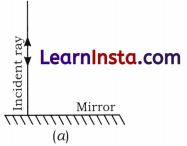
Therefore, ray reflects same path as incident ray.
(ii) (b)

Angle of incidence 0°,
Angle of reflection =0°
Reflected ray retraces the path of the incident ray.
(iii) (c)
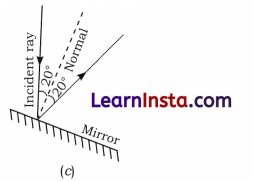
Angle of incidence =20°,
According to the law of reflection ( ∠i=∠r ) Angle of reflection =20°
Question 3.
In Fig. 10.23, the cap of a sketch pen is placed in front of three types of mirrors.

i. Match each image with the correct mirror.

Answer:
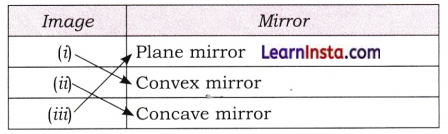
Question 4.
In Fig. 10.24 the cap of a sketch pen is placed behind a convex lens, a concave lens, and a flat transparent glass piece – all at the same distance.
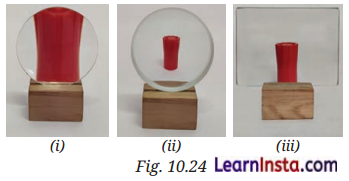
Match each image with the correct type of lens or glass.

Answer:
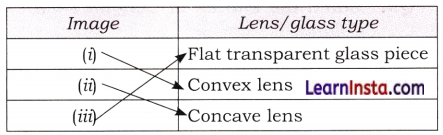
Question 5.
When the light is incident along the normal on the mirror, which of the following statements is true:
(i) Angle of incidence is 90°
(ii) Angle of incidence is 0°
(iii) Angle of reflection is 90°
(iv) No reflection of light takes place in this case
Answer:
(ii) Angle of incidence is 0°
Question 6.
Three mirrors – plane, concave and convex are placed in Fig. 10.25. On the basis of the images of the graph sheet formed in the mirrors, identify the mirrors and write their names above the mirrors.

Answer:

Question 7.
In a museum, a woman walks towards a large convex mirror. She will see that:

(i) her erect image keeps decreasing in size.
(ii) her inverted image keeps decreasing in size.
(iii) her inverted image keeps increasing in size and eventually it becomes erect and magnified.
(iv) her erect image keeps increasing in size.
Answer:
(iv) her erect image keeps increasing in size.
Question 8.
Hold a magnifying glass over text and identify the distance where you can see the text bigger than they are written. Now move it away from the text. What do you notice? Which type of lens is a magnifying glass?
Answer:
When we hold a magnifying glass over text, the letters appear enlarged and erect. As you move the magnifying glass farther from the text, the text appears too blur or eventually inverted and smaller, depending on the distance. A magnifying glass uses a convex lens.
Question 9.
Match the entries in Column I with those in Column II.

Answer:
| Column I | Column II |
| (i) Concave mirror | (a) Spherical mirror with a reflecting surface that curves inwards. |
| (ii) Convex mirror | (b) It forms an image which is always erect and diminished in size. |
| (iii) Convex lens | (c) Object placed behind it may appear inverted at some distance. |
| (iv) Concave lens | (d) Object placed behind it always appears diminished in size. |
Question 10.
The following question is based on Assertion/Reason.
Assertion: Convex mirrors are preferred for observing the traffic behind us.
Reason: Convex mirrors provide a significantly larger view area than plane mirrors.
Choose the correct option:
(i) Both Assertion and Reason are correct and Reason is the correct explanation for Assertion.
(ii) Both Assertion and Reason are correct but Reason is not the correct explanation for Assertion.
(iii) Assertion is correct but Reason is incorrect.
(iv) Both Assertion and Reason are incorrect.
Answer:
(i) Both Assertion and Reason are correct and Reason is the correct explanation for Assertion.
Question 11.
In Fig. 10.27, note that O stands for object, M for mirror, and I for image.

Which of the following statements is true?
(i) Figure (a) indicates a plane mirror and Figure (b) indicates a concave mirror.
(ii) Figure (a) indicates a convex mirror and Figure (b) indicates a concave mirror.
(iii) Figure (a) indicates a concave mirror and Figure (b) indicates a convex mirror.
(iv) Figure (a) indicates a plane mirror and Figure (b) indicates a convex mirror.
Answer:
(ii) Figure (a) indicates a convex mirror and Figure (b) indicates a concave mirror.
Question 12.
Place a pencil behind a transparent glass tumbler (Fig. 10.28a). Now fill the tumbler halfway with water (Fig. 10.28b). How does the pencil appear when viewed through the water? Explain why its shape appears changed.

Answer:
When viewed through the water, pencil appears bent and distorted. The part of pencil inside the water may appear enlarged or magnified. This is because the curved water surface acts like a lens just similar to how a convex lens behaves. We know that convex lens bends light rays towards each other(converge them). When light passes from the pencil through this curved water surface, it alters the path of the rays. This causes the image of the pencil to shift or enlarge, making it appear bent or magnified.
Class 8 Light: Mirrors and Lenses Question Answer (Activities)
Activity 10.1: Let Us Explore (Page 153)
Aim: To explore how a metallic spoon acts like a mirror.

Observation: When you look at the inner curved side of a shiny metallic spoon, your image appears inverted and smaller if the spoon is far from your face. If the spoon is close, the image appears erect and enlarged. When you flip the spoon and look at the outer side, the image of your face is always erect but smaller in size than the actual face.
Conclusion: The shiny metallic spoon acts like a mirror. The inner side of the metallic spoon behaves like a concave mirror, which shows inverted and enlarged images depending on the distance. The outer side behaves like a convex mirror, which always forms a small and upright image. This shows how the shape of the reflecting surface affects the type of image formed.
Activity 10.2: let us distinguish (page 155)
Aim: To distinguish between concave and convex mirror from the side view.
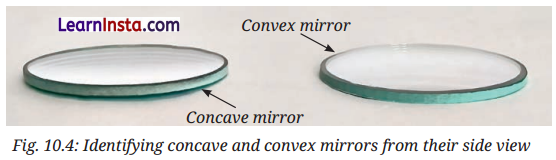
Observation and conclusion: This activity helps us understand the type of a mirror whether it is concave or convex. When the concave and convex mirrors are placed on a table with their reflecting surfaces facing upwards and viewed from the side at eye level, the difference in their shapes becomes clear. The concave mirror shows a surface that curves inward like the inside of a bowl, while the convex mirror shows a surface that curves outward like the back of a spoon.This shows that a concave mirror has an inward curved reflecting surface, while a convex mirror has an outward curved reflecting surface.
Activity 10.3 : let us explore (page 155)
Aim: To explore the images formed by concave and convex mirror when an object is placed at different distances from the mirrors.

Observation and conclusion:
- When the object is placed close to the concave mirror, the image appears erect and enlarged. As the object is moved farther, the image becomes inverted and smaller.
- In the convex mirror, the image is always erect and smaller. As the object moves farther, the image remains erect and diminished, with only slight change in the size of the image.
- Lateral inversion can be observed in both the mirrors.
This activity shows that concave and convex mirrors behave differently. A concave mirror forms enlarged and inverted images depending on distance, while a convex mirror always forms a diminished and erect image.
Activity 10.4: let us experiment (pages 157-158)
Aim: To find out whether angle of incidence (i) is equal to the angle of reflection (r).
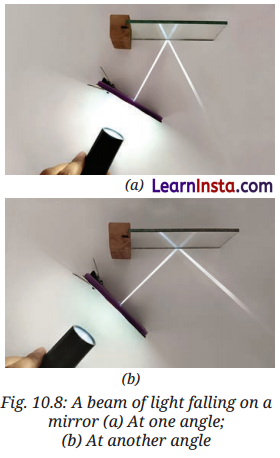
Observation: When the narrow beam of light from the torch strikes the plane mirror at different angles, the reflected beam also changes direction accordingly. Each time the angle of incidence is changed, the angle of reflection also changes. When the light falls straight along the normal, the beam is reflected back along the same path, and both angles are zero. After measuring, we find that the angle of incidence is always equal to the angle of reflection.
Table 10.1: Measuring angles of incidence and reflection
| S.No. | Angle of incidence (i) | Angle of reflection (r) |
| 1. 2. 3. 4. 5. |
20° 30° 45° 60° 0° (along normal) |
20° 30° 45° 60° 0° |
Conclusion: This activity confirms that the angle of incidence (i) is always equal to the angle of reflection (r). No matter how the light beam strikes the plane mirror, the angle at which it is reflected is same as the angle at which it strikes the mirror. This proves the law of reflection.
Activity 10.5: Let Us Experiment (Page 159)
Aim: To find out the incident ray, the reflected ray, and the normal all lie in the same plane.

Observation: When the beam of light is shined on the mirror placed on the flat chart paper, the reflected beam appears clearly on the extended flat part of the sheet. But when the extended part of the chart paper is bent down along the table’s edge, the reflected beam disappears. But when the paper is made flat again, the reflected beam reappears in the same place.
Conclusion: This activity shows that the reflected ray travels in the same plane as the incident ray and the mirror’s surface. When the surface is bent, the alignment is broken, and the reflected beam vanishes from view. But, when the paper is flattened reflected beam reappears again. This proves the second law of reflection, the incident ray, the reflected ray, and the normal all lie in the same plane.
Activity 10.6: Let Us Explore (Page 160)
Aim: To observe how a parallel beam of light reflects from a plane, concave and convex mirror and understand how the shape of the mirror causes the rays to converge or diverge.

Observation: When multiple parallel beams of light fall on a plane mirror, the reflected beams also remain parallel. When the same parallel beams fall on a concave mirror, the multiple reflected rays come closer together, that is they converge. In the case of a convex mirror, the multiple reflected beams spread out, that is, they diverge.
Conclusion: This activity shows that while all light rays follow the laws of reflection, mirror shapes affect the direction of reflected rays. A plane mirror reflects rays parallelly. A concave mirror makes light rays converge, and a convex mirror makes them diverge. The shape of the mirror decides whether the rays will meet at a point or spread apart.
Activity 10.7: let us explore (page 161)
Aim: To demonstrate that a concave mirror can concentrate sunlight at a single point, producing enough heat to ignite a piece of paper.

Observation: When the concave mirror is held facing the Sun and the reflected light is directed onto a sheet of paper, a small, sharp bright spot appears on the paper. After holding it steady for a few minutes, the paper begins to produce smoke and may start burning at that point.
Conclusion: This activity shows that a concave mirror can concentrate sunlight at one point after reflection. The converged light rays produce sufficient heat at that point to ignite the paper.
Activity 10.8 : let us explore (page 162)
Aim: To demonstrate that a drop of water on a oily/ waxy surface acts as a convex lens and magnifies the text placed beneath it.

Observation: When a small drop of water is placed on the oiled or waxed surface of glass or plastic, it forms a curved shape. When we look at printed text under the water drop, the letters appear larger than the surrounding text. The water drop makes the text below it look zoomed in or magnified.
Conclusion: This activity shows that a curved surface of water drop acts like a simple convex lens. It bends light rays and makes small objects appear bigger, just like a magnifying glass. The outward curve of the water surface helps in enlarging the image, making it easier to read small print.
Activity 10.9 : let us experiment (page 163)
Aim: To explore the images formed by concave and convex lenses when an object is placed at different distances from the lenses.

Observation:
- When an object is placed close to a convex lens, its image appears erect and enlarged. As the object is moved farther away, the image becomes inverted and smaller.
- When the object is viewed through a concave lens, the image is always erect and smaller than the object. The image size slightly changes with distance but remains diminished.
Conclusion: This activity shows that a convex lens can form both enlarged and inverted images depending on the object’s distance. While, a concave lens always forms a small and upright image.
Activity 10.10: let us investigate (page 164)
Aim: To observe how light behaves when it passes through a glass plate, a convex lens, and a concave lens, and to understand the converging and diverging nature of lenses.
Observation:
- When multiple parallel beams of light are passed through a thin glass plate, the light continues in a straight line without bending.
- When the light passes through a convex lens, the rays bend inward, converge and meet at one point.
- When the light passes through a concave lens, the rays bend outward and diverge.
Conclusion:
This activity shows that different lenses bend light in different ways.
- rom this experiment we can conclude that, A convex lens converges the light rays together at one point, so it is called a converging lens.
- A concave lens spreads the light rays apart, so it is called a diverging lens.
- The glass plate does not bend the light and lets it pass straight through parallel to each other.
Activity 10.11: let us investigate (page 165)
Aim: To demonstrate the converging property of a convex lens by focusing sunlight to a point and observing its ability to produce enough heat to ignite a piece of paper.

Observation: When a convex lens is placed in the path of sunrays and a sheet of paper is held at the correct distance on the other side, a bright, sharp spot of light appears on the paper. After a while, the spot gets very hot, and the paper start to produce smoke or even burn.
Conclusion: This activity shows that a convex lens can focus sunlight to a point, just like a concave mirror. The converging property of the convex lens concentrates light rays and produces enough heat to burn paper. This proves that a convex lens is a converging lens.