Students can access the CBSE Sample Papers for Class 12 Political Science with Solutions and marking scheme Set 1 will help students in understanding the difficulty level of the exam.
CBSE Sample Papers for Class 12 Political Science Set 1 with Solutions
Time Allowed: 3 hours
Maximum Marks: 80
General Instructions:
- The question paper consists of five sections (A, B, C, D and E) with 30 questions in total.
- All questions are compulsory.
- Question numbers 1-12 are multiple choice questions of one mark each.
- Question numbers 13-18 are of 2 marks each. Answers to these questions should not exceed 50-60 words each.
- Question numbers 19-23 are of 4 marks each. Answers to these questions should not exceed 100-120 words each. There is an internal choice in two of the 4 marks questions
- Question numbers 24-26 are passage, cartoon and map-based questions. Answer accordingly.
- Question numbers 27-30 are of 6 marks each. Answers to these questions should not exceed 170-180 words.
- There is an internal choice in 6 marks questions.
Section-A (12 Marks)
Question 1.
Arrange the following in chronological order: [1]
(i) The Soviet invasion of Afghanistan. (iv) 1917
(ii) End of civil war in Tajikistan. (iii) 1991
(iii) A military coup by the Communist Party hardliners. (ii) 1997
(iv) Russian Revolution. (i) 1979
(a) (i), (ii), (iii), (iv)
(b) (ii), (i), (iv), (iii)
(c) (iv), (i), (iii), (ii)
(d) (iii), (i), (ii), (iv)
Answer:
(c) (iv), (i), (iii), (ii)
Explanation:
Russian Revolution -1917
The Soviet invasion of Afghanistan- 1979
A military coup by the Communist Party hardliners-1991
End of civil war in Tajikistan- 1997
Question 2.
The President of which Central Asian country appointed himself to power, first for ten years and extended it for another ten years? [1]
(a) Turkmenistan
(b) Ukraine
(c) Azerbaijan
(d) Kyrgyzstan
Answer:
(a) Turkmenistan
Explanation:
The presidents of Turkmenistan and Uzbekistan appointed themselves to power first for ten years and then extended it for another ten years. They allowed no dissent or opposition. A judicial culture and independence of the judiciary was yet to be established in most of these countries.

Question 3.
Arms control is an important measure of traditional security as: [1]
(a) It prevents the military action.
(b) It coordinates actions to defend against military attack.
(c) It regulates the acquisition or development of weapons.
(d) It is concerned with preventing a war like situation.
Answer:
(c) It regulates the acquisition or development of weapons.
Question 4.
…………….. ensures that rivals do not go to war through misunderstanding or misconception. [1]
(a) Alliance building
(b) Confidence building
(c) Balance of power
(d) Arms control
Answer:
(b) Confidence building
Explanation :
Confidence building is a process in which different countries share ideas and information with rival countries by intimating each other about their military plans.
Question 5.
Match the List I with the List II [1]
| List I | List II |
| a. Indigenous people of the Cordillera region | (i) Chile |
| b. Mapuche | (ii) Bangladesh |
| c. Tribal people of the Chittagong hill tracts | (iii) Philippines |
| d. Kuna trive | (iv) East of Panama Canal |
Codes:
(a) a-(iii), b-(i), c-(ii), d-(iv)
(b) a-(ii), b-(i), c-(iii), d-(iv)
(c) a-(ii), b-(i), c-(iv), d-(iii)
(d) a-(iv), b-(ii), c-(iii), d-(i)
Answer:
(a) a-(iii), b- (i), c-(ii), d-(iv)
Question 6.
In the following question, a statement of Assertion (A) is followed by a statement of Reason (R). Choose the appropriate option: [1]
Assertion (A): Throughout the Cold War the industrialized countries of the North tried to ensure a steady flow of resources.
Reason (R): They deployed military forces near exploitation sites.
(a) Both the Assertion and the Reason are correct, and the Reason is the correct explanation of the Assertion.
(b) Both the Assertion and the Reason are correct, but the Reason is not the correct explanation of the Assertion.
(c) The Assertion is incorrect, but the Reason is correct.
(d) The Assertion is correct, but the Reason is incorrect.
Answer:
(b) Both the Assertion and the Reason are correct, but the Reason is not the correct explanation of the Assertion.
Explanation:
Resources have provided some of the key means and motives of global European power expansion. They have also been the focus of interstate rivalry. Western geopolitical thinking about resources has been dominated by the relationship of trade, war and power, at the core of which were overseas resources and maritime navigation.
Question 7.
Name the founder President of Congress Socialist Party. [1]
(a) K.M. Munshi
(b) Acharya Narendra Dev
(c) Shyama Prasad Mukherjee
(d) Minoo Masani
Answer:
(b) Acharya Narendra Dev
Explanation:
The Founder President of Congress Socialist Party was Acharya Narendra Dev. After 1955 it came to be known as Socialist Party.
Question 8.
After Independence, the first Lok Sabha elections had to be postponed twice and was finally held from: [1]
(a) November 1951 to February 1952
(b) December 1951 to February 1952
(c) September 1951 to February 1952
(d) October 1951 to February 1952
Answer:
(d) October 1951 to February 1952
Explanation:
The elections had to be postponed twice and finally held from October 1951 to February 1952. But this election is referred to as the 1952 election since most parts of the country voted in January 1952.
Question 9.
Which one of the following Chinese leaders was accompanied by Dalai Lama during the visit to India in 1956? [1]
(a) HuaGuofeng
(b) ZhaoZiyang
(c) Premier Zhou Enlai
(d) Li Peng
Answer:
(c) Premier Zhou Enlai
Explanation:
In 1956, the Chinese premier Zhou Enlai visited India. Dalai lama accompanied him as a member of the official delegation.
Question 10.
In the following question, a statement of Assertion (A) is followed by a statement of Reason (R). Choose the appropriate option: [1]
Assertion (A): The Sixth Schedule of the Constitution allows tribal autonomy of preserving their practices and customary laws.
Reason (R): These provisions proved crucial in resolving complex political problems in the Northeast.
(a) Both the Assertion and the Reason are correct, and the Reason is the correct explanation of the Assertion.
(b) Both the Assertion and the Reason are correct, but the Reason is not the correct explanation of the Assertion.
(c) The Assertion is incorrect, but the Reason is correct.
(d) The Assertion is correct, but the Reason is incorrect.
Answer:
(a) Both the Assertion and the Reason are correct, and the Reason is the correct explanation of the Assertion.
Question 11.
For the early realization of freedom of which country did India make an earnest effort by convening an international conference to support the freedom struggle? [1]
(a) Malaysia
(b) Vietnam
(c) Thailand
(d) Indonesia
Answer:
(d) Indonesia
Explanation:
India made earnest efforts for the early realisation of freedom of Indonesia from the Dutch colonial regime by convening an international conference in 1949 to support its freedom struggle.
Question 12.
Bodo community belongs to ……………… [1]
(a) Manipur
(b) Assam
(c) Mizoram
(d) Arunachal Pradesh
Answer:
(b) Assam
Explanation:
Bodo is the largest ethnolinguistic group in the state of Assam, India. It are the largest minority group in Assam and are concentrated in the northern areas of the Brahmaputra River valley.
Section-B (12 Marks)
Question 13.
Highlight any two the features of Indo-Bhutan relationship. [2]
Answer:
India does not have any major conflict with the Bhutanese government.
(i) The efforts made by Bhutanese monarch to weed out the guerrillas and militants from northeastern India that operate in the country have been helpful to India.
(ii) India is involved in big hydroelectric projects in Bhutan and remains the Himalayan Kingdom’s biggest source of development aid.
Question 14.
Analyse any two components of India’s security strategy. [2]
Answer:
India’s security strategy has four broad components:
(i) The first component was strengthening its military capabilities. India’s decision to conduct nuclear tests in 1998 was. justified by the Indian Government in terms of safeguarding national security.
(ii) The second component of India’s security strategy has been to strengthen international norms and international institutions to protect its security interests.
(iii)The third component of Indian security strategy is geared towards meeting security challenges within the country. Several militant groups from areas such as Nagaland, Mizoram, the Punjab and Kashmir among others have from time to time sought to break away from India. India has tried to preserve national unity by adopting a democratic political system.
(iv)There has been an attempt in India to develop its economy in a way that the vast mass of citizens is lifted out of poverty.
Question 15.
State any two differences between the First Five Year Plan and the Second Five Year Plan. [2]
Answer:
Difference between the First Five Year Plan and the Second Five-year Plan:
(i) First Five-year plan started with a thrust on agricultural development; whereas the Second Five Year Plan stressed on heavy industries.
(ii) The First Five Year Plan had emphasized on patience and Second Five Year Plan wanted to bring about quick structural transformation.
Question 16.
Describe any two problems faced by the Election Commission while holding the first general elections in the country. [2]
Answer:
(i) Holding election required delimitation or drawing the boundaries of the electoral constituencies and this task took a long time.
(ii) When the first draft of the electoral roll was published, names of nearly 40 lakh women were not recorded in the list.
(iii)There were 17 crore eligible voters, who had to elect about 3,200 MLAs and 489 members of Lok Sabha.
(iv)Only 15 percent of these eligible voters were literate. The EC had to think about some special methods of voting.
Question 17.
Describe any two security challenges faced by the newly independent countries of Asia and Africa after the Second World War. [2]
Answer:
(i) The newly independent countries faced threats not only from outside their borders but also from within.
(ii) Some of these states faced threats from the various separatist movements country.
(iii)Terrorism was a problem that they faced from across the borders.
(iv) Newly independent countries were thickly populated, so they faced the problem of poverty.
Question 18.
Explain any two lessons learnt from the emergency imposed in 1975. [2]
Answer:
The emergency brought out both the strengths and weaknesses of India’s democracy.
(i) Most important lesson of Emergency was that it was extremely difficult to do away with democracy in India.
(ii) Secondly, it brought out some ambiguities regarding the Emergency provision in the Constitution that have been rectified. It amended that internal emergency could be proclaimed only on the grounds of armed rebellion. The advice to the President to proclaim emergency must be given in writing by council of ministers.
(iii)Thirdly, emergency made everyone more aware of civil liberties; courts also took an active role in protecting civil liberties of individuals.
Section-C (20 Marks)
Question 19.
Describe any four features of India’s Nuclear Policy. [4]
Answer:
The main features of India’s Nuclear Policy are:
(i) Nehru had always put his faith in science and technology for rapidly building a modem India. A significant component of his industrialization plan was the nuclear program initiated in the late 1940s under the guidance of Homi J. Bhabha. India wanted to generate atomic energy for peaceful purposes.
(ii) India advocates no first use and reiterates India’s commitment to global verifiable on nondiscriminatory nuclear disarmament loading to a nuclear weapon free world.
(iii)India was against nuclear weapons, hence pleaded for nuclear disarmament with superpowers.
(iv)India always considered NPT as discriminatory and refused to sign on it.
(v) Even India’s first Nuclear Test in May 1974 was termed as a peaceful explosion and India argued to use nuclear power for peaceful purposes only.
Question 20.
Discuss the developments that escalated the crisis within the USSR that hastened its Disintegration. [4]
Answer:
(i) Gorbachev initiated the policies of economic and political reforms (perestroika and glasnost) and democratization within the country. Leaders within the Communist Party opposed the reforms.
(ii) A coup took place in 1991 which was encouraged by Communist Party hardliners. The people had tasted freedom by then and did not want the oldstyle rule of the Communist Party. Power began to shift from the Soviet centre to the republics, especially in the more Europeanized part of the Soviet Union, which saw them as Sovereign states.
(iii)The administration and political system of the Soviet Union became stagnant. The Communist Party that ruled the Soviet Union for over 70 years was not accountable to the people. Rampant corruption, unwillingness to allow more openness in government led to the collapse of the system.
(iv)Gorbachev’s ignorance and his liberal outlook, in turn, strengthened the anti-communal forces in Eastern Europe. Consequently, Czechoslovakia, Romania, Hungary, Poland, Bulgaria and East Germany witnessed the downfall of the communist regimes. These sudden developments paved the way for the disintegration of the USSR.
Question 21.
‘In spite of the conflict, Sri Lanka has registered considerable economic growth and recorded high levels of human development’. Comment on the statement.
OR
Highlight any four hurdles in the path of building a stable democracy in Pakistan. [4]
Answer:
The ethnic conflict has been going on since 1983 but Sri Lanka made considerable economic growth as is clear from the following facts:
(i) Sri Lanka was one of the first developing countries to successfully control the rate of growth of population.
(ii) It was the first country to liberalize the economy.
(iii)It had the highest per capita gross domestic product (GDP) for many years right through the civil war.
(iv)Despite the ravages of internal conflict, Sri Lanka maintained
OR
The following factors are responsible for Pakistan’s failure in building a stable democracy:
(i) The lack of genuine international support for a democratic rule in Pakistan has encouraged the military to continue its dominance. The US and other countries have also supported military rule due to fulfilling their own interests.
(ii) Pakistan’s conflict with India has made paramilitary groups more powerful which have often said that political parties and democracy in Pakistan are flawed, that Pakistan’s security would be harmed by selfish minded parties and chaotic democracy hence, army stays in power is justified.
(iii)The social dominance of military clergy and land owning aristocracy has led to a frequent overthrow of elected governments and the establishment of military governments.
(iv)Global islamic terrorism and their apprehension that Pakistan’s nuclear arsenal might fall into the hands of these terrorist groups, the military regime in Pakistan were seen as the protector of western interests in West Asia and South Asia
Question 22.
‘The culture of the politically & economically dominant society leaves its imprint on a less powerful society.’ Analyse the statement.
OR
Analyse the economic effects of globalization on developing nations [4]
Answer:
The culture of the politically and economically dominant society leaves its imprint on a less powerful society:
(i) The world begins to look more like the dominant power wishes it to be.
(ii) Those who make this argument often draw attention to the ‘McDonaldisation’ of the world, with cultures seeking to buy into the dominant American dream.
(iii)This is dangerous not only for the poor countries but for the whole of humanity, for it leads to the shrinking of the rich cultural heritage of the entire globe.
(iv)Globalization also broadens our cultural outlook and generates cultural homogenization, making cultures more different and distinctive.
OR
(i) Globalisation has increased trade in commodities across the globe. The restrictions imposed by different countries on the imports of other countries have been reduced.
(ii) The restrictions on the movement of capital across countries have also been reduced. Thus, investors in rich counties can invest their money in other countries particularly developing countries, where they get better returns.
(iii) Globalisation has led to spread of ideas such as internet and computer related services.
(iv) Globalisation hasled to increase in the movement of people. For example, about 300,000 Indians are working in Silicon Valley in USA. Yes, it has had a positive impact on the developing nations.
Question 23.
Regional demands from different parts of India exemplify the principle of unity with diversity. Do you agree? Support your answer with appropriate arguments. [4]
Answer:
Yes, I agree for the following reasons.
(i) Regional aspirations are part of democratic politics. Regional demands have to be addressed in a democratic way.
(ii) When we try to suppress, regional aspirations will lead to resistance and secession. It is not in India but in other smaller countries like the UK there are regional aspirations. The best way to respond to regional aspirations is through democratic negotiations.
(iii) Regional parties should be allowed to share power at regional level at state as well as centre in order to be more representative.
(iv) Farsightedness of the makers ofour constitution Allows federal characteristic to provide flexibility and special provision to accommodate diversity like file Sixth Schedule of the Constitution. Regional imbalances can be accommodated without being discriminated in any way. Therefore, regional aspirations are not encouraged to espouse separatism. Thus, in India regionalism is accepted as part of democratic politics.
Section-D (12 Marks)
Question 24.
Read the passage given below and answer the questions that follow: ‘Commons’ are those resources which are not owned by anyone but rather shared by a community. This could be a ‘common room’, a ‘community centre’, a park or a river. Similarly, there are some areas or regions of the world which are located outside the sovereign jurisdiction of any one state, and therefore require common governance by the international community. These are known as res communis humanitatis or global commons.
1. Which of the following is a part of global commons? [1]
(a) Ocean floor
(b) River Namada
(c) Thar desert
(d) Nilgiris
Answer:
(a) Ocean floor
Explanation:
The Earth’s atmosphere, Antarctica, ocean floor and outer space are considered as part of the global commons.
2. The Earth summit was held in ………… [1]
(a) Kyoto
(b) Rio-de-Janeiro
(c) Rome
(d) Montreal
Answer:
(b) Rio-de-Janeiro
Explanation:
The United Nations Conference on Environment and Development (UNCED), also known as the ‘Earth Summit’, was held in Rio de Janeiro, Brazil, in June 1992.
3. Which of the following agencies of the United Nations is associated in dealing with environmental issues? [1]
(a) UNESCO
(b) ECOSOC
(c) UNEP
(d) UNFCCC
Answer:
(c) UNEP
Explanation:
The United Nations Environment Programme (UNEP) established in 1972, is the voice for the environment within the United Nations system.
4. Why is cooperation over global commons not easy? [1]
(a) Task cannot be monitored
(b) Lack of consensus on common environmental agendas
(c) Similar approach to environment between the global north and south.
(d) All of the above
Answer:
(b) Lack of consensus on common environmental agendas
Question 25.
In the given outline political map of India, four states have been marked as (A), (B), (C) and (D). Identify these states on the basis of the information given below and write their correct names in your answer book along with the respective serial numbers of the information used and the concerned alphabets as per the format that follows: [1+1+1+1]
(i) The state related to the leader who signed the Tashkent Agreement.
(ii) The state related to C Natarajan Annadurai.
(iii) The state related to Karpuri Thakur, who implemented reservation for backward classes.
(iv) VV Giri belonged to this state.
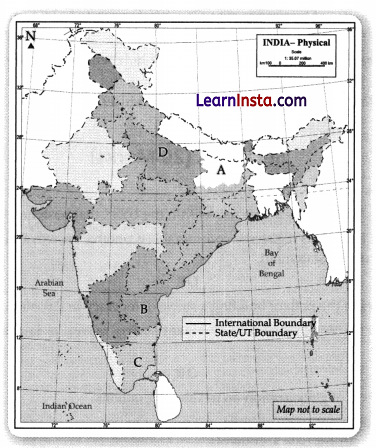
| Sr. Number of the information used | Alphabet concerned | Name of the state |
| (i) | ||
| (ii) | ||
| (iii) | ||
| (iv) |
Answer:
| Sr. Number of the information used | Alphabet concerned | Name of the state |
| (i) | D | Uttar Pradesh |
| (ii) | C | Tamil Nadu |
| (iii) | A | Bihar |
| (iv) | B | Andhra Pradesh |
(i) Himachal Pradesh
(ii) Gujarat
(iii) Sikkim
(iv) Arunachal Pradesh
Question 26.
Study the given cartoon and answer the questions that follow: [1+1+2]
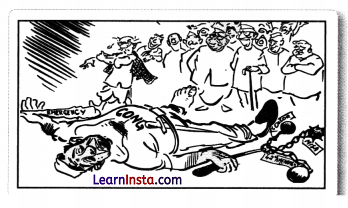
(i) Identify any two leaders shown in cartoon who had won the 1977 elections.
(ii) Explain the term MISA?
(iii) Why was the Congress voted out of power?
Answer:
(i) Morarji Desai, Atal Bihari Vajpayee, Jagjivan Ram, Charan Singh, Raj Narain (Any 2)
(ii) Maintenance of Internal Security Act
(iii) Imposition of Emergency, 42nd Amendment, Censorship of press, Misuse of Preventive detention laws.
Section-E (24 Marks)
Question 27.
Explain the factors that make European Union a highly influential regional organisation.
OR
What is meant by ‘ASEAN Way’? Name the pillars and objectives of ASEAN community. What are the components of the ASEAN Vision 2020? [6]
Answer:
(i) Economic factors:
(a) Three times larger share in World trade than the US.
(b) Its currency Euro can pose a threat to the dominance of US Dollar.
(c) The EU functions as an important bloc in World Trade Organization (WTO).
(ii) Political factors:
(a) One member of the EU, France holds permanent seat in Security Council and can influence UN policies.
(b) The EU also includes various non-permanent members of UNSC.
(c) The European Union plays an influential role in diplomacy and negotiations. EU’s dialogue with China on Human Rights and environmental degradation is remarkable.
(iii) Military factors:
(a) The EU’s combined armed forces are second largest in world.
(b) Its total military expenditure is second to the US.
(c) Its one important member— France has nuclear arsenals of 335 nuclear warheads.
(d) The EU is world’s second most important source of space.
OR
‘ASEAN WAY’ is an interaction that is informal, confrontationist and cooperative to promote supernational structures in the Association of South East Asian Nations (ASEAN).
The ASEAN community established the following three pillars:
(i) The ASEAN Security Community
(ii) The ASEAN Economic Community
(iii) The ASEAN Socio-cultural Community.
The objectives of ASEAN community are as follows:
(i) Territorial disputes should not escalate into armed confrontations.
(ii) To accelerate economic growth through social progress and cultural development.
(iii) To promote regional peace and stability based on the rule of law and the principles of the United Nations Charter.
(iv) To establish dispute settlement mechanism to resolve economic disputes.
(v) To create free trade areas for investments, labour and services.
[( Any Two) 2]
The components of the ASEAN Vision- 2020 are:
(i) Outward looking role.
(ii) Encouragement to negotiate.
Question 28.
‘Reforming the UN means restructuring of the Security Council’. Justify this statement with suitable arguments.
OR
What makes the UN an indispensable organisation? What steps should be taken to make the UN more relevant in the changing context? [6]
Answer:
Security Council plays a crudal role in functioning of the UN. In today’s scenario power equations have been changed with the disintegration of USSR and many new countries are entering into the UN:
(i) The UN charter has given a privileged position to permanent members to bring stability all over the world. This position remains the same and no one is allowed to enter.
(ii) Except permanent members enjoy veto power to be placed in a valuable position.
(iii) Permanent member’s category is from industrialized developed country which should be balanced by enhancing representation from developing countries to become either permanent or non-permanent members.
(iv) Hence, Security Council should reform and improve its working to make the UN more effective i.e., inclusion of member states should be judged on the basis of contribution to peace keeping initiatives.
OR
(i) Interdependence and globalisation is not possible without the international organisations such as the UN.
(ii) To enforce cooperation on the issues of poverty, unemployment, environmental degradation etc.
(iii) To provide financial assistance to developing countries to stabilize economy all over the world
(iv) The UN works as a forum to solve any international dispute among nations and sort out the best possible way.
(v) To promote international peace and understanding (any three)
Steps to be taken to make the UN more relevant in the changing context:
(i) Creation of Peace Building Commission.
(ii) Acceptance of responsibility of international community in case of failures of national governments to protect their own citizens from atrocities.
(iii) Condemnation of terrorism in all its forms and manifestations.
(iv) An agreement to achieve the Millennium Development Goals.
Question 29.
Explain any three challenges faced by India at the time of its independence.
OR
Analyse any six consequences of the partition of India in 1947. [6]
Answer:
(i) Challenge to Shape a Nation: India was divided among various states at the time of independence. Hence a great challenge arose to unify and integrate country into one bond. Sardar Vallabhai Patel took upon himself to integrate these states either wishfully or diplomatically to be completed into different stages.
(ii) To Establish Democracy: India constituted representative democracy based parliamentary form of government and it was a great challenge to develop these democratic practices in the nation.
(iii) To ensure economic development and well being of the society and to achieve welfare goals with the help of effective economic policies and eradication of poverty and unemployment.
OR
(i) The first consequence of partition was the largest unplanned and tragic transfer of population that human history has known. On both sides of the border, there were large-scale killings and atrocities. In the name of religion, people of one community killed the people of another community.
(ii) Minorities were forced to abandon their homes and move across borders. Even during their journey, they were often attacked, killed, and looted. On both sides, thousands of women were raped, abducted, and killed. The partition forced about 80 lakh people to migrate across the new border. More than five lakh people were killed due to partition.
(iii) Another consequence of the partition was the ‘Refugees Problem’. The people who crossed the border found that they had no home. For lakhs of people independence meant life in ‘refugee camps’. The Indian leadership and the Government of India had to face, this immediate and unexpected problem.
(iv) Partition also meant the division of properties, liabilities, and financial assets.
(v) The employees of the government and railways were also divided.
(vi) Even after large-scale migration of Muslims to Pakistan, about 12 percent of the total population of India were Muslims. The biggest problem before the Indian Government was how to deal with Muslim minorities and other religious minorities.
(vii) Due to the partition, Bengal was divided into East Bengal (now Bangladesh) and West Bengal. Similarly, Punjab was divided into the Punjab province of West Pakistan and the Indian state of Punjab.
Question 30.
Describe any three major developments in Indian politics since 1989.
OR
‘In the midst of severe competition and many conflicts, a consensus appears to have emerged among most parties.’ Describe any three points of consensus. [6]
Answer:
In the decade of eighties, the country witnessed five main developments which had a long-lasting impact on politics:
(i) End of Congress system
(ii) Mandal issues
(iii) New Economic Reforms
(iv) Babri Masjid Issues
(v) Assassination of Rajiv Gandhi 1989 elections led to defeat of Congress and emergence of the era of ‘Multi Party- System’ when no single party secured majority in Lok Sabha elections since 1989. It led the era of coalition government also when regional parties played an crucial role in forming a ruling alliance. Since 1989, there have been nine governments at the Centre either coalition government or minority government supported by other parties. In this phase, government could be formed only with the participation of many regional parties. The nineties also saw the emergence of powerful parties to represent Dalit’s and backward classes and regional assertions as well.
OR
(i) Most political parties were in support of new economic policies to lead the country to prosperity and a status of economic power in the world.
(ii) All political parties supported reservation of seats for backward classes in education and employment and even to ensure the OBCS to get adequate share of power.
(iii) Role of state level parties was accepted in the governance of country.
(iv) Coalition politics has shifted the focus of political parties from ideological differences to power sharing arrangements. Hence most of the NDA did not agree with the Hindutva ideology of BJP, still they come together to form a government and remained in power for full term. (Any 3 to be explained)