These Class 6 Science Curiosity Worksheet and Class 6 Science Chapter 12 Beyond Earth Worksheet with Answers are excellent for board exam practice.
Class 6 Science Chapter 12 Beyond Earth Worksheet
Class 6 Beyond Earth Worksheet
Worksheet On Beyond Earth Class 6 – Beyond Earth Worksheet Class 6
A. Objective Type Questions
Multiple Choice Questions
Question 1.
Which of the following is a natural satellite?
(a) IRSA
(b) EDUSAT
(c) Moon
(d) INSAT-I
Answer:
(c) Moon
Question 2.
Asteroids are found between the orbit of ____.
(a) mars and venus
(b) mars and mercury
(c) mars and saturn
(d) mars and jupiter
Answer:
(d) mars and jupiter

Question 3.
_____ is the closest celestial body to our Earth.
(a) Mars
(b) Galaxy
(c) Moon
(d) Planet
Answer:
(c) Moon
Question 4.
Which of the following is the largest planet in the solar system?
(a) Venus
(b) Mercury
(c) Earth
(d) Jupiter
Answer:
(d) Jupiter
Question 5.
The Earth is called as blue planet because
(a) colour of air is blue
(b) colour of land is blue
(c) blue buildings are more
(d) two-third surface is covered by water
Answer:
(d) two-third surface is covered by water
Question 6.
The hottest planet in our solar system is
(a) mercury
(b) earth
(c) mars
(d) venus
Answer:
(d) venus
Question 7.
The movement of a planet around the Sun is known as
(a) rotation
(b) revolution
(c) orbit
(d) oscillation
Answer:
(b) revolution
Question 8.
The polar star indicates ____ direction.
(a) north
(b) east
(c) south
(d) west
Answer:
(a) north
Question 9.
The planet known as the Earth twin is ____
(a) mars
(b) saturn
(c) venus
(d) mercury
Answer:
(c) venus
Question 10.
Which star is the head of our solar system?
(a) Earth
(b) Proxima Centauri
(c) Sun
(d) Big bear
Answer:
(c) Sun
Question 11.
The stars are not visible during the day because
(a) of their self-illumination
(b) stars are far away from the earth
(c) sunlight is very bright
(d) their size is large
Answer:
(c) sunlight is very bright
Question 12.
A group of ____ forming various patterns is called constellation.
(a) stars
(b) earth
(c) planet
(d) moon
Answer:
(a) stars
Question 13.
The moon shines because it
(a) has their own natural light
(b) reflects the Venus’s light
(c) reflects the Earth’s light
(d) reflects the sunlight
Answer:
(d) reflects the sunlight
Question 14.
The planets don’t have ____ of their own.
(a) heat and water
(b) oxygen and water
(c) water and light
(d) heat and light
Answer:
(d) heat and light
Fill in the Blanks
Fill in the blanks using the correct word and complete the statement.
Question 1.
The ____ indicates the north direction. (north star/planet)
Answer:
North star
Question 2.
The ____ is in the centre of the solar system. (Sun/moon)
Answer:
Sun
Question 3.
We can see the ____ only once in about a month’s time. (full moon/saturn)
Answer:
full moon
Question 4.
Full moon night is also known as ____. (purnima/ amavasya)
Answer:
Purnima
Question 5.
Ursa Major or ____ is a constellation. (big bear/pole star)
Answer:
big bear
True/False
Write T for true and F for false for the following statements.
(a) All the planets move around the Sun in an elongated path.
Answer:
True
(b) Stars are huge and made up of extremely hot liquids.
Answer:
False
(c) The moon is in the centre of the solar system.
Answer:
False
(d) Till recently (August 2006), Pluto was also considered a planet.
Answer:
True
Match the Following
Match items in Column I with one or more items in Column II.
Column I Column II
(a) Inner planet (i) Saturn
(b) Outer planet (ii) Halley
(C) Constellation (iii) Great Bear
(d) Star (iv) Mars
(e) Comet (y) Taurus
(a) ____
(b) ____
(c) ____
(d) ____
(e) ____
Answer:
(a) (iv)
(b) (i)
(c) (iii)
(d) (v)
(e) (ii)
Assertion-Reason Questions
In the following questions, two statements are given- one is labelled as Assertion (A) and the other is labelled as Reason (R). Read the statements carefully and choose the correct alternative (a), (b), (c) and (d) as given below.
(a) Both A and R are true and R is correct explanation of the assertion.
(b) Both A and R are true, but R is not the correct explanation of the assertion.
(c) A is true, but R is false.
(d) A is false, but R is true.
Question 1.
Assertion (A) The sun is a star.
Reason (R) It is made up of gases.
Answer:
(c) A is true, but R is false.
Sun is a star, but it is not only made up of gases but it also contains hot liquid and solid materials.
Question 2.
Assertion (A) Ursa Major or big bear is a constellation.
Reason (R) Various patterns formed by different groups of stars are known as constellations.
Answer:
(a) Both A and R are true and R is correct explanation of the assertion.
Question 3.
Assertion (A) There was no way of determining the directions or time during the ancient times.
Reason (R) The north star indicates the north direction. It is also called the pole star.
Answer:
(d) A is false, but R is true.
In ancient, directions were determined by certain stars like pole star and constellations.
Question 4.
Assertion (A) All celestial bodies have their own heat and light.
Reason (R) Some celestial bodies are lit by the light of the stars. Such bodies are called planets.
Answer:
(d) A is false, but R is true.
Celestial bodies like planets, natural satellites, comets etc. do not have their own light and heat.
Question 5.
Assertion (A) Earth is the only planet in the solar system which supports life.
Reason (R) The Earth is slightly flattened at the pool. That is why, its shape is described as a Geoid.
Answer:
(b) Both A and R are true, but R is not the correct explanation of the assertion.
Life on Earth exists because its temperature is moderate, it has oxygen and other life supporting conditions which are not available on other planets.
B. Subjective Type Questions
Define the following terms
Question 1.
Constellations
Answer:
Question 2.
Polaris
Answer:
Question 3.
Light pollution
Answer:
Question 4.
Revolution
Answer:
Question 5.
Planet
Answer:
Question 6.
Natural Satellites
Answer:
Question 7.
Asteroids
Answer:
Question 8.
Comets
Answer:
Very Short Answer Type Questions
Question 1.
How long does it take to go from a new moon to a full moon?
Question 2.
Name one dwarf planet.
Question 3.
Which is the third nearest planet to the sun?
Question 4.
Name the natural satellite of the earth?
Question 5.
Where are the most asteroids found?
Question 6.
How many times can we see full moon in a month?
B. Subjective Type Questions
Define the following terms
Question 1.
Constellations
Question 2.
Polaris
Question 3.
Light pollution
Question 4.
Revolution
Question 5.
Planet
Question 6.
Natural Satellites
Question 7.
Asteroids 8- Comets
Very Short Answer Type Questions
Question 1.
How long does it take to go from a new moon to a full moon?
Question 2.
Name one dwarf planet.
Question 3.
Which is the third nearest planet to the sun?
Question 4.
Name the natural satellite of the earth?
Question 5.
Where are the most asteroids found?
Question 6.
How many times can we see full moon in a month?
Question 7.
How long does it take for the moon to complete one revolution?
Question 8.
How does planets differ from star?
Question 9.
From where does earth receive heat and light?
Question 10.
What is the spçed of light?
Question 11.
How much time light takes to reach the earth?
Question 12.
Why Earth is called blue planet?
Question 13.
Name all the planets according to their distance from the Sun.
Short Answer Type Questions
Question 1.
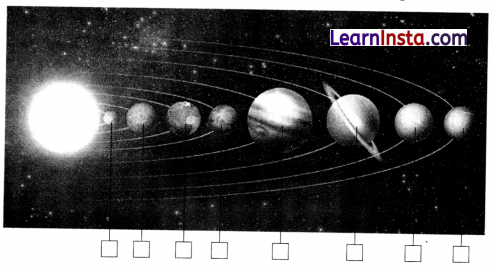
An artist’s representation of the solar system is given in figure. Is the order of the planets correct? If not, write the correct order in the boxes in the figure.
Question 2.
What do you know about the Moon?
Question 3.
What is Sun? Name the next nearest star. What is the distance of the Sun from Earth?
Question 4.
We know that planets move around the Sun. Are there any objects that move around planets?
Question 5.
Explain the terms:
(a) Comets
(b) Asteroids
Question 6.
You can see stars fading away at dawn and appearing at dusk. During the day we do not see the stars. Explain why?
Question 7.
A portion of the night sky is shown in figure. Draw lines to connect the stars for orion and label the star sirius.

Question 8.
What is the distance of the sun from the earth? Which unit do we use to express this distance?
Question 9.
Define big dipper and little dipper.
Question 10.
Do we find patterns among the stars just for fun or are there some use of these patterns?
Long Answer Type Questions
Question 1.
To improve our understanding of the moon, India launched different missions to moon. Write a short note on it.
Question 2.
Briefly tell about set of constellation boundaries which were defined by the International Astronomical Union (IAU).
Question 3.
Name the inner and outer planets. What are they made up of?
Question 4.
Why can the earth not be compared to other planets of the solar system?
Question 5.
Distinguish between a satellite and a star.
Case Based Questions
Apart from the stars, planets and satellites, there are numerous tiny bodies which also move around the sun. These bodies are called (1). They are found between the orbits of (2) and (3). The small pieces of rocks which move around the sun are called (4). Do you see a whitish broad band, like a white glowing path across the sky on a clear starry night? It is a cluster of millions of stars. This band is the (5) galaxy. Our solar system is a part of this galaxy. In ancient India, it was imagined to be a river of light flowing in the sky. Thus, it was named (6). A galaxy is a huge system of billions of stars, and clouds of dust and gases. There are millions of such galaxies that make the universe.
Question 1.
What is the name of bodies mentioned as (1)?
Question 2.
Where are the asteroids found?
Question 3.
Name the galaxy mentioned as (5) and (6).
Question 4.
What is a galaxy?
Skill Based Activities
Question 1.
Solve the following crossword puzzle with the help of clues given below.

Across
5. The closest planet to the sun
6. A person who studies the sun; the moon, planets, and stars
7. The fixed path followed by the planets to move around the sun
8. The natural satellite of the earth
Down
1. A place built to tell people about astronomy and the night sky
2. A constellation shaped as a hunter
3. The instrument used to see heavenly bodies
4. The closest star to the earth
Question 2.
A list of jumbled words are given here. Write the correct form of each word.
- UNS
- UCYRREM
- USVNE
- THERA
- RMSA
- TRSA
- AELTPN
Question 3.
Find out the weather conditions due to which the Indian Institute of Astrophysics (IIA) found Hanle, Ladakh a suitable place to set up an observatory.
Question 4.
Try to find out the names of planets in your local language. Also, find out the stories associated with stars and constellations in your region. Present these stories in a pictorial form.
Question 5.
Find out if the increasing light pollution is causing problems for humans, wildlife and the environment. Write an action that you would take at the personal level to control light pollution.
Question 6.
Record the timings of sunrise and sunset given in your local newspaper and note down the months which have the shortest days.