Beyond Earth Class 6 Extra Questions and Answers Science Chapter 12
Beyond Earth Class 6 Very Short Answer Type Questions
Question 1.
What is Sun?
Answer:
The Sun is a star.
Question 2.
Name the planet nearest to the ‘Sun’.
Answer:
Mercury
Question 3.
Name the planet nearest to the Earth.
Answer:
Mars
Question 4.
Name the planets opposite side of the Earth.
Answer:
Mars and Venus
Question 5.
Name the star which is nearest to the Earth.
Answer:
Proxima Centauri
Question 6.
Name the constellation in which Big Dipper lies.
Answer:
Ursa Major
Question 7.
Which planet has rings around it?
Answer:
Saturn

Question 8.
Name the planet farthest from the Sun.
Answer:
Neptune.
Question 9.
How big is the Sun?
Answer:
It is about 100 times bigger then the Earth in diameter.
Question 10.
The Big Dipper is known as in Sanskrit.
Answer:
Saptarishi.
Question 11.
Which constellation contains the star Sirius?
Answer:
Canis Major
Question 12.
Which star is part of the Little Dipper?
Answer:
Pole Star or Polaris
Question 13.
How many constellations were officially listed by the International Astronomical Union (IAU)?
Answer:
88 constellations
Question 14.
What is the other name of Orion?
Answer:
Hunter.
Question 15.
Which is the nearest star to the Earth?
Answer:
Sun.
Question 16.
Which star is called Morning Star or the Evening Star?
Answer:
Venus.
Question 17.
Which colour is seen on Earth from space?
Answer:
Blue.
Question 18.
Which planet is called Red planet?
Answer:
Mars
Question 19.
Which planet is also known as Budha in India from ancient times?
Answer:
Mercury.
Question 20.
Which planet is now called a dwarf planet?
Answer:
Pluto.
Question 21.
Which planets are called inner planets?
Answer:
Mercury, Venus, Earth and Mars.
Question 22.
Which planets are called outer planets?
Answer:
Jupiter, Saturn, Uranus and Neptune.
Question 23.
Write the name of natural satellite of Earth.
Answer:
The Moon
Question 24.
When did the Chandrayaan-3 land and what did it explore?
Answer:
It landed on the Moon’s south pole on August 23, 2023.
Question 25.
Name the planet which have two moons.
Answer:
Mars
Question 26.
Name the planet where life exists.
Answer:
Earth.
Question 27.
Which is our home galaxy?
Answer:
Milky Way Galaxy
Question 28.
How many planets are there in the solar system?
Answer:
Eight.
Question 29.
The objects in the outer region of the Solar System with long tails are known as?
Answer:
Comets.
Question 30.
What is the distance between the Sun and the Earth?
Answer:
150 million km.
Question 31.
Do all the objects in the sky twinkle?
Answer:
No, all the objects do not twinkle in the sky.
Question 32.
What are the sizes of the asteroids that lie in between?
Answer:
From 10 m to about 500 km.
Question 33.
What are stars?
Answer:
The objects in the sky which their own light are called stars.
Question 34.
Name the nearest star.
Answer:
The Sun
Question 35.
What are natural satellite?
Answer:
The bodies which revolve around the planets are called natural satellite.
Beyond Earth Class 6 Short Answer Type Questions
Question 1.
Write any two points about the planet Mars.
Answer:
(i) Mars is the red planet due to reddish soil
(ii) Mars is the fourth planet from the Sun.
Question 2.
What is Proxima Centauri and write its distance from the Sun.
Answer:
Proxima Centauri is nearest star after the Sun and distance is about 269000 AU.
Question 3.
Describe the ways in which light pollution impacts astronomical observations.-
Answer:
When there is too much light from cities and towns, it makes the sky too bright. This makes it difficult to see faint stars and faraway galaxies.
Question 4.
Why Pole Star is not visible from the southern hemisphere of Earth?
Answer:
Pole Star (Polaris) is aligned with Earth’s northern axis, making it visible from the northern hemisphere but not the southern.
Question 5.
Why do we classify the Sun as a star?
Answer:
The Sun is a star because it has its own source of energy and continuously emits heat and light.
Question 6.
Why are stars invisible during the day time?
Answer:
Stars are far away from us compared to the Sun. So, the glare of the Sun is much more than the glare of star during the daytime. Therefore stars are not visible during the day time.
Question 7.
What are planets?
Answer:
The celestial bodies which revolve around the Sun are called planets. There are eight planets in the Solar System.
Question 8.
Which mobile application is used for identification of stars?
Answer:
Sky Map is very handy app for identification of stars, constellations and planets from mobile phone.
Question 9.
Define asteroid belt.
Answer:
Many asteroids revolve around the Sun between Mars and Jupiter in a region known as the asteroid belt.
Question 10.
What are asteroids?
Answer:
Many small objects in the solar system are rocky and irregular in shape, known as asteroids.
Question 11.
Why do people worship the Sun?
Answer:
The Sun is the main source of light and heat on the Earth, was elevated in most ancient civilization of the status of a deity. In India, the Sun is worshipped as Surya.
Question 12.
Define astronomical unit and what is the distance between the Sun and the Earth?
Answer:
The distance between the Sun and the Earth called astronomical unit (AU) and distance between the Sun and the Earth is about 150 million km.
Question 13.
What is a satellite?
Answer:
A satellite is an object that revolves around the planets.
Question 14.
What are comets?
Answer:
Comets revolve around the Sun and have a bright head with a long tail.
Question 15.
What do you understand by dwarf planets?
Answer:
A dwarf planet is a small planetary-mass object that orbits the Sun. Perhaps the most famous dwarf planet, Pluto was once considered the ninth planet in our Solar System. However, in 2006, the International Astronomical Union (IAU) redefined the term “planet,” and Pluto was reclassified as a dwarf planet.
Question 16.
Describe the structure of the Moon’s surface.
Answer:
When astronauts landed on the moon they found that moon’s surface is dusty and v barren. There are many craters of different sizes. It also has a large number of steep and high mountains.
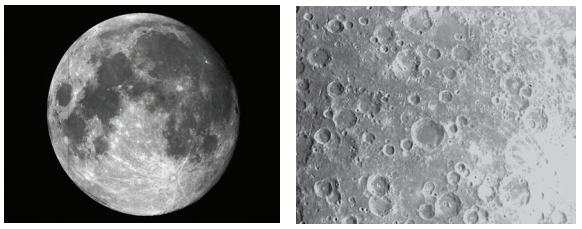
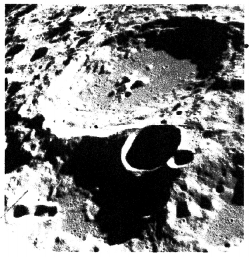
Surface of the moon
Beyond Earth Class 6 Long Answer Type Questions
Question 1.
Differentiate between stars and planets.
Answer:
| Stars | Planets |
| (i) Stars twinkle in the sky. | (i) Planets do not twinkle in the sky. |
| (ii) They are fixed at a point. | (ii) They revolve around the Sun. |
| (iii) They have their own light. | (iii) They have no light. |
| (iv) They are very big in size. | (iv) Planets are small as compared to star. |
Question 2.
Why can we not hear any sound on the moon?
Answer:
Moon is a natural satellite of the Earth. It revolves around the Earth. But there is no medium on the moon. There is no air on the surface of the moon. Sound travels with the help of any medium. Without the medium it cannot travel from one place to other. So we cannot hear any sound on the surface of the moon.
Question 3.
What is the Sun? Name the next nearest star. What is the distance of the Sun from the Earth? Write the unit of the large distances.
Answer:
The Sun is the nearest star. It is a spherical ball of gases and is very hot. It shines brightly because it releases a large amount of energy. The Sun is Earth’s primaiy source of energy, producing both light and heat. The next nearest star is Proxima Centauri. It lies at a distance of 269000 au from the Sun. The Sun is nearly 150 million km away from the Earth. Such large distances are expressed in another unit called astronomical unit (AU).
Question 4.
What are constellations? Explain some common constellations.
Answer:
The group of stars that has a recognisable pattern is called constellation.
Some common constellations are:
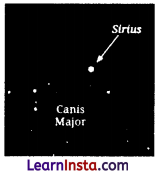
(i) Canis Major: It appears like a dog. It contains a star called Sirius; the brightest star in the night sky.
(ii) Taurus: It looks like is a bull. It contains two types of stars; a group of stars called Pleiades (Krittika). Another star in the constellation is known as Aldebaran (Rohini).
(in) Orion: This constellation contains three stars in the middle which represent the belt of the hunter. It is also called the hunter. Orion contains other star (nakshatra) known as Betelgeuse (Ardra).
Question 5.
What is Pole Star? How do you locate the position of Pole Star?
Answer:
Pole Star or Polaris, is a star in the sky that appears stationary and does not move like other stars. It is situated above the north pole of the earth which helps to locate the north direction in the northern hemisphere. It is part of Little Dipper and is also known as Dhruva tarn.
Question 6.
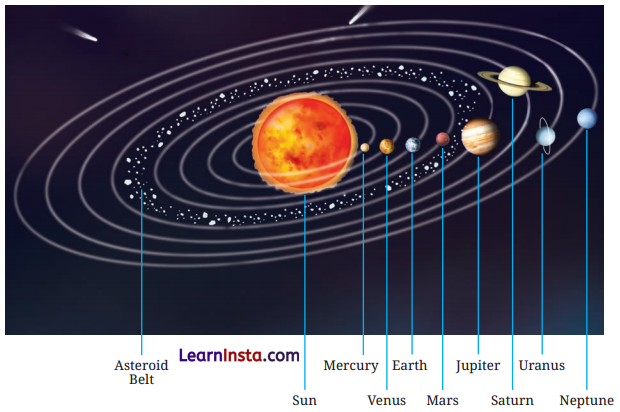
Explain the Solar System.
Answer:
The Sun and the other bodies which revolve around it, form the Solar System. It consists of a large number of bodies such as planets, comets, asteroids and meteors. Our Earth is also a planet.which revolves around the Sun. It is also a member of the solar system. There are seven other planets that revolve around the Sun. The eight planets are: Mercury, Venus, Earth, Mars, Jupiter, Saturn, Uranus and Neptune.
Question 7.
Explain the following terms:
(a) Asteroids
(b) Comets
Answer:
(a) Asteroids: Many small objects in the solar system are rocky and irregular in shape, known as asteroids. There is a gap between the orbits*of Mars and Jupiter. This gap is occupied by a large number of small objects that revolve around the Sun is known as asteroid belt.
(b) Comets: Comets are also small bodies which revolve around the Sun in highly elliptical orbits. They become, visible – from the Earth only when they come closer to the Sun. They are characterised by a small head followed by a long tail.
Question 8.
What are planets? Explain them.
Answer:
The bodies which revolve around the Sun in a certain orbit are called planets. There are following eight planets:
(i) Mercury: The planet Mercury is nearest to the Sun. It is the smallest planet of the solar system. It has no satellite of its own.
(ii) Venus: Venus is Earth’s nearest planetary neighbour. It is the brightest planet in the night sky. Venus has no moon or satellite of its own.
(iii) Earth: It is the third planet. The Earth is the only planet in the solar system on which life exists. Earth appears blue from space due to the reflection of light from water. It has only one moon.
(iv) Mars: The fourth planet is called Mars. It is called the red planet because of reddish soil. Mars has two moons.
(v) Jupiter: It is the largest planet of the solar system and mostly made of gases. It is so large compared to Earth. It has a large number of moon, (ni) Saturn: It contains beautiful rings made of dust particles and rocky material. It is visible with naked eyes, appears like a shining star.
(vii) Uranus: It is the seventh planet. It is the second outermost planet.
(viii) Neptune: The outermost planet is called Neptune and contains large number of moons.
Beyond Earth Class 6 Skill Based Questions
Question 1.
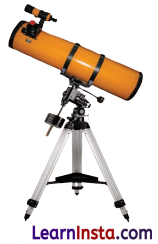
(a) Draw a diagram of a telescope.
Answer:
(b) How many moons do the Earth have?
Answer:
There is only one moon of the Earth.
(c) Name a planet which has two moons.
Answer:
Mars is a planet which has two moons.
Question 2.
(a) Draw a diagram to show the the Pole star.
Answer:
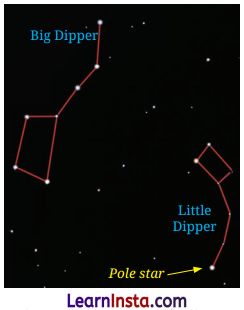
(b) What is the other name of Pole star?
Answer:
Polaris
(c) On which pole of the Earth does the Pole star exist?
Answer:
Pole Star exists on the north pole of the Earth.
(d) What are the special characteristics of the Pole Star?
Answer:
Pole Star does not move as other stars move and it is part of Little Dipper.
Question 3.
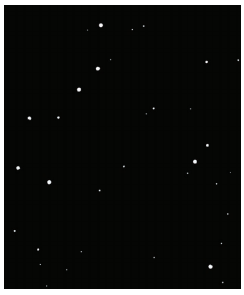
Identify the following figure and answer the following questions:
(a) What are such group of stars called?
Answer:
The given figure is of the constellation Orion.
(b) Why is it also called Hunter?
Answer:
Such groups of stars are called constellations.
(c) Name the star that is the part of this constellation.
Answer:
Because it looks like a hunter. Betelgeuse
Question 4.
(a) Draw a diagram of the solar system.
Answer:
(b) How many planets are there in the solar system? Name them.
Answer:
There are eight planets in the solar system namely: Mercury, Venus, Earth, Mars, Jupiter, Saturn, Uranus and Neptune.
Question 5.
(a) Draw a diagram to show the asteroid belt.
Answer:
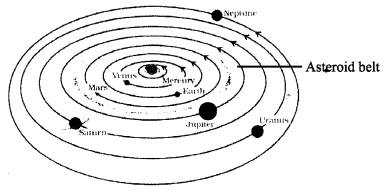
(b) Name the planets between which the asteroid belt occurs.
Answer:
Asteroid belt occurs between Mars and Jupiter.
Question 6.
Draw diagram to locating – Sirius.
Answer:
Beyond Earth Class 6 Case Based Questions
Question 1.
The asteroid belt is a region of space located between the orbits of Mars and Jupiter. It contains many small, rocky objects known as asteroids, which vary in size from tiny rocks to objects that are hundreds of kilometres across.
I. Define asteroid belt.
II. What are asteroids made of?
III. What is the size of asteroids?
IV. How does asteroids affect the solar system?
Answer:
I. The asteroid belt is a region of space located between the orbits of Mars and Jupiter.
II. Asteroids are made of many small and rocky objects.
III. The size vary from tiny rocks to objects that are hundreds of kilometres across.
IV. Craters are formed due to the impact of asteroids from the space hitting the Earth’s or moon surface.