Get the simplified Class 8 Maths Extra Questions Part 2 Chapter 7 Area Class 8 Extra Questions and Answers with complete explanation.
Class 8 Area Extra Questions
Class 8 Maths Chapter 7 Area Extra Questions
Class 8 Maths Chapter 7 Extra Questions – Area Extra Questions Class 8
Very Short Answer Type Questions
Question 1.
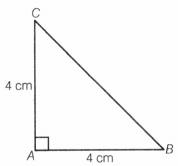
Find the area of ∆ABC.
Answer:
We know that the area of triangle = \(\frac{1}{2}\) × Base × Height
So, area of ∆ABC = \(\frac{1}{2}\) × AB × AC
= \(\frac{1}{2}\) × 4 × 4
[∵ AB = 4 cm and AC = 4 cm]
= 8 cm
Question 2.
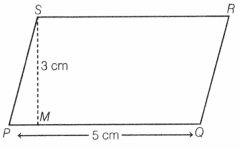
Find the area of parallelogram PQRS.
Answer:
We know that the area of parallelogram = Base × Height
So, area of parallelogram = PQ × SM = 5 × 3 = 15 cm2
[∵ PQ = 5 cm and SM = 3 cm]
= \(\frac{1}{2}\) × 6 × 5
= 15 sq units
Question 3.
Convert 6 in into cm.
Answer:
We know that
1 in = 2.54 cm
So, 6 in = 6 × 2.54 cm = 15.24 cm
Question 4.
How manycm2 is a m2?
Answer:
We know that
1 m = 100 cm
So, 1 m2 = (100 × 100) cm2
= 10000 cm2
Question 5.
Convert 7.08 cm into inches.
Answer:
We know that
1 cm = \(\frac{1}{2.54}\)m
So, 7.08 cm = \(=\frac{7.08}{2.54}\) = 2.787 m

Short Answer Type Questions
Question 1.
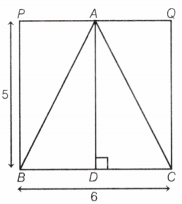
Find the area of ∆ABC.
Answer:
Given, the base of ∆ABC, BC = 6
and the height of ∆ABC, BP = 5
So, area of ∆ABC = \(\frac{1}{2}\) × BC × BP
= \(\frac{1}{2}\) × 6 × 5
= 15 sq units
Question 2.
Find the area of ∆ABC, given that it is isosceles, ADis perpendicular to BCand the area of ∆ADC is 12 sq units.

Answer:
Since, ∆ABC is an isosceles triangle with altitude AD to the base BC.
The altitude drawn from the vertex angle (the angle between two equal sides) to the base of an isosceles triangle always bisects the base.
So, BD = DC
and AD is a common side in both ∆ABD and ∆ADC.
So, ∆ABD = ∆ADC
Now, area of ∆ABC = Area of ∆ABD + Area of ∆ADC
= 12 + 12
= 24 sq units
Question 3.
Find the area of the quadrilateral ABCD, given that AC = 11cm, BN = 4 cm, DM = 4 cm, BN and DM are perpendicular to /AC.

Answer:
Since, the diagonal AC divides the rectangle ABCD into two triangles ADC and ABC.
So, area of rectangle ABCD = Area of ∆ADC + Area of ∆ABC
= \(\frac{1}{2}\) × AC × DM + \(\frac{1}{2}\) × AC × BN
= \(\frac{1}{2}\) × 11 × 4 + \(\frac{1}{2}\) × 11 × 4
= 22 + 22
= 44 sq cm
Question 4.
Find the area of the following parallelogram and rhombus.

Answer:
Given, base = 7 cm
and height = 4 cm
Then, area of parallelogram = Length × Width
= 7 × 4
= 28 cm2

Answer:
Given, the diagonals of the rhombus is 8 cm and 6 cm.
Then, area of rhombus
\(\frac{1}{2}\) × Product of the diagonals
= \(\frac{1}{2}\) × 8 × 6
= 4 × 6 = 24 cm2
Question 5.
Express the following lengths in centimetres,
(i) 4 in
(ii) 8.4 in
Answer:
We know that 1 in = 254 cm
(i) 4 in = 4 × 2.54 = 10.16 cm
(ii) 8.4 in = 8.4 × 254 = 21.336 cm
Long Answer Type Questions
Question 1.
Identify the missing sidelengths.
Answer:
In rectangle ABEF
AB = \(\frac{\text { Area of rectangle } A B E F}{A F}=\frac{28}{4}\) = 7 m
[∵area of rectangle ABEF = 28 m2 and AF = 4 m] Since, AF = BE
So, BE = 4m
Now, in rectangle BCDE,
BC = \(\frac{\text { Area of rectangle } B C D E}{B E}=\frac{16}{4}\) = 4m
[∵ area of rectangle BCDE = 16 m2]
Now, in rectangle EFGH,
EH = \(\frac{\text { Area of rectangle } E F G H}{E F}=\frac{60}{7}\) = 15 m
[∵ area of rectangle EFGH = 60 m2 and EF = AB = 7m]
Question 2.
Find the length of the altitude DE.

Answer:
In ∆ADB, we have
Base, BD = 4 units and height, AC = 4 units
Then, area of ∆ADB = \(\frac{1}{2}\) × 4 × 4 = 8sq units … (i)
Now, area of ∆ADB using base AB = \(\frac{1}{2}\) × AB × DE
= \(\frac{1}{2}\) × 6 × DE
= 3DE ……….(ii)
From Eqs. (i) and (ii), we have
8 = 3DE
⇒ DE = \(\frac{1}{2}\)
= 2.66 units
Question 3.
Find the area of the shaded region, given that ABCD is a rectangle.

Answer:
We know that the area of rectangle = Length × Width
So, area of rectangle ABCD = 16 × 6
= 96 cm2
We know that the area of triangle = \(\frac{1}{2}\) × Base × Height
So, area of ∆AEF = \(\frac{1}{2}\) × 10 × 4 = 20 cm2
and area of ∆EBC = \(\frac{1}{2}\) × 6 × 6 = 18 cm2
Now, area of shaded region EFDC = Area of rectangle ABCD – Area of ∆AEF- Area of ∆EBC
= 96 – 20 – 18
= 58 cm2
Question 4.
Find AD.

Answer:
In parallelogram ABDE, we have
Base, DB = 12 cm and height, AC = 4 cm
So, the area of parallelogram ABDE = DB × AC
= 12 × 4 = 48 cm2 ..(i)
Now, the area of parallelogram using baseED and height AD.
So, the area of parallelogram ABDE = ED × AD
= 6 × AD …(ii)
From Eqs. (i) and (ii),
48 = 6 × AD
⇒ AD = \(\frac{48}{6}\) = 8 cm
Question 5.
Consider a rectangle and a parallelogram of the same sidelengths 6 cm and 5 cm. Which has the greater area?

Answer:
We know that the area of rectangle = Length × Width
Given, the length of rectangle = 5 cm
and the width of rectangle = 6 cm
Area of rectangle = 5 × 6 = 30 cm2
and we know that the area of parallelogram
= Base × Height
Here, the height of the parallelogram must be less than the length of its slanted side 5 cm.
So, its area will be less than 30 cm2.

Hence, rectangle has the greater area.
Skill Based Questions
Question 1.
Inner rectangular park EFGH is 40 m by 30 m. There is a uniform path of width 2 m around it, forming outer rectangle ABCD.

(a) Find the dimensions of ABCD.
Answer:
Length = 44 m and breadth = 34 m
(b) Find the area of the path.
Answer:
296 m2
Question 2.
Your school is planning a rectangular flower garden inside the campus. The gardening committee decides.
- The inner garden is 18 m long and 12 m wide.
- There will be a uniform walking path around the garden, 1.5 m wide, laid with tiles.
- Tiles are sold by area in square feet.
(a) Find the area of the walking path in m
Answer:
99 m2
(b) Convert this area into square feet.
[take 1 ft = 30 cm = 0.3 m.]
Answer:
1100 ft2 (approx)
Question 3.
Two tables are offered to a school:
Table A Rectangular top, 1.2 m by 0.8 m.
Table B Trapezium top with parallel sides 1.4 m, 1.0 m and height 0.7 m.
(a) Find the area of each tabletop.
Answer:
Table A = 0.96 m2, Table B = 0.84 m2
(b) Which table offers more working surface?
Answer:
Table A
(c) Why might someone still prefer the table with slightly smaller area?
Answer:
Do yourself
Question 4.
A park is in the shape of a regular pentagon. Each side of the pentagon is 10 m. A designer draws lines from the centre of the pentagon to all its vertices, dividing it into 5 congruent isosceles triangles.
(a) Explain, why all 5 triangles have the same area.
Answer:
Do yourself
(b) The perpendicular distance from the centre to any side is 6.9 m. Find
(i) the area of one of the triangles.
(ii) the total area of the pentagonal park.
Answer:
(i) 34.5 m2
(ii) 172.5 m2 (approx)
Question 5.
A tile designer makes a regular hexagonal floor tile.-Each side of the hexagon is 8 cm. She knows that by joining the centre to all vertices, the hexagon is divided into 6 congruent equilateral triangles.
(a) Justify, why each of the 6 small triangles is equilateral.
Answer:
Do yourself
(b) Find the area of one small triangle.
Answer:
27.68 cm2
(c) Hence, find the area of the hexagonal tile, [use √3 ≈ 1.73]
Answer:
166 cm2 (approx)
Case Study Based Question
Question 1.
A town planner is designing a park pathway. The pathway surrounds a small rectangular garden and forms an isosceles trapezium, when seen from above.
The parallel sides of the trapezium are 30 m and 18 m and the distance between them is 10 m.
To calculate the area easily, the planner uses the idea from the Sulba-Sutras that an isosceles trapezium can be converted into a rectangle of equal area by cutting and rearranging.
From the basis of above information, answer the following questions.
(i) Write the formula used to find the area of a trapezium.
Answer:
Area of the trapezium = \(\frac{1}{2}\) × (Sum of parallel sides) × Height
(ii) Find the area of the trapezium shaped pathway.
Answer:
Area of the trapezium shaped pathway
= \(\frac{1}{2}\) × (30 + 18) × 10
= \(\frac{1}{2}\) × 48 × 10
= 24 × 10
= 240 m2
(iii) If the trapezium is converted into a rectangle, whose height is 10 m, find the length of the rectangle.
Answer:
Given, area of trapezium = Area of rectangle = 240 m2
and height of rectangle = 10 m
So, the length of rectangle = \(\frac{\text { Area }}{\text { Height }}=\frac{240}{10}\)
= 24 m